
 100% FREE ACCESS
12th Standard Syllabus & Materials
12th Standard
TN 12th Computer Applications மின்னணு தரவு பரிமாற்றம் Sample Question Papers Study Material - QB365 Set A
NEW12th Standard
TN 12th Computer Applications மின் - வணிக பாதுகாப்பு அமைப்புகள் Sample Question Papers Study Material - QB365 Set A
NEW12th Standard
TN 12th Computer Applications மின்னணு செலுத்தல் முறைகள் Sample Question Papers Study Material - QB365 Set A
NEW12th Standard
TN 12th Computer Applications மின் - வணிகம் Sample Question Papers Study Material - QB365 Set A
NEW12th Standard
TN 12th Computer Applications திறந்த மூல கருத்துருக்கள் Sample Question Papers Study Material - QB365 Set A
NEW12th Standard
TN 12th Computer Applications வலையமைப்பு வடமிடல் Sample Question Papers Study Material - QB365 Set A

Published on: 30/01/2021
12th Standard Bio-Zoology English Medium Biodiversity and its Conservation Reduced Syllabus Important Questions With Answer Key 2021
Download Tamil Nadu 12th Standard Biology question papers, model tests, one-mark questions, important questions, and public exam papers in PDF format. Free study materials and answer keys for TN State Board students.
Questions + Answers key
Take MCQ Biology Test1.
IUCN is an organisation working in the of nature conservation. It is located in
Washington, USA
London, England
Stockholm, Sweden
Gland VD, Switzerland
2.
Statement 1: Exotic species are the non-native organism.
Statement 2: Sailfin catfish is an exotic species to India
Statement 1 is correct, statement 2 in incorrect
Statement 1 is incorrect, statement 2 in correct
Both the statements are correct
Both the statements are incorrect
3.
How many number of biogeographic zones are there in India?
Twelve
Seventeen
Ten
Fifteen
4.
Total number of mega biodiversity countries in the world is_________
Twelve
Fifteen
Seventeen
Nineteen
5.
Mundanthurai wild life sanctuary is located in ___________ district.
Coimbatore
Tirunelveli
Kancheepuram
Nagapattinam
6.
Project Tiger was launched in the Jim Corbett National Park in the State of ___ in 1973.
Assam
Uttarakhand
Kerala
Gujarat
7.
The red data book is maintained by ____________
WWF
ENVIS
IUCN
NBA
8.
IUCN has its headquarters in _______________
New York
New Delhi
Columbia
Switzerland
9.
___________ is a biographical gateway for much of India's flora and fauna.
North East India
Coastal Region
Trans Himalayan region
Sunderbans
10.
The grizzled squirrel and lion tailed Macaque are endemic to _____________
Semi-Arid zone
Indian Desert
Western Ghats
Eastern Ghats
11.
There are ________ mega biodiversity countries in the world
15
12
17
10
12.
Which one of the following are at high risk extinction due to habitat destruction?
Mammals
Birds
Amphibians
Echinoderms
13.
Who introduced the term biodiversity?
Edward Wilson
Walter Rosen
Norman Myers
Alice Norman
14.
What is a biosphere reserve?
15.
Give examples of any three Wild Life Sanctuaries in Tamilnadu.
16.
What is Red Data Book or Red list?
17.
What is extinction?
18.
What is Co-extinction?
19.
Why has the dodo become extinct?
20.
21.
What are the factors that drive habitat loss?
22.
Why do we find a decrease in biodiversity distribution, if we move from the tropics towards the poles?
23.
What are called endangered species?
24.
Compare and Contrast the insitu and exsitu conservation. (or) What are the differences between in-situ and ex-situ conservation ?
25.
“Amazon forest is considered to be the lungs of the planet”- Justify this statement.
26.
27.
Enlist the factors that determine the distribution of biodiversity.
28.
What is species richness? Give example.
29.
Mention any 4 categories of species in Red list.
30.
Name the types of extinctions.
31.
Give an equation for Species-Area relationship on a log scale
32.
What is ecosystem/community diversity?
33.
Why do animals have greater diversification than plant diversity?
34.
35.
Mention the reasons for the richness biodiversity in the tropics.
36.
Give comparative account on ex-situ conservation.
37.
Explain in detail about various types of extinctions.
38.
What is the significance of slope of regression in a species area relationship?
39.
Why Tropical regions are rich in biodiversity?
40.
Write the general strategies in conservation?
1.
(d)
Gland VD, Switzerland
2.
(c)
Both the statements are correct
3.
(c)
Ten
4.
(c)
Seventeen
5.
(b)
Tirunelveli
6.
(b)
Uttarakhand
7.
(c)
IUCN
8.
(d)
Switzerland
9.
(a)
North East India
10.
(c)
Western Ghats
11.
(c)
17
12.
(a)
Mammals
13.
(b)
Walter Rosen
14.
Biosphere Reserve (BR) is an international designation by UNESCO for representative parts of natural and cultural landscapes extending over large area of terrestrial or coastal! marine ecosystems or a combination thereof.
15.
| S. No: |
Prominent WLS in Tamil Nadu | Districts |
|---|---|---|
| i. | Vedanthangal Lake Birds WLS | Chengalpet |
| ii | Mudumalai WLS | Nilgiris |
| iii. | Point Calimere WLS | Nagapattinam |
16.
It is a catalogue of taxa facing risk of extinction. IUCN maintains the Red Data Book. It has eight categories of species.
17.
Species is considered extinct when none of its members are- alive anywhere in the world
Eg.DODO.
18.
Co-extinction of a species is the loss of a species as a consequence of the extinction of another.
(Eg. Orchid bees and forest trees by cross pollination).
19.
Excessive exploitation of a species, reduces the size of its population to such a level that it becomes vulnerable to extinction. Dodo has become extinct in the last 200-300 years due to over exploitation by humans
20.
21.
(i) Development of human society is inevitable. Natural habitats are destroyed for the purpose of settlement, agriculture, mining, Industries and construction of highways
(ii) As a result species are forced to adapt to the changes in the environment or move to other places. If not, they become victim to predation, starvation, disease and eventually die or results in human animal conflict.
(iii) Over population, urbanization, Industrialization and agricultural advancements require additional land, water and raw materials every year.
(iv) This is made possible only through fragmentation or destruction of natural habitats by filling wetlands, ploughing grasslands, cutting down trees, forest, desilting rivers, constructing transport ways, caving mountains, extracting, ores, changing the course of rivers and filling of seashore.
22.
The term biodiversity was introduced by Walter Rosen (1986). Biodiversity is the assemblage of different life forms. Each species is adapted to live in its specific environments.
The changes in climatic conditions are reflected in the distribution and pattern of biodiversity on our planet. The number of species per unit area declines as we move from tropics towards the poles. The Tundra and Taiga of northern Canada, Alaska, northern Europe and Russia possess less than 12 species of trees. The temperate forests of the United states have 20-35 species of trees, while the tropical forests of Panama have over 110 species of trees in a relatively small area.
23.
(i) A species that has been categorized as very likely to become extinct is an endangered species. Endangered (EN), as categorized by the International Union for Conservation of Nature (IUCN)
(ii) Red List, is the second most severe conservation status for wild populations in the IUCN's scheme after Critically Endangered (CR).
(iii) Example: In 1998 there were 1102 animal and 1197 plant species in the IUCN Red List
(iv) In 2012, the list features 3079 animal and 2655 plant species as endangered (EN) worldwide.
24.
Insitu and Exsitu are two types of biodiversity conservation strategies.
| S. No | Insitu Conservation | Exsitu Conservation |
|---|---|---|
| i) | It is the on-site conservation or the conservation of genetic resources in natural populations of plant or animal species. | This is a conservation strategy which involves placing of threatened animals and plants in special care locations for their protection. |
| ii) | It is the process of protecting an endangered plant or animal species in its natural habitat, either by protecting or restoring the habitat itself or by defending the species from predators. | It helps in recovering populations or preventing their extinction under simulated conditions that closely resemble their natural habitats. |
| iii) | National Parks, Biosphere Reserve, Wild Life Sanctuaries form insitu conservation strategies. | Zoological parks and Botanical gardens are common exsitu conservation programs. |
25.
(i) Amazon is a rainforest that covers most of the amazon has in of south America and territory including nations. It represents over half of the planets rain forests and exhibit the largest and the most diversified tropical rain forest.
(ii) It is home to more than 40000 species of plants 3000 of fishes, 1300 of birds, mammals, amphibians, reptiles and more than 125000 invertebrates.
(iii) It is called lungs of the planet earth because its vegetation continuously recycles CO2 into O2.
26.
27.
Temperature, precipitation, distance from the equator (latitudinal gradient), altitude from sea level (altitudinal gradient) are some of the factors that determine biodiversity distribution patterns.
28.
The number of species per unit area at a specific time is called species richness, which denotes the measure of species diversity.
E.g., Western ghats have more amphibian species than Eastern ghats
29.
(a) Extinct
(b) Critically endangered
(c) Vulnerable
(d) Not evaluated.
30.
Natural extinction, mass extinction and anthropogenic extinction
31.
log S = log C + Z log A
where S = Species richness
A = Area
Z = Slope of the line (regression coefficient)
C = Y-intercept
32.
Community/ecosystem diversity is the variety of habitats, biotic communities and ecological processes in the biosphere.
33.
More than 70% of species recorded on earth are animals and 22% are planted. This is because the animals have adapted themselves to ensure their survival in changing environments in comparison to plants. Eg. Presence of nervous system helps animals to control and coordinate their body structures. Therefore diversification in animals is more than in plants.
34.
35.
(i) The reasons for the richness of biodiversity the tropics are: Warm tropical regions between the tropics of Cancer and Capricorn on either of equator possess congenial habitats living organisms.
(ii), Environmental conditions of the tropics are favorable not only for special but also for supporting both variety number of organisms. J
(iii) The temperatures vary between 25o to 35oC, a range in which most meta activities of living organisms occur ease and efficiency.
(iv)The average rainfall is often more 200 mm per year. .
(v) Climate, seasons, temperature, humid photoperiods are more or less stable encourage both variety and numbers.
(vi) Rich resource and nutrient availability.
(vii) Rich resource and nutrient availability.
36.
Ex-Situ Conservation :
It is conservation of selected rare plants/ animals in places outside their natural homes. It includes offsite collections and gene banks. Offsite Collections: They are live collections of wild and domesticated species in Botanical gardens, Zoological parks, Wildlife safari parks, Arborata (gardens with trees and shrubs). The organisms are well maintained for captive breeding programmes. As a result, many animals which have become extinct in the world continue to be maintained in Zoological Parks. As the number increases in captive breeding, the individuals are selectively released in the wild. In this way the Indian crocodile and gangetic dolphin have been saved from extinction.
Gene Banks:
Gene banks are a type of biorepository which preserve genetic materials. Seeds of different genetic strains of commercially important plants can be stored for long periods in seed banks, gametes of threatened species can be preserved in viable and fertile condition for long periods using cryopreservation techniques. However, it is not economically feasible to conserve all biological wealth and all the ecosystems. The number of species required to be saved from extinction far exceeds the conservation efforts.
37.
There are three types of Extinctions
i. Natural extinction: It is a slow process of replacement of existing species with better adapted species due to changes in environmental conditions, evolutionary changes, predators and diseases. A small population can get extinct sooner than the large population due to inbreeding depression (less adaptivity and variation)
ii. Mass extinction: The Earth has experienced quite a few mass extinctions due to environmental catastrophes. Amass extinction occurred about 225 million years ago during the Permian, where 90% of shallow water marine invertebrates disappeared .
iii. Anthropogenic extinctions: These are abetted by human activities like hunting, habitat destruction, over exploitation, urbanization and industrialization. Some examples of extinctions are Dodo of Mauritius and Steller's sea cow of Russia. Amphibians seem to be at higher risk of extinction because of habitat destruction. The most serious aspect of the loss of biodiversity is the extinction of species. The unique information contained in its genetic material (DNA) and the niche it possesses are lost forever.
38.
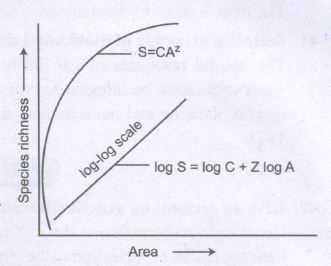
German Naturalist and Geographer Alexander von Humboldt explored the wilderness of south American jungles and found that within a region the species richness increased with increasing area but upto a certain limit. The relationship between species richness and area for a wide variety of taxa (angiosperm plants, birds, bats and freshwater fishes) turned out to be the rectangular hyperbola. On a logarithmic scale, the relationship is a straight line described by the equation.
where
log S = log C + Z log A
S = Species richness
A = Area
Z = Slope of the line
(regression coefficient)
C = Y-intercept
Regression coefficient Z generally has a value of 0.1-0.2 regardless of taxonomic group or region. However, in case of the species - area relationship in very large areas like entire continents; the slope of the line appears to be much steeper (Z-value in the range of 0.6-1.2). For example, in case of the fruit eating (frugivorous) birds and mammals in the tropical forests of different continents, the slope is found to be a steeper line.
39.
The reasons for the richness of biodiversity in the Tropics are:
(i) Warm tropical regions between the tropic of Cancer and Capricorn on either side of equator possess congenial habitats for living organisms.
(ii) Environmental conditions of the tropics are favourable not only for speciation but also for supporting both variety and number of organisms.
(iii) The temperatures vary between 25°C to 35°C, a range in which most metabolic activities of living organisms occur with ease and efficiency.
(iv) The average rainfall is often more than 200 mm per year.
(v) Climate, seasons, temperature, humidity, photoperiods are more or less stable and encourage both variety and numbers.
(vi) Rich resource and nutrient availability.
40.
General strategies in conservation:
(i) identify and protect all threatened species
(ii) identify and conserve in protected areas the wild relatives of all the economically important organisms
(iii) identify and protect critical habitats for feeding, breeding, nursing, resting of each species
(iv) resting, feeding and breeding places of the organisms should be identified and protected
(v) Air, water and soil should be conserved on priority basis
(vi) Wildlife Protection Act should be implemented
(vii) There are two aspects of conservation strategies
(1) In-situ conservation
(2) Ex-situ conservation

12th Standard Syllabus & Materials
12th Standard
TN 12th Computer Applications களப்பெயர் முறைமை (DNS) Sample Question Papers Study Material - QB365 Set A
NEW12th Standard
TN 12th Computer Applications வலையமைப்பு எடுத்துக்காட்டுகள் மற்றும் நெறிமுறைகள் Sample Question Papers Study Material - QB365 Set A
NEW12th Standard
TN 12th Computer Applications கணினி வலையமைப்பு ஓர் அறிமுகம் Sample Question Papers Study Material - QB365 Set A
NEW12th Standard
TN 12th Computer Applications PHP-உடன் MySQL-ஐ இணைத்தல் Sample Question Papers Study Material - QB365 Set A



Tamilnadu Stateboard 12th Standard Subjects

Maths

Chemistry

Physics
Biology

Computer Science

Business Maths and Statistics

Economics

Commerce

Accountancy

History

Computer Applications
Biology
Computer Technology
Computer Applications
Computer Science
Business Maths and Statistics
Commerce
Economics
Maths
Chemistry
Physics
Computer Technology
History
Accountancy

Tamil

English

French
Tamilnadu Stateboard Standards

