
 100% FREE ACCESS
12th Standard Syllabus & Materials
12th Standard
TN 12th Computer Applications மின்னணு தரவு பரிமாற்றம் Sample Question Papers Study Material - QB365 Set A
NEW12th Standard
TN 12th Computer Applications மின் - வணிக பாதுகாப்பு அமைப்புகள் Sample Question Papers Study Material - QB365 Set A
NEW12th Standard
TN 12th Computer Applications மின்னணு செலுத்தல் முறைகள் Sample Question Papers Study Material - QB365 Set A
NEW12th Standard
TN 12th Computer Applications மின் - வணிகம் Sample Question Papers Study Material - QB365 Set A
NEW12th Standard
TN 12th Computer Applications திறந்த மூல கருத்துருக்கள் Sample Question Papers Study Material - QB365 Set A
NEW12th Standard
TN 12th Computer Applications வலையமைப்பு வடமிடல் Sample Question Papers Study Material - QB365 Set A

Published on: 29/01/2021
12th Standard Bio-Zoology English Medium Evolution Reduced Syllabus Important Questions With Answer Key 2021
Download Tamil Nadu 12th Standard Biology question papers, model tests, one-mark questions, important questions, and public exam papers in PDF format. Free study materials and answer keys for TN State Board students.
Questions + Answers key
Take MCQ Biology Test1.
The codon _________ codes for phenylalanine
UAA
UUU
UCU
UAC
2.
In genetic code there are __________ possible triplets.
62
61
68
64
3.
A nucleosome has _________ histone protein molecules.
6
8
10
24
4.
The distance between two consecutive base pairs in DNA is_________.
3.4 nm
0.34 nm
34.0 nm
31 x 10-9
5.
The concept of RNA world was independently proposed by __________
Orgel, Brick and Carl woese
Brick, Griffith and Crick
Wilkins and Franklin
Walter Gilbert
6.
One difference between deoxyribose and Ribose is due to________.
One Oxygen atom more in Ribose
Two Oxygen atoms less in Deoxyribose
Two Carbon atoms less in Ribose
Four Carbon atoms more in Ribose
7.
___________ used radioactive labelled molecules to prove that DNA is the genetic material.
Hershey and Chase
Wilkins and Franklin
Griffith
Mcleod and Avery
8.
Chromosomes were first observed by ________.
Miescher
Hofmeister
Avery
Griffith
9.
One gene one enzyme hypothesis was proposed by Beadle and Tatum based on ________
Yeast
Drosophila
E. coli
Neurospora
10.
When lactose is present in the culture medium:
Transcription of lac y, lac z, lac a genes occurs.
Repressor is unable to bind to the operator.
Repressor is able to bind to the operator.
Both (a) and (b) are correct.
11.
An operon is a: ______.
Protein that suppresses gene expression
Protein that accelerates gene expression
Cluster of structural genes with related function
Gene that switched other genes on or off
12.
Which of the following statements is not true about DNA replication in eukaryotes?
Replication begins at a single origin of replication.
Replication is bidirectional from the origins.
Replication occurs at about 1 million base pairs per minute
There are numerous different bacterial chromosomes, with replication occuring in each at the same time.
13.
Which of the following statements about DNA replication is not correct?
Unwinding of DNA molecule occurs as hydrogen bonds break.
Replication occurs as each base is paired with another exactly like it
Process is known as semi conservative replication because one old strand is conserved in the new molecule.
Complementary base pairs are held together with hydrogen bonds
14.
Which of the following is the correct sequence of event with reference to the central dogma?
Transcription, Translation, Replication
Transcription, Replication, Translation
Duplication, Translation, Transcription
Replication, Transcription, Translation
15.
What is the basis for the difference in the synthesis of the leading and lagging strand of DNA molecules?
Origin of replication occurs only at the 5' end of the molecules
DNA ligase works only in the 3' → 5' direction
DNA polymerase can join new nucleotides only to the 3' end of the growing stand.
Helicases and single-strand binding proteins that work at the 5' end
16.
Which type of bond is formed
(a) between a purine and pyrimidine base?
(b) between the pentose sugar and adjacent nucleotide?
17.
Point out the nitrogenous bases of RNA
18.
What is genophore?
19.
What are nucleotides?
20.
From their examination of the structure of DNA, What did Watson and Crick infer about the probable mechanism of DNA replication, coding capability and mutation?
21.
Mention any two ways in which single nucleotide polymorphism (SNPs) identified in human genome can bring revolutionary change in biological and medical science.
22.
Differentiate - Template strand and coding strand.
23.
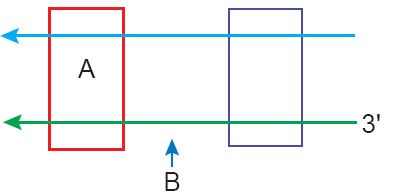
Name the parts marked ‘A’ and ‘B’ in the given transcription unit:
24.
Give reasons: ‘Genetic code is universal’.
25.
Explain the components of operon.
26.
Both strands of DNA are not copied during transcription. Give reason.
27.
State Chargaff's rule.
28.
What is S-D Sequence?
29.
What is a anticodon?
30.
What is initiation complex in transcription?
31.
Distinguish replication and transcription.
32.
It is established that RNA is the first genetic material. Justify giving reasons.
33.
Distinguish between structural gene, regulatory gene and operator gene
34.
In E.coli, three enzymes β- galactosidase, permease and transacetylase are produced in the presence of lactose. Explain why the enzymes are not synthesized in the absence of lactose.
35.
State any three goals of the human genome project.
36.
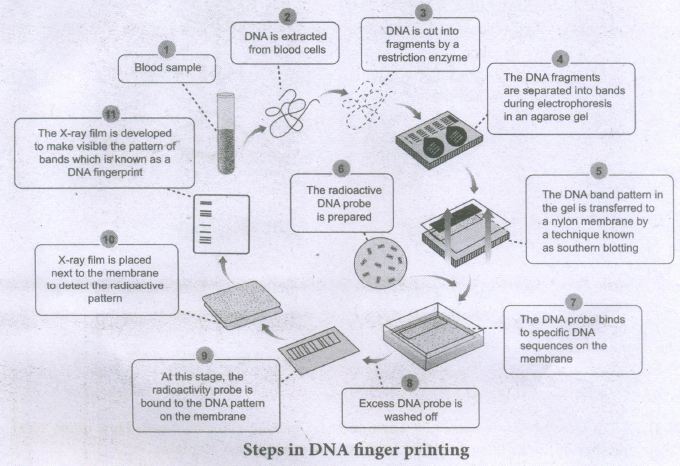
Draw a flow chart depicting the steps of DNA fingerprinting technique.
37.
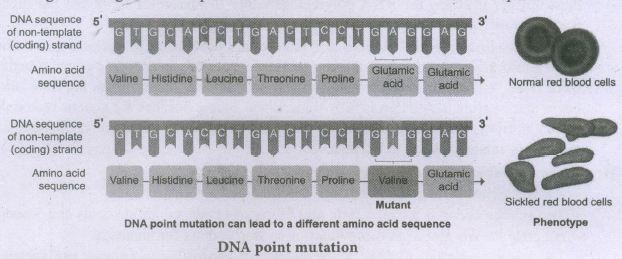
Mutations on genetic code affects the phenotype. Describe with example.
38.
Meselson and Stahl's experiment proved the semi-conservation mode of DNA replication. Explain.
39.
List the salient features of classical concept of gene.
40.
How is the two stage process of protein synthesis advantageous?
41.
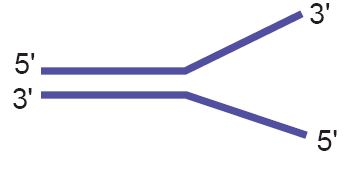
a) Identify the figure given below
b) Redraw the structure as a replicating fork and label the parts
c) Write the source of energy for this replication and name the enzyme involved in this process.
d) Mention the differences in the synthesis of protein, based on the polarity of the two template strands.
42.
Why the human genome project is called a mega project?
1.
(b)
UUU
2.
(d)
64
3.
(b)
8
4.
(b)
0.34 nm
5.
(a)
Orgel, Brick and Carl woese
6.
(a)
One Oxygen atom more in Ribose
7.
(a)
Hershey and Chase
8.
(b)
Hofmeister
9.
(d)
Neurospora
10.
(d)
Both (a) and (b) are correct.
11.
(c)
Cluster of structural genes with related function
12.
(d)
There are numerous different bacterial chromosomes, with replication occuring in each at the same time.
13.
(b)
Replication occurs as each base is paired with another exactly like it
14.
(d)
Replication, Transcription, Translation
15.
(c)
DNA polymerase can join new nucleotides only to the 3' end of the growing stand.
16.
a) Purine and pyrimidine bases are linked by hydrogen bonds.
b) Pentose sugar is linked to adjacent nucleotide by phosphodiester bonds.
17.
Adenine, Guanine, Cytosine and Uracil.
18.
The DNA as a nucleoid is organized into large loops held by protein. DNA of prokaryotes is almost circular and lacks chromatin organization, hence termed genophore.
19.
In nucleic acids (DNA and RNA), the nitrogenous base is chemically linked to one molecule of sugar forming a nucleotide.
When a phosphate group is attached to the nucleoside, it becomes a nucleotide. The nucleotides are polymerised to form a polynucleotide chain (DNA and RNA).
20.
They inferred each strand of the double strands helps was used as a template for the formation of a new, daughter strand having a complementary sequence of bases.
21.
There are 1.4 million locations where single base DNA differences (Called SNPs - Single Nucleotide Polymorphism - pronounce as snips) occurs in human's genome.
(i) By tracing human history
(ii) By finding chromosomal locations for disease associated sequences
22.
| Template Strand | Coding Strand |
|---|---|
| It is that strand of transcription unit upon which RNA ls transcribed in \(\text { 5' } \rightarrow 3^{\prime}\) direction. |
It is that strand of transcription unit having the same base sequence as that of the transcription mRNA (transcript) from the template strain. |
| It has \(3^{\prime} \rightarrow 5^{\prime}\) polarity | It has \(\text { 5' } \rightarrow 3^{\prime}\) polarity |
23.
A - \(5^{\prime} \rightarrow 3^{\prime}\) is called a coding strand.
B - \(3^{\prime} \rightarrow 5^{\prime}\) is called a template strand.
24.
1. The genetic code is universal. It means that all known living systems use nucleic acids and the same three base codons (triplet codon) direct the synthesis of protein from amino acids. E.g, mRNA ,(UUU) codon codes for phenylalanine in all cells of all organisms.
2. Some exceptions are reported in prokaryotic, mitochondrial and chloroplast genomes. However similarities are more common than differences.
25.
Structure of the operon: Each operon is a unit of gene expression and regulation and consists of one or more structural genes and an adjacent operator gene that controls transcriptional activity of the structural gene.
i) The structural gene codes for proteins, rRNA and tRNA required by the cell .
ii) Promoters are the signal sequences in DNA that initiate RNA synthesis. RNA polymerase binds to the promoter prior to the initiation of transcription.
iii) The operators are present between the promoters and structural genes. The repressor protein binds to the operator region of the operon.
26.
Both the strands of DNA are not copied during transcription for two reasons.
1. If both the strands act as a template, they would code for RNA with different sequences. This, in turn, would code for proteins with different amino acid sequences. This would result in one segment of DNA coding for two different proteins, hence complicate the genetic information transfer machinery.
2. If two RNA molecules were produced simultaneously, double-stranded RNA complementary to each other would be formed. This would prevent RNA from being translated into proteins.
27.
According to Erwin Chargaff,
a) Adenine pairs with thymine with two hydrogen bonds.
b) Guanine pairs with cytosine with three hydrogen bonds.
28.
The 5' end of the mRNA of prokaryotes has a special sequence which precedes the initial AUG start codon of mRNA. This ribosome binding site is called the Shine - Dalgamo equence or S-D sequence.
29.
There are three nucleotides, called 'anticodon' found on the anticodon arm of tRNA. The anticodon pairs with a codon in mRNA to facilitate picking of correct amino acid from cytoplasm for synthesis of the polypeptide chain.
30.
The assembly of the ribosomal subunits, mRNA and tRNA represent the initiation complex.
31.
| Replication | Transcription |
| 1) Replication is a process by which a DNA molecule makes as a copy of itself. | 1) The process of copying genetic information from one strand of DNA into RNA is called transcription. |
| 2) It takes place during phase of cell cycle. | 2) It takes place during protein synthesis. |
| 3) It requires DNA and enzymes like DNA polymerases and Ligases. | 3) It requires DNA and enzymes like RNA Polymerases |
32.
RNA is said to be as the first genetic material because
1. RNA can directly code for protein synthesis of protein and hence can easily expresses the character. It is the genetic material in many viruses.
2. RNA can also act as a catalyst; there are some important biothemical reactions in living systems that are catalyzed, by RNAs and not as proteins.
3. Many essential life processes like splicing translation, etc have evolved around RNA.
33.
| Structural gene | Regulatory gene | operator gene |
| They are concerned with the transcription of mRNA for the synthesis of particular polypeptide |
It controls the functioning of operator gene |
It determines the functioning of operator gene |
| They function only when RNA polymerases join |
It produces a repressor or apo- repressor for blocking operator gene |
It works only when it is not blocked by repressor |
| They function by forming mRNA for specific polypeptide |
It functions through the formation of mRNA of repressor or apo-repressor |
It functions through the presence (or) absence of repressor |
34.
When lactose is absent "i" gene regulates and produces repressor mRNA in the absence of lactose, which blocks the transcription. The repressor protein binds to the operator region of the operon and as a result prevents RNA polymerase from binding to the operon. The operon will be switched off (stop) in this situation.
35.
(i) Identify all the genes (approximately 30000) in human DNA.
(ii) To store this information in databases.
(iii) Improve tools for data analysis.
36.
37.
The simplest type of mutation at the molecular level is a change in nucleotide that substitutes one base for another. Such changes are known as base substitutions which may occur spontaneously or due to the action of mutagens. A well-studied example is sickle cell anaemia in humans which results from a point mutation of an allele of \(\beta \) - haemoglobin gene (\(\beta \) Hb).
A haemoglobin molecule consists of four polypeptide chains of two types, two a chains and two \(\beta \) chains. Each chain has a heme group on its surface. The heme groups are involved in the binding of oxygen. The human blood disease, sickle cell anaemia is due to abnormal haemoglobin. This abnormality in haemoglobin is due to a single base substitution at the sixth codon of the beta-globin gene from GAG to GTG in \(\beta \) -chain of haemoglobin. It results in a change of amino acid glutamic acid to valine at the 6th position of the \(\beta \) -chain. This is the classical example of point mutation that results in the change of amino acids residue glutamic acid to valine. The mutant haemoglobin undergoes polymerisation under oxygen tension causing the change in the shape of the RBC from biconcave to a sickle-shaped structure.
38.
The mode of DNA replication was determined in 1958 by Meselson and Stahl. They designed an experiment to distinguish between semi-conservative, conservative and dispersive replications. In their experiment, they grew two cultures of E.coli for many generations in separate media. The 'heavy' culture was grown in a medium in which the nitrogen source (NH4CI) contained the heavy isotope 15N and the 'light' culture was grown in a medium in which the nitrogen source contained light isotope 14N for many generations. At the end of growth, they observed that the bacterial DNA in the heavy culture contained only 14N and in the light culture only 14N. The heavy DNA could be distinguished from light DNA (15N from 14N)with a technique called Cesium Chloride (CsCI) density gradient centrifugation. In this process, heavy and light DNA extracted from cells in the two cultures settled into two distinct and separate bands (hybrid DNA).
The heavy culture (15N) was then transferred into a medium that had only NH4CI and took samples at various definite time intervals (20 minutes duration). After the first replication, they extracted DNA and subjected it to density gradient centrifugation. The DNA settled into a band that was intermediate in position between the previously determined heavy and light bands. After the second replication (40 minutes duration), they again extracted DNA samples, and this time found the DNA settling into two bands, one at the light band position and one at intermediate position. These results confirm Watson and Crick's semi-conservative replication hypothesis.
39.
According to the classical concept of gene introduced by Sutton in 1902, genes have been defined as discrete particles that follow Mendelian rules of inheritance, occupy a definite locus in the chromosome and are responsible for the expression of specific phenotypic character. They show the following properties:
(i) Number of genes in each organism is more than the number of chromosomes; hence several genes are located on the same chromosome.
(ii) The genes are arranged in a single linear order like beads on a string.
(iii) Each gene occupies a specific position called locus.
(iv) Genes may exist in several alternate forms called alleles.
(v) Genes may undergo sudden change in positions and composition called mutations.
(vi) Genes are capable of self-duplication producing their own copies.
40.
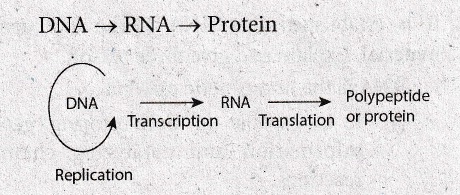
1. The process protein synthesis actually consists of two stages-transcription and translation.
2. In eukaryotic cells, transcription takes place in the nucleus. During transcription, DNA is used as a template to make a molecule of messenger RNA (mRNA). The molecule of mRNA then leaves the nucleus and reaches ribosome in the cytoplasm, where translation occurs.
3. During translation, the genetic code in mRNA is read and used to make a protein.
4. These two processes are summedup by the central dogma of molecular biology
41.
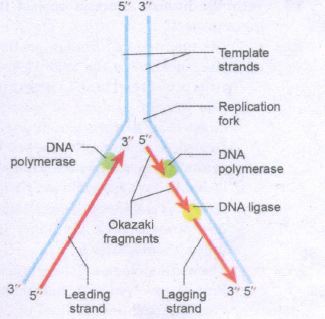
(a) Replicating fork of DNA
(b)
(c) Source of Energy:
NTP's are used in the synthesis of RNA primers and ATP is used as an energy source for some of the enzymes, needed to initiate and sustain DNA synthesis occurs at the replication fork.
Enzymes involved in replication :
(i) DNA Helicase
(ii) DNA polymerase
(iii) Topoisomerase/DNA Gyrase
(iv) DNA ligase
(v) Primase
(d) Both the strands of (parental) DNA act as template for the synthesis of new strands
1. On the templates strand with \(3^{\prime} \rightarrow 5^{\prime}\) polarity the new strand (leading strand) is synthesized as a continuous stretch. It is called continuous synthesis (DNA polymerase carryout polymerisation).
2. On the other strand \(5^{\prime} \rightarrow 3^{\prime}\) polarity DNA synthesized as short stretches; it is called discontinuous synthesis.
3. Later the short stretches of DNA are joined by DNA-ligases into a continuous strand called lagging strand.
42.
Human genome project was considered to be a mega project because
1. It had a specific goal to sequence for everybase pair present in the human genome. (Human Genome has 3.1647 billion nucleotide base pairs).
2. It took around 13 years of completion and got accomplished in year 2006.
3. It was a large-scale project, which aimed at developing new technology and generating new information in the field of genomic studies.
4. As a result of it, several news areas and avenues have opened up in the field of genetics, biotechnology and medical sciences.
5. It provided clues regarding the understanding of human biology.

12th Standard Syllabus & Materials
12th Standard
TN 12th Computer Applications களப்பெயர் முறைமை (DNS) Sample Question Papers Study Material - QB365 Set A
NEW12th Standard
TN 12th Computer Applications வலையமைப்பு எடுத்துக்காட்டுகள் மற்றும் நெறிமுறைகள் Sample Question Papers Study Material - QB365 Set A
NEW12th Standard
TN 12th Computer Applications கணினி வலையமைப்பு ஓர் அறிமுகம் Sample Question Papers Study Material - QB365 Set A
NEW12th Standard
TN 12th Computer Applications PHP-உடன் MySQL-ஐ இணைத்தல் Sample Question Papers Study Material - QB365 Set A



Tamilnadu Stateboard 12th Standard Subjects

Maths

Chemistry

Physics
Biology

Computer Science

Business Maths and Statistics

Economics

Commerce

Accountancy

History

Computer Applications
Biology
Computer Technology
Computer Applications
Computer Science
Business Maths and Statistics
Commerce
Economics
Maths
Chemistry
Physics
Computer Technology
History
Accountancy

Tamil

English

French
Tamilnadu Stateboard Standards

