
 100% FREE ACCESS
12th Standard Syllabus & Materials
12th Standard
TN 12th Maths Applications of Matrices and Determinants Sample Question Papers Study Material - QB365 Set A
NEW12th Standard
TN 12th Computer Applications மின்னணு தரவு பரிமாற்றம் Sample Question Papers Study Material - QB365 Set A
NEW12th Standard
TN 12th Computer Applications மின் - வணிக பாதுகாப்பு அமைப்புகள் Sample Question Papers Study Material - QB365 Set A
NEW12th Standard
TN 12th Computer Applications மின்னணு செலுத்தல் முறைகள் Sample Question Papers Study Material - QB365 Set A
NEW12th Standard
TN 12th Computer Applications மின் - வணிகம் Sample Question Papers Study Material - QB365 Set A
NEW12th Standard
TN 12th Computer Applications திறந்த மூல கருத்துருக்கள் Sample Question Papers Study Material - QB365 Set A

Published on: 30/01/2021
12th Standard Bio-Zoology English Medium Human Health and Diseases Reduced Syllabus Important Questions 2021
Download Tamil Nadu 12th Standard Biology question papers, model tests, one-mark questions, important questions, and public exam papers in PDF format. Free study materials and answer keys for TN State Board students.
Questions + Answers key
Take MCQ Biology Test1.
_________________ is a chronic memory disorder due to alcohol misuse.
Cushing's syndrome
Turners' syndrome
Klinefelters' syndrome
Korsakoff syndrome
2.
The enzyme attached to RNA of HIV is _________________
RNA polymerase
reverse transcriptase
primase
endonuclease
3.
Yellow fever is a _____________ type of disease.
Neurotropic
Viscerotropic
Pneumotropic
Dermotropic
4.
This is not a lifestyle disorder in man
Cancer
diabetes
cardiovascular disease
lung disease
5.
Continuous consumption of alcohol affects ___________
Heart
Kidney
liver
brain
6.
Which statement is wrong regarding the malaria?
In the human liver, the sporozoites undergo sexual fission
Erythrocytes lyse and release the merozoites and haemozoin
In the mosquito's gut, the ookinete is formed
Male and female gametes develop in the body of a mosquito.
7.
The incubation period of malaria is_______days.
10
12
15
18
8.
________is a DNA virus
Rubella
Varicella
Polio
Mumps
9.
________is a dermotropic disease
Influenza
Measles
Cold
Rabies
10.
Vector control research Centre is located in__________
Chennai
Delhi
Puducherry
Hyderabad
11.
The site of infection for yersinia pestis is___________
Intestine
Lungs
Lymph nodes
Nervous system
12.
Rigidity of the Jaw muscle is a symptom of__________
Typhoid
Kala azar
Tetanus
Chikungunya
13.
Allergy involves
IgE
IgG
lgA
IgM
14.
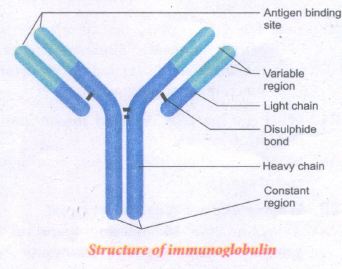
Paratope is an
Antibody binding site on variable regions
Antibody binding site on heavy regions
Antigen binding site on variable regions
Antigen binding site on heavy regions
15.
A 30 year old woman has bloody diarrhea for the past 14 hours, which one of the following organisms is likely to cause this illness?
Streptococcus pyogens
Clostridium difficile
Shigella dysenteriae
Salmonella enteritidis
16.
Explain
(a) Cell Mediated Immunity
(b) Antibody Mediated Immunity
17.
Comment on Malaria vaccine.
18.
What is drug abus?
19.
Mention any 3 effects of alcohol in the during adolescence.
20.
Define hygiene as given by WHO.
21.
Write a few lines about filarial worm.
22.
Why do you think it is not possible to produce vaccine against 'common cold'?
23.
(i) Write the scientific name of the filarial worm that causes filariasis.
(ii) Write the symptoms of filariasis.
(iii) How is this disease transmitted?
24.
List the causative agent, mode of transmission and symptoms for Diptheria and Typhoid.
25.
26.
Explain the events in life cycle of Plasmodium in the secondary host/Man.
27.
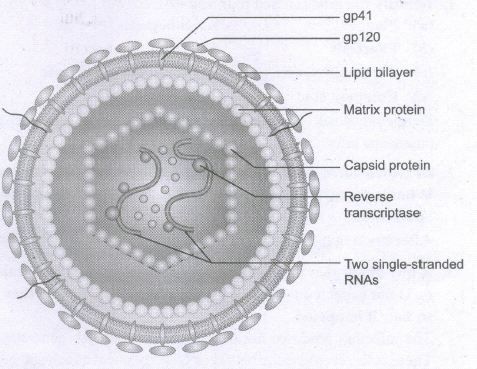
Describe the structure of HIV with a diagram
28.
How primary immune response differ from secondary immune response?
29.
List any five viral diseases, their causative agents, site of infection, mode of transmission and symptoms
30.
What is vaccine? What are its types?
31.
Expand
(a) MALT
(b) NACO
32.
Write any two differences between CMI and AMI
33.
What is diapedesis?
34.
Name the causative organism of filariasis and mention the site of infection of parasite.
35.
Filarial worm and Plasmodium both are digenic parasites Man is a common host for both parasites. Name the other host.
36.
Name any two fungal disease and helminthic disease.
37.
Differentiate between infectious and non-infections disease.
38.
What is haemozoin?
39.
What is sporogony?
40.
Name the causal agent of swine flu. Mention two symptoms.
41.
Autoimmunity is a misdirected immune response. Justify.
42.
A person is infected by HIV. How will you diagnose for AIDS?
1.
(d)
Korsakoff syndrome
2.
(b)
reverse transcriptase
3.
(b)
Viscerotropic
4.
(d)
lung disease
5.
(c)
liver
6.
(a)
In the human liver, the sporozoites undergo sexual fission
7.
(b)
12
8.
(b)
Varicella
9.
(b)
Measles
10.
(c)
Puducherry
11.
(c)
Lymph nodes
12.
(c)
Tetanus
13.
(a)
IgE
14.
(c)
Antigen binding site on variable regions
15.
(c)
Shigella dysenteriae
16.
(a) Cell-mediated immunity
When pathogens are destroyed by cells without producing antibodies, then it is known as cell mediated immune response or cell mediated immunity. This is brought about by T cells, macrophages, and natural killer cells.
(b) Antibody mediated immunity or humoral immunity
When pathogens are destroyed by the production of antibodies, then it is known as antibody mediated or humoral immunity. This is brought about by B cells with the aid of antigen presenting cells and T helper cells. Antibody production is the characteristic feature of vertebrates only.
17.
Malaria vaccine is used to prevent malaria. The only approved vaccine as of 2015 is RTS, S(Mosquirix). It requires four injections and has relatively low efficacy (26-50%). Due to this low efficacy, WHO does not recommend the use of RTS, S vaccine in babies between 6 and 12 weeks of age
18.
The intake of certain drugs for a purpose other than their normal clinical use in an amount and frequency that impair one's physical, physiological and psychological functions is called drug abuse.
19.
(i) Alcohol interferes with the ability of the liver to break down fat. Over time fat accumulation and high levels of alcohol destroy the liver cells and a scar tissue grows in the place of dead cells. This scarring of the liver is called "Liver cirrhosis ".
(ii) Alcohol irritates the stomach lining due to the production of excess acid leading to ulcers.
(iii) Excessive alcohol use weakens the heart muscle, causing scar tissue to build up in the cardiac muscle fibers. As a result, heavy drinkers have an increased risk of high blood pressure, stroke, coronary artery disease and heart attack.
20.
According to the World Health Organization (WHO), hygiene refers to "conditions and practices that help to maintain health and prevent the spread of diseases."
21.
(i) Commonly called filarial worm. It is found in the Iymph vessels and lymphnodes of man.
(ii) Wuchereria bancrofti is sexually dimorphic viviparous and digenic. The life cycle is completed in two hosts, man and the female Culex mosquito.
(iii) The accumulation of the worms block the lymphatic system resulting in inflammation of the lymph nodes.
In some cases, the obstruction of lymph vessels causes elephantiasis or filariasis of the both scrotum and mammary glands.
22.
The common cold has evaded medical sciences advances for two primary reasons:
(i) The first issue is that the colds are most often caused by a rhinoviruses-a large family of viruses with hundreds of variants. This makes vaccination an impossibility and gives our immune system a challenging task.
(ii) Secondly, these viruses evolve rapidly so even if we could produce vaccines to cover the full spectrum of rhinoviruses, they would quickly become resistant.
23.
(i) "Wuchereria bancrofti".
(ii) Chronic inflammation of the lymph nodes. Obstruction of lymph in the vessels of the lower limb.
(iii) Transmitted through an agent/vector called Female Culex mosquito.
24.
(i) For Diphtheria:
Causal agent: Corynebacterium diphtheria.
Mode of Transmission: Droplet infection through breathing.
Symptoms: Fever, sore throat, hoarseness and difficulty in breathing
(ii) For Typhoid:
Causal agent: Salmonella typhi
Mode of Transmission: Through contaminated food and water
Symptoms: Headache, abdominal discomfort, fever and diarrhea.
25.
26.
Life cycle of Plasmodium :
(i) The life cycle of Plasmodium involves three phases namely schizogony,gamogony and sporogony.
(ii) The parasite enters the human blood stream through the bite of an infected female Anopheles mosquito.
(iii) As it feeds, the mosquito injects the saliva containing the sporozoties.
(iv) The sporozoite within the blood stream enter the hepatic cells of the liver.
(v) It undergoes multiple asexual fission (schizogony) and produces merozoties which are released from liver cells.
(vi) The merozoites penetrate the RBC's. Inside the RBC of blood, the merozoite begins to develop unicellular trophozoites. The trophozoite grows in size and a central vacuole develops p them to one side of cytoplasm and becomes the signet ring stage.
(vii) The trophozoite nucleus divides asexually to produce the schizont.
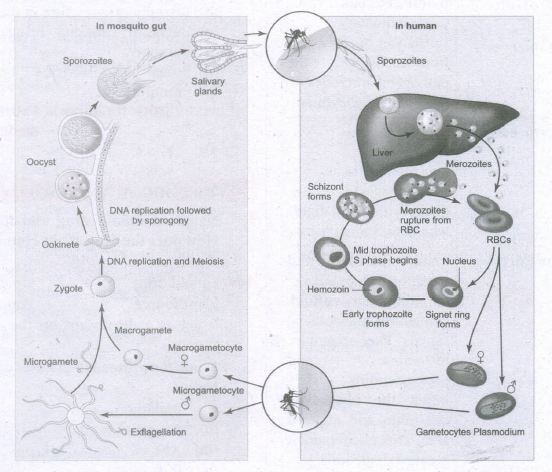
(viii) The schizont divides and produces mononucleated merozoites.
(ix) Eventually the erythrocyte lyses, releasing the merozoites and haemozoin toxin into the blood stream to infect other erythrocytes.
(x) Lysis of red blood cells results in fever and other symptoms.
(xi) This erythrocytic stage is cyclic and repeats itself approximately every 48 to 72 hours or longer depending on the species of Plasmodium involved.
(xii) The sudden release of merozoites triggers an attack on the RBCs.
(xiii) Occasionally, merozoites differentiate into macrogametocytes and microgametocytes. when these are ingested by a mosquito, they develop into male and female gametes respectively.
27.
The human immunodeficiency virus belongs to the genus Lentivirus. When observed under the electron microscope, HIV is seen as a spherical virus, 100-120 nm in diameter, containing a dense core surrounded by a lipoprotein envelope. The envelope has .glycoprotein (GP) spikes termed GP 41 and GP 120. At the core, there are two large single-stranded RNA. Attached to the RNA are molecules of reverse transcripte. It also contains enzymes like protease and ribonuclease. The core is covered by a capsid made of proteins. This is followed by another layer of matrix proteins as shown above.
28.
| S.No | Primary Immune Response | Secondary Immune Response |
|---|---|---|
| 1. | It occurs as a result of primary contact with an antigen. | It occurs as a result of second and subsequent contacts with the same antigen |
| 2. | Antibody level reaches peak in 7 to 10 days | Antibody level reaches peak in 3 to 5 days. |
| 3. | Prolonged period is required to establish immunity | It establishes immunity in a short time. |
| 4. | There is rapid decline in antibody level | Antibody level remains high for longer period. |
| 5. | It appears mainly in the lymph nodes and spleen. | It appears mainly in the bone marrow followed by the spleen and lymph nodes |
29.
| S.No | Diseases | Caustive agent | Site of infection | Mode of transmission | Symptoms |
|---|---|---|---|---|---|
| 1. | Common cold | Rhino viruses | Respiratory tract | Droplet infection | Nasal congestion and discharge sore throat, cough and headache |
| 2. | Mumps | Mumps cirus (RNA virus)Paramyxa cirus |
Salivary glands | Saliva and droplet infection | Enlargement of the parotid glands |
| 3. | Measles | Rubella virus (RNA virus Parmyxco), | Skin and respiratory tract | Droplet infection | Sore throat, running nose cough and fever. reddish rashes on the skin, neck and ears |
| 4. | Viral hepatitis | Hepatitis - B virus | Liver | Parenteral route blood transfusion | Liver damage, jaundice, nausea yellowish eyes, fever and pain in the abdomen |
| 5. | Chicken pox | Varicella-Zoster virus (DNA Virus | Respiratory tract,skin and nervous | Droplet infection and direct contact | Mild fever with itchy skin, rash and blisters |
30.
(i) A vaccine is a biological preparation that provides active acquired immunity to a particular disease and resembles a disease-causing microorganism and is often made from weakened or attenuated or killed forms of the microbes, their toxins, or one of its surface proteins.
(ii) Vaccines "teach" our body how to defend itself when viruses or bacteria, invade it.
(iii) Vaccine initiates the immunization process. The vaccines are classified as first, second and third generation vaccines.
First generation vaccine:
(i) First generation vaccine is further subdivided into live attenuated vaccine, killed vaccine and toxoids.
(ii) Live attenuated live vaccines use the weakened (attenuated), aged, less virulent form of the virus
(iii) Eg. Measles, Mumps and Rubella (MMR) vaccine and the Varicella (chickenpox) vaccine, killed (inactivated) vaccines are killed or inactivated by heat and other methods. Eg. Salk's polio vaccine.
(iv) Toxoid vaccines contain a toxin or chemical secreted by the bacteria or virus.
(v) They make us immune to the harmful effects of the infection, instead of to the infection itself.
(vi) Eg. DPT vaccine (Diphtheria, pertussis and Tetanus), (Triple antigen).
Second generation vaccine: contains the pure surface antigen of the Pathogen. :
Eg. Hepatitis-B vaccine
Third generation vaccine: contains the purest and the highest potency vaccines which are synthetic in generation. The latest revolution in vaccine is DNA vaccine (or) recombinant vaccine
31.
(a) MALT - Mucosal - Associated Lymphoid Tissue
(b) NACO - National AIDS Control Organisation
32.
| Cell Mediated Immunity (CMI) | Antibody Mediated Immunity (AMI) | |
|---|---|---|
| a. | In CMI, pathogens are destroyed by cells without producing antibodies. | In AMI, pathogens are destroyed by antibodies. |
| b. | It is carried out by T cells, Macrophages NK cells | It is carried out by B cells, T helper cells, APC cells |
33.
Tissue damage and infection induce leakage of vascular fluid, containing chemotactic signals like serotonin, histamine, and prostaglandins. They influx the phagocytic cells into the affected area. This phenomenon is called diapedesis,
34.
Causative organisms of filariasis is Wuchereria bancrofti (filarial worm). The site of infection is lymph vessels and lymph nodes
35.
The other host of filarial worm is female Culex mosquito
The other host of Plasmodium is female Anopheles mosquito
36.
Fungal disease: Candidiasis, Athlete's foot
Helminthic disease: Ascariasis, Filariasis
37.
| Infectious disease | Non-infectious disease |
|---|---|
| Disease which are transmitted form one person to another are called infectious disease. e.g. Common cold | Disease which do not transmitted form one person to another are called non-infectious disease. e.g. Anaemia |
38.
It is a toxin produced by lysis of insected red blood cells in a person affected with malaria. This causes malaria symptoms such as fever, chills, shivering etc.,
39.
In the life cycle of plasmodium, the oocyte undergoes meiosis by a process called sporogony to from sporozoites. This takes place in the gut of the mosquito
40.
Causal agent of swine flu HI N1 virus strain Symptoms sore throat, fever, cough, body ache and weakness.
41.
Autoimmunity is due to an abnormal immune response in which the immune system fails to properly distinguish between self and non-self and attacks its own body. Our body produces antibodies (autoantibodies) and cytotoxic T cells that destroy our own tissues. If disease-state results, it is referred to as auto-immune disease.
Thus, autoimmunity is a misdirected immune response. Eg., Rheumatoid arthritis and multiple sclerosis
42.
(i) A simple blood test is available that can determine whether the person has been infected with HIV.
(ii) The ELISA test (Enzyme Linked Immuno Sorbent Assay) detects the presence of HIV antibodies.
(iii) It is a preliminary test. Western blot test is more reliable and a confirmatory test.
(iv) It detects the viral core proteins. If both tests detect the presence of the antibodies, the person is considered to be HIV positive.

12th Standard Syllabus & Materials
12th Standard
TN 12th Computer Applications வலையமைப்பு வடமிடல் Sample Question Papers Study Material - QB365 Set A
NEW12th Standard
TN 12th Computer Applications களப்பெயர் முறைமை (DNS) Sample Question Papers Study Material - QB365 Set A
NEW12th Standard
TN 12th Computer Applications வலையமைப்பு எடுத்துக்காட்டுகள் மற்றும் நெறிமுறைகள் Sample Question Papers Study Material - QB365 Set A
NEW12th Standard
TN 12th Computer Applications கணினி வலையமைப்பு ஓர் அறிமுகம் Sample Question Papers Study Material - QB365 Set A



Tamilnadu Stateboard 12th Standard Subjects

Maths

Chemistry

Physics
Biology

Computer Science

Business Maths and Statistics

Economics

Commerce

Accountancy

History

Computer Applications
Biology
Computer Technology
Computer Applications
Computer Science
Business Maths and Statistics
Commerce
Economics
Maths
Chemistry
Physics
Computer Technology
History
Accountancy

Tamil

English

French
Tamilnadu Stateboard Standards

