
 100% FREE ACCESS
12th Standard Syllabus & Materials
12th Standard
TN 12th Maths Applications of Matrices and Determinants Sample Question Papers Study Material - QB365 Set A
NEW12th Standard
TN 12th Computer Applications மின்னணு தரவு பரிமாற்றம் Sample Question Papers Study Material - QB365 Set A
NEW12th Standard
TN 12th Computer Applications மின் - வணிக பாதுகாப்பு அமைப்புகள் Sample Question Papers Study Material - QB365 Set A
NEW12th Standard
TN 12th Computer Applications மின்னணு செலுத்தல் முறைகள் Sample Question Papers Study Material - QB365 Set A
NEW12th Standard
TN 12th Computer Applications மின் - வணிகம் Sample Question Papers Study Material - QB365 Set A
NEW12th Standard
TN 12th Computer Applications திறந்த மூல கருத்துருக்கள் Sample Question Papers Study Material - QB365 Set A

Published on: 30/01/2021
12th Standard Bio-Zoology English Medium Human Health and Diseases Reduced Syllabus Important Questions With Answer Key 2021
Download Tamil Nadu 12th Standard Biology question papers, model tests, one-mark questions, important questions, and public exam papers in PDF format. Free study materials and answer keys for TN State Board students.
Questions + Answers key
Take MCQ Biology Test1.
Which one of the following statements is not correct?
Bursa of Fabricius is a primary lymphoid organ of birds
Blymphocytes mature in the bursa.
Bursa of Fabricius brings cell mediated immunity
Bursa of Fabricius brings humoral immunity.
2.
The test that confirms HIV positive is ________________
Western blot
Northern blot
Southern blot
all the above
3.
Infection of Ascariasis occur due to ___________________
Sand fly
contaminated food
mosquito bite
stagnant water
4.
Secretion of HCI in stomach is an example for ______________
Anatomical barriers
Phagocytic barriers
Physiological barriers
Inflammatory barriers
5.
Pick out the disease which is caused by virus
Candidiasis
Ascariasis
Poliomyelitis
Dysentery
6.
Choose the correct sequence with regard to plasmodium.
(i) Sporozoite
(ii) Microgametocyte
(iii) Signet ring stag
(iv) oocyte
i, iii, iv, ii
i, iii, ii, iv
i, iv, ii, iii
i, ii, iii, iv
7.
One after following statement is wrong. Find out.
I Bhang affects the cardiovascular system
II Opium acts a depresent on the central nervous system
III Lysergic acid diethylamide distorts the way one sees, hears and feels
IV Barbiturates slows down the activity of the fore brain.
I II IV
II IV
all the above
none of the above
8.
Yellow fever and dengue fever are categorized under this group, classifies based on the organs which get affected
neurotropic disease
viscerotropic disease
dermotropic disease
pneumotropic disease
9.
This part of our body is affected by viral infection in mumps.
Liver
Salivary glands
Nervous system
Skin and blood
10.
___________is not a symptom of Kala-azar
Anemia
Fever
Spleen enlargement
Muscle spasms
11.
___________is a pandemic disease
Polio
Swine flu
Dysentery
Dengue fever
12.
The site of infection for yersinia pestis is___________
Intestine
Lungs
Lymph nodes
Nervous system
13.
Spread of cancerous cells to distant sites is termed as
Metastasis
Oncogenes
Proto-oncogenes
Malignant neoplasm
14.
The sporozoite of the malarial parasite is present in ______
saliva of infected female Anopheles mosquito
RBC of human suffering from malaria.
Spleen of infected humans
Gut of female Anopheles mosquito
15.
Cirrhosis of liver is caused by chronic intake of ______
Opium
Alcohol
Tobacco
Cocaine
16.
According to the WHO, what is health?
17.
What steps should be taken to maintain good health?
18.
Name two plants with hallucinogenic properties.
19.
Differentiate male and female Ascaris.
20.
What is a digenic organism?
21.
Name two mosquito species which act as vectors for diseases
22.
Name two RNA viruses which cause diseases in humans.
23.
What are non-infectious diseases?
24.
Autoimmunity is a misdirected immune response. Justify.
25.
What are interferons? Mention their role.
26.
Explain the events in life cycle of Plasmodium in the secondary host/Man.
27.
28.
Write in detail about various types of antigen-antibody reactions.
29.
Describe the structure of lymph node with a labeled diagram
30.
Explain the structure and role of thymus in primary lymphoid organ.
31.
Point out the differences between active and passive immunity.
32.
Give an account of helminthic disease.
33.
What is vaccine? What are its types?
34.
Explain the process of replication of retrovirus after it gains entry into the human body.
35.
In which form does the malarial parasite enter the human body through mosquito?
What is the target site of parasite immediately after entering the host body?
36.
Secondary response is a booster response - Explain.
37.
What is innate immunity?
38.
Give a brief account of Kala-azar.
39.
What is irritable bowel syndrome?
40.
Define hygiene as given by WHO.
41.
What is signet ring stage?
42.
1.
(c)
Bursa of Fabricius brings cell mediated immunity
2.
(a)
Western blot
3.
(b)
contaminated food
4.
(c)
Physiological barriers
5.
(c)
Poliomyelitis
6.
(b)
i, iii, ii, iv
7.
(d)
none of the above
8.
(b)
viscerotropic disease
9.
(b)
Salivary glands
10.
(d)
Muscle spasms
11.
(b)
Swine flu
12.
(c)
Lymph nodes
13.
(a)
Metastasis
14.
(a)
saliva of infected female Anopheles mosquito
15.
(b)
Alcohol
16.
The World Health Organization [WHO] defines health as a state of complete physical, mental and social wellbeing and not merely absence of diseases.
17.
Personal hygiene, regular exercise, and a balanced diet are very important to maintain good health.
18.
Atropa belladonna and Datura
19.
(i) Male Ascaris is shorter than female Ascaris
(ii)The posterior end of the male worm is carried whereas in female worm this is not found.
20.
(i) An organism which completes its life cycle in two hosts is said to be digenic,
(ii) Eg : plasmodium vivax which casues malaria is a digenic parasite invading man as secondary host and female Anopheles mosquito as primary host.
21.
| Mosquito vector | Disease |
|---|---|
| (a) Aedes aegypti | Dengue fever |
| (b) Female Anopheles mosquito | Malaria |
22.
Rubella Virus - causes Measles
Polio virus - causes Poliomyelitis
23.
Non-infection diseases are not transmitted from an infected person to a healthy person. In origin they may be genetic (cystic fibrosis), nutritional (vitamin deficiency diseases) and degenerative (arthritis, heart attack, stroke).
24.
Autoimmunity is due to an abnormal immune response in which the immune system fails to properly distinguish between self and non-self and attacks its own body. Our body produces antibodies (autoantibodies) and cytotoxic T cells that destroy our own tissues. If disease-state results, it is referred to as auto-immune disease.
Thus, autoimmunity is a misdirected immune response. Eg., Rheumatoid arthritis and multiple sclerosis
25.
Interferons: These are the proteins made and released by host cells in response to the presence of pathogens such as viruses, bacteria, parasites etc
RoIe: They inhibit viral infections and stimulate the entire immune system to fight disease. They also regulate many kinds of cell functions
26.
Life cycle of Plasmodium :
(i) The life cycle of Plasmodium involves three phases namely schizogony,gamogony and sporogony.
(ii) The parasite enters the human blood stream through the bite of an infected female Anopheles mosquito.
(iii) As it feeds, the mosquito injects the saliva containing the sporozoties.
(iv) The sporozoite within the blood stream enter the hepatic cells of the liver.
(v) It undergoes multiple asexual fission (schizogony) and produces merozoties which are released from liver cells.
(vi) The merozoites penetrate the RBC's. Inside the RBC of blood, the merozoite begins to develop unicellular trophozoites. The trophozoite grows in size and a central vacuole develops p them to one side of cytoplasm and becomes the signet ring stage.
(vii) The trophozoite nucleus divides asexually to produce the schizont.
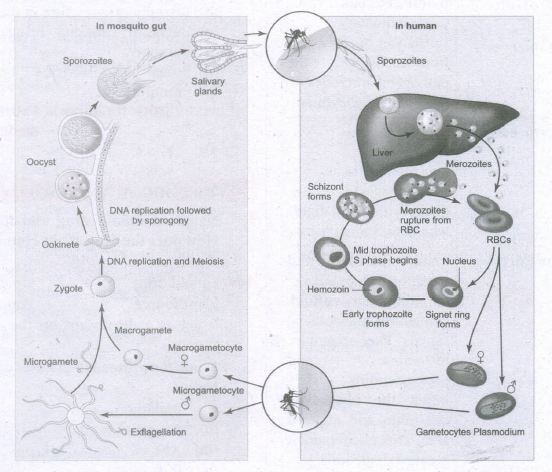
(viii) The schizont divides and produces mononucleated merozoites.
(ix) Eventually the erythrocyte lyses, releasing the merozoites and haemozoin toxin into the blood stream to infect other erythrocytes.
(x) Lysis of red blood cells results in fever and other symptoms.
(xi) This erythrocytic stage is cyclic and repeats itself approximately every 48 to 72 hours or longer depending on the species of Plasmodium involved.
(xii) The sudden release of merozoites triggers an attack on the RBCs.
(xiii) Occasionally, merozoites differentiate into macrogametocytes and microgametocytes. when these are ingested by a mosquito, they develop into male and female gametes respectively.
27.
28.
Different types of antigen and antibody reactions: The reaction between soluble antigen and antibody leads to the visible precipitate formation, which is called a precipitin reaction. Antibodies that bring about precipitate formation on reacting with antigens are called as precipitins. Whenever a particulate antigen interacts with its antibody, it would result in clumping or agglutination of the particulate antigen, which is called agglutination reaction. The antibody 'involved in bringing about agglutination reaction is called agglutinin. Opsonisation or enhanced attachment is the process by which a pathogen is marked of ingestion and destruction by a phagocyte. Opsonization involves the binding of an opsonin i.e., antibody, to a receptor on the pathogens. cell membrane. After opsonin binds to the membrane, phagocytes are attracted to the pathogen. So, opsonization is a process in which pathogens are coated with a substance called an opsonin, marking the pathogen out for destruction by the immune system. This results in a much more efficient phagocytosis. The neutralization reactions are the reactions of antigen-antibody that involve the elimination of the harmful effects of bacterial exotoxins or a virus by specific antibodies. These neutralizing substances i.e. antibodies are known. as antitoxins. This specific antibody is produced by a host cell in response to a bacterial exotoxin or corresponding toxoid (inactivated toxin).
29.
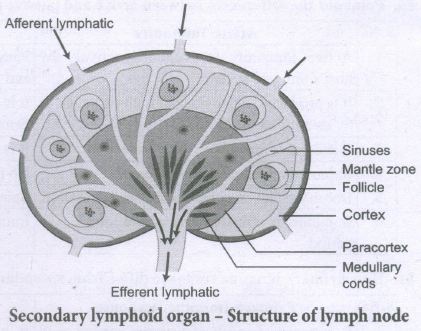
Lymph node has three zones. They are the cortex, paracortex, and medulla. The outer most layer of the lymph node is called cortex, which consists of B-lymphocytes, macrophages, and follicular dendritic cells. The paracortex zone is beneath the cortex, which is richly populated by T lymphocytes and interdigitating dendritic cells. The innermost zone is called the medulla which is sparsely populated by lymphocytes, but many of them are plasma cells, which actively secrete antibody molecules. As the lymph enters, it slowly percolates through the cortex, paracortex, and medulla, giving sufficient chance for the phagocytic cells and dendritic cells to trap the antigen brought by the lymph. The lymph leaving a node carries enriched antibodies secreted by the medullary plasma cells against the antigens that enter the lymph node. Sometimes visible swelling of lymph nodes occurs due to active immune response and increased the concentration of lymphocytes. Thus swollen lymph nodes may signal an infection. There are several groups of lymph nodes. The most frequently enlarged lymph nodes are found in the neck, under the chin, in the armpits, and in the groin.
30.
Thymus is most active during the neonatal and pre-adolescent periods. The. thymus is a fiat and bilobed organ located behind the stemun, above the heart. Each lobe of the thymus contains numerous lobules, separated from each other by connective tissue called septa. Each lobule is differentiated into an outer cortex and an inner medulla. Within each lobule, the developing T cells called thymocytes are arranged into outer cortex and inner medulla. The inner medulla contains immature thymocytes and outer cortex has matured thymocytes. One of its main secretions is the hormone thymosin. It stimulates the T cell to become mature and immunocompetent. By the early teens, the thymus begins to atrophy and is replaced by adipose tissue.
31.
| S. No | Active Immunity | Passive Immunity |
|---|---|---|
| 1. | Active immunity is produced actively by host's immune system | Passive immunity is received passively and there is no active host participation |
| 2. | It is produced due to contact with pathogen or by its antigen. | It is produced due to antibodies obtained from outside |
| 3. | It is durable and effective in protection. | It is transient and less effective |
| 4. | Immunological memory is present | No memory |
| 5. | Booster effect on subsequent dose is possible. | Subsequent dose is less effective |
| 6. | Immunity is effective only after a short period | Immunity develops immediately |
32.
Helminths are mostly endoparasitic in the gut and blood of human beings and cause diseases called helminthiasis. The two most prevalent helminthic diseases are Ascariasis and Filariasis. Ascaris is a monogenic parasite and exhibits sexual dimorphism. Ascariasis is a disease caused by the intestinal endoparasite Ascaris lumbricoides commonly called the roundworms. It is transmitted through ingestion of embryonated eggs through contaminated food and water. Children playing in contaminated soils are also prone to have a chance of transfer of eggs from hand to mouth. The symptoms of the disease are abdominal pain, vomiting, headache, anemia, irritability, and diarrhoea. A heavy infection can cause nutritional deficiency and severe abdominal pain and causes stunted growth in children. It may also cause enteritis, hepatitis, and bronchitis.
Filariasis is caused by Wuchereria bancrofti, commonly called filarial worm. It is found in the lymph vessels and lymph nodes of man. Wuchereria bancrofti is sexually dimorphic, viviparous and digenic. The life cycle is completed in two hosts, man and the female Culex mosquitoes. The female filarial worm gives rise to juveniles called microfilariae larvae. In the lymph glands, the juveniles develop into adults. The accumulation of the worms blocks the lymphatic system resulting in inflammation of the lymph nodes. In some cases, the obstruction of lymph vessels causes elephantiasis or filariasis of the limbs, scrotum and mammary glands
33.
(i) A vaccine is a biological preparation that provides active acquired immunity to a particular disease and resembles a disease-causing microorganism and is often made from weakened or attenuated or killed forms of the microbes, their toxins, or one of its surface proteins.
(ii) Vaccines "teach" our body how to defend itself when viruses or bacteria, invade it.
(iii) Vaccine initiates the immunization process. The vaccines are classified as first, second and third generation vaccines.
First generation vaccine:
(i) First generation vaccine is further subdivided into live attenuated vaccine, killed vaccine and toxoids.
(ii) Live attenuated live vaccines use the weakened (attenuated), aged, less virulent form of the virus
(iii) Eg. Measles, Mumps and Rubella (MMR) vaccine and the Varicella (chickenpox) vaccine, killed (inactivated) vaccines are killed or inactivated by heat and other methods. Eg. Salk's polio vaccine.
(iv) Toxoid vaccines contain a toxin or chemical secreted by the bacteria or virus.
(v) They make us immune to the harmful effects of the infection, instead of to the infection itself.
(vi) Eg. DPT vaccine (Diphtheria, pertussis and Tetanus), (Triple antigen).
Second generation vaccine: contains the pure surface antigen of the Pathogen. :
Eg. Hepatitis-B vaccine
Third generation vaccine: contains the purest and the highest potency vaccines which are synthetic in generation. The latest revolution in vaccine is DNA vaccine (or) recombinant vaccine
34.
(i) After getting into the body of the person, the virus enters into macrophages where RNA genome of the virus replicates to form viral DNA with the help of the enzyme reverse transcriptase.
(ii) This viral DNA gets incorporated into the DNA of host cells and directs the infected cells to produce viral particles.
(iii) The macrophages continue to produce viral particles and act like a HIV factory. simultaneously, HIV enters into helper T-lymphocytes (TH), replicates and produces progenies viruses.
The progenies viruses are released into the blood attack other helper T-lymphocytes. This is repeated, leading to a progressive decrease in the number of helper T-lymphocytes in the body of the infected person.
(v) During this period, the person suffers from bouts of fever, diarrhea and weight loss. Due to decrease in the number of helper T-lymphocytes, the person starts suffering from infections that could have been otherwise overcome, such as those due to bacteria especially mycobacterium viruses; fungi and even parasites like toxoplasma.
(vi) The patient becomes so immune deficient that he/she is unable to protect himself/herself against infections.
35.
Sporozoites.
After entering the bloodstream of host it finally reaches the liver cell.
36.
The secondary immune response occurs when a person is exposed to the same antigen again. During this time, immunological memory has been established and the immune system can start producing antibodies immediately. Within hours after recognition of the antigen, a new army of plasma cells are generated. Within 2 to 3 days, the antibody concentration in the blood rises steeply to reach much higher level than primary response. This is' also called as "booster response".
37.
Innate immunity is the natural phenomenon of resistance to infection which an individual possesses right from the birth. The innate defense mechanisms are non-specific in the sense that they are effective against a wide range of potentially infectious agents. It is otherwise known as non-specific immunity or natural immunity
38.
Kala-azar or visceral leishmaniasis is caused by Leishmania donovani, which is transmitted by the vector Phlebotomus (sand fly). Infection may occur in the endothelial cells, bone marrow, liver, lymph glands and blood vessels of the spleen. Symptoms of Kala-azar are weight loss, anaemia, fever, enlargement of spleen and liver
39.
Several people complain of stomach discomfort or pain and trouble with bowel movements, causing diarrhoea. This is called irritable bowel syndrome and caused by stress or other illnesses
40.
According to the World Health Organization (WHO), hygiene refers to "conditions and practices that help to maintain health and prevent the spread of diseases."
41.
Inside the human RBC, the merozoite of plasmodium begins to develop as unicellular trophozoites. The trophozoite grows in size and a central vacuole develops pushing them to one side of cytoplasm and becomes the signet ring stage.
42.

12th Standard Syllabus & Materials
12th Standard
TN 12th Computer Applications வலையமைப்பு வடமிடல் Sample Question Papers Study Material - QB365 Set A
NEW12th Standard
TN 12th Computer Applications களப்பெயர் முறைமை (DNS) Sample Question Papers Study Material - QB365 Set A
NEW12th Standard
TN 12th Computer Applications வலையமைப்பு எடுத்துக்காட்டுகள் மற்றும் நெறிமுறைகள் Sample Question Papers Study Material - QB365 Set A
NEW12th Standard
TN 12th Computer Applications கணினி வலையமைப்பு ஓர் அறிமுகம் Sample Question Papers Study Material - QB365 Set A



Tamilnadu Stateboard 12th Standard Subjects

Maths

Chemistry

Physics
Biology

Computer Science

Business Maths and Statistics

Economics

Commerce

Accountancy

History

Computer Applications
Biology
Computer Technology
Computer Applications
Computer Science
Business Maths and Statistics
Commerce
Economics
Maths
Chemistry
Physics
Computer Technology
History
Accountancy

Tamil

English

French
Tamilnadu Stateboard Standards

