
 100% FREE ACCESS
12th Standard Syllabus & Materials
12th Standard
TN 12th Maths Applications of Matrices and Determinants Sample Question Papers Study Material - QB365 Set A
NEW12th Standard
TN 12th Computer Applications மின்னணு தரவு பரிமாற்றம் Sample Question Papers Study Material - QB365 Set A
NEW12th Standard
TN 12th Computer Applications மின் - வணிக பாதுகாப்பு அமைப்புகள் Sample Question Papers Study Material - QB365 Set A
NEW12th Standard
TN 12th Computer Applications மின்னணு செலுத்தல் முறைகள் Sample Question Papers Study Material - QB365 Set A
NEW12th Standard
TN 12th Computer Applications மின் - வணிகம் Sample Question Papers Study Material - QB365 Set A
NEW12th Standard
TN 12th Computer Applications திறந்த மூல கருத்துருக்கள் Sample Question Papers Study Material - QB365 Set A

Published on: 30/01/2021
12th Standard Bio-Zoology English Medium Microbes in Human Welfare Reduced Syllabus Important Questions With Answer Key 2021
Download Tamil Nadu 12th Standard Biology question papers, model tests, one-mark questions, important questions, and public exam papers in PDF format. Free study materials and answer keys for TN State Board students.
Questions + Answers key
Take MCQ Biology Test1.
Corn \(\overset { A }{ \rightarrow } \) Fermentable sugars \(\overset { B }{ \rightarrow } \) Ethanol. Find out A and B for above statement.
A - Agaricus, B - Sarcina
A - Zymomonas, B - Vinegar
A - Rhizopus, B - Aspergillus
A - Aspergillus, B - Yeast
2.
Which of the following plant species is the most suitable oilseed for biodirect production?
Ground nut
Areca nut
Jatropha curcas
Phyllanthus amarus
3.
Assertion (A): Oenology deals with study of wine and its preparation.
Reason (R): Zymology deals with biochemical process of fermentation and its uses.
A is right R is wrong
R explains A.
A and R are wrong.
A and R are right. R cannot explain A.
4.
Chlortetracycline was isolated from the culture _________________
Streptomyces aureofaciens
Streptomyces griseus
Streptococcus lactis
Aspergillus niger
5.
Name the person who was the first to use the term antibiotic
Selman Waksman
Alexander Flemming
Earnest Chain
Howard Florey
6.
Which of the following is wrongly matched in the given table?
| Microbe | Product | Application |
| Trichoderma polysporum | Cyclosporin A | Immunosuppressive drug |
| Microbe | Product | Application |
| Monascus purpureus | Statins | Lowering of blood cholesterol |
| Microbe | Product | Application |
| Streptococcus | Sterptockinase | Removal of clot from blood vessel |
| Microbe | Product | Application |
| Clostridium butylicum | Lipase | Removal of oil stains |
7.
What gases are produced in anaerobic sludge digesters?
Methane and CO2 only
Methane, hydrogen sulphide and CO2
Methane, hydrogen sulphide and O2
Hydrogen sulphide and CO2
8.
Which of the following are likely to be present in deep-sea water?
Archaebacteria
Eubacteria
Blue-green algae
Saprophytic fungi
9.
Rhizopus oryzae can produce_________
Fumaric acid
Malic acid
Acetic acid
Citric acid
10.
_______is a prokaryotic organism helping to improve fertility of the soil
Glomus
Azolla
legume
Tolypothrix
11.
Biofertilizers are not involved in this process
increase water holding capacity of soil
Help to degrade pollutants
Provide nutrients
Improve soil texture
12.
________is not used as a biofertilizer
Bacillus thuringiensis
Rhizobium
Nostoc
Anabaena
13.
The enzyme________is got from Aspergillus.
Rennet
Zymase
Amylase
Lipase
14.
Which of the following is not involved in nitrogen fixation?
Pseudomonas
Azotobacter
Anabaena
Nostac
15.
Which of the following bacteria is used extensively as a bio-pesticide?
Bacillus thurigiensis
Bacillus subtilis
Lactobacillus acidophilus
Streptococcus lactis
16.
Name the act enforced by government to conserve water bodies. Also, mention its objectives.
17.
Explain the types of bioremediation
18.
What are bio weedicides?
19.
How does Delta-endotoxin affect insects?
20.
What is 'activated sludge' in sewage treatment?
21.
How can we avoid antibiotic resistance?
22.
What is SCP?
23.
How is yoghurt produced?
24.
When does antibiotic resistance develop?
25.
Justify the role of microbes as a bio-fertilizer
26.
Write the key features of organic farming.
27.
How is milk converted into curd? Explain the process of curd formation
28.
Name the biocontrol agents used to get rid of Aphids & mosquito larvae
29.
Complete the table by filling with respective organic acid and microbes.
| Organic acid | Microbes |
|---|---|
| Acetic acid | ............W.......... |
| .......X....... | Aspergillus niger |
| Fumaric acid | ...........Y........... |
| ........Z........ | Clostridium butyricum |
30.
What is studied under zymology and oenology?
31.
Compare Broad spectrum antibiotics with narrow-spectrum antibiotics
32.
Why is curd more nutritious than milk?
33.
Write the equation for fermentation of glucose
34.
What is antibiotic resistance?
35.
How are antibiotics classified?
36.
What is biological oxygen demand?
37.
Bioremediation & microbes - Discuss.
38.
Describe the stages of Sewage treatment process
39.
Explain the working of a biogas plant
40.
Explain the process of sewage treatment.
41.
What is the key difference between primary and secondary sewage treatment?
42.
Write short notes on the following.
a) Brewer's yeast
b) Ideonella sakaiensis
c) Microbial fuel cells
1.
(d)
A - Aspergillus, B - Yeast
2.
(c)
Jatropha curcas
3.
(d)
A and R are right. R cannot explain A.
4.
(a)
Streptomyces aureofaciens
5.
(a)
Selman Waksman
6.
(d)
| Microbe | Product | Application |
| Clostridium butylicum | Lipase | Removal of oil stains |
7.
(b)
Methane, hydrogen sulphide and CO2
8.
(a)
Archaebacteria
9.
(a)
Fumaric acid
10.
(d)
Tolypothrix
11.
(b)
Help to degrade pollutants
12.
(a)
Bacillus thuringiensis
13.
(c)
Amylase
14.
(a)
Pseudomonas
15.
(a)
Bacillus thurigiensis
16.
National river conservation plan (NRCP) was enacted in 1995 to improve the water quality of the rivers, which are the major freshwater resources in our country. This important assignment taken up under the NRCP includes,
(i) To capture the raw sewage flowing into the river through open drains and divert them for treatment.
(ii) Setting up sewage treatment plants for treating the diverted sewage.
(iii) Construction of low-cost sanitation toilets to prevent open defecation on river banks.
17.
It is grouped into in situ bioremediation (treatment of contaminated soil or water in the site) and ex situ bioremediation (treatment of contaminated soil or water that.is removed from the site and treated).
18.
(i) Weedicides are substances which destroy weeds without harming the useful plants. Bio Weedicides are compounds and secondary metabolites derived from microbes such as fungi, bacteria or protozoa
(ii) Mycoherbicides produced by fungus phytophthora palmivora controls strangler vine in citrus crops
19.
When the insects ingest the toxin crystals their alkaline digestive tract denatures the insoluble crystals making them soluble. The cry toxin then gets inserted into the gut cell membrane and paralyzes the digestive tract. The insect then stops eating and starves to death.
20.
In secondary treatment of sewage, once the BOD of sewage water is reduced significantly, the effluent is passed into a settling tank where the bacterial "floes" are allowed to sediment. This sediment is calleda as activated slidge. A small part of activated sludge is pumped back into the aeration tank to serve as the inoculum.
21.
(i) Antibiotics should be used only when prescribed by a certified health professional.
(ii) Narrow spectrum antibiotics are preferable since they effectively and accurately target specific pathogens and are less likely to cause resistance.
22.
Single cell protein refers to edible unicellular microorganisms like Spirulina. Protein extracts from pure or mixed cultures of algae, yeasts, fungi or bacteria may be used as ingredient or as a substitute for protein rich foods and is suitable for human consumption or as animal feed.
23.
Yogurt is produced by bacterial fermentation of milk, and lactic acid is produced as a byproduct. Microorganisms such as Streptococcus thermophilus and Lactobacillus bulgaricus coagulate the milk protein and convert the lactose in the milk to lactic acid. The flavour in yogurt is due to acetaldehyde.
24.
(i) Antibiotic resistance occurs when bacteria develop the ability to defeat the drug designed to kill or inhibit their growth.
(ii) It is one of the most acute threats to public health.
(iii) Antibiotic resistance is accelerated by the misuse and overuse of antibiotics, as well as poor infection prevention control.
(iv) Antibiotics should be used only when prescribed by a certified health professional. When the bacteria become resistant, antibiotics cannot fight against them and the bacteria multiply.
(v) Narrow spectrum antibiotics are preferred over broad spectrum antibiotics. They effectively and accurately target specific pathogenic organisms and are less likely to cause resistance.
(vi) "Superbug" is a term used to describe strains of bacteria that are resistant to the majority of antibiotics commonly used today.
25.
(i) Bio-fertilizers are formulation of living microorganisms that enrich the nutrient quality of the soil. They increase physico - chemical properties of soils such as soil structure, texture, water holding capacity, cation exchange capacity and pH by providing several nutrients and sufficient organic matter.
(ii) The main sources of bio-fertilizers are bacteria, fungi and cyanobacteria. Rhizobium is a example for symbiotic nitrogen fixing bacteria. This bacterium infects the root nodules of leguminous plants and fixes atmospheric nitrogen into organic forms. Azospirillum and Azotobacter are free living bacteria that fix atmospheric nitrogen and enrich the nitrogen content of soil.
(iii) A symbiotic association between a fungus and the roots of the plants is called mycorrhiza. The fungal symbiont in these associations absorbs the phosphorus from soil and transfers to the plant. Plants having such association show other benefits such as resistance to root-borne pathogens, tolerance to salinity, drought, enhances plant growth and developments. For example, genus Glomus form mycorrhiza.
(iv) Cyanobacteria (or) blue green algae (BGA) are prokaryotic free-living organisms which can fix nitrogen. Oscillatoria, Nostoc, Anabaena, Tolypothrix are well known nitrogen fixing cyanobacteria. In water logged paddy fields Cyanobacteria multiply and fix molecular nitrogen. Cyanobacteria secrete growth promoting substances like indole-3-acetic acid, indole-3-butyric acid, naphthalene acetic acid, amino acids, proteins, vitamins which promotes plant growth and production.
(v) Biofertilizers are commonly used in organic farming methods.
(vi) This process involves the use of biological materials, avoiding synthetic substances to maintain soil fertility and ecological balance thereby minimizing pollution and wastage.
26.
(i) Protecting soil quality using organic materials and encouraging biological activity.
(ii) Indirect provision of crop nutrients using soil microorganisms.
(iii) Nitrogen fixation in soils using legumes.
(iv) Weed and pest control based on methods like crop rotation, biological diversity, natural predators, organic manures and suitable chemical, thermal and biological interventions.
27.
1. Milk is converted into curd with the help of bacteria like Lactobacillus acidophilus Lactobacillus lactis and Streptococcus lactis are commonly called Lactic Acid Bacteria (LAB).
2. The LAB bacteria grow in milk and convert it into curd, thereby digesting the milk protein casein.
3. A small amount of curd added to fresh milk as a starter or inoculum contains millions of Lactobacilli, which under suitable temperature \(\left(\leq 40^{\circ} \mathrm{C}\right)\) multiply and convert milk into curd by fermentation.
4. Curd is more nutritious than milk as it contains a number of organic acids and vitamins.
28.
Lady bird beetle & Dragon flies
29.
W- Acetobacter acetic
X -Citric acid,
Y - Rhizopus oryzae,
Z - Butyric acid
30.
(i) Zymology deals with biochemical process of fermentation and its application.
(ii) Oenology deals with study of wine and winemaking.
31.
Broad-spectrum antibiotics act against a wide range of disease-causing bacteria.
Narrow-spectrum antibiotics are active against a selected group of bacterial types.
32.
Curd is more nutritious than milk Since it contains a number of organic acids and vitamins
33.
\(\underset { (Glucose) }{ { C }_{ 6 }{ H }_{ 12 }{ O }_{ 6 } } \overset { Yeast }{ \underset { Fermentation }{ \longrightarrow } } { 2C }_{ 2 }{ H }_{ 5 }+2{ CO }_{ 2 }\uparrow \)
34.
Antibiotic resistance occurs when bacteria develop the ability to defeat the drug designed to kill or inhibit their growth. Thus they multiply and antibiotics cannot light them.
35.
Antibiotics are classified as:
Broad-spectrum antibiotics: They act against a wide range of disease-causing bacteria.
Eg.streptomycin
Narrow-spectrum antibiotics They are active against a selected group of bacterial types
36.
BOD stands for Biological Oxygen Demand. BOD refers to the amount of oxygen that would be consumed if all the organic matter in one liter of water were oxidized by bacteria. The greater the BOD of the waste water, the more is its polluting potential.
37.
Aerobic microbes degrade the pollutants in the presence of oxygen. They mainly degrade pesticides and hydrocarbons. Pseudomonas putida is a genetically engineered microorganism (GEM). Ananda Mohan Chakrabarty obtained patent for this recombinant bacterial strain. It is multiplasmid hydrocarbon-degrading bacterium which can digest the hydrocarbons in the oil spills.
Nitrosomonas europaea is also capable of degrading benzene and a variety of halogenated organic compounds including trichloroethylene and vinyl chloride. Ideonella sakaiensis is currently tried for recycling of PET plastics. These bacteria use PETase and MHETase enzymes to breakdown PET plastic into terephthalic acid and ethylene glycol.
Anaerobic microbes degrade the pollutants in the absence of oxygen. Dechloromonas aromatica has the ability to degrade benzene anaerobically and to oxidize toluene and xylene. Phanerochaete chrysosporium an anaerobic fungus exhibits strong potential for bioremediation of pesticides, polyaromatic hydrocarbons, dyes, trinitrotoluene, cyanides, carbon tetrachloride, etc., Dehalococcoides species are responsible for anaerobic bioremediation of toxic trichloroethene to nontoxic ethane. Pestalotiopsis microspora is a species of endophytic fungus capable of breaking down and digesting polyurethane. This makes the fungus a potential candidate for bioremediation projects involving large quantities of plastics.
38.
Sewage treatment is usually performed in the following three stages
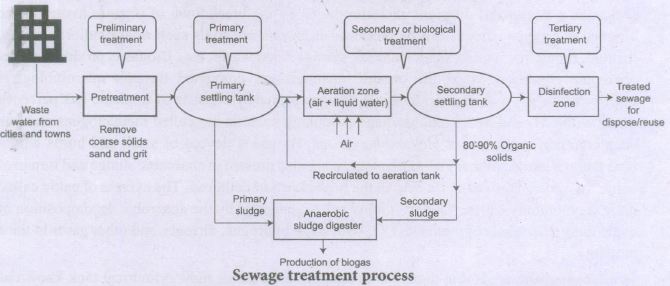
Primary treatment: Primary treatment involves the physical removal of solid and particulate organic and inorganic materials from the sewage through filtration and sedimentation. Floating debris is removed by sequential filtration. Then the grit (soil and small pebbles) are removed by sedimentation. All solids that settle form the primary sludge and the supernatant forms the effluent. The effluent from the primary settling tank is taken for secondary treatment.
Secondary treatment or biological treatment: The primary effluent is passed into large aeration tanks where it is constantly agitated mechanically and air is pumped into it. This allows vigorous growth of useful aerobic microbes into floc (masses of bacteria associated with fungal filaments to form mesh like structures). While growing, these microbes consume the major part of the organic matter in the effluent. This significantly reduces the BOD (Biochemical oxygen demand or Biological oxygen demand). BOD refers to the amount of the oxygen that would be consumed, if all the organic matter in one litre of water were oxidized by bacteria. The sewage water is treated till the BOD is reduced. The greater the BOD of the waste water more is its polluting potential. Once the BOD of sewage water is reduced significantly, the effluent is then passed into a settling tank where the bacterial "floes" are allowed to sediment. This sediment is called activated sludge. A small part of activated sludge is pumped back into the aeration tank to serve as the inoculum. The remaining major part of the sludge is pumped into large tanks called anaerobic sludge digesters. Here, the bacteria which grow anaerobically, digest the bacteria and the fungi in the sludge. During this digestion, bacteria produce a mixture of gases such as methane, hydrogen sulphide and CO2. These gases form biogas and can be used as a source of energy.
Tertiary treatment: Tertiary treatment is the final process that improves the quality of the waste water before it is reused, recycled or released into natural water bodies. This treatment removes the remaining inorganic compounds and substances, such as nitrogen and phosphorus. UV is an ideal disinfectant for wastewater since it does not alter the water quality - except for inactivating microorganisms. UV is a chemical free process that can completely replace the existing chlorination system and also inactivates chlorine-resistant microorganisms like Cryptosporidium and Giardia.
39.
(i) Biogas is a mixture of different gases produced by the breakdown of organic matter in the absence of oxygen. Biogas can be produced from raw materials such as agricultural wastes, manure, municipal wastes, plant material, sewage, food waste, etc.,
(ii) The excreta of cattle called dung is commonly called "Gobar'. Gobar gas is generated by the anaerobic decomposition of cattle dung. It consists of methane, CO2 with some hydrogen, nitrogen and other gases in trace amounts.
(iii) In a biogas plant, anaerobic digestion is carried out in an air tight cylindrical tank known as digester (Fig.). It is made up of concrete bricks and cement or steel. Bio-wastes are collected and slurry of dung is fed into this digester. It has a side opening into which organic materials for digestion are incorporated for microbial activity. Anaerobic digestion is accomplished in three stages: solubilisation, acidogenesis and methanogenisis. The outlet is connected to a pipe to supply biogas. The slurry is drained through another outlet and is used as fertilizer. Biogas is used for cooking and lighting.
40.
Sewage treatment is usually performed in the following three stages:
(I) Primary treatment:
(a) Primary treatment involves the physical removal of solid and particulate organic and inorganic materials from the sewage through filtration and sedimentation.
(b) Floating debris is removed by sequential filtration. Then the grit (soil and small pebbles) are removed by sedimentation.
(c) All solids that settle form the primary sludge and the supernatant forms the effluerit and is taken for secondary treatment.
(II) Secondary treatment or biological treatment:
(a) The primary effluent is passed into large aeration tanks where it is constantly agitated mechanically and air is pumped into it.
(b) This allows vigorous growth of useful aerobic microbes into floc (masses of bacteria associated with fungal filaments to form mesh like structures). Which consume the organic matter in the effluent.
(c) This significantly reduces the BOD (Biochemical oxygen demand or Biological oxygen demand). BOD refers to the amount of the oxygen that would be consumed, if all the organic matter in one litre of water were oxidized by bacteria. The sewage water is treated till the BOD is reduced. The greater the BOD of the waste water more is its polluting potential.
(d) Once the BOD of sewage water is reduced Significantly, the effluent is then passed into a settling tank where the bacterial "flocs" are allowed to sediment. Which is called activated sludge. A small part of activated sludge is pumped back into the aeration tank to serve as the inoculum.
(e) The remaining major part of the sludge is pumped into large tanks called anaerobic sludge digesters. Here, the bacteria which grow anaerobically, digest the bacteria and the fungi in the sludge. During digestion, bacteria produce a mixture of gases such as methane, hydrogen sulphide and CO2 Which form biogas and can be used as a source of energy.
(III) Tertiary treatment
(a) Tertiary treatment is the final process that improves the quality of the waste water before it is reused, recycled or released into natural water bodies.
(b) This treatment removes the remaining inorganic compounds and substances, such as nitrogen and phosphorus.
(c) UV is an ideal disinfectant for wastewater since it does not alter the water quality - except for inactivating microorganisms. UV is a chemical-free process that can completely replace the existing chlorination system and also inactivates chlorine-resistant microorganisms like Cryptosporidium and Giardia.
41.
| S. No | Primary Treatment | Secondary Treatment |
|---|---|---|
| i. | It involves the physical removal of solid, and particulate organic and inorganic materials fro the sewage through filtration and sedimentation. The supernatant is the effluent which is taken for secondary treatment. | The process takes place in large aeration tanks with vigorous growth of microbes. The organisms break down the organic matter and reduces the Biological oxygen demand it is further passed into a setting tank where are bacterial 'flocs' sediment to form the activated sludge. |
| ii. | It is a total physical process. | It is a biological process. |
| iii. | The solid waste is mainly removed. | The dissolved organic waste is removed by this process by aerobic and anaerobic means. |
| iv | It is a similar process. | It is more time consuming and a major part of sewage treatment. |
| v. | No by products are produced | Biogas production occurs. |
42.
(a) Brewer's yeast:
(i) Saccharomyces cerevisiae commonly called brewer's yeast.
(ii) It is used for fermenting malted cereals and fruit juices to produce various alcoholic beverages.
(iii) Wine is made from the fermentation of grape juice.
(iv) Grape juice is fermented by various strains of Saccharomyces cerevisiae into alcohol.
(v) Beer is produced from germinated barley malt grain by Saccharowces carlsbergensis or Saccharomyces cerevisiae.
(vi) Rum is made from fermented sugarcane or molasses or directly from sugarcane juice by Saccharomyces cerevisiae.
(vii) Whisky is a type of distilled alcoholic beverage made from fermented grain mash.
(viii) It is the major producer- of ethanol (C2H5OH)
(ix) It is used as industrial alcohol and also used for laboratory and fuel purposes.
(x) It is used for commercial production of enzymes.
(b) Ideonella sakaiensis:
(i) Ideonella sakaiensis is currently tried for recycling of PET plastics.
(ii) These bacteria use PETase and MHETase enzymes to breakdown PET plastic into terephthalic acid and ethylene glycol.
(c) Microbial fuel cells (MFC)
1. Microbial fuel cells work by allowing bacteria to oxidize and reduce organic molecules.
2. Bactedal respiration is basically one big redox reaction in which electrons are being moved around.
3. A MFC consists of an anode and a cathode separated by a proton exchange membrane.
4. Microbes at the anode oxidize the organic fuel generating protons which pass through the membrane to the cathode and the electrons pass through the anode to the external circuit to generate current.

12th Standard Syllabus & Materials
12th Standard
TN 12th Computer Applications வலையமைப்பு வடமிடல் Sample Question Papers Study Material - QB365 Set A
NEW12th Standard
TN 12th Computer Applications களப்பெயர் முறைமை (DNS) Sample Question Papers Study Material - QB365 Set A
NEW12th Standard
TN 12th Computer Applications வலையமைப்பு எடுத்துக்காட்டுகள் மற்றும் நெறிமுறைகள் Sample Question Papers Study Material - QB365 Set A
NEW12th Standard
TN 12th Computer Applications கணினி வலையமைப்பு ஓர் அறிமுகம் Sample Question Papers Study Material - QB365 Set A



Tamilnadu Stateboard 12th Standard Subjects

Maths

Chemistry

Physics
Biology

Computer Science

Business Maths and Statistics

Economics

Commerce

Accountancy

History

Computer Applications
Biology
Computer Technology
Computer Applications
Computer Science
Business Maths and Statistics
Commerce
Economics
Maths
Chemistry
Physics
Computer Technology
History
Accountancy

Tamil

English

French
Tamilnadu Stateboard Standards

