
 100% FREE ACCESS
12th Standard Syllabus & Materials
12th Standard
TN 12th Computer Applications மின்னணு தரவு பரிமாற்றம் Sample Question Papers Study Material - QB365 Set A
NEW12th Standard
TN 12th Computer Applications மின் - வணிக பாதுகாப்பு அமைப்புகள் Sample Question Papers Study Material - QB365 Set A
NEW12th Standard
TN 12th Computer Applications மின்னணு செலுத்தல் முறைகள் Sample Question Papers Study Material - QB365 Set A
NEW12th Standard
TN 12th Computer Applications மின் - வணிகம் Sample Question Papers Study Material - QB365 Set A
NEW12th Standard
TN 12th Computer Applications திறந்த மூல கருத்துருக்கள் Sample Question Papers Study Material - QB365 Set A
NEW12th Standard
TN 12th Computer Applications வலையமைப்பு வடமிடல் Sample Question Papers Study Material - QB365 Set A

Published on: 29/01/2021
12th Standard Bio-Zoology English Medium Molecular Genetics Reduced Syllabus Important Questions 2021
Download Tamil Nadu 12th Standard Biology question papers, model tests, one-mark questions, important questions, and public exam papers in PDF format. Free study materials and answer keys for TN State Board students.
Questions + Answers key
Take MCQ Biology Test1.
SNP stands for
Single nucleotide Polymorphism
Single Nucleoside Polypeptide
Single nucleotide Polymorphism
Single nucleotide polymer
2.
Lac Z gene codes for _______________
Permease
transacetylase
\(\beta \)-galactosidase
Aminoacyl transferase
3.
In sickle cell anaemia, the __________ codon of \(\beta \) - globin gene is modified
Eighth
Seventh
Sixth
Nineth
4.
Select the two statements out of the four (I -IV) given below about lac operon,
i. Glucose or galactose may bind with the repressor and inactive it.
ii. In the absence of lactose, the repressor binds with the operator region
iii. The z-gene codes for permease.
iv. This was elucidated by Francois Jacob and Jacques Monod.
The correct statements are
i and ii
ii and iii
ii and iv
i and ii
5.
The diagram shows an important concept in the genetic implication of DNA. Fill in the blanks A to C.
A B C
DNA ⟶ mRNA ⟶ protein⟶ proposed by__________
A - transcription, B-replication, C- James Watson
A - transcription, B-transcription, C-Erwin
A - transcription, B - translation, C - Francis Crick
A- transcription, B- extension, C-Rosalind Frankin
6.
The association of histone H1 with a nudeosome indicates
Transcription is occurring
DNA replication is occurring
The DNA is condensed into chromatin fiber
The DNA double helix is exposed
7.
Chromosome __________ has 231 genes only.
X
19
Y
22
8.
The concept of RNA world was independently proposed by __________
Orgel, Brick and Carl woese
Brick, Griffith and Crick
Wilkins and Franklin
Walter Gilbert
9.
_______demonstrated that RNA is the genetic material in RNA containing viruses.
Avery
Conrat and Singer
Griffith
Watson and Crick
10.
The term nucleic acid was coined by ________.
Miescher
Hofmeister
Altman
Mcleod
11.
Chromosomes were first observed by ________.
Miescher
Hofmeister
Avery
Griffith
12.
13.
Which of the following statements is not true about DNA replication in eukaryotes?
Replication begins at a single origin of replication.
Replication is bidirectional from the origins.
Replication occurs at about 1 million base pairs per minute
There are numerous different bacterial chromosomes, with replication occuring in each at the same time.
14.
15.
DNA and RNA are similar with respect to _____.
Thymine as a nitrogen base
A single-stranded helix shape
Nucleotide containing sugars, nitrogen bases and phosphates
The same sequence of nucleotides for the amino acid phenyl alanine
16.
Write in simple about semi-conservative mode of DNA replication.
17.
How 5' of DNA differ from its 3'?
18.
What is S-D Sequence?
19.
Distinguish monocistronic and polycistronic gene.
20.
What is initiation complex in transcription?
21.
Differentiate DNA and RNA.
22.
Mention any 3 rules as defined by classical concept of gene
23.
Distinguish between structural gene, regulatory gene and operator gene
24.
Distinguish between exons and introns
25.
Given below are some events of eukaryotic replication. Name the enzymes involved in the process.
(a) Unwinding of DNA
(b) Joining of Okazaki fragments
(c) Addition of nucleotides to new strand
(d) Correcting the repair
26.
Name the various types of prokaryotic DNA polymerase. State their role in replication process.
27.
Which is the widely accepted model of DNA replication? Who has proved it?
28.
Expand and define NHC
29.
Which type of bond is formed
(a) between a purine and pyrimidine base?
(b) between the pentose sugar and adjacent nucleotide?
30.
What is genophore?
31.
What does 'RNA world' refer to?
32.
Why is the term nucleic acid used for DNA and RNA?
33.
Differentiate between purines and pyrimidines.
34.
Name the anticodon required to recognize the following codons: AAU, CGA, UAU, and GCA.
35.
Why tRNA is called an adapter molecule?
36.
Explain the mechanism of lac-operon of the E-coli.
37.
Meselson and Stahl's experiment proved the semi-conservation mode of DNA replication. Explain.
38.
Describe the steps involved in DNA finger printing.
39.
Explain the negative control of transcription initiation as described by Jacob and Monod.
40.
Explain how mutation can impact genetic code with an example
41.
Explain the properties of genetic material.
42.
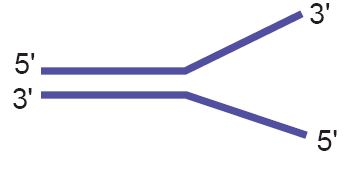
a) Identify the figure given below
b) Redraw the structure as a replicating fork and label the parts
c) Write the source of energy for this replication and name the enzyme involved in this process.
d) Mention the differences in the synthesis of protein, based on the polarity of the two template strands.
1.
(a)
Single nucleotide Polymorphism
2.
(c)
\(\beta \)-galactosidase
3.
(c)
Sixth
4.
(c)
ii and iv
5.
(c)
A - transcription, B - translation, C - Francis Crick
6.
(c)
The DNA is condensed into chromatin fiber
7.
(c)
Y
8.
(a)
Orgel, Brick and Carl woese
9.
(b)
Conrat and Singer
10.
(c)
Altman
11.
(b)
Hofmeister
12.
(c)
13.
(d)
There are numerous different bacterial chromosomes, with replication occuring in each at the same time.
14.
(b)
15.
(c)
Nucleotide containing sugars, nitrogen bases and phosphates
16.
Semi-conservative replication was proposed by Watson and Crick in 1953. This mechanism of replication is based on the DNA model. They suggested that the two polynucleotide strands of DNA molecule unwind and start separating at one end. During this process, covalent hydrogen bonds are broken. The separated single strand then acts as template for the synthesis of a new strand. Subsequently, each daughter double helix carries one polynucleotide strand from the parent molecule that acts as a template and the other strand is newly synthesised and complementary to the parent strand.
17.
The 5' of DNA refers to the carbon in the sugar to which phosphate (PO4V) functional group is attached. The 3' of DNA refers to the carbon in the sugar to which a hydroxyl (OR) group is attached.
18.
The 5' end of the mRNA of prokaryotes has a special sequence which precedes the initial AUG start codon of mRNA. This ribosome binding site is called the Shine - Dalgamo equence or S-D sequence.
19.
| Monodstronic | Polycistronic |
| 1) It is found in eukaryotes. | 1) It is found in prokaryotes. |
| 2) Each mRNA carries only a single gene and encodes information for only a single protein. | 2) Clusters of related genes known as Operon found next to each other on a chromosome are transcribed together to give a single mRNA |
20.
The assembly of the ribosomal subunits, mRNA and tRNA represent the initiation complex.
21.
| DNA | RNA |
| 1) It stands for De Oxyribo Nucleic acid | 1) It stands for Ribo Nucleic acid |
| 2) It contains De Oxyribose Sugar | 2) It contains Ribose Sugar |
| 3) The nitrogenous bases are adenine, guanine, thymine and cytosine | 3) The nitrogenous bases are adenine, guanine, uracil and cytosine |
| 4) It is a double stranded molecule | 4) It is a single stranded molecule. |
| 5) DNA is the hereditary material in all living organisms. | 5) RNA is the hereditary material only in some viruses. |
22.
According to the classical concept of gene introduced by Sutton in 1902, genes have been defined as discrete particles that follow Mendelian rules of inheritance, occupy a definite locus in the chromosome and are responsible for the expression of specific phenotypic character. They show the following properties:
(I) Number of genes in each organism is more than the number of chromosomes, hence several genes are located on the same chromosome.
(II) The genes are arranged in a single linear order like beads on a string.
(Ill) Each gene occupies a specific position called locus.
(IV) Genes may exist in several alternate forms called alleles.
23.
| Structural gene | Regulatory gene | operator gene |
| They are concerned with the transcription of mRNA for the synthesis of particular polypeptide |
It controls the functioning of operator gene |
It determines the functioning of operator gene |
| They function only when RNA polymerases join |
It produces a repressor or apo- repressor for blocking operator gene |
It works only when it is not blocked by repressor |
| They function by forming mRNA for specific polypeptide |
It functions through the formation of mRNA of repressor or apo-repressor |
It functions through the presence (or) absence of repressor |
24.
| Exons | Introns |
| Expressed sequences (Coding sequences) of an eukaryotic gene. | Intervering sequences (non-coding sequences) of an eukaryotic gene. |
25.
(a) Helicase
(b) DNA ligase
(c) DNA polymerase
(d) Nuclease
26.
DNA polymerase I }
DNA polymerase II } Involved in DNA repair mechanism
DNA polymerase III} Involved in DNA replication
27.
Semi-conservative replication model. It was proved by Meselson and Stahl in 1958.
28.
NHC: Non-histone Chromosomal protein.
In eukaryotes, apart from histone proteins, additional set of proteins are required for packing of chromatin at higher level and are referred as non - histone chromosomal proteins
29.
a) Purine and pyrimidine bases are linked by hydrogen bonds.
b) Pentose sugar is linked to adjacent nucleotide by phosphodiester bonds.
30.
The DNA as a nucleoid is organized into large loops held by protein. DNA of prokaryotes is almost circular and lacks chromatin organization, hence termed genophore.
31.
The term 'RNA world' first used by Walter Gilbert 1986, hypothesizes RNA as the first genetic material on earth. There is now enough evidence to suggest that essential life processes (such as metabolism, translation, splicing etc.,) evolved around RNA. RNA has the ability to act as both genetic material and catalyst.
32.
The phosphate functional group (PO4) present in DNA and RNA gives the property of an acid (releasing H+ ion or proton in solution) at physiological pH. Hence the name nucleic acid.
33.
| Purines | Pyrimidines |
| Purines have double carbon-nitrogen ring structures. Eg.Adenine and Guanine. |
pyrimidines have single ring structure Eg: Thymine, Cytosine and Uracil |
34.
(i) AAU - UUA
(ii) CGA - GCU
(iii) UAU - AUA
(iv) GCA - CGU
35.
tRNA on one hand binds to specific amino acids and on the other hand reads the codon of the amino acid bound to it through its anticodon, it is called as adapter molecule.
36.
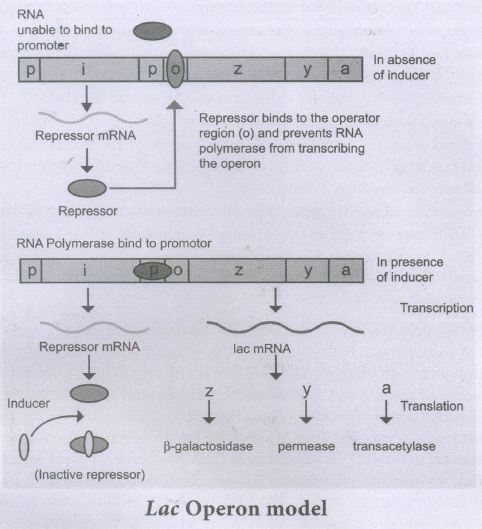
The Lac (Lactose) operon: The metabolism of lactose in E-coli requires three enzymes - permease, β-galactosidase (β-gal) and transacetylase. The enzyme permease is needed for entry of lactose into the cell, β-galactosidase brings about hydrolysis of lactose to glucose and galactose, while transacetylase transfers acetyl group from acetyl Co A to β-galactosidase. The lac operon consists of one regulator gene ('i' gene refers to inhibitor) promoter sites (P), and operator site (o). Besides these, it has three structural genes namely lac z, y and lac a. The lac 'z' gene codes for β-galactosidase, lac 'y' gene codes for permease and 'a' gene codes for transacetylase.
Jacob and Monod proposed the classical model of Lac operon to explain gene expression and regulation in E-coli. In lac operon, a polycistronic structural gene is regulated by a common promoter and regulatory gene. When the cell is using its normal energy source as glucose; the 'i' gene transcribes a repressor mRNA and after its translation, a repressor protein is produced. It binds to the operator region of the operon and prevents translation, as a result, β-galactosidase is not produced. In the absence of preferred carbon source such as glucose, if lactose is available as an energy source for the bacteria then lactose enters the cell as a result of permease enzyme. Lactose acts as an inducer and interacts with the repressor to inactivate it. The repressor protein binds to the operator of the operon and prevents RNA polymerase from transcribing the operon. In the presence of inducer, such as lactose or allolactose, the repressor is inactivated by interaction with the inducer. This allows RNA polymerase to bind to the promotor site and transcribe the operon to produce lac mRNA which enables formation of all the required enzymes needed for lactose metabolism. This regulation of lac operon by the repressor is an example of negative control of transcription initiation.
37.
The mode of DNA replication was determined in 1958 by Meselson and Stahl. They designed an experiment to distinguish between semi-conservative, conservative and dispersive replications. In their experiment, they grew two cultures of E.coli for many generations in separate media. The 'heavy' culture was grown in a medium in which the nitrogen source (NH4CI) contained the heavy isotope 15N and the 'light' culture was grown in a medium in which the nitrogen source contained light isotope 14N for many generations. At the end of growth, they observed that the bacterial DNA in the heavy culture contained only 14N and in the light culture only 14N. The heavy DNA could be distinguished from light DNA (15N from 14N)with a technique called Cesium Chloride (CsCI) density gradient centrifugation. In this process, heavy and light DNA extracted from cells in the two cultures settled into two distinct and separate bands (hybrid DNA).
The heavy culture (15N) was then transferred into a medium that had only NH4CI and took samples at various definite time intervals (20 minutes duration). After the first replication, they extracted DNA and subjected it to density gradient centrifugation. The DNA settled into a band that was intermediate in position between the previously determined heavy and light bands. After the second replication (40 minutes duration), they again extracted DNA samples, and this time found the DNA settling into two bands, one at the light band position and one at intermediate position. These results confirm Watson and Crick's semi-conservative replication hypothesis.
38.
Steps in DNA printing:
i) Extraction of DNA: The process of DNA fingerprinting starts with obtaining a sample of DNA from blood, semen, vaginal fluids, hair roots, teeth, bones, etc.,
ii) Polymerase chain reaction (PCR) In many situations, there is only a small amount of DNA available for fingerprinting. If needed many copies / f the DNA can be produced by PCR (DNA amplification).
iii) Fragmenting DNA: DNA is treated with restriction enzymes which cut the DNA into smaller fragments at specific sites.
iv) Separation of DNA electrophoresis: During electrophoresis in an agarose gel, the DNA fragments are separated into bands of different sizes. The bands of separated DNA are sieved out of the gel using a nylon membrane (treated with chemicals that allow for it to break the hydrogen bonds of DNA so there are single strands).
v) Denaturing DNA: The DNA on gels is denatured by using alkaline chemicals or by heating.
vi) Blotting: The DNA band pattern in the gel is transferred to a thin nylon membrane placed over the 'size fractionated DNA strand' by Southern blotting.
vii) Using probes to identify specific DNA: A radioactive probe (DNA labeled with a radioactive substance) is added to the DNA bands. The probe attaches by base pairing to those restriction fragments that are complementary to its sequence. The probes can also be prepared by using either. 'fluorescent substance' or 'radioactive isotopes'.
viii) Hybridization with probe: After the probe hybridizes and the excess probe washed off, a photographic film is placed on the membrane containing 'DNA hybrids'.
ix) Exposure film to make a genetic/ DNA Fingerprint: The radioactive label exposes the film to form an image (image of bands) corresponding to specific DNA bands. The thick and thin dark bands form a pattern of bars which constitutes a genetic fingerprint.
39.
i) JAcob and Monod proposed the classical model of Lac operon to explain gene expression and regulation in E.coli. In lac operon, a polycistronic structural gene is regulated by a common promoter and regulatory gene.
ii) When the cell is using its normal energy source as glucose, the gene transcribes a repressor mRNA and after its translation, are pressor protein is produced. It binds to the operator region of the operon and prevents translation, as a result, β-galactosidase is not produced.
iii) In the absence of preferred carbon source such as glucose, if lactose is available as an energy source for the bacteria then lactose enters the cell as a result of permease enzyme. Lactose acts as an inducer and interacts with the repressor to inactivate it.
iv) The repressor protein binds to the operator of the operon and prevents RNA polymerase from transcribing the operon.
v) In the presence of inducer, such as lactose, or allolactose, the repressor is inactivated by interaction with the inducer. This allows RNA polymerase to bind to the promoter site and transcribe the operon to produce lac mRNA which enables formation of all the required enzymes needed for lactose metabolism.
vi) This regulation of lac operon by the repressor is an example of negative control of transcription initiation.
40.
i) Comparative studies of mutations (sudden change in a gene) and corresponding alteration in amino acid sequence of specific protein have confirmed the validity of the genetic code.
ii) The simplest type of mutation at the molecular level is a change in nucleotide that substitutes one base for another and are known as base substitutions which may occur spontaneously or due to the action of mutagens.
iii) An example is sickle cell anaemia in humans which results from a point mutation of an allele of B-haemoglobin gene (βHb)
iv) A haemoglobin molecule consists of four polypeptide chans of two types, two a chains and two B chains. Each chain has a heme group on its surface. The heme groups are involved in the binding of oxygen.
v) The human blood disease, sickle cell anaemia is due to abnormal haemoglobin due to a single base substitution at the sixth codon of the beta globin gene from GAG to GTG in' β-chain of haemoglobin. It results in a change of amino acid glutamic acid to valine at the 6th position of β-chain.
vi) This is point mutation that results in the change of amino acids residue glutamic acid to valine. The mutant haemoglobin undergoes polymerisation under oxygen tension causing the change in the shape of the RBC from biconcave to a sickle shaped structure.
41.
(i) DNA acts as a genetic material. However, in some viruses like Tobacco mosaic virus (TMV), bacteriophage θB, RNA acts as the genetic material. A molecule that can act as a genetic material should have the following properties:
(ii) Self Replication: It should be able to replicate. According to the rule of base pairing and complementarity, both nucleic acids (DNA and RNA) have the ability to direct duplications. Proteins fail to fulfill this criteria.
(iii) It should be stable structurally and chemically. The genetic material should be stable enough not to change with different stages of life cycle, age or with change in physiology of the organism.
(iv) Griffith's transforming principle, Heat which killed the bacteria did not destroy some of the properties of genetic material. In DNA the two strands being complementary, if separated (denatured) by heating can come together (renaturation) when appropriate condition is provided.
(v) Further 2' OH group present at every nucleotide in RNA is a reactive group that makes RNA liable and easily degradable. RNA is also known to be catalytic and reactive.
(vi) Hence DNA is chemically more stable and chemically less reactive when compared to RNA.
(vii) Presence of thymine instead of uracil in DNA confers additional stability to DNA.
(viii) It should be able to express itself in the form of Mendelian characters ', RNA can directly code for protein synthesis DNA, however depends on RNA for synthesis of proteins.
(ix) Both DNA and RNA can act as a genetic material, but DNA- being more stable stores the genetic information and RNA transfers the genetic information
(x) Variation through mutation: It should be able to mutate. Both DNA and RNA are able to mutate. RNA being unstable, mutates at a faster rate.
42.
(a) Replicating fork of DNA
(b)
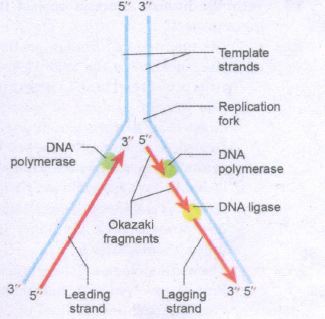
(c) Source of Energy:
NTP's are used in the synthesis of RNA primers and ATP is used as an energy source for some of the enzymes, needed to initiate and sustain DNA synthesis occurs at the replication fork.
Enzymes involved in replication :
(i) DNA Helicase
(ii) DNA polymerase
(iii) Topoisomerase/DNA Gyrase
(iv) DNA ligase
(v) Primase
(d) Both the strands of (parental) DNA act as template for the synthesis of new strands
1. On the templates strand with \(3^{\prime} \rightarrow 5^{\prime}\) polarity the new strand (leading strand) is synthesized as a continuous stretch. It is called continuous synthesis (DNA polymerase carryout polymerisation).
2. On the other strand \(5^{\prime} \rightarrow 3^{\prime}\) polarity DNA synthesized as short stretches; it is called discontinuous synthesis.
3. Later the short stretches of DNA are joined by DNA-ligases into a continuous strand called lagging strand.

12th Standard Syllabus & Materials
12th Standard
TN 12th Computer Applications களப்பெயர் முறைமை (DNS) Sample Question Papers Study Material - QB365 Set A
NEW12th Standard
TN 12th Computer Applications வலையமைப்பு எடுத்துக்காட்டுகள் மற்றும் நெறிமுறைகள் Sample Question Papers Study Material - QB365 Set A
NEW12th Standard
TN 12th Computer Applications கணினி வலையமைப்பு ஓர் அறிமுகம் Sample Question Papers Study Material - QB365 Set A
NEW12th Standard
TN 12th Computer Applications PHP-உடன் MySQL-ஐ இணைத்தல் Sample Question Papers Study Material - QB365 Set A



Tamilnadu Stateboard 12th Standard Subjects

Maths

Chemistry

Physics
Biology

Computer Science

Business Maths and Statistics

Economics

Commerce

Accountancy

History

Computer Applications
Biology
Computer Technology
Computer Applications
Computer Science
Business Maths and Statistics
Commerce
Economics
Maths
Chemistry
Physics
Computer Technology
History
Accountancy

Tamil

English

French
Tamilnadu Stateboard Standards

