
 100% FREE ACCESS
12th Standard Syllabus & Materials
12th Standard
TN 12th Computer Applications மின்னணு தரவு பரிமாற்றம் Sample Question Papers Study Material - QB365 Set A
NEW12th Standard
TN 12th Computer Applications மின் - வணிக பாதுகாப்பு அமைப்புகள் Sample Question Papers Study Material - QB365 Set A
NEW12th Standard
TN 12th Computer Applications மின்னணு செலுத்தல் முறைகள் Sample Question Papers Study Material - QB365 Set A
NEW12th Standard
TN 12th Computer Applications மின் - வணிகம் Sample Question Papers Study Material - QB365 Set A
NEW12th Standard
TN 12th Computer Applications திறந்த மூல கருத்துருக்கள் Sample Question Papers Study Material - QB365 Set A
NEW12th Standard
TN 12th Computer Applications வலையமைப்பு வடமிடல் Sample Question Papers Study Material - QB365 Set A

Published on: 30/01/2021
12th Standard Bio-Zoology English Medium Organisms and Populations Reduced Syllabus Important Questions 2021
Download Tamil Nadu 12th Standard Biology question papers, model tests, one-mark questions, important questions, and public exam papers in PDF format. Free study materials and answer keys for TN State Board students.
Questions + Answers key
Take MCQ Biology Test1.
As altitude increases _____________
O2 density increases
Precipitation decreases
Temperature increases
Snowing decreases
2.
Maximum reproductive capacity of an organism under favorable condition is referred to as_______________
Carrying capacity
Biotic potential
Natality
Fecundity
3.
Assertion (A): Diapause is carried out to overcome abiotic stress.
Reason (R): Animals become inactive during winter.
Both A and R are correct R explain A
A is correct R is incorrect
R does not explain A
Both A and R are incorrect
4.
Assertion (A): Snake is a stenotherm.
Reason (R): Organism can tolerate narrow temperature fluctuations
Both A and R are correct R explain A
A is correct R is incorrect
R does not explain A
Both A and R are incorrect
5.
Functional status of an organism in its community is _______________
Biome
Niche
Species
Population
6.
Identify the proper sequence in increasing order of population
Species ⟶ Population ⟶ Community ⟶ biome
Population ⟶ Community ⟶ Species ⟶ biome
Biome ⟶ Species ⟶ Community ⟶ Population
Community ⟶ Population ⟶ Biome ⟶ Species
7.
A biologist studies the population of eats in a barn. He found that the average natality was 250, average mortality is 240, immigration is 20 and emigration to be 30. The in population is
10
15
05
Zero
8.
People who have migrated from the planes to an area adjoining Rohtang Pass about six months back
Have more RBC's and their haemoglobin has a lower binding affinity to O2
Are not physically fit to play games like football
Suffer from altitude sickness with symptoms like nausea, fatigue, etc.
Have the usual RBC count but then haemoglobin has very high binding affinity to O2.
9.
Nuts are eaten by birds and squirrels. This is an example of an interaction called _____________
Commensalism
Mutualism
Amensalism
Competition
10.
Birds sitting on cows to eat insects is an example of ____________
Competition
Mutualism
Commensalism
Amensalism
11.
"Birds and mammals attain greater body size in colder regions than warmer regions." - Choose the correct option.
Bergmann's rule
Jordon's rule
Sewall wright effect
Allen's rule
12.
Animals that can move from fresh water to sea called as______
Stenothermal
Eurythermal
Catadromous
Anadromous
13.
Which of the following is correct for r-selected species
Large number of progeny with small size
large number of progeny with large size
small number of progeny with small size
small number of progeny with large size
14.
Match the following and choose the correct combination from the options given below.
| Column I | Column II |
| A. Mutalism | 1. Lion and deer |
| B. Commensalism | 2. Round worm and man |
| C. Parasitism | 3. Birds compete with squirrels for nuts |
| D. Competition | 4. Sea anemone on hermit crab |
| E. Predation | 5. Barnacles attached to Whales. |
A- 4, B-5, C-2, D –3, E-1
A- 3, B-1, C-4, D – 2, E-5
A- 2, B-3, C-1, D – 5, E-4
A- 5, B-4, C-2, D – 3, E-1
15.
16.
How the cold deserts are characterized? Give an example.
17.
What is a forest? Name the major forest biomes.
18.
Which is the largest biome on Earth? Classify it
19.
Name the types of migration in fishes.
20.
Name the physiological adaptations seen in animals.
21.
What is Ethology?
22.
State Bergmann's rule.
23.
Differentiate between Eurytherms and Stenotherms.
24.
What is Zero Stress?
25.
26.
Name the kind of interaction in the following pairs.
(a) Shark and Suckerfish
(b) Cat and Rat
(c) Lion and Deer
27.
Define temperature. How it impacts the life of an organism?
28.
Define the terms (a) guilds (b) ecological equivalents
29.
Define migration.
30.
What is phototaxis?
31.
List some adaptations seen in animals to overcome extreme winters and summers
32.
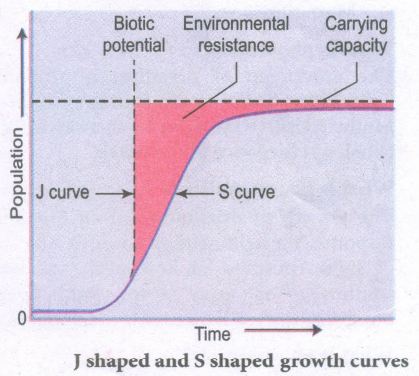
Draw a sketch to show J and S shaped growth form of a population.
33.
Draw a diagram to show age distribution in a increasing population.
34.
Give an account of population regulation
35.
36.
Rainfall shortage affects the normal lift In desert biome scanty rainfall occurs. Bm many organisms are living there. Discuss ~ characteristics of desert biomes.
37.
Explain structural and behavioural adaptations seen in organism.
38.
Write a note on grassland biome.
39.
List the adaptations of aquatic animals.
40.
Describe Growth Models/Curves.
41.
42.
Give an account of the properties of soil.
1.
(b)
Precipitation decreases
2.
(b)
Biotic potential
3.
(a)
Both A and R are correct R explain A
4.
(a)
Both A and R are correct R explain A
5.
(b)
Niche
6.
(a)
Species ⟶ Population ⟶ Community ⟶ biome
7.
(d)
Zero
8.
(a)
Have more RBC's and their haemoglobin has a lower binding affinity to O2
9.
(d)
Competition
10.
(c)
Commensalism
11.
(a)
Bergmann's rule
12.
(c)
Catadromous
13.
(a)
Large number of progeny with small size
14.
(a)
A- 4, B-5, C-2, D –3, E-1
15.
(b)
16.
Cold deserts are characterized by cold winters with snowfall and high overall rainfall throughout the winter and occasionally over the summer.
E.g. Ladakh region in India.
17.
Forest is a broad term used to describe areas where there are a large number of trees. The major forest biomes are the Tropical forests and the Temperate forests.
18.
Aquatic biome is the largest biome occupying 71% of biosphere.
The aquatic biomes on Earth are:
a) Freshwater biome (Lakes and Ponds)
b) Brackish water biome (Estuaries / Wetlands)
c) Marine biome (Coral reefs and abyssal zones)
19.
(i) Anadromous migration - migration of fishes from sea to fresh water Eg. Salmon.
(ii) Catadromous migration - migration of fishes from fresh water to sea Eg. Eel
20.
Hibernation and aestivation
21.
Ethology is the scientific study of animal behaviour, under natural conditions.
22.
Birds and mammals attain greater body size in colder regions than warmer regions (Bergmann's rule).
23.
| Stenohaline Animals | Euryhaline Animals |
|---|---|
| The animals which show tolerance only to a narrow range of salinities. | The animals which, can tolerate a wide range of salinities |
| Their distributional range is limited. |
Their distribution shows a wide range |
24.
This is the level of exposure of plants to environmental factors that leads to neither injury nor reduction in growth and yield of crops.
25.
26.
(a) Commensalism
(b) Amensalism
(c) Predation
27.
Temperature or degree of hotness and coldness is an essential and variable factor in any environment. It influences all forms of life by affecting many vital activities of organisms like metabolism, behaviour, reproduction, development and even death in the Biosphere.
28.
Groups of species with comparable role and niche dimensions within a community are termed 'guilds'. Species that occupy the same niche in different geographical regions are termed 'ecological equivalents'.
29.
Migration is a peculiar and unique kind of mass population movement from one place to another and back. To avoid the severe winter cold. Eg. Siberian cranes migrate from Siberia to Vedanthangal in Tamil Nadu and return back in spring.
30.
The movement of organism in response to light, either towards the source of light as in Moths (positive phototaxis) or away from light (Earthworm (negative phototaxis).
31.
The adaptations seen in animals to overcome extreme winters and summers are:
a) Formation of heat resistant spores
b) Formation of cysts (Entamoeba)
c) Presence of antifreeze proteins (Arctic fishes)
d) Hibernation (Winter sleep)
e) Aestivation (Summer sleep)
f) Migration
32.
33.
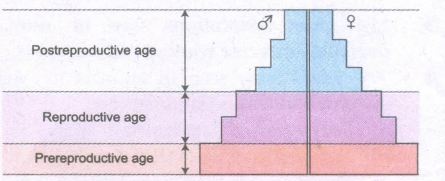
34.
(i) The inherent tendency of all animal populations is to increase in number. But it does not increase indefinitely.
(ii) Once the carrying capacity of the environment is reached, population numbers remain static or fluctuate depending on environmental conditions.
(iii) This is regulated by many factors which are:
1. Density independent - Extrinsic factors
2. Density dependent - Intrinsic factors
(iv) Extrinsic factors include the availability of space, shelter, weather, food, etc.
(v) Intrinsic factors include competition, predation, emigration, immigration, and diseases.
35.
36.
(i)Deserts cover about one fifth of the Earth's surface and occur where rainfall >500mm/year.
(ii) Rainfall is usually very low and concentrated in short bursts between long rainless periods. Evaporation rate regularly exceed rainfall rates.
(iii) Soils are course-textured, shallow, rock or gravely with good drainage and have no subsurface water. The finer dust and san~ particles are blown elsewhere, leaving heavier pieces behind. Sand dunes are common.
(iv) Mean annual temperatures range from 20-25° C. The extreme maximum range from 43.5 - 49° C. Minimum temperature sometimes drop to -18° C. Based on IlK temperature range, deserts can be H deserts and Cold deserts.
(v) Hot deserts such as the Sahara of North Africa and the deserts of the South western U.S., Mexico, Australia and Indi (Thar desert) occur at low latitudes.
(vi) Hot deserts have a considerable amount of specialized vegetation: (xerophytes aloe, agave, Opuntia species, Euphorbs royleana as well as specialized vertebra and invertebrate animals.
(vii) Soils have abundant nutrients because the need only water to become very productive and have little or no organic matter.
(viii) Only animals which can tap available water or capable of storing sufficient water and withstand the heat can survive in the desert. The animals include small nocturnal (active at night) carnivores. The dominant animals are burrowers and have cursorial, fossorial and saltatorial adaptations.
(ix) The animals stay inactive in protected hideaways during the hot day and come out to forage at dusk, dawn or at night, when the desert is cooler.
(x) The dominant animals of warm deserts are reptiles and small mammals. The Indian Spiny-tailed lizard, the black buck, the white-footed fox are the common fauna of the Thar deserts. There are also insects, arachnids and birds.
37.
The two most characteristic forms of behavioral adaptations are migration and courtship. Migration allows the animals to find better resources or evade threat. Courtship is a set of behavioral patterns to find a mate to reproduce. Most nocturnal animals remain underground or inactive during the daytime. This is a modification of their feeding and activity pattern or habit or behavior.
38.
(i) Grasslands occur in temperate and in the tropical regions.
(ii) They have hot summers, cold winters, and irregular rainfall.
(iii) Often they are characterized by high winds.
(iv) The low irregular rainfall is the factor which makes the difference between a temperate deciduous forest and a temperate grassland.
(v) Herbivores like antelope, bison, wild horse, jack rabbit, ground squirrel and prairie dogs are abundant.
(vi) Predators include coyotes, foxes, hawks and snakes.
(vi) In India, fauna of grasslands includes Elephant, Gaur, Rhino, Antelope.
(vii) Flora of grasslands include purple needle grass, wild oats, foxtail, ryegrass and buffalo grass.
39.
(i) The pectoral fins and dorsal fins act as stabilizers or balancers and the caudal fin helps in changing the direction as a rudder.
(ii) Arrangement of body muscles in the form of bundles (myotomes) help in locomotion.
(iii) Stream lined structure helps in the swift movement of the animals in water.
(iv) Respiration by gills making use of gases dissolved in water.
(v) Presence of air-bladders filled with air for buoyancy.
(vi) Presence of lateral-line, system. They function as rheoreceptors which is helpful in echolocating objects in water.
(vii) Integuments rich in mucous glands are protected by scales.
(viii) Maintain water and ionic balance in its body with excretory structures.
40.
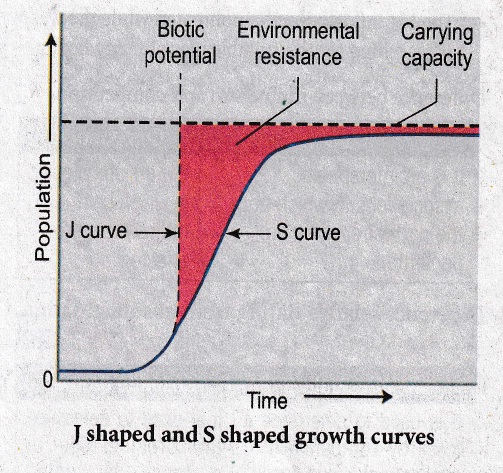
Biotic potential:
It is the maximum reproductive capacity of an organism under optimum environmental conditions.
Carrying capacity:
The maximum number of organisms live in a region can support without environmental degradation is called carrying capacity.
Environmental resistance:
Is the sum total of the environmental limiting factors, both biotic and abiotic which together act to prevent the biotic potential of an organism from being realized.
41.
42.
Properties of soil
(i) Texture of soil - The texture of soil is determined by the size of the soil particles. The types of soil include sand, silt and clay on the basis of their size differences.
(ii) Porosity - The space present between soil particles in a given volume of soil are called pore spaces. The percentage of soil volume occupied by pore space or by the interstitial spaces is called porosity of the soil.
(iii) Permeability of soil - The characteristic of soil that determines the movement of water through pore spaces is known as soil permeability. Soil permeability is directly dependent on the pore size. Water holding capacity of the soil is inversely dependent on soil porosity.
(iv) Soil Temperature - Soil gets its heat energy from solar radiation, decomposing organic matter, and heat from the interior of the earth. Soil temperature affects the germination of seeds, growth of roots and biological activity of soil-inhabiting micro-and macro-organisms.
(v) Soil water - In soil, water is not only important as a solvent and transporting agent, but also maintains soil texture, arrangement, and compactness of soil particles, making soil habitable for plants and animals.

12th Standard Syllabus & Materials
12th Standard
TN 12th Computer Applications களப்பெயர் முறைமை (DNS) Sample Question Papers Study Material - QB365 Set A
NEW12th Standard
TN 12th Computer Applications வலையமைப்பு எடுத்துக்காட்டுகள் மற்றும் நெறிமுறைகள் Sample Question Papers Study Material - QB365 Set A
NEW12th Standard
TN 12th Computer Applications கணினி வலையமைப்பு ஓர் அறிமுகம் Sample Question Papers Study Material - QB365 Set A
NEW12th Standard
TN 12th Computer Applications PHP-உடன் MySQL-ஐ இணைத்தல் Sample Question Papers Study Material - QB365 Set A



Tamilnadu Stateboard 12th Standard Subjects

Maths

Chemistry

Physics
Biology

Computer Science

Business Maths and Statistics

Economics

Commerce

Accountancy

History

Computer Applications
Biology
Computer Technology
Computer Applications
Computer Science
Business Maths and Statistics
Commerce
Economics
Maths
Chemistry
Physics
Computer Technology
History
Accountancy

Tamil

English

French
Tamilnadu Stateboard Standards

