
 100% FREE ACCESS
12th Standard Syllabus & Materials
12th Standard
TN 12th Maths Applications of Matrices and Determinants Sample Question Papers Study Material - QB365 Set A
NEW12th Standard
TN 12th Computer Applications மின்னணு தரவு பரிமாற்றம் Sample Question Papers Study Material - QB365 Set A
NEW12th Standard
TN 12th Computer Applications மின் - வணிக பாதுகாப்பு அமைப்புகள் Sample Question Papers Study Material - QB365 Set A
NEW12th Standard
TN 12th Computer Applications மின்னணு செலுத்தல் முறைகள் Sample Question Papers Study Material - QB365 Set A
NEW12th Standard
TN 12th Computer Applications மின் - வணிகம் Sample Question Papers Study Material - QB365 Set A
NEW12th Standard
TN 12th Computer Applications திறந்த மூல கருத்துருக்கள் Sample Question Papers Study Material - QB365 Set A

Published on: 30/01/2021
12th Standard Bio-Zoology English Medium Organisms and Populations Reduced Syllabus Important Questions With Answer Key 2021
Download Tamil Nadu 12th Standard Biology question papers, model tests, one-mark questions, important questions, and public exam papers in PDF format. Free study materials and answer keys for TN State Board students.
Questions + Answers key
Take MCQ Biology Test1.
Given below are some examples for population interactions. Which among the following shows mutualism?
Lion and deer
Man and tape worm
Hermit crab and sea-anemone
Sucker fish and shark
2.
Assertion (A): Movement of organism from one place to another and back is called migration.
Reason (R): Eel is an example for anadromous migration.
Both A and R are correct R explain A
A is correct R is incorrect
R does not explain A
Both A and R are incorrect
3.
Assertion (A): Diapause is carried out to overcome abiotic stress.
Reason (R): Animals become inactive during winter.
Both A and R are correct R explain A
A is correct R is incorrect
R does not explain A
Both A and R are incorrect
4.
Assertion (A): Snake is a stenotherm.
Reason (R): Organism can tolerate narrow temperature fluctuations
Both A and R are correct R explain A
A is correct R is incorrect
R does not explain A
Both A and R are incorrect
5.
Locomotory speed of an organism changes due to light. This phenomenon is referred as _____________
Photonasty
Photokinesis
Phototropism
Phototaxis
6.
Pick out the eurythermal organism
Fish
Frog
Tiger
Lizards
7.
Functional status of an organism in its community is _______________
Biome
Niche
Species
Population
8.
When does the growth rate of a population following the logistic model equal zero? The logistic model is given as dN/dt=rN(1-N/K):
When N/K is exactly one
When N nears the carrying capacity of the habitat
When N/K equals zero
When dearth rate is greater than birth rate
9.
Consider the following four conditions (A-D) and select the correct pair of them as adaptation to environment in desert lizards.
The conditions:
A) Burrowing in soil to escape high temperature.
B) Losing heat rapidly from the body during high temperature
C) Bask in sun when temperature is low
D) Insulating body due to thick fatty dermis.
(A) and (C)
(B) and (D)
(A) and (B)
(C) and (D)
10.
Study the four statements (A to D) given below and select the two correct ones out of them.
A) A lion eating a deer and a sparrow feeding on grain are ecologically similar in being consumers.
B) Predator starfish Pisaster helps in maintaining species diversity of some invertebrates.
C) Predators ultimately lead to the extinction of prey species.
D) Production of chemicals such as nicotine, strychnine by the plants is disordered.
The two correct statements are
(B) and (C)
(C) and (D)
(A) and (D)
(A) and (B)
11.
Nuts are eaten by birds and squirrels. This is an example of an interaction called _____________
Commensalism
Mutualism
Amensalism
Competition
12.
Which of the following is correct for r-selected species
Large number of progeny with small size
large number of progeny with large size
small number of progeny with small size
small number of progeny with large size
13.
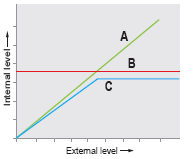
14.
Match the following and choose the correct combination from the options given below.
| Column I | Column II |
| A. Mutalism | 1. Lion and deer |
| B. Commensalism | 2. Round worm and man |
| C. Parasitism | 3. Birds compete with squirrels for nuts |
| D. Competition | 4. Sea anemone on hermit crab |
| E. Predation | 5. Barnacles attached to Whales. |
A- 4, B-5, C-2, D –3, E-1
A- 3, B-1, C-4, D – 2, E-5
A- 2, B-3, C-1, D – 5, E-4
A- 5, B-4, C-2, D – 3, E-1
15.
The interaction in nature, where one gets benefit on the expense of other is...
Predation
Mutualism
Amensalism
Commensalism
16.
What are the attributes of population?
17.
How do animals like fishes and bears avoid unfavourable climatic conditions?
18.
Define alpine zone
19.
Point out the major functions of soil.
20.
What does Jordon's rule state?
21.
StateIordon's rule.
22.
What are ecological equivalents?
23.
Differentiate between Eurytherms and Stenotherms.
24.
25.
Census refers to the official count or survey of population. Every 10 years our government undertake census. In India the next census will be carried out in 2021. Mention any four characters that are employed in human population census
26.
What are the four ways through which the living organisms respond to abiotic factor?
27.
Name the kind of interaction in the following pairs.
(a) Shark and Suckerfish
(b) Cat and Rat
(c) Lion and Deer
28.
Define migration.
29.
Define population.
30.
Eurythermy is advantageous to the animal. Justify.
31.
Draw a sketch to show J and S shaped growth form of a population.
32.
Describe Population Age Distribution
33.
Differentiate J and S shaped curve
34.
Explain hibernation and aestivation with examples.
35.
36.
Write in detail about Temperate forest and its types.
37.
Write a note on grassland biome.
38.
List out the properties of soil
39.
List the adaptations of aquatic animals.
40.
41.
Classify the adaptive traits found in organisms
42.
What are the ways by which organisms respond to abiotic factors?
1.
(c)
Hermit crab and sea-anemone
2.
(a)
Both A and R are correct R explain A
3.
(a)
Both A and R are correct R explain A
4.
(a)
Both A and R are correct R explain A
5.
(b)
Photokinesis
6.
(c)
Tiger
7.
(b)
Niche
8.
(a)
When N/K is exactly one
9.
(a)
(A) and (C)
10.
(d)
(A) and (B)
11.
(d)
Competition
12.
(a)
Large number of progeny with small size
13.
(a)
14.
(a)
A- 4, B-5, C-2, D –3, E-1
15.
(d)
Commensalism
16.
Population density, Natality, Mortality, Age distribution, dispersion (immigration and emigration).
17.
Fishes undergo aestivation to avoid summer related problems.
Bears undergo hibernation to avoid winter-related problems.
18.
The alpine zone between Timberline and snow zone includes in the descending order, a subs now the zone immediately below the snow zone, a meadow zone in the centre and a shrub zone which gradually merges into the timber zone.
19.
Soil has four major functions-
(i) medium for plant growth
(ii) means for water storage and purification
(iii) modifier of Earth's atmosphere
(iv) habitat for many organisms, which in turn modify the soil
20.
In some aquatic environments, an inverse relationship between water temperature and fish meristic characters is observed - lower the temperature, more the vertebrae
21.
In some aquatic environments, an inverse relationship between water temperature and fish meristic characters is observed - lower the temperature, more the vertebrae.
22.
Species that occupy the same niche in different geographical regions, are termed 'ecological equivalents'
23.
| Stenohaline Animals | Euryhaline Animals |
|---|---|
| The animals which show tolerance only to a narrow range of salinities. | The animals which, can tolerate a wide range of salinities |
| Their distributional range is limited. |
Their distribution shows a wide range |
24.
25.
Birth rate, Death rate, Growth rate and Sex ratio
26.
Regulate, Conform, Migrate and Suspend
27.
(a) Commensalism
(b) Amensalism
(c) Predation
28.
Migration is a peculiar and unique kind of mass population movement from one place to another and back. To avoid the severe winter cold. Eg. Siberian cranes migrate from Siberia to Vedanthangal in Tamil Nadu and return back in spring.
29.
Population is defined as any group of organisms of the same species which can interbreed among themselves, and occupy a particular space and function as part of biotic community.
30.
(i) Eurythermy can be an evolutionary advantage: adaptations to cold temperatures (cold-eurythemy) are seen as essential for the survival of species during ice ages.
(ii) The ability to survive in a wide range of temperatures increases a species ability to inhabit other areas, an advantage for natural selection.
(iii) Eurythermy is an aspect of thermoregulation in organisms.
31.
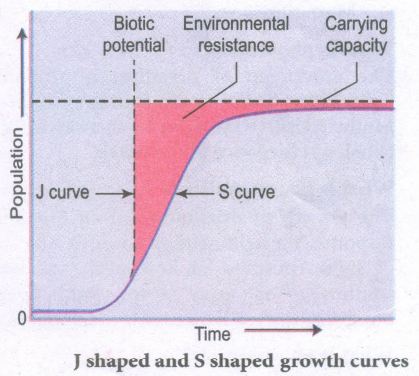
32.
(i) The proportion of the age groups in a population is its age distribution attribute.
(ii) This determines the reproductive status of the population at the given time and is an indicator of the future population size.
(iii) Usually a rapidly growing population will have larger proportion of young individuals.
(iv) A stable population will have an even distribution of various age classes.
(v) A declining population tends to have a larger proportion of older individuals
33.
| S. No. | J shaped curve | S shaped curve |
|---|---|---|
| 1. | When a population increases rapidly in an exponential fashion and then stops abruptly due to environmental resistance or due to sudden appearance of a limiting factor, they are said to exhibit J-shaped growth form, |
Some populations, as in a population of small mammals, increase lowly at first then more rapidly & gradually slow down as environmental resistance increases where by equilibrium is reached and maintained |
| 2. | Many insects show explosive increase in number during the rainy season followed by their disappearance at the end of season. | Their growth is represented by s shaped growth curve. |
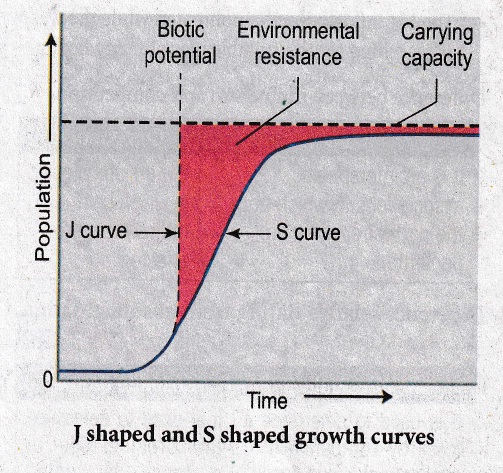
34.
Hibernation:
Spending the winter in an inactive dormant state to escape in time, is called hibernation. E.g: Bears and Frogs.
Aestivation:
Spending the dry, hot period in an inactive state to escape in time is called aestivation .E.g: Snails and Fish.
35.
36.
(i) These forests occur in eastern North America, northeastern Asia, and western and central Europe.
(ii) Have well-defined seasons with a distinct winter. Moderate climate and a growing season of 140-200 days during 4-6 frost-free months distinguish temperate forests.
(iii) Annual temperature varies from -300 C to 300 C.
(iv) Precipitation (750-1500 mm) is distributed evenly throughout the year.
(v) Soil is fertile, enriched with decaying litter.
(vi) Canopy is moderately dense and allows light to penetrate, resulting in well-developed and richly diversified under storey vegetation and stratification of animals.
(vii) Flora is characterized by 3-4 tree species per km2. Trees have broad leaves that are lost annually such as oak, hickory, beech, hemlock, maple, basswood, cottonwood, elm, willow, and spring-flowering herbs.
(viii) Fauna consists of squirrels, rabbits, skunks, birds, deer, mountain lion, bobcat, timber wolf, fox, and black bear. Based on seasonal distribution of rainfall, the types of temperate forests are:
(ix) Moist conifer and evergreen broad-leaved forests: wet winters and dry summers.
(x) Dry conifer forests: dominate higher elevation zones; low precipitation.
(xi) Mediterranean forests: precipitation is concentrated in winter (1000 mm /year).
(xii) Temperate coniferous forests: mild winters, high annual precipitation (> 2000 mm /year).
(xiii) Temperate broad-leaved rainforests: mild, frost-free winters, high precipitation (> 1500 mm/ year), evenly distributed throughout the year.
37.
(i) Grasslands occur in temperate and in the tropical regions.
(ii) They have hot summers, cold winters, and irregular rainfall.
(iii) Often they are characterized by high winds.
(iv) The low irregular rainfall is the factor which makes the difference between a temperate deciduous forest and a temperate grassland.
(v) Herbivores like antelope, bison, wild horse, jack rabbit, ground squirrel and prairie dogs are abundant.
(vi) Predators include coyotes, foxes, hawks and snakes.
(vi) In India, fauna of grasslands includes Elephant, Gaur, Rhino, Antelope.
(vii) Flora of grasslands include purple needle grass, wild oats, foxtail, ryegrass and buffalo grass.
38.
(i) Texture of soil - The texture of soil is determined by the size of the soil particles. The types of soil include sand, silt and clay on the basis of their size differences.
(ii) Porosity - The space present between soil particles in a given volume of soil are called pore spaces., The percentage of soil volume occupied by pore space or by the interstitial spaces is called porosity of the soil.
(iii) Permeability of soil - The characteristic of soil that determines the movement of water through pore spaces is known as soil permeability. Soil permeability is directly dependent on the pore size. Water holding capacity of the soil is inversely dependent on soil porosity.
(iv) Soil Temperature - Soil gets its heat energy from solar radiation, decomposing organic matter, and heat from the interior of earth. Soil temperature effects the germination of seeds, growth of roots and biological activity of soil-inhabiting micro and macro-organisms.
(v) Soil water - In soil, water is not only important as a solvent and transporting agent, but also maintains soil texture, arrangement and compactness of soil particles, making soil habitable for plants and animals impactness of soil particles, making soil habitable for plants and animals.
39.
(i) The pectoral fins and dorsal fins act as stabilizers or balancers and the caudal fin helps in changing the direction as a rudder.
(ii) Arrangement of body muscles in the form of bundles (myotomes) help in locomotion.
(iii) Stream lined structure helps in the swift movement of the animals in water.
(iv) Respiration by gills making use of gases dissolved in water.
(v) Presence of air-bladders filled with air for buoyancy.
(vi) Presence of lateral-line, system. They function as rheoreceptors which is helpful in echolocating objects in water.
(vii) Integuments rich in mucous glands are protected by scales.
(viii) Maintain water and ionic balance in its body with excretory structures.
40.
41.
Adaptation is a dynamic evolutionary process that fits organisms to their environment and enhancing their evolutionary fitness.
(a) Structural adaptations:
1. The external and internal structures of animals can help them to adapt better to their environment. Some of the most common examples are mammals growing thicker fur to survive freezing climates.
2. Some of the most attractive adaptations in nature occur for reasons of crypsis. (e.g: Camouflage) and mimicry.
3. Cryptic animals are those which camouflage perfectly with their environment and are almost impossible to detect. Certain reptiles and insects such as chameleons and stick insects show this type of adaptation, which helps in prey capture or to evade from predators. Likewise, horse legs are suitable for fast running and adapted for grasslands or plains and similar terrestrial environments.
(b) Behavioural adaptations:
1. Action and behaviour of animals are instinctive or learned. Animals develop certain behavioural traits or adaptations for survival.
2. Fleeing from a predator, hiding during sleep, seeking refuge from climate change or moving to find different food sources are all behavioural adaptations.
3. The two most characteristic forms of behavioural adaptations are migration and courtship.
4. Migration allows the animals to find better resources or evade threat.
5. Courtship is a set of behavioural patterns to find a made to reproduce.
6. Most nocturnal animals remain underground (or) inactive during daytime.
7. This is a modification of their feeding and activity pattern (or) habit (or) behaviour.
(c) Physiological adaptations:
1. The adaptations of organisms that help them to live and survive in their environment with unique niches.
2. Example: Lions have sharp canines to hunt and tear meat of preys and digestive system suitable for digesting raw meat.
3. The two most well-known physiological adaptations are hibernation and aestivation.
4. These are two different types of inactivity where the metabolic rate slows down so much that the animal can survive without eating or drinking.
5. Aquatic medium and terrestrial habitats have their own respective environmental conditions. Hence organisms have to evolve appropriate adaptations to select suitable habitats and niches.
42.
Every living organism responds to its environment. There are various ways by which organisms respond to abiotic conditions. The types of response observed are:
Regulate:
1. Some organisms are able to maintain homeostasis by physiological means which ensures constant body temperature, ionic/ osmotic balance. Birds, mammals and a fewer lower vertebrate and invertebrate species are capable of such regulation.
Conform:
1. Most animals cannot maintain a constant internal environment.
2. Their body temperature changes with the ambient temperature.
3. In aquatic animals like fishes, the osmotic concentration of the body fluids changes with that of the ambient water osmotic concentration. Such animals are called conformers. In case of extreme condition, the inhabitants relocate themselves as in-migration
Migrate:
1. Organisms tend to move away temporarily from a stressful habitat to a new, hospitable area and return when the stressful period is over.
2. Birds migrate from Siberia to Vedanthangal in Tamilnadu to escape from the severe winter periods.
Suspend:
1. In certain conditions, if the organism is unable to migrate, it may avoid the stress by becoming inactive.
2. This is seen commonly in bears going into hibernation during winter.
3. Some snails and fish go into aestivation to avoid summer related problems like heat and desiccation.
4. Some lower animal suspend a certain phase of their life cycle which is to as diapause.

12th Standard Syllabus & Materials
12th Standard
TN 12th Computer Applications வலையமைப்பு வடமிடல் Sample Question Papers Study Material - QB365 Set A
NEW12th Standard
TN 12th Computer Applications களப்பெயர் முறைமை (DNS) Sample Question Papers Study Material - QB365 Set A
NEW12th Standard
TN 12th Computer Applications வலையமைப்பு எடுத்துக்காட்டுகள் மற்றும் நெறிமுறைகள் Sample Question Papers Study Material - QB365 Set A
NEW12th Standard
TN 12th Computer Applications கணினி வலையமைப்பு ஓர் அறிமுகம் Sample Question Papers Study Material - QB365 Set A



Tamilnadu Stateboard 12th Standard Subjects

Maths

Chemistry

Physics
Biology

Computer Science

Business Maths and Statistics

Economics

Commerce

Accountancy

History

Computer Applications
Biology
Computer Technology
Computer Applications
Computer Science
Business Maths and Statistics
Commerce
Economics
Maths
Chemistry
Physics
Computer Technology
History
Accountancy

Tamil

English

French
Tamilnadu Stateboard Standards

