
 100% FREE ACCESS
12th Standard Syllabus & Materials
12th Standard
TN 12th Computer Applications மின்னணு தரவு பரிமாற்றம் Sample Question Papers Study Material - QB365 Set A
NEW12th Standard
TN 12th Computer Applications மின் - வணிக பாதுகாப்பு அமைப்புகள் Sample Question Papers Study Material - QB365 Set A
NEW12th Standard
TN 12th Computer Applications மின்னணு செலுத்தல் முறைகள் Sample Question Papers Study Material - QB365 Set A
NEW12th Standard
TN 12th Computer Applications மின் - வணிகம் Sample Question Papers Study Material - QB365 Set A
NEW12th Standard
TN 12th Computer Applications திறந்த மூல கருத்துருக்கள் Sample Question Papers Study Material - QB365 Set A
NEW12th Standard
TN 12th Computer Applications வலையமைப்பு வடமிடல் Sample Question Papers Study Material - QB365 Set A

Published on: 29/01/2021
12th Standard Bio-Zoology English Medium Reproduction in Organisms Reduced Syllabus Important Questions With Answer Key 2021
Download Tamil Nadu 12th Standard Biology question papers, model tests, one-mark questions, important questions, and public exam papers in PDF format. Free study materials and answer keys for TN State Board students.
Questions + Answers key
Take MCQ Biology Test1.
Which among the following animals exhibit ovoviviparity?
frog
shark
sheep
hen
2.
Identify the mismatched pair.
Paedogenesis - Liver fluke
Strobilation - Aurelia
Amphitoky - Honeybee
Encystment - Amoeba
3.
Identify the wrong statement.
Oviparous animals lays eggs.
Viviparous animals give rise to young ones
Ovoviviparous animals lays eggs and then hatch it to young ones.
Amphibians are oviparous animals
4.
Identify the incorrect statement regarding parthenogenesis.
Development of sperm without fertilization.
It was first discovered by Charles Bonnet.
Honey bees exhibit incomplete parthenogenesis
Amphitoky is a type of natural parthenogenesis.
5.
Transverse binary fission is noticed in _________________
Amoeba
Planaria
Ceratium
Vorticella
6.
Given below, are a few statements related to external fertilization. Choose the correct statements:
i. The male and female gametes are formed and released simultaneously
ii. Only a few gametes are released into the medium
iii. Water is the medium in a majority of organism exhibiting external fertilization
iv. Offspring formed as a result of external fertilization have better chance of survival than those formed inside the organism
iii and iv
i and iii
ii and iv
i and iv
7.
In _____ types of parthenogenesis egg can develop into individuals of any sex.
Thelytoky
paedogenesis
Amphitoky
Arrhenotoky
8.
In _____ types of natural parthenogenesis only females are produced.
Thelytoky
Arrhenotoky
Amphitoky
Arrhenotoky
9.
______ refers to the fusion of small sized, morphologically different gametes.
Isogamy
Hologamy
Paedogamy
Merogamy
10.
Conjugation is a type of ______
Asexual reproduction
Autogamy
External fertilization
Sexual reproduction
11.
If the entire organism behaves as a gamete the Phenomenon is called _____
Autogamy
Syngamy
Morphallaxis
Hologamy
12.
Regeneration is not seen in ______
Starfish
Lizard
Hydra
Sea Anemone
13.
Transverse Binary fission is seen is ______
Vorticella
Paramecium
Plasmodium
Euglena
14.
In which type of parthenogenesis are only males produced?
Arrhenotoky
Thelytoky
Amphitoky
Both a and b
15.
In each of the following questions there are two statements. One is assertion (A) and other is reasoning (R). Mark the correct answer as
Assertion (A): Offsprings produced by asexual reproduction are genetically identical to the parent.
Reason(R): Asexual reproduction involves only mitosis and no meiosis.
Codes:
A. If both A and R are true and R is correct explanation for A
B. If both A and R are true but R is not the correct explanation for A
C. If A is true but R is false
D. If both A and R are false.
both A and R are true and R is correct explanation for A
If both A and R are true but R is not the correct explanation for A
If A is true but R is false
If both A and R are false.
16.
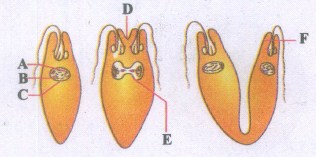
Identify the parts marked as A, B, C, D, E and F for the below diagram.
17.
Mention the different modes of asexual reproduction.
18.
With regard to asexual reproduction. mention two phenomena seen is Hydra.
19.
Mention the phases in the life cycle of an organism.
20.
How are animals classified based on breeding periods?
21.
Define conjugation.
22.
What is syngamy?
23.
What is morphallaxis?
24.
What is the difference between syngamy and fertilization?
25.
How is juvenile phase different from reproductive phase?
26.
Name an organism where cell division is itself a mode of reproduction.
27.
'A' and 'B' are the male & female sex cells respectively which look alike and performs similar functions. 'A' and 'B' fuse to form a new individual 'D'. Which type of gametic fusion does this represent? Give an example
28.
How Charles Bonnet and Abraham Trembley contributed to Biological filed?
29.
Differentiate between asexual and sexual reproduction
30.
Enumerate the types of syngamy
31.
How exogenous buds are developed by Hydra?
32.
What is ovoviviparous condition?
33.
What are gemmules?
34.
What is asexual reproduction?
35.
Why are the offsprings of oviparous animal at a greater risk as compared to offsprings of viviparous organisms?
36.
The unicellular organisms which reproduce by binary fission are considered immortal. Justify
37.
Which type of reproduction is effective -Asexual or sexual and why?
38.
Given an account on following terms.
(a) Hologamy
(b) Isogamy
(c) Anisogamy
(d) Merogamy
(e) Paedogamy
39.
Describe the regeneration process noticed in living organism.
40.
Write notes on binary fission in animals.
41.
42.
Differentiate between the following:
(a) Binary fission in amoeba and multiple fission in Plasmodium
(b) Budding in yeast and budding in Hydra
(c) Regeneration in lizard and Planaria
1.
(b)
shark
2.
(c)
Amphitoky - Honeybee
3.
(c)
Ovoviviparous animals lays eggs and then hatch it to young ones.
4.
(a)
Development of sperm without fertilization.
5.
(b)
Planaria
6.
(b)
i and iii
7.
(c)
Amphitoky
8.
(a)
Thelytoky
9.
(d)
Merogamy
10.
(d)
Sexual reproduction
11.
(d)
Hologamy
12.
(d)
Sea Anemone
13.
(b)
Paramecium
14.
(a)
Arrhenotoky
15.
A. If both A and R are true and R is correct explanation for A
16.
A - Chromosomes
B - Nucleoli
C - Nucleus
D - Longitudinal furrow
E - Nuclear constriction
F - Daughter Euglena
17.
The different modes of asexual reproduction seen in animals are fission, sporulation, budding, gemmule formation, fragmentation and regeneration.
18.
Budding and Regeneration.
19.
Juvenile phase I Vegetative phase, reproductive phasel maturity phase, Senescent phase.
20.
(i) On the basis of time, breeding animals are of two types: seasonal breeders and continuous breeders.
(ii) Seasonal breeders reproduce at particular period of the year such as frogs, lizards, most birds, deers etc.,
Continuous breeders continue to breed throughout their sexual maturity. E.g. honey bees, poultry, rabbit etc.
21.
conjugation is the temporary union of the two individuals of the same species. During their union both individuals, called the conjugants exchange certain amount of nuclear material (DNA) and then get separated. E.g. Paramecium
22.
In syngamy, the fusion of two haploid gametes takes place to produce a diploid zygote.
23.
It is a type of regeneration. In morphallaxis the whole body grows from a small fragment. E.g. Hydra.
24.
| syngamy | fertilization |
| It is the fusion of two haploid gametes to form a diploid zygote | It is the act (or) process of rendering fertile zygote as the result of Fertilization |
25.
| juvenile phase | reproductive phase |
| lt is also known as young and Vegetative Phase | It is also known as Maturity adult Phase |
| lt is the period of growth between the birth of the individual upto reproductive maturitiy. | The organisms reproduce and their offsprings reach maturity period |
26.
In monocellular organs cell division is itself a mode of reproduction. (e.g:) Bacteria, Euglena and Amoeba.
27.
Isogamy. Eg: Monocystis
28.
Charles Bonnet discovered the process of parthenogenesis.
Abraham Trembley was the first to study the concept of Regeneration in the Hydra.
29.
| Asexual Reproduction | Sexual Reproduction | |
|---|---|---|
| a | Involves only one parent | Involves two parents (male & female) |
| b | Only mitotic cell division takes place | Both mitosis & meiosis takes place |
| c | Offsprings are genetically identical to the parent. | Offsprings genetically differ from the parents. |
| d | Gametes are not produced | Gametes are produced |
30.
(a) Autogamy
(b) Exogamy
(c) Hologamy
(d) Paedogamy
(e) Merogamy
(f) Isogamy
(g) Anisogamy
(h) Conjugation
31.
When buds are formed on the outer surface of the parent body, it is known as exogenous budding e.g. Hydra. In Hydra when food is plenty, the ectoderm cells increase and form a small elevation on the body surface. Ectoderm and endoderm are pushed out to form the bud. The bud contains an interior lumen in continuation with the parent's gastrovascular cavity. The bud enlarges, develops a mouth and a circle of tentacles at its free end. When fully grown, the bud constricts at the base and finally separates from the parent body and leads an independent life.
32.
(i) In Ovoviviparous animals, the embryo develops inside the egg and remains in the mother's body until they are ready to hatch.
(ii) This method of reproduction is similar to Viviparity but the embryos have no placental connection with the mother and receive their nourishment from the egg yolk. Ovoviviparity is seen in fishes like shark.
33.
(i) It is a mode of asexual reproduction in sponges.
(ii) Internal buds called gemmules are formed which is a hard ball, consisting of an internal mass of food laden archaeocytes.
(iii) During unfavourable conditions, the sponge disintegrates, but the gemmule withstands adverse conditions.
(Iv) The gemmules hatch during favourable conditions.
34.
(i) Reproduction by a single parent without the involvement of gamete formation is asexual reproduction and the offspring produced are genetically identical. (uniparental inheritance)
(ii) Asexual reproduction is usually by amitotic or mitotic division of the somatic (body) cells, hence is also known as somatogenic or blastogenic reproduction. Eg. members of Protista, Bacteria.
35.
Oviparous animals lay eggs outside their body. These eggs are exposed to various environmental conditions and may be eaten by predators also. They face lot of risks until the young ones hatche. But the offsprings of viviparous animals are more safe and protected in the maternal womb until they are born.
36.
1. In unicellular organism there is no special structure for reproduction.
2. In binary fission the entire parent body constitute the reproductive unit and disappears when its division into two daughter unicellular cell is completed.
3. These two daughter cells function as two new individuals.
4. There is no remains of parent body cell and parent cannot be said to have died.
5. In fact after binary fission parent continues living as two daughter individual.
Hence, the unicellular organisms which undergo binary fission are called immortal (no natural death).
37.
1. Sexual reproduction is considered to be a better mode of reproduction because it creates a hybrid that has more vigor than the parents.
2. It also creates the variation in off springs making its survival better.
3. The fact that most of the eukaryotes reproduce sexually in evidence of its evolutionary success.
4. In many animals, it is actually the only mode of reproduction.
38.
(a) Hologamy: In Hologamy, the adult individuals do not produce gametes, but they themselves act as gametes and fuse to form new individuals.
E.g: Trichonympha
(b) Isogamy: Fusion of morphologically & physiologically similar gametes.
E.g: Monocystis
(c) Anisogamy: Fusion of morphologically & physiologically dissimilar gametes.
Eg: Vertebrates.
(d) Merogamy: Fusion of small-sized morphologically different gametes (microgametes)
(e) Paedogamy: Fusion of young individuals produced immediately after the mitotic division of adult parent cell.
39.
Regeneration is regrowth in the injured region. Regeneration was first studied in Hydra by Abraham Trembley in 1740. Regeneration is of two types, morphallaxis, and epimorphosis. In morphallaxis, the whole body grows from a small fragment e.g. Hydra and Planaria. When Hydra is accidentally cut into several pieces, each piece can regenerate the lost parts and develop into a whole new individual. The parts usually retain their original polarity, with oral ends, by developing tentacles .and aboral ends, by producing basal discs. Epimorphosis is the replacement of lost body parts. It is of two types, namely reparative and restorative regeneration. In reparative regeneration, only certain damaged tissue can be regenerated, whereas in restorative regeneration severed body parts can develop. e.g. starfish, the tail of wall lizard.
40.
In binary fission, the parent organism divides into two halves and each half forms a daughter individual. The nucleus divides first amitotically or mitotically (karyokinesis), followed by the division of the cytoplasm (cytokinesis). The resultant offsprings are genetically identical to the parent. Depending on the plane of fission, binary fission is of the following types
(i) Simple irregular binary fission
(ii) Transverse binary fission
(iii) Longitudinal binary fission
(iv) Oblique binary fission
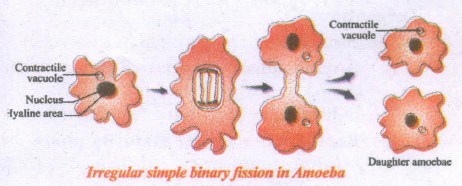
(i) Simple irregular binary fission is seen in Amoeba like irregular shaped organisms, where the plane of division is hard to observe. The contractile vacuoles cease to function and disappear. The nucleoli disintegrate and the nucleus divides mitotically. The cell then constricts in the middle, so the cytoplasm divides and forms two daughter cells.
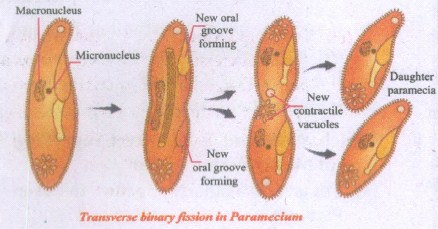
(ii) In Transverse binary fission, the plane of the division runs along the transverse axis of the individual. E.g. Paramecium and Planaria. In Paramecium the macronucleus divides by amitosis and the micronucleus divides by mitosis.
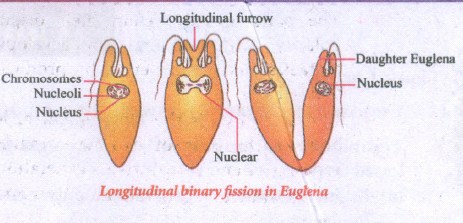
(iii) In Longitudinal binary fission the nucleus and the cytoplasm divides in the longitudinal axis of the organism. In flagellates, the flagellum is retained usually by one daughter cell. The basal granule is divided into two and the new basal granule forms a flagellum in the other daughter individual. E.g. Vorticella and Euglena.
(iv) In Oblique binary fission the plane of division is oblique. It is seen in dinoflagellates. E.g. Ceratium.
41.
42.
(a)
| Binary Fission in Amoeba | Multiple fission in Plasmodium |
| lt results in the production of two individuals from a single parent. | It results in the production of several individuals |
| lt occurs under favourable conditions | It occurs both under favourable and unfavourable conditions |
| Nucleus of the parent cell divides only once to form two daughter nuclei | Nucleus of the parent cell undergoes repeated divisions to form a number of daughter nuclei |
| Cytoplasm divides after nuclear division | Cytoplasm does not divide after each nuclear division but divides during favourable condition |
| No part of parent body is left unused (e,g: Amoeba) | A part of the body (covering and residuai cytoplasm) is left unused. (e,g: Paramecium) |
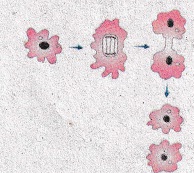 |
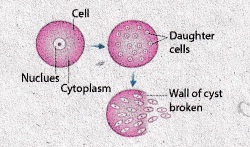 |
(b) Budding in yeast and budding in hydra
| Budding in Yeast | Budding in Hydra |
| During budding the cell wall of the parent cell bulges out in the form of an out growth as bud | During budding the ectoderm cells increase and form a small elevation on the body surface as bud. |
| The parent nucleus divides into two daughter nuclei one of which migrates into bud. | Ectoderm and endoderm are pushed out to form the bud. The bud contains an interior lumen in continuation with parent's gastro vascular cavity (coelenteron) |
| As the bud enlarges and is fully formed, it is separated from the parentcell and grows into mature yeast. Sometimes a bud may produce another bud over it which is still attached to parent cell forming a false mycelium (or) pseudomycelium | The bud enlarges, develops a mouth and a circle of tentacles at its free end. When fully grown, the bud constricts at the base and finally separates from the parent body and leads an independent life |
(c) Regeneration is regrowth in the injured region
| Regeneration in Lizard | Regeneration in Planaria |
| This type of regeneration comes under epimorphosis type. | This type of regeneration comes under morphallaxis type |
| Several body parts can develop. | When the body is cut into several pieces, each piece can regenerate the lost parts and develops into a whole individual |

12th Standard Syllabus & Materials
12th Standard
TN 12th Computer Applications களப்பெயர் முறைமை (DNS) Sample Question Papers Study Material - QB365 Set A
NEW12th Standard
TN 12th Computer Applications வலையமைப்பு எடுத்துக்காட்டுகள் மற்றும் நெறிமுறைகள் Sample Question Papers Study Material - QB365 Set A
NEW12th Standard
TN 12th Computer Applications கணினி வலையமைப்பு ஓர் அறிமுகம் Sample Question Papers Study Material - QB365 Set A
NEW12th Standard
TN 12th Computer Applications PHP-உடன் MySQL-ஐ இணைத்தல் Sample Question Papers Study Material - QB365 Set A



Tamilnadu Stateboard 12th Standard Subjects

Maths

Chemistry

Physics
Biology

Computer Science

Business Maths and Statistics

Economics

Commerce

Accountancy

History

Computer Applications
Biology
Computer Technology
Computer Applications
Computer Science
Business Maths and Statistics
Commerce
Economics
Maths
Chemistry
Physics
Computer Technology
History
Accountancy

Tamil

English

French
Tamilnadu Stateboard Standards

