
 100% FREE ACCESS
12th Standard Syllabus & Materials
12th Standard
TN 12th Computer Applications மின்னணு தரவு பரிமாற்றம் Sample Question Papers Study Material - QB365 Set A
NEW12th Standard
TN 12th Computer Applications மின் - வணிக பாதுகாப்பு அமைப்புகள் Sample Question Papers Study Material - QB365 Set A
NEW12th Standard
TN 12th Computer Applications மின்னணு செலுத்தல் முறைகள் Sample Question Papers Study Material - QB365 Set A
NEW12th Standard
TN 12th Computer Applications மின் - வணிகம் Sample Question Papers Study Material - QB365 Set A
NEW12th Standard
TN 12th Computer Applications திறந்த மூல கருத்துருக்கள் Sample Question Papers Study Material - QB365 Set A
NEW12th Standard
TN 12th Computer Applications வலையமைப்பு வடமிடல் Sample Question Papers Study Material - QB365 Set A

Published on: 29/01/2021
12th Standard Bio-Zoology English Medium Reproductive Health Reduced Syllabus Important Questions 2021
Download Tamil Nadu 12th Standard Biology question papers, model tests, one-mark questions, important questions, and public exam papers in PDF format. Free study materials and answer keys for TN State Board students.
Questions + Answers key
Take MCQ Biology Test1.
According to WHO, India is the ____________ largest HIV affected country.
first
second
third
seventh
2.
Identify the correct statement.
Lactational amenorrhea is a permanent birth control method
Condoms are made of polyethylene glycol and lambskin
LNG -20 is a copper-releasing IUD
Diaphragm covers the cervix there by preventing sperm entry
3.
In context of amniocentesis, which of the following statements is incorrect?
It is usually done when a woman is between 14-16 weeks pregnant
It is used for prenatal sex determination
It can be used for detection of Down syndrome
It can be used for detection of cleft palate
4.
Which of the following is a hormone releasing Intrauterine Device (IUD)?
Multi load 375
LNG - 20
Cervical cap
Vault
5.
The ______ method of contraception has a success rate of 95 - 99% in India.
IUDs Intra-uterine devices
Hormonal
Chemical
mechanical
6.
_____ is an example of a contraceptive pill.
Alesse
Ortho Tri-cyclen
Saheli
Eryosterol
7.
Oral contraceptive pills contain synthetic ____ and hormones. (or) Contraceptive pills contain:
androgen and testosterone
Androgen and Oxytocin
relaxin and inhibin
Progesterone and estrogen
8.
This is an ideal contraceptive for females who want to delay pregnancy
Oral contraceptives
IUDs
Diaphragms, cervical caps
Vaults
9.
One of the following prevents sperm from heading off to penis as the discharge has no sperms in it.
Tubectomy
LNG - 20
Vasectomy
Cu T 380 Ag
10.
In India, Family Planning Programme was introduced in
1941
1951
1961
1971
11.
The incubation period for _____ can be more than 10 years.
HPV
HBV
Treponema
HIV
12.
The family planning programme was initiated by India in _____
1953
1972
1963
1951
13.
Identify the correct statements from the following.
Chlamydiasis is a viral disease
Gonorrhoea is caused by a spirochaete bacterium, Treponema palladium
The incubation period for syphilis is 2 to 14 days in males and 7 to 21 days in females
Both syphilis and gonorrhoea are easily cured with antibiotics
14.
15.
Which of the following is correct regarding HIV, hepatitis B, gonorrhoea and trichomoniasis?
Gonorrhoea is a STD whereas others are not.
Trichomoniasis is a viral disease whereas others are bacterial.
HIV is a pathogen whereas others are diseases.
Hepatitis B is eradicated completely whereas others are not.
16.
Name the most effective long-acting reversible contraceptive methods.
17.
Suggest any two simple precautions to avoid contracting RTl's.
18.
How the technique of amniocentesis is performed?
19.
What does ICSI stands for? Describe the technique.
20.
What is embryo transfer technique?
21.
Mention the type of IUDs with example.
22.
What is lactational amenorrhoea?
23.
What is meant by regeneration ? Give example.
24.
The procedure of GIFT involves the transfer of female gametes into the fallopain tube, can gametes be transferred to the uterus to achieve the same result? Explain.
25.
Correct the following statements
a) Transfer of an ovum collected from donor into the fallopian tube is called ZIFT.
b) Transfering of an embryo with more than 8 blastomeres into uterus is called GIFT.
c) Multiload 375 is a hormone releasing IUD.
26.
Select the correct term from the bracket and complete the given branching tree
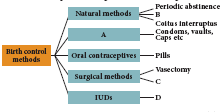
(Barriers, Lactational amenorrhoea, CuT, Tubectomy)
27.
What do you mean by the term - coitus interruptus?
28.
Point out any four STD's caused by viruses
29.
What is Mayer- Rokitansky syndrome?
30.
Mention two sexually transmitted diseases caused by bacteria.
31.
What is the role of IUDs?
32.
What is PCPNDT Act?
33.
Which type of women are benefited by Invitro fertilization?
34.
Differentiate foeticide and infanticide
35.
36.
List out the causes of fertility in human.
37.
Give a detailed account on various natural methods of contraception.
38.
What is ART? Explain any two for ART.
39.
Explain any five techniques of Assisted Reproductive Technology (ART).
40.
Open Book Assessment
‘Healthy reproduction, legally checked birth control measures and proper family planning programmes are essential for the survival of mankind’ Justify
41.
How are STDs transmitted?
42.
Describe the major STDs and their symptoms.
1.
(c)
third
2.
(d)
Diaphragm covers the cervix there by preventing sperm entry
3.
(d)
It can be used for detection of cleft palate
4.
(b)
LNG - 20
5.
(a)
IUDs Intra-uterine devices
6.
(c)
Saheli
7.
(d)
Progesterone and estrogen
8.
(b)
IUDs
9.
(c)
Vasectomy
10.
(b)
1951
11.
(d)
HIV
12.
(d)
1951
13.
(d)
Both syphilis and gonorrhoea are easily cured with antibiotics
14.
(b)
15.
(c)
HIV is a pathogen whereas others are diseases.
16.
Intrauterine devices and contraceptive implants
17.
1. Avoiding coitus with unknown/multiple partners.
2. Use of condoms during coitus.
18.
Amniocentesis is generally performed in a pregnant woman between the 15th and 20th weeks of pregnancy by inserting a long, thin needle through the abdomen into the amniotic sac to withdraw a small sample of amniotic fluid. The amniotic fluid contains cells shed from the foetus.
19.
ICSI stands for Intra-Cytoplasmic Sperm Injection. In this method, a sperm is carefully injected into the cytoplasm of the egg and the zygote formed is allowed to divide till 8 celled stages and transferred to uterus. Fertilization occurs in 75-85% of eggs injected with sperm
20.
The transfer of an embryo with more than 8 blastomeres stage into uterus is called embryo transfer technique.
21.
(i) Copper releasing IUD - Multiload 375 CuT 380.
(ii) Hormone - releasing IUD - LNG-20.
(iii) Non-medicated IUD - Lippes loop.
22.
Menstrual cycles resume as early as 6 to 8 weeks from parturition. However, the reappearance of normal ovarian cycles may be delayed for six months during breastfeeding. This delay in ovarian cycles is called lactational amenorrhoea. It serves as a natural but an unreliable form of birth control.
23.
Regeneration is regrowth in the injured region. Regeneration was first studied in Hydra by Abraham Trembley in 1740. Regeneration is of two types, morphallaxis and epimorphosis. In morphallaxis the whole body grows from a small fragment e.g. Hydra and Planaria. When Hydra is accidentally cut into several pieces, each piece can regenerate the lost parts and develop into a whole new individual. The parts usually retain their original polarity, with oral ends, by developing tentacles and aboral ends, by producing basal discs. Epimorphosis is the replacement of lost body parts. It is of two types, namely reparative and restorative regeneration. In reparative regeneration, only certain damaged tissue can be regenerated, e.g. human beings (liver tissue) whereas in restorative regeneration severed body parts can develop. e.g. star fish, tail of wall lizard.
24.
1. Directly gametes cannot be transferred into the uterus, because the uterine environment is not suited for the survival of the gametes.
2. If the gametes directly transferred into the uterus, gametes will undergo degeneration (or) could be phagocytosed and viable zygotes will not be formed.
3. In this method, the own collected from a donor female is transferred to the fallopian tube of another woman.
4. The ovum has to be fertilized by the sperm of the woman's husband; the fallopian tube is the site for fertilization in a human female.
5. The gamete (ovum) if introduced into the uterus cannot move to the fallopian tube, the site of fertilization.
25.
(a) Transfer of an ovum collected from donor into the fallopian tube is called GIFT (Gamete Intra-fallopian transfer)
(b) Transferring of an embryo with more than 8 blastomeres into uterus is called IUT (Intra uterine transfer)
(c) Multi load 375 is a copper releasing IUD
26.
A - Barrier methods
B - Lactational amenorrhoea
C - Tubectomz
D - CuT
27.
Coitus interruptus is a oldest family planning method, where the male partner withdraws his penis before ejaculation, there by preventing the deposition of semen into vagina.
28.
1. Genital herpes
2. Hepatitis -B
3. Genital warts
4. AIDS
29.
All women are born with ovaries, but some do not have functional uterus. This condition is called Mayer- Rokitansky syndrome.
30.
Syphilis and Gonorrhoea
31.
IUD - Intra-Uterine Device. They increase of phagocytosis of sperm within the uterus and prevent meeting of gametes there by acting as birth control measure.
32.
Government of India has taken various steps like PCPNDT Act (Preconception and Prenatal diagnostic technique act-1994) enacted to ban the identification of sex and to prevent the use of prenatal diagnostic techniques for selective abortion.
33.
IVF is used to treat women with blocked, damaged or absent fallopian tubes.
34.
| Foeticide | Infanticide |
| It refers to aborting the female in the mother's womb. |
It refers to killing the female child after her birth |
35.
36.
Causes for male infertility:
(i) Undescended tests and swollen veins in scrotum
(ii) Underdeveloped testes
(iii) Tight clothing increases the temperature in scrotum and affect sperm production.
(iv) Autoimmune response against own sperm.
(v) Usage of alcohol, tobacco, marijuana drugs etc.
Causes for female infertility:
(i) Malformation of cervix or fallopian tubes.
(ii) Inadequate nutrition at puberty.
(iii) Low body fat (anorexia = psychological eating disorder due to fear of gaining weight) .
(iv) Pelvic Inflammatory Disease (PID), uterine disorders, endometriosis.
(v) underdeveloped ovaries.
(vi) Developing antibodies against sperm.
Common Causes for both the sexes:
(i) Tumours in pituitary or sex organs
(ii) Inherited mutation of hormone synthesizing genes
(iii) Long term stress
(iv) Ingestion of toxins (Cadmium) & drugs
(v) Injuries to gonads
(vi) Ageing
37.
Natural method is used to prevent meeting of sperm with ovum. i.e., Rhythm method (safe period), coitus interruptus, continuous abstinence and lactational amenorrhoea.
a. Periodic abstinence/rhythm method: Ovulation occurs at about the 14th day of the menstrual cycle. Ovum survives for about two days and sperm remains alive for about 72 hours in the female reproductive tract. Coitus is to be avoided during this time.
b. Continuous abstinence is the simplest and most reliable way to avoid pregnancy is not to have coitus for a defined period that facilitates conception.
c. Coitus interruptus is the oldest family planning method. The male partner withdraws his penis before ejaculation, thereby preventing deposition of semen into the vagina.
d. Lactational amenorrhoea : Menstrual cycles resume as early as 6 to 8 weeks from parturition. However, the reappearance of normal ovarian cycles may be delayed for six months during breast-feeding. This delay in ovarian cycles is called lactational amenorrhoea. It serves as a natural, but an unreliable form of birth control. Suckling by the baby during breast-feeding stimulates the pituitary to secrete increased prolactin hormone in order to increase milk production. This high prolactin concentration in the mother's blood may prevent menstrual cycle by suppressing the release of GnRH (Gonadotropin Releasing Hormone) from hypothalamus .and gonadotropin secretion from the pituitary.
38.
A collection of procedures, which includes the handling of gametes and/or embryos outside the body to achieve a pregnancy as known as Assisted Reproductive Technology. It increases the chance of pregnancy in infertile couples. ART includes intra-uterin insemination (IUI), in vitro fertilization, (IVF) Embryo transfer, (ET), Zygote intra-fallopian transfer (ZIPT), Gamete intrafallopian transfer (GIFT), Intra-cytoplasmic, sperm Injection (ICSI), .Preimplantation genetic diagnosis, oocyte and sperm donation and surrogacy.
(i) Intra-cytoplasmic sperm injection (ICSI): In this method only one sperm is injected into the focal point of the egg to fertilize. The sperm is carefully injected into the cytoplasm of the egg. Fertilization , occurs in 75 - 85% of eggs injected with the sperms. The zrgote is allowed to divide to form an 8 celled blastomere and then transferred to the uterus to develop a productive pregnancy.
(ii) Surrogacy: Surrogacy is a method of assisted reproduction or agreement whereby a woman agrees to carry a Pregnancy for another person, who will become the newborn child's parent after birth. Through in vitro fertilization (IVF), embryesz are created in a lab and are transferred into the surrogate mother's uterus.
39.
A collection of procedures which includes the handling of gametes and/or embryos outside the body to achieve a pregnancy is known as Assisted Reproductive Technology. ART includes
(i) Intra - uterine insemination : This is a procedure to treat infertile men with low sperm count. The semen is collected either from the husband or from a healthy donor and is introduced into the uterus through the vagina by a catheter after stimulating the ovaries to produce more ova. The sperms swim towards the fallopian tubes to fertilize the egg, resulting normal pregnancy.
(ii) Zygote intra - fallopian transfer(ZIFT)
The zygote is allowed to divide to form 8 celled blastomere and transferred to the fallopian tube by laparoscopy. The zygote continues its natural divisions and migrates towards the uterus where it gets implanted.
(iii) Intra uterine transfer (iUT)
Embryo with more than 8 blastomeres is inserted into uterus to complete its further development.
(iv) Gamete Intra-falloplan transfer(GIFT)
Transfer of an ovum collected from a donor into the fallopian tube. In this, the eggs are collected from the ovaries and placed with the sperms in one of the fallopian tubes. The zygote travels toward the uterus and gets implanted in the inner lining of the uterus.
(v) Intra-cytoplasmic sperm injection (ICS):
In this method, only one sperm is injected into the focal point of the egg to fertilize. The sperm is carefully injected into the
cytoplasm of the egg. Fertilization occursin 75% - 85% of eggs injected with the sperms. The zygote is allowed to divide to form an 8 celled blastomere and then transferred to the uterus to develop a protective pregnancy.
40.
1. Reproductive health refers not only to healthy reproductive functions, but to the total well being of physical mental emotional, behavioural and social aspects of reproduction.
2. People having physically and functionally normal reproductive organs and exhibit normal behavioural and emotional interactions among themselves in all reproduction-related aspects are considered reproductively healthy.
3. 214 million women of reproductive age in developing countries who wants to avoid pregnancy are not using a modern contraceptive method.
4. Some family planning methods, such as condoms help prevent the transmission of HIV and other sexual transmitted infections.
5. Family planning contraception reduces the need for abortion, especially unsafe abortion.
6. Family planning reinforces people's rights to determine the number and spacing of their children.
7. By preventing unintended pregnancy, family planning/contraception prevents deaths of mothers and children.
8. Family planning is the key to slowing unsustainable population growth and the resulting negative impacts on the economy, environment and National and Regional development efforts.
41.
Sexually transmitted diseases (STD) or veneral diseases(VD) or Reproductive tract infections (RTI) are called as Sexually transmitted infections (STI).
Transmissions:
1. Normally STI are transmitted from person to person during intimate sexual contact with an infected partner.
2. Infections like Hepatitis-B and HIV are transmitted sexually as well as by sharing of infusion needles, surgical instruments, etc with infected people, blood transfusion (or) from infected mother to baby.
3. People in the age of 15 to 24years are prone to these infections.
4. The bacterial STI are gonorrhoea syphilis, chancroid, chlamydiasis and lymphogranuloma venereum.
5. The viral STI are genital herpes, genital warts Hepatitis-B and AIDS.
6. Trichomoniasis is a protozoan STI, and candidiasis is a fungal STI.
42.
The major sexually transmitted diseases are
(i) Gonorrhoea
1. Causative agent: Neisseria gonorrhoeae
2. Symptoms: Affects the urethra, rectum and throat and in females the cervix also get affected
3. Pain and pus discharge in the genital tract and burning sensation during urination.
4. Incubation period: 2 to 5 days
(ii) Syphilis
Causative agent : Treponema pallidum
Symptoms:
1. Primary stage: Formation of painless ulcer on the external genitalia.
2. Secondary stage : Skin lesions, rashes, swollen joints and fever and hair loss.
3. Tertiary stage : Appearance of chronic ulcers on nose. Lower legs and palate, loss of movement mental disorder visual impairment, heart problems, gummas (soft non-cancerous growths) etc.
(iii) Hepatitis B
1. Causative agent: Hepatitis B virus (HBV) with DNA.
2. Symptoms: Fatigue, jaundice, fever, rash and stomach pain.
3. Liver cirrhosis and liver failure occur in the later stage.
4. Incubation period: 30-80 days
(iv) AIDS:
1. Causative agent: Human immuno deficiency Virus (HIV) .
2. Symptoms: Enlarged lymph nodes, prolonged fever, prolonged diarrhoea, weight reduction, night sweating.
3. Incubation periods: 2 to 6 weeks even more than 10 years

12th Standard Syllabus & Materials
12th Standard
TN 12th Computer Applications களப்பெயர் முறைமை (DNS) Sample Question Papers Study Material - QB365 Set A
NEW12th Standard
TN 12th Computer Applications வலையமைப்பு எடுத்துக்காட்டுகள் மற்றும் நெறிமுறைகள் Sample Question Papers Study Material - QB365 Set A
NEW12th Standard
TN 12th Computer Applications கணினி வலையமைப்பு ஓர் அறிமுகம் Sample Question Papers Study Material - QB365 Set A
NEW12th Standard
TN 12th Computer Applications PHP-உடன் MySQL-ஐ இணைத்தல் Sample Question Papers Study Material - QB365 Set A



Tamilnadu Stateboard 12th Standard Subjects

Maths

Chemistry

Physics
Biology

Computer Science

Business Maths and Statistics

Economics

Commerce

Accountancy

History

Computer Applications
Biology
Computer Technology
Computer Applications
Computer Science
Business Maths and Statistics
Commerce
Economics
Maths
Chemistry
Physics
Computer Technology
History
Accountancy

Tamil

English

French
Tamilnadu Stateboard Standards

