
 100% FREE ACCESS
12th Standard Syllabus & Materials
12th Standard
TN 12th Computer Applications மின்னணு தரவு பரிமாற்றம் Sample Question Papers Study Material - QB365 Set A
NEW12th Standard
TN 12th Computer Applications மின் - வணிக பாதுகாப்பு அமைப்புகள் Sample Question Papers Study Material - QB365 Set A
NEW12th Standard
TN 12th Computer Applications மின்னணு செலுத்தல் முறைகள் Sample Question Papers Study Material - QB365 Set A
NEW12th Standard
TN 12th Computer Applications மின் - வணிகம் Sample Question Papers Study Material - QB365 Set A
NEW12th Standard
TN 12th Computer Applications திறந்த மூல கருத்துருக்கள் Sample Question Papers Study Material - QB365 Set A
NEW12th Standard
TN 12th Computer Applications வலையமைப்பு வடமிடல் Sample Question Papers Study Material - QB365 Set A

Published on: 01/11/2019
Botany - Principles of Ecology
Download Tamil Nadu 12th Standard Biology question papers, model tests, one-mark questions, important questions, and public exam papers in PDF format. Free study materials and answer keys for TN State Board students.
Questions + Answers key
Take MCQ Biology Test1.
Sticky glands of Boerhavia and Cleome support _______.
Anemochory
Zoochory
Autochory
Hydrochory
2.
Strong, sharp spines that get attached to animal’s feet are found in the fruits of ______.
Argemone
Ecballium
Heritier
Crossandra
3.
4.
Ophrys an orchid resembling the female of an insect so as to able to get pollinated is due to phenomenon of ______.
Myrmecophily
Ecological equivalents
Mimicry
None of these
5.
6.
Which of the given plant produces cardiac glycosides?
Calotropis
Acacia
Nepenthes
Utricularia
7.
A specific place in an ecosystem, where an organism lives and performs its functions is _____.
habitat
niche
landscape
biome
8.
What is seed ball?
9.
What is myrmecophily?
10.
11.
Soil formation can be initiated by biological organisms. Explain how?
12.
What is Phytoremediation ?
13.
Define ecology.
14.
Water is very essential for life. Write any three features for plants which enable them to survive in water scarce environment.
15.
List any two adaptive features evolved in parasites enabling them to live successfully on their host?
16.
What is mutualism? Mention any two example where the organisms involved are commercially exploited in modern agriculture.
17.
Distinguish habitat and niche
18.
Explain different types of hydrophytes with examples.
19.
Describe the mutual relationship between the fig and wasp and comment on the phenomenon that operates in this relationship.
20.
Amensalism
21.
Competition
22.
Predation
23.
Mutualism
24.
Parental bedrock
25.
Plants in sandy soils are commonly called as ____________.
26.
Wasps is the fruits of fig is an example for _________ type of species interaction
27.
______________ is the transition zone between two ecosystems.
28.
Amensalism is called as__________.
29.
The surface features of earth are called _________.
1.
(b)
Zoochory
2.
(a)
Argemone
3.
(d)
4.
(c)
Mimicry
5.
(c)
6.
(a)
Calotropis
7.
(b)
niche
8.
It is a technique of encasing seeds in a mixture of clay & soil humus & scattering them on to suitable ground, not planting of trees manually.
9.
1. Sometimes, ants take their shelter on some trees such as mango, litchi, jamun, acacia etc.
2. These ants act as body guards of the plants against any disturbing agent and the plants in turn provide food and shelter to these ants.
3. This phenomenon is known as Myrmecophily.
Example: Acacia and, Acacia ants.
10.
11.
Soil formation is initiated by the weathering process. Biological weathering takes place when organisms like bacteria, fungi, lichens & plants help in the breakdown of rocks through the production of acids & certain chemical substances.
12.
Certain plants can also be used to remove cadmium from contaminated soil, this is known as phytoremediation.
Example: Eichhornia
13.
1. It deals with the study of environment in relation to organisms.
2. It can be studied by considering individual organisms, population, community, biome or biosphere and their environment.
14.
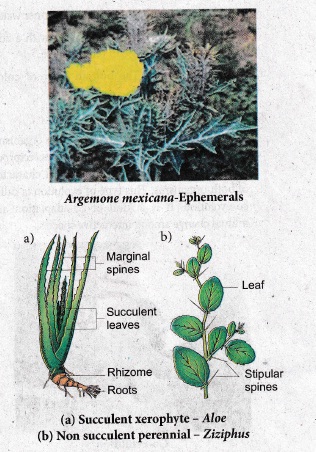
(a) Life cycle is completed within a short period (Ephemerals)
(b) In succulents the stem possess a water storage region
(c) Root hairs & root caps are also well developed
15.
1. Cuscuta is a total stem parasite of the host plant Acacia, Duranta and many other plants Cuscuta even gets flower inducing hormone from its host Plant.
2. Balanophora, orobanche and Refflesia are the total root parasites found on higher plants.
16.
(a) Mutualism: It is an interaction between two species of organisms in which both are benefitted from the obligate association. The following are common examples of mutualism.
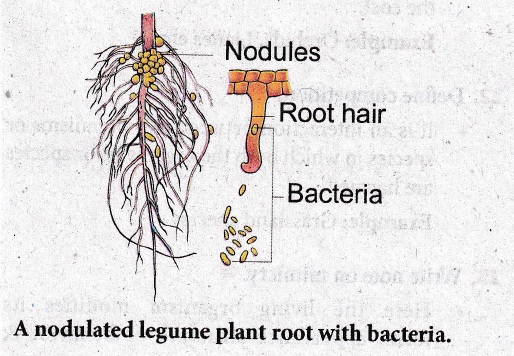
(b) Nitrogen fixation : Rhizobium (Bacterium) forms nodules in the roots of leguminous plants and lives symbiotically. The Rhizobium obtains food from leguminous plant and in turn fixes atmospheric nitrogen into nitrate, making it available to host plants.
Other examples:
Water fern (Azolla) and Nitrogen fixing Cyanobacterium (Anabaena) .
17.
The differences between habitat and niche are as follows.
| S. No | Habitat | Niche |
| 1 | A specific physical space occupied by an organism (species). | A functional space occupied by an organism in the same eco-system |
| 2 | Same habitat may be shared by many organisms (species). | A single niche is occupied by a single species. |
| 3 | Habitat specificity is exhibited by organism. | Organisms may change their niche with time and season |
18.
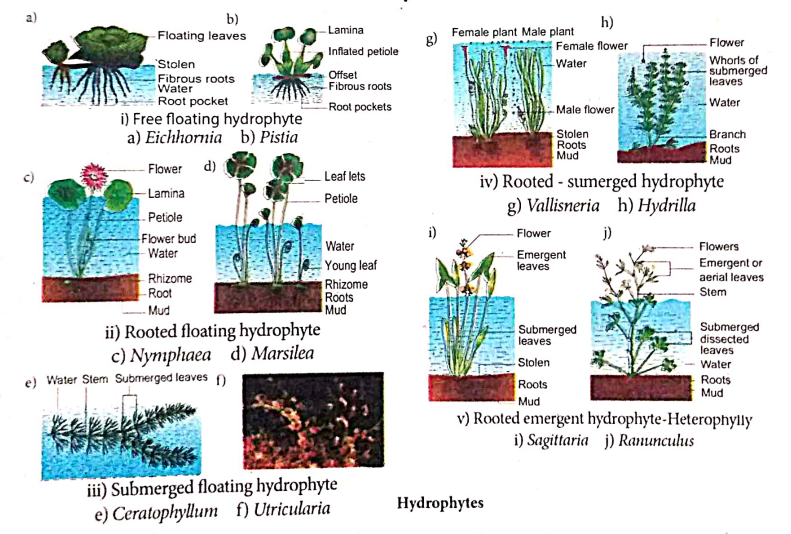
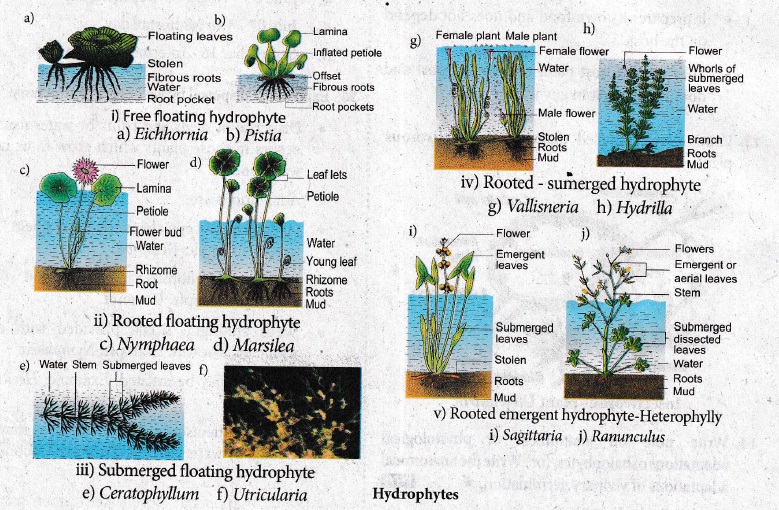
i. Free floating hydrophytes: These plants float freely on the surface of water. They remain in contact with water and air, but not with soil. Examples: Eichhornia, Pistia and Wolffia (smallest flowering plant).
ii. Rooted floating hydrophytes: In these plants, the roots are fixed in mud, but their leaves and flowers are floating on the surface of water. These plants are in contact with soil, water and air. Examples: Nelumbo, Nymphaea, Potomogeton and Marsilea. Lotus seeds showing highest longevity in plant kingdom.
iii. Submerged floating hydrophytes: These plants are completely submerged in water and not in contact with soil and air. Examples: Ceratophyllum and Utricularia.
iv. Rooted-submerged hydrophytes: These plants are completely submerged in water and rooted in soil and not in contact with air. Examples: Hydrilla, Vallisneria and Isoetes.
v. Amphibious hydrophytes (Rooted emergent hydrophytes): These plants are adapted to both aquatic and terrestrial modes of life. They grow in shallow water. Examples: Ranunculus, Typha and Sagittaria.
19.
1. In many species of fig trees, there is a one-to one relationship with the pollinator species of wasp. It means that a given fig species can be pollinated only by its 'partner' wasp species & no other species.
2. The female wasp uses the fruit not only as an oviposition (egg, laying) site but uses the developing seeds within the fruit for nourishing its larvae.
3. The wasp pollinates the fig inflorescence while searching for suitable egg-laying sites.
4. In return for the favour of pollination the fig offers the wasp, some of its developing seeds, as food for the developing wasp larvae.
5. The relationship that operates here is co-evolution.
20.
-.0
21.
-,-
22.
+,-
23.
+,+
24.
R-Horizon
25.
()
Psammophytes
26.
()
Mutualism
27.
()
Ecotone
28.
()
Antibiosis
29.
()
Topography

12th Standard Syllabus & Materials
12th Standard
TN 12th Computer Applications களப்பெயர் முறைமை (DNS) Sample Question Papers Study Material - QB365 Set A
NEW12th Standard
TN 12th Computer Applications வலையமைப்பு எடுத்துக்காட்டுகள் மற்றும் நெறிமுறைகள் Sample Question Papers Study Material - QB365 Set A
NEW12th Standard
TN 12th Computer Applications கணினி வலையமைப்பு ஓர் அறிமுகம் Sample Question Papers Study Material - QB365 Set A
NEW12th Standard
TN 12th Computer Applications PHP-உடன் MySQL-ஐ இணைத்தல் Sample Question Papers Study Material - QB365 Set A



Tamilnadu Stateboard 12th Standard Subjects

Maths

Chemistry

Physics
Biology

Computer Science

Business Maths and Statistics

Economics

Commerce

Accountancy

History

Computer Applications
Biology
Computer Technology
Computer Applications
Computer Science
Business Maths and Statistics
Commerce
Economics
Maths
Chemistry
Physics
Computer Technology
History
Accountancy

Tamil

English

French
Tamilnadu Stateboard Standards

