
 100% FREE ACCESS
12th Standard Syllabus & Materials
12th Standard
TN 12th Maths Applications of Matrices and Determinants Sample Question Papers Study Material - QB365 Set A
NEW12th Standard
TN 12th Computer Applications மின்னணு தரவு பரிமாற்றம் Sample Question Papers Study Material - QB365 Set A
NEW12th Standard
TN 12th Computer Applications மின் - வணிக பாதுகாப்பு அமைப்புகள் Sample Question Papers Study Material - QB365 Set A
NEW12th Standard
TN 12th Computer Applications மின்னணு செலுத்தல் முறைகள் Sample Question Papers Study Material - QB365 Set A
NEW12th Standard
TN 12th Computer Applications மின் - வணிகம் Sample Question Papers Study Material - QB365 Set A
NEW12th Standard
TN 12th Computer Applications திறந்த மூல கருத்துருக்கள் Sample Question Papers Study Material - QB365 Set A

Published on: 09/03/2020
12th Standard Biology English Medium All Chapter Book Back and Creative Five Mark Questions 2020
Download Tamil Nadu 12th Standard Biology question papers, model tests, one-mark questions, important questions, and public exam papers in PDF format. Free study materials and answer keys for TN State Board students.
Questions + Answers key
Take MCQ Biology Test1.
Explain Raunkiaer classification in the world’s vegetation based on the temperature.
2.
3.
How does Neanderthal man differ from the modern man in appearance?
4.
How is juvenile phase different from reproductive phase?
5.
‘Pollination in Gymnosperms is different from Angiosperms’ – Give reasons.
6.
Explain Oparin - Haldane hypothesis on evolution.
7.
How the DNA is packed in an eukaryotic cell?
8.
Describe in detail on population interaction.
9.
10.
How microbes are used in Gobar gas production?
11.
Explain the role of microbes in the production of enzymes & bio-active molecules
12.
Describe the structure of HIV with a diagram
13.
What is the significance of slope of regression in a species area relationship?
14.
Why Tropical regions are rich in biodiversity?
15.
What are the ethical issues about cloning.
16.
Explain in detail about stem cell therapy. (or) What are the multipotent cells involved in replenishing adult tissue ? What is the rich source for it?
17.
Explain the procedure of Southern Blotting Technique. Southern Blotting Techniques - DNA
18.
Explain the process of oogenesis.
19.
Describe the regeneration process noticed in living organism.
20.
Describe incomplete dominance exhibited by Mirabilis jalapa.
21.
Explain Dihybrid cross in pea plant.
22.
Give the characteristic features of Anemophilous plants.
23.
Describe the development process of male gametophyte.(or) Explain the different mode of entry of pollen tube into the ovule.
24.
Write in detail about Autogenic succession and Allogenic succession.
25.
Write a note on the strategies of ecosystem management.
26.
Point out any five morphological adaptations of epiphytes.
27.
Explain various edaphic factors that affect vegetation.
28.
Point out the applications of plant tissue culture.
29.
Explain the steps involved in protoplast culture.
30.
Explain the steps involved in hybridization.
31.
Give a comparative account on Seaweed liquid fertilizer.
32.
Write a comparative note on Carbon Foot Print (CFP).
33.
What are the objectives of Afforestation programme?
34.
Draw a table mentioning binominals, family name, useful part and their medical uses of any five local medicinal plants
35.
Write the botanical name, origin, cultivational area and uses of Black gram.
Botanical name : Vigna mungo
36.
Explain about the objections to Darwinism.
37.
What is radioactive waste how cap it be managed
38.
What is infertility and write its causes.
39.
Explain about breast self Examination and Early diagnosis of Cancer.
40.
Write a note on grassland biome.
41.
Explain the process of fertilization in human beings.
42.
List any five bacterial diseases causative agents, mode of transmission of syndrome.
43.
List the salient features of genetic code.
44.
Write notes on binary fission in animals.
45.
Describe the structure of HIV with a diagram.
46.
Explain the role of thymus as an lymphoid organ.
47.
Discuss the methods adopted for the improvement of human race.
48.
Write a note on allosomal chromosomal abnormalities.
49.
What is vaccine? What are its types?
50.
51.
52.
List out the new breeding techniques involved in developing new traits in plant breeding.
53.
54.
55.
Various stages of succession are given bellow. From that rearrange them accordingly. Find out the type of succession and explain in detail.
Reed-swamp stage, phytoplankton stage, shrub stage, submerged plant stage, forest stage, submerged free floating stage, marsh meadow stage.
56.
Draw a pyramid from following details and explain in brief.
Quantities of organisms are given-Hawks - 50, plants - 1000.rabbit and mouse - 250 + 250, pythons and lizard - 100 + 50 respectively.
57.
58.
Describe Growth Models/Curves.
59.
Describe how deforestation might contribute to global warming
60.
Discuss briefly the following :
a. Catalytic converter
b. Ecosan toilets
61.
Mention the advantages (3) and disadvantages of cloning (3).
62.
63.
Mention any three similarities found common in Neanderthal man and Homo sapiens.
64.
Open Book Assessment
‘Healthy reproduction, legally checked birth control measures and proper family planning programmes are essential for the survival of mankind’ Justify
65.
66.
67.
Explain the formation of a nucleosome.
68.
The following is the illustration of the sequence of ovarian events (a-i) in a human female.
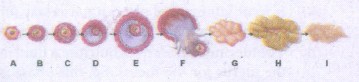
a) Identify the figure that illustrates ovulation and mention the stage of oogenesis it represents.
b) Name the ovarian hormone and the pituitary hormone that have caused the above-mentioned events.
c) Explain the changes that occurs in the uterus simultaneously in anticipation.
d) Write the difference between C and H.
69.
Comment on the methods of Eugenics.
70.
Explain the inheritance of sex linked characters in human being.
71.
72.
73.
Differentiate between the following:
(a) Binary fission in amoeba and multiple fission in Plasmodium
(b) Budding in yeast and budding in Hydra
(c) Regeneration in lizard and Planaria
74.
Explain polygenic inheritance with an example.
75.
76.
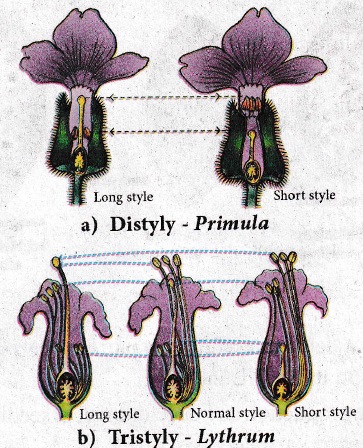
Write short note on Heterostyly.
77.
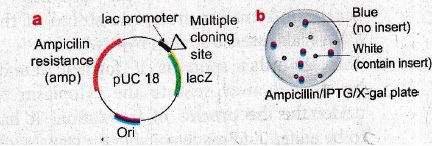
Explain a method for screening of recombinant Plasmid
78.
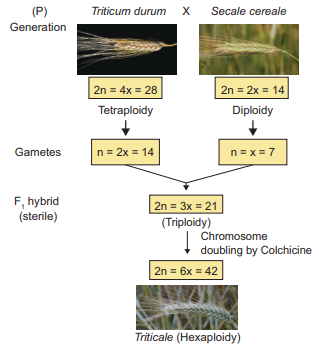
List out the significance of ploidy.
79.
Why crossing over is important?
80.
Which TSM is widely practiced and culturally accepted in Tamil Nadu? - explain.
81.
82.
Differentiate between Tundra and Taiga Biomes.
83.
Explain why cloning of Dolly, the sheep was such a major scientific breakthrough?
84.
85.
Mention the major threats to biodiversity caused by human activities. Explain.
86.
When does antibiotic resistance develop?
87.
What do you know about Germplasm conservation. Describe it.
88.
Amniocentesis, the foetal sex determination test, is banned in our country, Is it necessary? Comment.
89.
It is established that RNA is the first genetic material. Justify giving reasons.
90.
Explain the role of oxytocin and relaxin in parturition and lactation.
91.
Why do you think it is not possible to produce vaccine against 'common cold'?
92.
List the common withdrawal symptoms of drugs and alcohol abuse.
1.
Based on the temperature prevailing in an area, Raunkiaer classified the world's vegetation into the following four types.
(i) Megatherms
(ii) Mesotherms
(iii) Microtherms
(iv) Hekistotherms
2.
3.
(i) Neanderthal human was found in Neander Valley, Germany with a brain size of 1400 cc and lived between 34,000 - 1,00,000 years ago.
(ii) They differ from the modern. human in having semierect posture, flat cranium, sloping forehead, thin large orbits, heavy brow ridges, protruding jaws and no chin.
4.
| juvenile phase | reproductive phase |
| lt is also known as young and Vegetative Phase | It is also known as Maturity adult Phase |
| lt is the period of growth between the birth of the individual upto reproductive maturitiy. | The organisms reproduce and their offsprings reach maturity period |
5.
Gymnosperms - Pollination is said to be direct as the pollen are deposited directly on the exposed ovules Angiosperms - Pollination is said to be indirect as the pollen are deposited on the stigma of the pistil.
6.
According to the theory of chemical evolution, primitive organisms in the primordial environment of the Earth evolved spontaneously from inorganic substances and physical forces such as lightning, UV radiations, volcanic activities, etc. Oparin (1924) suggested that the organic compounds could have undergone a series of reactions leading to more complex molecules. He proposed that the molecules formed colloidal aggregates or 'coacervates' in an aqueous environment. The coacervates were able to absorb and assimilate organic compounds from the environment. Haldane (1929) proposed that the primordial sea served as a vast chemical laboratory powered by solar energy. The atmosphere was oxygen free and the combination of CO2, NH3 and UV radiations gave rise to organic compounds. The sea became a 'hot' dilute soup containing large populations of organic monomers and polymers. They envisaged that groups of monomers and polymers acquired lipid membranes and further developed into the first living cell. Haldane coined the term prebiotic soup and this became the powerful symbol of the Oparin-Haldane view on the origin of life (1924-1929). Oparin and Haldane independently suggested that if the primitive atmosphere was reducing and if there was appropriate supply of energy such as lightning or UV light then a wide range of organic compounds can be synthesized.
7.
In eukaryotes, organization is more complex. Chromatin is formed by a series of repeating units called nucleosomes. Kornberg proposed a model for the nucleosome, in which 2 molecules of the four histone proteins H2A, H2B, H3 and H4 are organized to form a unit of eight molecules called histone octamere. The negatively charged DNA is wrapped around the positively charged histone octamere to form a structure called nucleosome. A typical nucleosome contains 200 bp of DNA helix. The histone octameres are in close contact and DNA is coiled on the outside of nucleosome. Neighbouring nucleosomes are connected by linker DNA (HI) that is exposed to enzymes. The DNA makes two complete turns around the histone octameres and the two turns are sealed off by an HI molecule. Chromatin lacking HI has a beads-on-a-string appearance in which DNA enters and leaves the nucleosomes at random places. HI of one nucleosome can interact with HI of the neighbouring nucleosomes resulting in the further folding of the fibre. The chromatin fiber in interphase nuclei and mitotic chromosomes have a diameter that vary between 200-300 nm and represents inactive chromatin. 30 nm fibre arises from the folding of nucleosome, chains into a solenoid structure having six nucleosomes per turn. This structure is stabilized by interaction between different HI molecules. DNA is a solenoid and packed about 40 folds. The hierarchical nature of chromosome structure is illustrated. Additional set of proteins are required for packing of chromatin at higher level and are referred to as non-histone chromosomal proteins (NHC). In a typical nucleus, some regions of chromatin are loosely packed (lightly stained) and are referred to as euchromatin. The chromatin that is tightly packed (stained darkly) is called heterochromatin. Euchromatin is transcriptionally active and heterochromatin is transcriptionally inactive.
8.
Organisms belonging to different populations interact for food, shelter, mating or for other necessities. Interaction may be intra specific (interaction within the members of same species) or interspecific (among organisms of different species).
Intraspecific association is observed for all livelihood processes like feeding, territoriality, breeding, and protection.
Interspecific associations or interactions can be:
Neutral: Where different species live together but do not affect each other.
Positive: It is a symbiotic relationship ill which no organism in association is harmed and either one or both may be benefitted. It is of two types - Mutualism and Commensalism.
Negative: One or both of the interacting organisms will be affected as in case of competition, predation, and parasitism.
9.
10.
Biogas is a mixture of different gases produced by the breakdown of organic matter in the absence of oxygen. Biogas can be produced from raw materials such as agricultural wastes, manure, municipal wastes, plant material, sewage, food waste, etc., Biogas is produced under the anaerobic condition when the organic materials are converted through microbiological reactions into gas and organic fertilizer. Biogas primarily consists of methane (63 percent), along with CO2 and hydrogen. Methane-producing bacteria are called methanogens and one such common bacterium is Methanobacterium. Biogas is devoid of smell and bums with a blue flame without smoke. The Methanogens are also present in anaerobic sludge and rumen of cattle. In the rumen, these bacteria help in the breakdown of cellulose. The excreta of cattle called dung is commonly called "Gobar". Gobar gas is generated by the anaerobic decomposition of cattle dung. It consists of methane, CO2 with some hydrogen, nitrogen and other gases in trace amounts.
In a biogas plant, anaerobic digestion is carried out in an airtight cylindrical tank known as digester. It is made up of concrete bricks and cement or steel. Bio-wastes are collected and a slurry of dung is fed into this digester. It has a side opening into which organic materials for digestion are incorporated for microbial activity. Anaerobic digestion is accomplished in three stages: solubilisation, acidogenesis, and methanogens. The outlet is connected to a pipe to supply biogas. The slurry is drained through another outlet and is used as fertilizer. Biogas is used for cooking and lighting. The technology of biogas production was developed in India mainly due to the efforts of the Indian Agricultural Research Institute (IARl) and Khadi and Village Industries Commission (KVIC).
11.
Microbes used for production of chemicals like organic acids and enzymes. Examples of organic acid producers are Aspergillus niger for citric acid, Acetobacter aceti for acetic acid, Rhizopus oryzae for fumaric acid, Clostridium butyricum for butyric acid and Lactobacillus for lactic acid.
Yeast (Saccharomyces cerevisiae) and bacteria are used for commercial production of enzymes. Lipases are used in detergent formulations and are used for removing oily stains from the laundry. Bottled juices are clarified by the use of pectinase, protease, and cellulase. Rennet can also be used to separate milk into solid curds for cheese making. Streptokinase produced by the bacterium Streptococcus and genetically engineered Streptococci are used as "clot buster" for removing clots from the blood. vessels of patients who have undergone myocardial infarction.
Cyclosporin A, an immunosuppressant used in organ transplantation is produced from the fungus Trichoderma polysporum. It is also used for its anti-inflammatory, anti-fungal, and anti-parasitic properties. Statins produced by the yeast Monascus purpureus have been used to lower blood cholesterol levels. It acts by competitively inhibiting the enzyme responsible for the synthesis of cholesterol. Recombinant human insulin has been produced predominantly using E. coli and Saccharomyces cerevisiae for therapeutic use in human.
12.
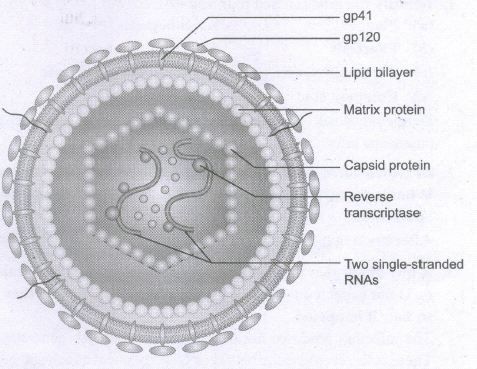
The human immunodeficiency virus belongs to the genus Lentivirus. When observed under the electron microscope, HIV is seen as a spherical virus, 100-120 nm in diameter, containing a dense core surrounded by a lipoprotein envelope. The envelope has .glycoprotein (GP) spikes termed GP 41 and GP 120. At the core, there are two large single-stranded RNA. Attached to the RNA are molecules of reverse transcripte. It also contains enzymes like protease and ribonuclease. The core is covered by a capsid made of proteins. This is followed by another layer of matrix proteins as shown above.
13.
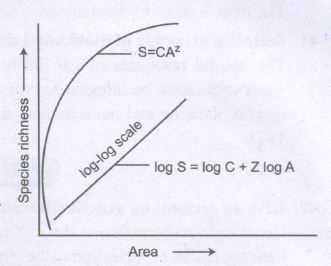
German Naturalist and Geographer Alexander von Humboldt explored the wilderness of south American jungles and found that within a region the species richness increased with increasing area but upto a certain limit. The relationship between species richness and area for a wide variety of taxa (angiosperm plants, birds, bats and freshwater fishes) turned out to be the rectangular hyperbola. On a logarithmic scale, the relationship is a straight line described by the equation.
where
log S = log C + Z log A
S = Species richness
A = Area
Z = Slope of the line
(regression coefficient)
C = Y-intercept
Regression coefficient Z generally has a value of 0.1-0.2 regardless of taxonomic group or region. However, in case of the species - area relationship in very large areas like entire continents; the slope of the line appears to be much steeper (Z-value in the range of 0.6-1.2). For example, in case of the fruit eating (frugivorous) birds and mammals in the tropical forests of different continents, the slope is found to be a steeper line.
14.
The reasons for the richness of biodiversity in the Tropics are:
(i) Warm tropical regions between the tropic of Cancer and Capricorn on either side of equator possess congenial habitats for living organisms.
(ii) Environmental conditions of the tropics are favourable not only for speciation but also for supporting both variety and number of organisms.
(iii) The temperatures vary between 25°C to 35°C, a range in which most metabolic activities of living organisms occur with ease and efficiency.
(iv) The average rainfall is often more than 200 mm per year.
(v) Climate, seasons, temperature, humidity, photoperiods are more or less stable and encourage both variety and numbers.
(vi) Rich resource and nutrient availability.
15.
Biotechnology has given to the society cheap drugs, better fruits and vegetables, pest resistant crops, indigenious cure to diseases and lot of controversy. This is mainly because the major part of the modem biotechnology deals with genetic manipulations. People fear that these genetic manipulations may lead to unknown consequences. The major apprehension of recombinant DNA technology is that unique microorganisms either inadvertently or deliberately for the purpose of war may be developed that could cause epidemics or environmental catastrophies. Although many are concerned about the possible risk of genetic engineering, the risks are in fact slight and the potential benefits are substantial.
16.
Stem cells are undifferentiated cells found in most of the multi cellular animals. These cells maintain their undifferentiated state even after undergoing numerous mitotic divisions. Stem cell research has the potential to revolutionize the future of medicine with the ability to regenerate damaged and diseased organs. Stem cells are capable of self renewal and exhibit 'cellular potency'. Stem cells can differentiate into all types of cells that are derived from any of the three germ layers ectoderm, endoderm and mesoderm.
In mammals there are two main types of stem cells - embryonic stem cells (ES cells) and adult stem cells. ES cells are pluripotent and can produce the three primary germ layers ectoderm, mesoderm and endoderm. Embryonic stem cells are multipotent stem cells that can differentiate into a number of types of cells. ES cells are isolated from the epiblast tissue of the inner cell mass of a blastocyst. When stimulated ES can develop into more than 200 cells types of the adult body. ES cells are immortal ie. they can proliferate in a sterile culture medium and maintain their undifferentiated state. Adult stem cells are found in various tissues of children as well as adults. An adult stem cell or somatic stem cell can divide and create another cell similar to it. Most of the adult stem cells are multipotent and can act as a repair system of the body, replenishing adult tissues. The red bone marrow is a rich source of adult stem cells.
The most important and potential application of human stem cells is the generation of cells and tissues that could be used for cell based therapies. Human stem cells could be used to test new drugs.
17.
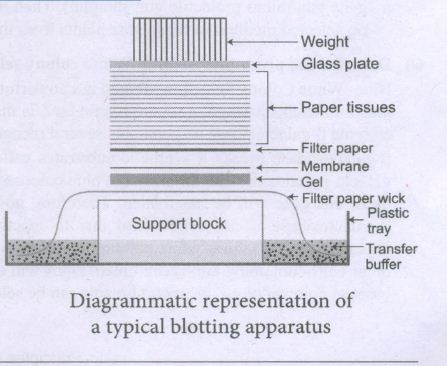
The transfer of denatured DNA from Agarose gel to Nitrocellulose Blotting or Filter Paper technique was introduced by Southern in 1975 and this technique is called Southern Blotting Technique.
steps
The transfer of DNA from agarose gel to nitrocellulose filter paper is achieved by Capillary Action. A buffer Sodium Saline Citrate (SSC) is used, in which DNA is highly soluble, it can be drawn up through the gel into the Nitrocellulose membrane By this process ss-DNA becomes 'Trapped' in the membrane matrix. This DNA is hybridized with a nucleic acid and can be detected by autoradiography. Autoradiography - A technique that captures the image formed in a photographic emulsion due to emission of light or radioactivity from a labelled component placed together with unexposed film.
18.
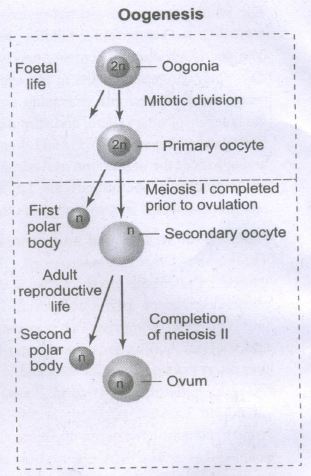
Oogenesis is the process of development of the female gamete or ovum or egg in the ovaries. During foetal development, certain cells in the germinal epithelium of the foetal ovary divide by mitosis and produce millions of egg mother cells or oogonia. No more oogonia are formed or added after birth. The oogonial cells start dividing and enter into Prophase- I of meiotic division-I to form the primary oocytes which are temporarily arrested at this stage. The primary oocytes then get surrounded by a single layer of granulosa cells to form the primordial or primary follicles. A large number of follicles degenerate during the period from birth to puberty, so at puberty, only 60,000 to 80,000 follicles are left in each ovary. The primary follicle gets surrounded by many layers of granulosa cells and a new theca layer to form the secondary follicle. A fluid filled space, the antrum develops in the follicle and gets transformed into a tertiary follicle. The theca layer gets organized into an inner theca intema and an outer theca extema. At this time, the primary oocyte within the tertiary follicle grows in size and completes its first meiotic division and forms the secondary oocyte. It is an unequal division resulting in the formation of a large haploid secondary oocyte and a first polar body. The first polar body disintegrates. During fertilization, the secondary oocyte undergoes second meiotic division and produces a large cell, the ovum, and a second polar body. The second polar body also degenerates. The tertiary follicle eventually becomes a mature follicle or Graafian follicle. If fertilization does not take place, the second meiotic division is never completed and the egg disintegrates. At the end of gametogenesis in females, each primary oocyte gives rise to only one haploid ovum.
19.
Regeneration is regrowth in the injured region. Regeneration was first studied in Hydra by Abraham Trembley in 1740. Regeneration is of two types, morphallaxis, and epimorphosis. In morphallaxis, the whole body grows from a small fragment e.g. Hydra and Planaria. When Hydra is accidentally cut into several pieces, each piece can regenerate the lost parts and develop into a whole new individual. The parts usually retain their original polarity, with oral ends, by developing tentacles .and aboral ends, by producing basal discs. Epimorphosis is the replacement of lost body parts. It is of two types, namely reparative and restorative regeneration. In reparative regeneration, only certain damaged tissue can be regenerated, whereas in restorative regeneration severed body parts can develop. e.g. starfish, the tail of wall lizard.
20.
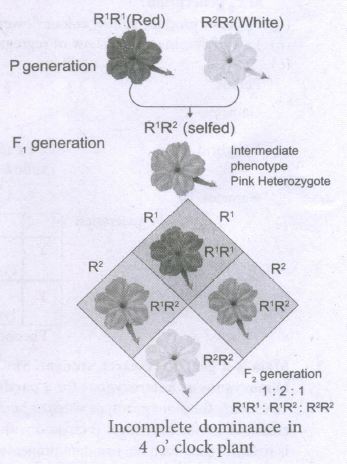
The German Botanist Carl Correns's (1905) Experiment - In 4 0' clock plant, Mirabilis jalapa when the pure breeding homozygous red (R1 R1) parent is crossed with homozygous white (R 2R2), the phenotype of the F1 hybrid is heterozygous pink (R1R2). The F1 heterozygous phenotype differs from both the parental homozygous phenotype. This cross did not exhibit the character of the dominant parent but an intermediate colour pink. When one allele is not completely dominant to another allele it shows incomplete dominance. Such allelic interaction is known as incomplete dominance. F1 generation produces intermediate phenotype pink coloured flower.
When pink coloured plants of F 1 generation were interbred in F2 both phenotypic and genotypic ratios were found to be identical as 1 : 2 : 1(1 red: 2 pink: 1 white). Genotypic ratio is 1 R1R1 : 2 R1R2 : 1 R2R2. From this we conclude that the alleles themselves remain discrete and unaltered proving the Mendel's Law of Segregation. The phenotypic and genotypic ratios are the same. There is no blending of genes. In the F2 generation R1 and R2 genes segregate and recombine to produce red, pink and white in the ratio of 1 : 2 : 1. R 1 allele codes for an enzyme responsible for the formation of red pigment. R2 allele codes for defective enzyme. R1 and R2 genotypes produce only enough red pigments to make the flower pink. Two R1R1 are needed for producing red flowers. Two R2R2 genes are needed for white flowers. If blending had taken place, the original pure traits would not have appeared and all F2 plants would have pink flowers. It is very clear that Mendel's particulate inheritance takes place in this cross which is confirmed by the reappearance of original phenotype in F2.
21.
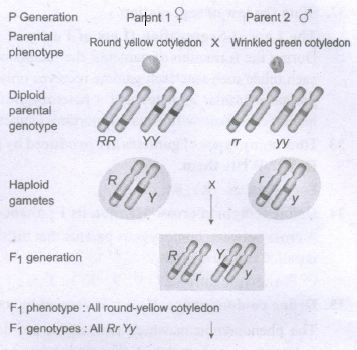
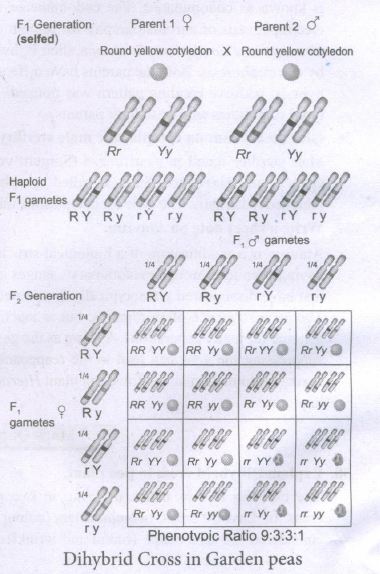
The crossing of two plants differing in two pairs of contrasting traits is called dihybrid cross. In a dihybrid cross, two characters (colour and shape) are considered at a time. Mendel considered the seed shape (round and wrinkled) and cotyledon colour (yellow & green) as the two characters. In seed shape round (R) is dominant over wrinkled (r); in cotyledon colour yellow (Y) is dominant over green (y). Hence the pure breeding round yellow parent is represented by the genotype RRYY and the pure breeding green wrinkled parent is represented by the genotype rryy. During gamete formation the paired genes of a character assort out independently of the other pair. During the F1 x F1 fertilization each zygote with an equal probability receives one of the four combinations from each parent. The resultant gametes thus will be genetically different and they are of the following four types:
1) Yellow round (YR)- 9/16
2) Yellow wrinkled (Yr)- 3/16
3) Green round (yR) - 3/16
4) Green wrinkled(yr) - 1/16
These four types of gametes of F1 dihybrids unite randomly in the process of fertilization and produce sixteen types of individuals in F2 in the ratio of 9 : 3 : 3 : 1 as shown in the figure. Mendel's 9:3:3:1 dihybrid ratio is an ideal ratio based on the probability including segregation, independent assortment and random fertilization. In sexually reproducing organism / plants from the garden peas to human beings, Mendel's findings laid the foundation for understanding inheritance and revolutionized the field of biology. The dihybrid cross and its result led Mendel to propose a second set of generalisations that we called Mendel's Law of independent assortment.
22.
Anemophilous plants have the following characteristic features:
(i) The flowers are produced in pendulous, catkin-like or spike inflorescence.
(ii) The axis of inflorescence elongates so that the flowers are brought well above the leaves.
(iii) The perianth is absent or highly reduced.
(iv) The flowers are small, inconspicuous, colourless, not scented, do not secrete nectar.
(v) The stamens are numerous, filaments are long, exerted and versatile.
(vi) Anthers produce enormous quantities of pollen grains compared to a number of ovules available for pollination. They are minute, light and dry so that they can be carried to long distances by wind.
(vii) In some plants, anthers burst violently and release the pollen into the air. Example: Urtica.
(viii) Stigmas are comparatively large, protruding, sometimes branched and feathery, adapted to catch the pollen grains. Generally, a single ovule is present.
(ix) The plant produces flowers before the new leaves appear, so the pollen can be carried without hindrance of leaves.
23.
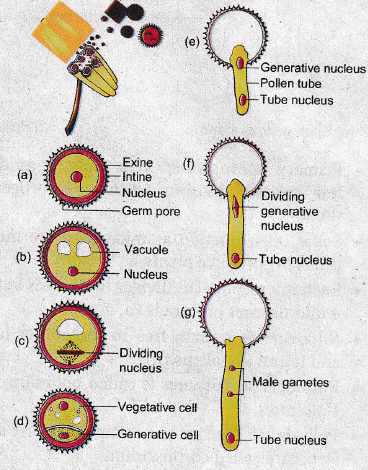
(i) The microspore is the first cell of the male gametophyte and is haploid.
(ii) The development of male gametophyte takes place while they are still in the microsporangium.
(iii) The nucleus of the microspore divides to form a vegetative and a generative nuclei.
(iv) A wall is laid around the generative nucleus resulting in the formation of two unequal cells, a large irregular nucleus bearing with abundant food reserve called vegetative cell and a small generative cell.
(v) At this two celled stage, the pollens are liberated from the anther.
(vi) In some plants, the generative cell again undergoes a division to form two male gametes.
(vii) In these plants, the pollen is liberated at 3 celled stages.
(viii) In 60% of the angiosperms, pollen is liberated in 2 celled stages.
(ix) The growth of the male gametophyte occurs only if the pollen reaches the right stigma.
(x) The pollen on reaching the stigma of absorbs moisture and swells.
(xi) The intine grows as pollen tube through the germ pore.
(xii) In case the pollen is liberated at 2 celled stages the generative cell divides in the pollen into 2 male cells (sperms) after reaching the stigma.
(xiii) The stages in the development of male gametophyte occurs in gynoecium of the plant.
24.
Autogenic succession
Autogenic succession occurs as a result of biotic factors. The vegetation reacts with its environment and modifies its own environment causing its own replacement by new communities. This is known as autogenic succession.
Example: In forest ecosystem, the larger trees produce broader leaves providing shade to the forest floor area. It affects the shrubs and herbs which require more light (heliophytes) but supports the shade tolerant species (sciophytes) to grow well.
Allogenic succession
Allogenic succession occurs as a result of abiotic factors. The replacement of existing community is caused by other external factors (soil erosion and leaching, etc.,) and not by existing organisms.
Example: In a forest ecosystem soil erosion and leaching alter the nutrient value of the soil leading to the change of vegetation in that area.
25.
Strategy of ecosystem management
(I) It is used to maintain biodiversity of ecosystems.
(II) It helps in indicating the damaged ecosystem (Some species indicate the health of the ecosystem: such species are called a flagship species).
(III) It is used to recognize the inevitability of ecosystem change and plan accordingly.
(IV) It is one of the tools used for achieving sustainability of ecosystem through sustainable development programme (or projects).
(V) It is also helpful in identifying ecosystems which are in need of rehabilitation.
(VI) It involves collaborative management with government agencies, local population, communities and NGO's.
(VII) It is used to build the capacity of local institutions and community groups to assume responsibility for long term implementation of ecosystem management activities even after the completion of the project.
26.
Morphological adaptations:
Root system is extensively developed. These roots may be of two types. They are Clinging roots and Aerial roots.
Clinging roots fix the epiphytes firmly on the surface of the supporting objects.
Aerial roots are green coloured roots which may hang downwardly and absorb moisture from the atmosphere with the help of a spongy tissue called velamen.
1. Stem of some epiphytes are succulent and develop pseudo bulb or tuber.
2. Generally the leaves are lesser in number and may be fleshy and leathery.
3. Myrmecophily is a common occurrence in the epiphytic vegetation to prevent the predators
4. The fruits and seeds are very small and usually dispersed by wind, insects and birds.
27.
The important edaphic factors which affect vegetation are as follows:
1. Soil moisture: Plants absorbs rain water and moisture directly from the air.
2. Soil water: Soil water is more important than any other ecological factors affecting the distribution of plants. Rain is the main source of soil water. Capillary water held between pore spaces of soil particles and angles between them is the most important form of water available to the plants.
3. Soil reactions: Soil may be acidic or alkaline or neutral in their reaction. pH value of the soil solution determines the availability of plant nutrients. The best pH range of the soil for cultivation of crop plants is 5.5 to 6.8.
4. Soil nutrients: Soil fertility and productivity is the ability of soil to provide all essential plant nutrients such as minerals and organic nutrients in the form of ions.
5. Soil temperature: Soil temperature of an area plays an important role in determining the geographical distribution of plants. Low temperature reduces use of water and solute absorption by roots.
6. Soil atmosphere: The spaces left between soil particles are called pore spaces which contains oxygen and carbon-di-oxide.
7. Soil organisms: Many organisms existing in the soil like bacteria, fungi, algae, protozoans, nematodes, insects and earthworms, etc., are called soil organisms.
28.
Plant tissue culture techniques have several applications such as:
i. Improved hybrids production through somatic hybridization.
ii. Somatic embryoids can be encapsulated into synthetic seeds (synseeds). These encapsulated seeds or synthetic seeds help in conservation of plant biodiversity.
iii. Production of disease resistant plants through meristem and shoot tip culture.
iv. Production of stress resistant plants like herbicide tolerant, heat tolerant plants.
v. Micropropagation technique to obtain large numbers of plantlets of both crop and tree species useful in forestry within a short span of time and all through the year.
vi. Production of secondary metabolites from cell culture utilized in pharmaceutical, cosmetic and food industries.
29.
Protoplasts are cells without a cell wall, but bounded by a cell membrane or plasma membrane. Using protoplasts, it is possible to regenerate whole plants from single cells and also develop somatic hybrids. The steps involved in protoplast culture are:
i) Isolation of protoplast: Small bits of plant tissue like leaf tissue are used for isolation of protoplast. The leaf tissue is immersed in 0.5% Macrozyme and 2% Onozuka cellulase enzymes dissolved in 13% sorbitol or mannitol at pH 5.4. It is then incubated overnight at 25°C. After a gentle teasing of cells, protoplasts are obtained, and these are then transferred to 20% sucrose solution to retain their viability. They are then centrifuged to get pure protoplasts as different from debris of cell walls.
ii) Fusion of protoplast: It is done through the use of a suitable fusogen. This is normally PEG (Polyethylene Glycol). The isolated protoplast are incubated in 25 to 30% concentration of PEG with Ca++ ions and the protoplast shows agglutination (the formation of clumps of cells) and fusion.
iii) Culture of protoplast: MS liquid medium is used with some modification in droplet, plating or micro-drop array techniques, Protoplast viability is tested with fluorescein diacetate before the culture. The cultures are incubated in continuous light 1000-2000 lux at 25°C. The cell wall formation occurs within 24-48 hours and the first division of new cells occurs between 2-7 days of culture.
iv) Selection of somatic hybrid cells: The fusion product of protoplasts without nucleus of different cells is called a cybrid. Following this nuclear fusion happen. This process is called somatic hybridization.
30.
Steps involved in hybridization are as follows:
1. Selection of Parents: Male and female plants of the desired characters are selected. It should be tested for their homozygosity.
2. Emasculation: It is a process of removal of anthers to prevent self pollination before anthesis (period of opening of a flower).
3. Bagging: The stigma of the flower is protected against any undesirable pollen grains, by covering it with a bag.
4. Crossing: Transfer of pollen grains from selected male flower to the stigma of the female emasculated flower.
5. Harvesting seeds and raising plants: The pollination leads to fertilization and finally seed formation takes place. The seeds are grown into new generation which are called a hybrid.
31.
Seaweed liquid fertilizer (SLF) contains cytokinin, gibberellins, and auxin apart from macro and micro nutrients. Most seaweed-based fertilizers are made from kelp (brown algae) which grows to length of 150 metres. Liquid seaweed fertilizer is not only organic but also eco-friendly. The alginates in the seaweed that reacts with metals in the soil and form long, crosslinked polymers in the soil. These polymers improve the crumbing in the soil, swell up when they get wet and retain moisture for a long time. They are especially useful in organic gardening which provides carbohydrates for plants. Seaweed has more than 70 minerals, vitamins and enzymes. It promotes vigorous growth. Improves resistance of plants to frost and disease. Seeds soaked in seaweed extract germinate much rapidly and develop a better root system.
32.
Every human activity leaves a mark just like our footprint. This Carbon footprint is the total amount of greenhouse gases produced by human activities such as agriculture, industries, deforestation, waste disposal, burning fossil fuels directly or indirectly. It can be measured for an individual, family, organization like industries, state level or national level. It is usually estimated and expressed in equivalent tons of CO2 per year. The burning of fossil fuels releases CO2 and other greenhouse gases. In turn, these emissions trap solar energy and thus increase the global temperature resulting in ice melting, submerging of low lying areas and imbalance in nature Iike cyclones, tsunamis, and extreme weather conditions. To reduce the carbon footprint we can follow some practices like
(i) Eating indigenous fruits and products
(ii) Reduce use of your electronic devices
(iii) Reduce traveling
(iv) Do not buy fast and preserved, processed, packed foods.
(v) Plant a garden
(vi) Less consumption of meat and seafood. Poultry requires little space, nutrients and less pollution comparing cattle farming.
(vii) reduce the use of Laptops (when used for 8 hours, it releases nearly 2 kg. of CO2 annually)
(viii) Line dry your clothes. (Example: If you buy imported fruit like kiwi, indirectly it increases CFP. How? The fruit has traveled a long distance in shipping or airliner thus emitting tons of CO2)
33.
Afforestation Objectives:
(i) To increase forest cover, planting more trees, increases CO2 production and air quality.
(ii) Rehabilitation of degraded forests to increase carbon fixation and reducing CO2 from atmosphere.
(iii) Raising bamboo plantations.
(iv) Mixed plantations of minor forest produce and medicinal plants.
(v) Regeneration of indigenous herbs/shrubs.
(vi) Awareness creation, monitoring, and evaluation.
(vii) To increase the level and availability of water table or ground water and also to reduce nitrogen leaching in soil and nitrogen contamination of drinking water, thus making it pure not polluted with nitrogen.
(viii) Nature aided artificial regeneration.
34.
| S.No | Common Name | Botanical Name | Family | Plant Part Used | Medicinal Uses |
| 1 | Holy basil | Ocimum Sanctum | Lamiaceae | Leaves and Roots | The leaves are stimulant, antiseptic, antihypertensive and anti-bacterial and expectorant used in bronchitis. Decoction of roots is given as a diaphoretic in malarial fever. |
| 2 | Indian Phyllanthus | Phyllanthus emblica | Phyllanthaceae | Fruit | It is a potent rejuvenator and immune modulator. It has a anti-ageing properties. It helps to promote longevity, enhance digestion, treat constipation and reduce fever and cough. |
| 3 | Indian Acalypha | Acalypha indica | Euphorbiaceae | Leaves | Used to cure skin diseases caused by ringworms. Powdered leaves are used to cure bedsores and infected wounds |
| 4 | Vilvam | Aegle marmelos | Rutaceae | Fruit | The unripe fruit is used to treat problems of stomach indigestion. It kills intestinal parasites. |
| 5 | Veldt grape | Cissus quandran-gularis | Vitaceae | Stem and Root | Paste obtained from the and powdered stem and root root of this plant is used in bone fractures. Whole plant is useful to treat asthma and stomach troubles. |
35.
Black gram
(i) Botanical name : Vigna mungo.
(i) Origin and Area of cultivation : Black gram is native to India.
(ii) Earliest archeobotanical evidences record the presence of black gram about 3,500 years ago.
(iii) It is cultivated as a rain fed crop in drier parts of India.
(iv) India contributes to 80% of the global production of black gram.
(v) important states growing black gram in India are Uttar Pradesh, Chattisgarh and Karnataka.
Uses:
(i) Black gram is eaten whole or split, boiled or roasted or ground into flour.
(ii) Black gram batter is a major ingredients for the preparation of popular Southern Indian breakfast dishes.
(iii) Split pulse is used in seasoning Indian curries.
36.
Objections to Darwinism: Some objections raised against Darwinism were -
(i) Darwin failed to explain the mechanism of variation.
(ii) Darwinism explains the survival of the fittest but not the arrival of the fittest.
(iii) He focused on small fluctuating variations that are mostly non-heritable.
(iv) He did not distinguish between somatic and germinal variations.
(v) He could not explain the occurrence of vestigial organs, over specialization of some organs like large tusks in extinct mammoths, oversized antlers in the extinct Irish deer, etc.,
37.
Radioactive waste management involves the treatment, storage and disposal of liquid, airborne and solid effluents from the nuclear industry. Three ways are employed to manage nuclear wastes
(i) Spent Fuel Pools - The spent fuel discharged from the reactors is temporarily stored in the reactor pool. The Spent fuel rods are used in stored cooling ponds. They protect the surroundings from radiation and absorb the heat generated during radioactive decay.
(ii) Vitrification method - This prevents reaction or degradation of nuclear waste for extended periods of time and encased in dry cement caskets.
(iii) Geological Repositories - A deep geological repository is a nuclear waste repository excavated deep within a stable geologic environment. It is suited to provide a high level of long-term isolation and containment without future maintenance. In India at Tarapur and Kalpakkam, a wet storage facility of Spent Fuel is the main mode of storage.
38.
Inability to conceive or produce children even after unprotected sexual cohabitation is called infertility. That is, the inability of a man to produce sufficient numbers or quality of sperm to impregnate a woman or inability of a woman to become pregnant or maintain a pregnancy. The causes for infertility are tumours formed in the pituitary or reproductive organs, inherited mutations of genes responsible for the biosynthesis of sex hormones, malformation of the cervix or fallopian tubes and inadequate nutrition before adulthood. Long-term stress damages many aspects of health especially the menstrual cycle. Ingestion of toxins (heavy metal cadmium), heavy use of alcohol, tobacco and marijuana, injuries to the gonads and aging also cause infertility.
Other causes of infertility:
(i) Pelvic inflammatory disease (PID), uterine fibroids and endometriosis are the most common causes of infertility in women.
(ii) Low body fat or anorexia in women. i.e. a psychiatric eating disorder characterised by the fear of gaining weight.
(iii) Undescended testes and swollen veins (varicocele) in scrotum. Tight clothing in men may raise the temperature in the scrotum and affect sperm production.
(iv) Under developed ovaries or testes.
(v) Female may develop antibodies against her partner's sperm.
(vi) Males may develop an autoimmune response to their own sperm.
39.
Breast self examination and early diagnosis of cancer.
(i) Breast is divided into 4 quadrants and the center (Nipple) which is the 5th quadrant.
(ii) Each quadrant of the breast is felt for lumps using the palm of the opposite hand.
(iii) The examination is done in both lying down and standing positions, monthly once after the 1st week of menstrual cycle. This way if there are lumps or any deviation of the nipple to one side or any blood discharge from the nipple we can identify cancer at an early stage. Mammograms are done for women above the age of 40 years and for young girls and women below 40 years. Ultrasound of the breast aids in early diagnosis.
40.
(i) Grasslands occur in temperate and in the tropical regions.
(ii) They have hot summers, cold winters, and irregular rainfall.
(iii) Often they are characterized by high winds.
(iv) The low irregular rainfall is the factor which makes the difference between a temperate deciduous forest and a temperate grassland.
(v) Herbivores like antelope, bison, wild horse, jack rabbit, ground squirrel and prairie dogs are abundant.
(vi) Predators include coyotes, foxes, hawks and snakes.
(vi) In India, fauna of grasslands includes Elephant, Gaur, Rhino, Antelope.
(vii) Flora of grasslands include purple needle grass, wild oats, foxtail, ryegrass and buffalo grass.
41.
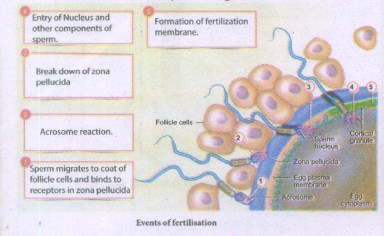
(i) Fertilisation occurs when a haploid sperm fuses with a haploid ovum to form a fertilized egg or diploid zygote.
(ii) The sperms deposited in the female reproductive tract undergo capacitation, which is a biochemical event that enables the sperm to penetrate and fertilise the egg.
(iii) Fertilization occurs only if the ovum and sperms are transported simultaneously to the ampullary isthmic junction of the fallopian tube.
(Iv) Before a sperm can enter the egg, it must penetrate the multiple layers of granulosa (follicular) cells which are around the ovum forming the corona radiata. The follicular cells are held together by an adhesive cementing substance called hyaluronic acid.
(v) The acrosomal membrane disintegrates releasing the proteolytic enzyme, hyaluronidase during sperm entry through the corona radiata and zona pellucida. This is called acrosomal reaction.
(vi) Once fertilisation is accomplished, cortical granules from the cytoplasm of the ovum form a barrier called the fertilisation membrane around the ovum preventing further penetration of other sperms. Thus polyspermy is prevented.
This is followed by cleavage
42.
| No | Diseases | Causative agent | Site of infection | Mode of transmission | Symptoms |
|---|---|---|---|---|---|
| 1. | Shigellosis (Bacillary dysentery) | Shigella sp. | Intestine | Food and water contaminated by faces oral route | Abdominal pain,dehydration, blood and mucus in the stools |
| 2. | Bubonic plague (Black death) | Yersinia pestis | Lymph nodes' | Rat flea vectorXenopsylla cheopis | Fever, headache, and swollen lymph nodes |
| 3. | Diphtheria | Corynebacterium diphtheriae | Larynx, skin nasal and genital passage | Droplet infection | Fever, sore throat, hoarseness and difficulty in breathing |
| 4. | Cholera | Vibrio cholerae | Intestine | Contaminated food and water/faecal oral route | Severe diarrhoea and dehydration |
| 5. | Tetanus)Lock jaw) | Clostridium tetani | Spasm of muscles | Through wound infection | Rigidity of jaw muscle increased heart beat rate and spasm of the muscles of the jaw and face |
43.
The salient features of genetic code are as follows:
(i) The genetic codon is a triplet code and 61 codons code for amino acids and 3 codons do not code for any amino acid and function as stop codon (Termination).
(ii) The genetic code is universal. It means that all known living systems use nucleic acids and the same three base codons (triplet codon) direct the synthesis of protein from amino acids. for example, the mRNA (UUU) codon codes for phenylalanine in all cells of all organisms. some exceptions are reported in prokaryotic, mitochondrial and chloroplast genomes. However similarities are more common than differences. Most part of the genetic code is universal in prokaryotes and eukaryotes.
(iii) A non-overlapping codon means that the same letter is not used for two different codons. for instance, the nucleotide sequence GUU GUC represents only two codons.
(iv) It is comma less, which means that the message would be read directly from one end to the other i.e., no punctuation are needed between two codes.
(v) A degenerate code means that more than one triplet codon could code for a specific amino acid. for example, codons GUU, GCU, GUA and GUG code for valine.
(vi) Non-ambiguous code means that one codon will code for one amino acid.
(vii) The code is always read in a fixed direction i.e. from 5'⟶3' direction called polarity.
(viii) AUG has dual functions. It acts as a initiator codon and also codes for the amino acid methionine.
(ix) UAA, UAG (tyrosine) and UGA (tryptophan) codons are designated as termination (stop) codons and also are known as "non-sense" codons.
44.
In binary fission, the parent organism divides into two halves and each half forms a daughter individual. The nucleus divides first amitotically or mitotically (karyokinesis), followed by the division of the cytoplasm (cytokinesis). The resultant offsprings are genetically identical to the parent. Depending on the plane of fission, binary fission is of the following types
(i) Simple irregular binary fission
(ii) Transverse binary fission
(iii) Longitudinal binary fission
(iv) Oblique binary fission
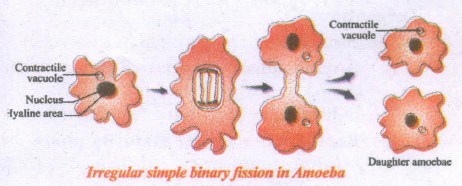
(i) Simple irregular binary fission is seen in Amoeba like irregular shaped organisms, where the plane of division is hard to observe. The contractile vacuoles cease to function and disappear. The nucleoli disintegrate and the nucleus divides mitotically. The cell then constricts in the middle, so the cytoplasm divides and forms two daughter cells.
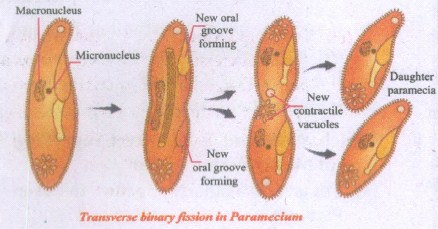
(ii) In Transverse binary fission, the plane of the division runs along the transverse axis of the individual. E.g. Paramecium and Planaria. In Paramecium the macronucleus divides by amitosis and the micronucleus divides by mitosis.
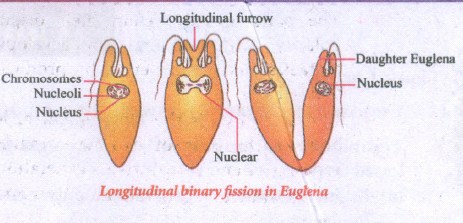
(iii) In Longitudinal binary fission the nucleus and the cytoplasm divides in the longitudinal axis of the organism. In flagellates, the flagellum is retained usually by one daughter cell. The basal granule is divided into two and the new basal granule forms a flagellum in the other daughter individual. E.g. Vorticella and Euglena.
(iv) In Oblique binary fission the plane of division is oblique. It is seen in dinoflagellates. E.g. Ceratium.
45.
(i) The human immunodeficiency virus belongs to the genus Lentivirus
(ii) When observed under the microscope, HIV is seen as a electron spherical virus, 100-12 nm in diameter, containing a dense core surrounded by a lipoprotein envelope.
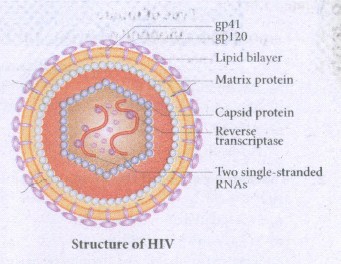
(iii) The envelope has glycoprotein (gp) spikes termed gp 41 and gp 120. At the core, there are two large single stranded RNA.
(iv) Attached to the RNA are molecules of reverse transcriptase. It also contains enzymes like protease and ribonuclease.
(v) The core is covered by a capsid made of proteins. This is followed by another layer of matrix' proteins as shown in the Fig.
46.
Thymus is most active during the neonatal an pre-adolescent periods. The thymus is a flat and bilobed organ located behind the sternum, above the heart.
(ii) Each lobe of the thymus contains numerous lobules, separated from each other by connective tissue called septa. Each lobule is differentiated into an outer cortex and an inner medulla.
(iii) Within each lobule, the developing T cells called thymocytes are arranged into outer cortex and inner medulla. The inner medulla contains immature thymocytes and outer cortex has matured thymocytes.
(iv) One of its main secretions is the hormone thymosin. It stimulates the T cell to become mature and immunocompetent. By the early teens, the thymus begins to atrophy and is replaced by adipose tissue.
47.
The methods adopted for the improvement of human beings are
(i) Eugenics
(ii) Euthenics
(iii) Euphenics
Eugenics:
Application of the laws of genetics for the improvement of human race is called eugenics. The term eugenics means "well born" and was coined by Francis Galton in 1885. For the betterment of future generations it is necessary to increase the population of outstanding people and to decrease the population of abnormal and defective people by applying the principles of eugenics.
Two methods of Eugenics
(i) Constructive method or Positive eugenics
(ii) Restrictive method or Negative eugenics
(i) Positive eugenics: Positive eugenics attempts to increase consistently better or desirable germplasm and to preserve the best germplasm of the society. The desirable traits can be increased by adopting the following measures:
a) Early marriage of those having desirable traits
b) Subsiding the fit and establishing sperm and egg banks of precious germplasm
c) Educating the basic principles of genetics and eugenics
d) Improvement of environmental conditions
e) Promotion of genetic research
(ii) Negative eugenics: Negative Eugenics attempts to eliminate the defective germplasm of the society by adopting the following measures:
(a) Sexual separation of the defectives
(b) Sterilization of the defectives
(c) Control of immigration and
(d) Regulation of marriages
Euphenics:
man is called Euphenics or Medical engineering. In 1960, Joshua Lederberg coined the term Euphenics. It means normal appearing. It deals with the control of several inherited human diseases especially the inborn errors of metabolism. Eg. Phenylketonuria (PKU)
Euthenics:
The science of improvement of existing human race by improving the environmental conditions is called euthenics. It can be achieved by subjecting them to better nutrition, better unpolluted ecological conditions, better education and sufficient medical facilities
48.
Mitotic or meiotic non-disjunction of sex chromosomes causes allosomal abnormalities. Several sex chromosomal abnormalities have been detected. Eg. Klinefelter's syndrome and Turner's syndrome.
i) Klinefelter's Syndrome (XXY Males)
This genetic disorder is due to the presence of an additional copy of the X chromosome resulting in a karyotype of 47,XXY. Persons with this syndrome have 47 chromosomes (44AA+XXY). They are usually sterile males, tall, obese, with long limbs, high pitched voice, under developed genitalia and have feeble breast (gynecomastia) development.
(ii) Turner's Syndrome (XO Females)
This genetic disorder is due to the loss of a X chromosome resulting in a karyotype of 45, X. Persons with this syndrome have 45 chromosomes (44 auto somes and one X chromosome) (44AA+XO) and are sterile females. Low stature, webbed neck, under developed breast, rudimentary gonads lack of menstrual cycle during puberty, are the main symptoms of this syndrome.
49.
A vaccine is a biological preparation that provides active acquired immunity to a particular disease and resembles a diseasecausing microorganism and is often made from weakened or atlenuated or killed forms of the microbes, their toxins, or one of its surface proteins. The vaccines are classified as first, second and third generation vaccines.
50.
51.
52.
(i) Hybridization, Mutation breeding, Polyploid breeding, Breeding for developing resistance to diseases, Biofortification, Breeding for resistance to insect pests, New Breeding Techniques (NBT) such as.
(ii) CRISPR/ Cas (Cutting and modifying the genome during the repair process by tool).
(iii) ODM: Oligonucleotide - directed mutagenesis
(iv) Transferring a gene from an identical or closely related species (Cisgenesis).
(v) Organising processes that alter gene activity without altering the DNA itself (Epigenetic methods).
53.
54.
.jpg)
55.
Type of succession
Hydrosere
(i) The succession in a freshwater ecosystem is also referred to as hydrosere
(ii) Succession in a pond, begins with colonization of the pioneer's like phytoplankton and finally ends with the formation of climax community like forest stage. It includes the following stages
(a) Phytoplankton stage
It is the first stage of succession consisting of the pioneer Community like blue green algae, green algae, diatoms, bacteria, etc.,
The colonization of these organisms enrich the amount of organic matter and nutrients of pond due to their life activities and death.
This favors the development of the next several stages
(b) Submerged plant stage
As the result of death and decomposition of planktons, silt brought from land by rain water, lead to a loose mud formation at the bottom of the pond. Hence, the rooted submerged hydrophytes begin to appear on the new substratum.
Example: Chara, Utricularia, Vallisneria and Hydrilla etc.
The death and decay of these plants will build up the substratum of pond to become shallow. Therefore, this habitat now replaces another group of plants which are of floating type.
(c) Submerged free floating stage
During this stage, the depth of the pond will become almost 2-5 feet
Hence, the rooted hydrophytic plants and with floating large leaves start colonising the pond.
Example: Rooted floating plants like Nelumbo, Nymphaea and Trapa. Some free floating species like Azolla, Lemna, Wolffia and Pistia are also present in this stage.
By death and decomposition of these plants, further the pond becomes more shallow.
Due to this reason, floating plant species is gradually replaced by another species which makes new several stage.
(d) Reed-swamp stage
It is also called an amphibious stage.
During this stage, rooted floating plants are replaced by plants which can live successfully in aquatic as well as aerial environment.
Example: Typha, Phragmites, Sagittaria and Scirpus etc. At the end of this stage, water level is very much reduced, making it unsuitable for the continuous growth of amphibious Plants.
(e) Marsh meadow stage
When the pond becomes swallowed due to decreasing water level
Species of Cyperaceae and Poaceae such as Carex, Iuncus, Cyperus and Eleocharis colonise the area
They form a mat-like vegetation with the help of their much branched root system.
This leads to an absorption and loss of large quantity of water
At the end of this stage, the soil becomes dry and the marshy vegetation disappears gradually and leads to shurb stage
(d) Shrub stage
As the disappearance of marshy vegetation continues, soil becomes dry.
Hence, these areas are now invaded by terrestrial plants like shrubs (Salix and Cornus) and trees (Populus and Alnus).
These plants absorb large quantity of water and make the habitat dry.
Further, the accumulation of humus with a rich flora of microorganisms produce minerals in the soil, ultimately favouring the arrival of new tree species in the area
(e) Forest stage
It is the climax community of hydrosere.
A variety of trees invade the area and develop any one of the diverse type of vegetation.
Example: Temperate mixed forest (Ulmus, Acer and Quercus), Tropical rain forest (Artocarpus and Cinnamomum) and Tropical deciduous forest (Bamboo and Tectona).
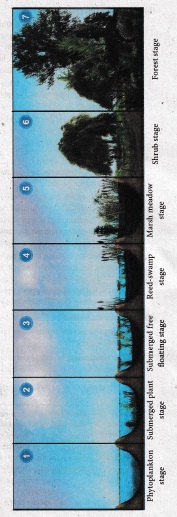
In the 7 stages of hydrosere succession, stage 1 is occupied by pioneer community, while the stage 7 is occupied by the climax community. The stages 2 to 6 are occupied by several communities,
56.
Grassland ecosystem : There is a gradual decrease in the number of organisms in each trophic level from producers to primary consumers and then to secondary consumers, and finally to tertiary consumers. Therefore pyramids of number in grassland ecosystem are always upright.
57.
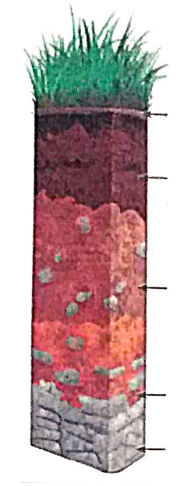 Horizon Description O-Horizon (Organic horizon) Humus It consists of fresh or partially decomposed organic matter.
58.
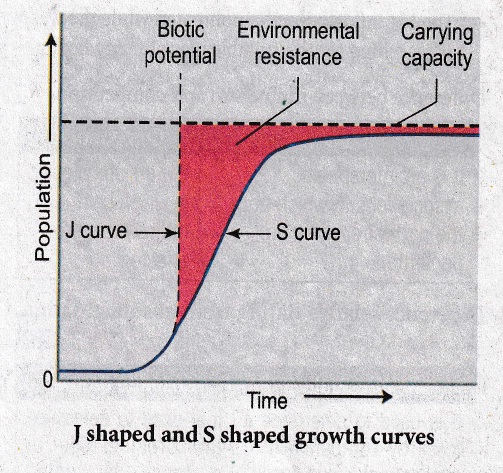
Biotic potential:
It is the maximum reproductive capacity of an organism under optimum environmental conditions.
Carrying capacity:
The maximum number of organisms live in a region can support without environmental degradation is called carrying capacity.
Environmental resistance:
Is the sum total of the environmental limiting factors, both biotic and abiotic which together act to prevent the biotic potential of an organism from being realized.
59.
(i) When trees are cut down and burnt or allowed to rot, their stored carbon is released into the air as carbon dioxide. This adds to the carbon dioxide content of the air. Carbon dioxide is a major greenhouse gas. The increase in concentration of carbon dioxide in the air increases the greenhouse effect and thereby causes global warming. It has been estimated that 25-30% of the greenhouse gases released into the atmosphere each year is because of deforestation.
(ii) Trees act as carbon sink since they utilize carbon dioxide for photosynthesis. When trees are cut down, the carbon footprint increases. This, in turn leads to global warming.
60.
(i) Catalytic converter:
1. Used in automobiles for reducing emission of harmful gases.
2. They have expensive metals like platinum, palladium and rhodium as catalysts.
3. As the exhaust passes through the catalytic converter, unburnt hydrocarbons are converted to CO2 and water, carbon monoxide & nitric oxide are changed into CO2 & nitrogen gas respectively.
4. Vehicles fitted with catalytic convertor must use unleaded petrol as lead will inactivate the catalyst.
(ii) Ecosan toilets
1. Ecological sanitation, commonly abbreviated as ecosan, is an approach to sanitation provision which aims to safely reuse excreta in agriculture.
2. It desires to close the loop' mainly for the nutrients and organic matter between sanitation and agriculture
61.
Advantages
1. Offers benefits for clinical traits and medical research.
2. It can help in the production of help in the production of proteins and drugs in the field of medicine.
3. Aids in stem cell research
4. Animal cloning could help to save endangered species.
Disadvantages
1. In animal and human activities, it as a threat to biodiversity saying that this alters evolution which will have an impact on populations and ecosystem.
2. The process is tedious and very expensive.
3. It can cause animals to suffer
4. Reports show that animal surrogates were manifesting adverse outcomes and cloned animals were affected with disease and have high mortality rate.
5. It might compromises human health through consumption of cloned animal meat.
6. Cloned animals age faster than normal animals and are less healthy than the parent organisms as discovered in Dolly.
7. Cloning can lead to occurrence of genetic disorders in animals.
8. More than 90% of cloning attempts fail to produce a viable offspring.
62.
63.
Similarities found in Neanderthal man and Homo sapiens.
(i) They knew to protect their bodies. Neanderthal man used animal hides to protect their bodies.
(ii) They knew the use of fire.
(iii) They buried their dead.
64.
1. Reproductive health refers not only to healthy reproductive functions, but to the total well being of physical mental emotional, behavioural and social aspects of reproduction.
2. People having physically and functionally normal reproductive organs and exhibit normal behavioural and emotional interactions among themselves in all reproduction-related aspects are considered reproductively healthy.
3. 214 million women of reproductive age in developing countries who wants to avoid pregnancy are not using a modern contraceptive method.
4. Some family planning methods, such as condoms help prevent the transmission of HIV and other sexual transmitted infections.
5. Family planning contraception reduces the need for abortion, especially unsafe abortion.
6. Family planning reinforces people's rights to determine the number and spacing of their children.
7. By preventing unintended pregnancy, family planning/contraception prevents deaths of mothers and children.
8. Family planning is the key to slowing unsustainable population growth and the resulting negative impacts on the economy, environment and National and Regional development efforts.
65.
66.
67.
(i) In eukaryotes, chromatin is formed by a series of repeating units called nucleosomes.
(ii) Korenberg proposed a model for the nucleosome, in which 2 molecules of the four histone proteins H2A, H2B, H3 AND H4 are organized to form a unit of eight molecules called histone octamere.
(iii) The negatively charged DNA is wrapped around the positively charged histone octamer to form a structure called nucleosome. A typical nucleosome contains 200 bp of DNA helix.
(iv) The histone octameres are in close contact and DNA is coiled on the outside of nucleosome.
(v) Neighbouring nucleosomes are connected by linker DNA (Hl) that is exposed to enzymes. The DNA makes two complete turns around the histone octameres and the two turns are sealed off by an HI molecule
(vi) Chromatin lacking HI has beads on a string appearance in which DNA enters and leaves the nucleosomes at random places.
(vii) HI of one nucleosome can interact with HI of the neighbouring nucleosomes resulting in the further folding of the fibre.
68.
(a) The figure 'F' represent ovulation.
Stage of oogenesis - Ovulatory or luteal stage of oogenesis
(b) (i) The ovarian hormone is progesterone which is released during ovulation.
(ii) The pituitary hormones are the follicle-stimulating hormone (FSH) and Luteinizing hormone (LSH) which are released during and ovulation from anterior pituitary gland.
(c) The endometrium of the uterus gets thickened and blood supply to the endometrium increase.
(d) Figure 'C' represents the secondary follicle and figure h represents the degenerating corpus luteum.
| Secondary follicle | Corpus luteurn |
| lt is surrounded by layers of granulosa cells | Absence of granulosa cells |
| Theca layer is present | Theca layer is absent. |
69.
Application of the laws of genetics for the improvement of human race is called eugenics.
Two methods of Eugenics are:
(i) Constructive method or Positive eugenics
(ii) Restrictive method or Negative eugenics
(i) Positive eugenics: Positive eugenics attempts to increase consistently better or desirable germplasm and to preserve the best germplasm of the society. The desirable traits can be increased by adopting the following measures:
(a) Early marriage of those having desirable traits
(b) Subsiding the fit and establishing sperm and egg banks of precious germ plasm.
(c) Educating the basic principles of genetics and eugenics.
(d) Improvement of environmental conditions.
(e) Promotion of genetic research.
(ii) Negative eugenics: Negative eugenics attempts to eliminate the defective germplasm of the society by adopting the following measures:
(a) Sexual separation of the defectives
(b) Sterilization of the defectives
(c Control of immigration and
(d) Regulation of marriages
70.
(i) The inheritance of a trait that is determined by a gene located on one of the sex chromosomes is called sex linked inheritance.
(ii) Genes present on the differential region of X or Y chromosomes are called sex linked genes. The genes present in the differential region of "X" chromosome are called X linked genes. The X-linked genes have no corresponding alleles in the Y chromosome.
(iii) The genes present in the differential region of Y chromosome are called Y- linked or holandric genes. The Y linked genes have no corresponding allele in X chromosome.
(iv) The Y linked genes inherit along with Y chromosome and they phenotypically express only in the male sex.
(v) Sex linked inherited traits are more common in males than females because, males are hemizygous and therefore express the trait when they inherit one mutant allele.
(vi) The X - linked and Y - linked genes in the differential region (non-homologus region) do not undergo pairing or crossing over during meiosis. The inheritance of X or Y linked genes is called sex-linked inheritance.
X linked Inheritance - Eg. Colour blindness
Y linked Inheritance - Eg. hypertrichosis
71.
72.
73.
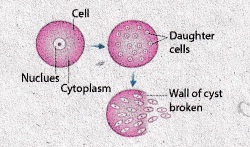
(a)
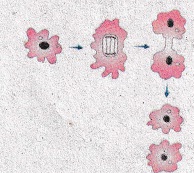
| Binary Fission in Amoeba | Multiple fission in Plasmodium |
| lt results in the production of two individuals from a single parent. | It results in the production of several individuals |
| lt occurs under favourable conditions | It occurs both under favourable and unfavourable conditions |
| Nucleus of the parent cell divides only once to form two daughter nuclei | Nucleus of the parent cell undergoes repeated divisions to form a number of daughter nuclei |
| Cytoplasm divides after nuclear division | Cytoplasm does not divide after each nuclear division but divides during favourable condition |
| No part of parent body is left unused (e,g: Amoeba) | A part of the body (covering and residuai cytoplasm) is left unused. (e,g: Paramecium) |
 |
 |
(b) Budding in yeast and budding in hydra
| Budding in Yeast | Budding in Hydra |
| During budding the cell wall of the parent cell bulges out in the form of an out growth as bud | During budding the ectoderm cells increase and form a small elevation on the body surface as bud. |
| The parent nucleus divides into two daughter nuclei one of which migrates into bud. | Ectoderm and endoderm are pushed out to form the bud. The bud contains an interior lumen in continuation with parent's gastro vascular cavity (coelenteron) |
| As the bud enlarges and is fully formed, it is separated from the parentcell and grows into mature yeast. Sometimes a bud may produce another bud over it which is still attached to parent cell forming a false mycelium (or) pseudomycelium | The bud enlarges, develops a mouth and a circle of tentacles at its free end. When fully grown, the bud constricts at the base and finally separates from the parent body and leads an independent life |
(c) Regeneration is regrowth in the injured region
| Regeneration in Lizard | Regeneration in Planaria |
| This type of regeneration comes under epimorphosis type. | This type of regeneration comes under morphallaxis type |
| Several body parts can develop. | When the body is cut into several pieces, each piece can regenerate the lost parts and develops into a whole individual |
74.
(i) Polygenic inheritance - Several genes combine to affect a single trait.
(ii) A group of genes that together determine (contribute) a characteristic of an organism is called polygenic inheritance. It gives explanations to the inheritance of continuous traits which are compatible with Mendel's Law.
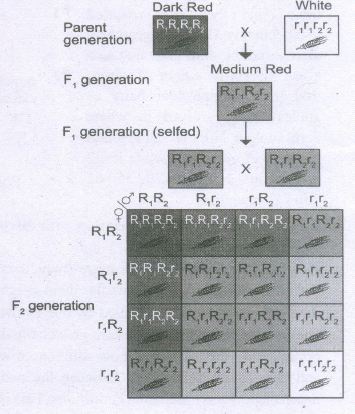
(iii) The first experiment was demonstrated by H. Nilsson - Ehle (1909) in wheat kernels.
(iv) He crossed the two pure breeding wheat varieties dark red & white.
(v) Dark red genotypes R1R1R2R2 and
(vi) white genotypes are r1r1r2r2
(vii) In the F1 generation medium red were obtained R1r1R2r2.
(viii) F1 wheat plant produces four types of gametes R1R2, R1r2, r1R2, r1r2.
(xi) The intensity of the red colour is determined by the number of R genes in the F2 generations.
(x) Four R genes - Dark red kernel.
(xi) Three R genes - Medium dark red kernel
(xii) Two R genes - Medium red kernel
(xiii) One R gene - Light red kernel.
(xiv) Absence of R gene - White kernel.
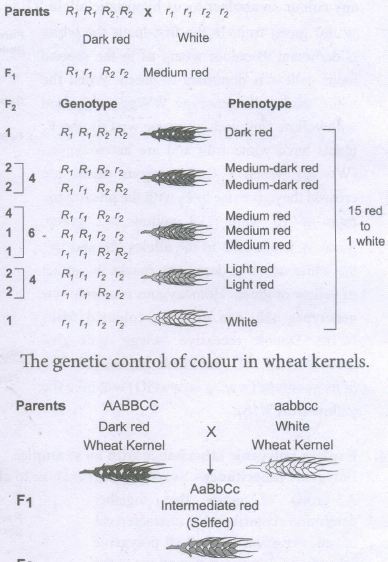
F2
| 1 | 6 | 15 | 20 | 15 | 6 | 1 |
| Dark red | Moderate red | Red | Intermediate red | light red | very light red | white |
(xv) In F2 generation plants have kernels with wide range of colour variation.
(xvi) This is due to that the genes are segregating and recombination takes place.
(xvii) The cumulative effect of several pairs of gene i interaction gives rise to many shades of kernel colour.
75.
76.
(i) Some plants produce two or three different forms of flowers the length of stamen and style differ in them pollination will take place only between organs of same length.
(ii) So cross pollination is only possible. Distyly (eg) Primula-produces two forms of flowers.
| Pin or long style | Thrum eyed or short style |
| Long stamen | Short stamen |
| Long stigmatic papillae | Small stigmatic papillae |
| Small pollen grains | Large pollen grains |
(iii) Stigma of thrum eyed anther of the pin lie in same level, Anther of the thrum eyed stigma of the pin lie in same level.
(iv) So effective cross pollination occurs, Tristyly - (eg) Lythrum
(v) The plant produces three kinds of flowers having difference in length of stamen and style.
(vi) Pollen from flowers of one type pollinate only the other two types can but not their, own type.
77.
(i) Blue- White Colony Selection Method is a powerful method used for screening of recombinant plasmid.
(ii) In this method, a reporter gene lacZ is inserted in the vector.
(iii) The lacZ encodes the enzyme β-galactosidase and contains several recognition sites for restriction enzyme.
(iv) β-galactosidase breaks a synthetic substrates called X-gal (5-bromo - 4 -chloroindolyl- β-D-galactose- pyranoside) into an insoluble blue coloured product.
(v) If a foreign gene is inserted into lacZ, this gene will be inactivated. Therefore, no-blue colour will develop (white) because β-galactosidase is not synthesized due to inactivation of lacZ.
(vi)Therefore, the host cell containing r-DNA form white coloured colonies on the medium contain X-gal, whereas the other cells containing non-recombinant DNA will develop the blue coloured colonies.
(vii) On the basis of colony colour, the recombinants can be selected.
78.
Many polyploids are more vigorous and more adaptable than diploids.
(i) Many ornamental plants are autotetraploids and have larger flower and longer flowering duration than diploids.
(ii) Autopolyploids usually have increase in fresh weight due to more water content.
(iii) Aneuploids are useful to determine the phenotypic effects of loss or gain of different chromosomes.
(iv) Many angiosperms are allopolyploids and they play a role in an evolution of plants.
79.
1. Exchange of segments leads to new gene combinations which plays an important role in evolution.
2. Studies of crossing over reveal that genes are arranged linearly on the chromosomes.
3. Genetic maps are made based on the frequency of crossing over.
4. Crossing over helps to understand the nature and mechanism of gene action.
5. If a useful new combination is formed it can be used in plant breeding.
80.
1. Siddha system is widely practiced and culturally accepted in Tamil Nadu.
2. The entire knowledge is documented in the form of poems in Tamil.
3. It is principally based on the Panchabuta philosophy.
4. The drug sources of Siddha include plants, animal parts, marine products and minerals. This system uses about 800 herbs as source of drugs.
5. Great stress is laid on disease prevention, health, promotion, rejuvenation and cure.
81.
82.
| No. | Tundra Biome | Taiga Biomes |
|---|---|---|
| 1. | This is almost treeless plain in the northern parts of Asia, Europe, and North America. | Taiga is a forest of coniferous trees such as spruce, fir and pine. |
| 2. | Winters are long with little daylight, summers are short, with long daylight hours. | Summer temperature ranges from 10octo 21oPc. |
| 3. | Because of the severe winters, many of the animals are migratory. For E g: the many shore birds and water fowl such as ducks and geese, nest in the Tundra during the summer and migrate south for the winter. |
Important migratory herbivores include moose, elk, deer and reindeer. Moose and reindeer migrate to the Taiga for winter and to Tundra for summers. |
83.
(i) Dolly was the first mammal (sheep) Clone developed by Ian Wilmot and Campbell in 1997.
(ii) Dolly the transgenic clone was developed by the nuclear transfer technique and the phenomenon of totipotency.
(iii) Totipotency, refers to the potential of a cell to develop different cells, tissues, organs and finally an organism.
(iv) Dolly was the first animal to be cloned from a differentiated somatic cell taken from an adult animal without the process of fertilization.
84.
85.
Even though India is one of the 17 identified megadiverse countries of the world, it faces lots of threats to its biodiversity.
(i) Apart from natural causes, human activities, both directly and indirectly are today's main reason for habitat loss and biodiversity loss.
(ii) Fragmentation and degradation due to agricultural practices, extraction (mining, fishing, logging, harvesting) and development (settlements, industrial and associated infrastructures) lead to habitat loss and fragmentation leads to the formation of isolated, small and scattered populations and as endangered species.
86.
(i) Antibiotic resistance occurs when bacteria develop the ability to defeat the drug designed to kill or inhibit their growth.
(ii) It is one of the most acute threats to public health.
(iii) Antibiotic resistance is accelerated by the misuse and overuse of antibiotics, as well as poor infection prevention control.
(iv) Antibiotics should be used only when prescribed by a certified health professional. When the bacteria become resistant, antibiotics cannot fight against them and the bacteria multiply.
(v) Narrow spectrum antibiotics are preferred over broad spectrum antibiotics. They effectively and accurately target specific pathogenic organisms and are less likely to cause resistance.
(vi) "Superbug" is a term used to describe strains of bacteria that are resistant to the majority of antibiotics commonly used today.
87.
Germplasm Conservation
1. Germplasm conservation refers to the conservation of living genetic resources like pollen, seeds or tissue of plant material maintained for the purpose of selective plant breeding, preservation in live condition and used for many research works.
2. Germplasm conservation resources is a part of collection of seeds and pollen that are stored in seed or pollen banks, so as to maintain their viability and fertility for any later use such as hybridization and crop improvement.
3. Germplasm conservation may also involve a gene bank, DNA bank of elite breeding lines of plant resources for the maintenance of biological diversity and also for food security.
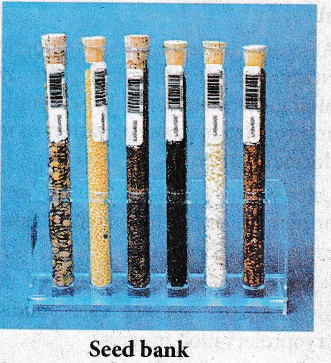
88.
1. Amniocentesis is the pre-natal diagnostic technique in which a sample of amniotic fluid from the womb of a pregnant woman is taken during early stages of embryonic development and the cells are cultured and analysed synthetically.
2. Any chromosomal disorder or a metabolic error can be detected and if necessary MTP can be advised.
3. But this technique is misused for knowing the sex of the foetus followed by female foeticide.
4. Female foeticide refers to aborting the female in the mother's womb.
5. In order to prevent female foeticide and infanticide, Government of India has taken various steps like PCPNDT Act .(preconception and prenatal diagnostic technique act-1994) enacted to ban the identification of sex and to prevent the use of prenatal diagnostic techniques for selective abortion.
89.
RNA is said to be as the first genetic material because
1. RNA can directly code for protein synthesis of protein and hence can easily expresses the character. It is the genetic material in many viruses.
2. RNA can also act as a catalyst; there are some important biothemical reactions in living systems that are catalyzed, by RNAs and not as proteins.
3. Many essential life processes like splicing translation, etc have evolved around RNA.
90.
Relaxin
(i) It is a hormone secreted by the placenta and also by the corpus luteum during pregnancy.
(ii) It promotes parturition by relaxing the pelvic joints and by dilation of cervical ligaments with continued powerful contractions.
Oxytocin:
(i) It causes the "Let-Down" reflex.
(ii) The actual ejection of milk from the alveoli of the mammary glands.
(iii) During lactation, oxytocin also stimulates the recently emptied uterus to contract, helping it to return to pre-pregnancy size..
91.
The common cold has evaded medical sciences advances for two primary reasons:
(i) The first issue is that the colds are most often caused by a rhinoviruses-a large family of viruses with hundreds of variants. This makes vaccination an impossibility and gives our immune system a challenging task.
(ii) Secondly, these viruses evolve rapidly so even if we could produce vaccines to cover the full spectrum of rhinoviruses, they would quickly become resistant.
92.
(i) Mild tremors to convulsions.
(ii) Severe agitation and fits.
(iii) Depressed mood.
(iv) Anxiety.
(v) Nervousness.
(vi) Restlessness.
(vii) Irritability.
(viii) Insomnia.
(ix) Dryness of throat.

12th Standard Syllabus & Materials
12th Standard
TN 12th Computer Applications வலையமைப்பு வடமிடல் Sample Question Papers Study Material - QB365 Set A
NEW12th Standard
TN 12th Computer Applications களப்பெயர் முறைமை (DNS) Sample Question Papers Study Material - QB365 Set A
NEW12th Standard
TN 12th Computer Applications வலையமைப்பு எடுத்துக்காட்டுகள் மற்றும் நெறிமுறைகள் Sample Question Papers Study Material - QB365 Set A
NEW12th Standard
TN 12th Computer Applications கணினி வலையமைப்பு ஓர் அறிமுகம் Sample Question Papers Study Material - QB365 Set A



Tamilnadu Stateboard 12th Standard Subjects

Maths

Chemistry

Physics
Biology

Computer Science

Business Maths and Statistics

Economics

Commerce

Accountancy

History

Computer Applications
Biology
Computer Technology
Computer Applications
Computer Science
Business Maths and Statistics
Commerce
Economics
Maths
Chemistry
Physics
Computer Technology
History
Accountancy

Tamil

English

French
Tamilnadu Stateboard Standards

