
 100% FREE ACCESS
12th Standard Syllabus & Materials
12th Standard
TN 12th Computer Applications மின்னணு தரவு பரிமாற்றம் Sample Question Papers Study Material - QB365 Set A
NEW12th Standard
TN 12th Computer Applications மின் - வணிக பாதுகாப்பு அமைப்புகள் Sample Question Papers Study Material - QB365 Set A
NEW12th Standard
TN 12th Computer Applications மின்னணு செலுத்தல் முறைகள் Sample Question Papers Study Material - QB365 Set A
NEW12th Standard
TN 12th Computer Applications மின் - வணிகம் Sample Question Papers Study Material - QB365 Set A
NEW12th Standard
TN 12th Computer Applications திறந்த மூல கருத்துருக்கள் Sample Question Papers Study Material - QB365 Set A
NEW12th Standard
TN 12th Computer Applications வலையமைப்பு வடமிடல் Sample Question Papers Study Material - QB365 Set A

Published on: 29/01/2021
12th Standard Bio-Botany English Medium Asexual and Sexual Reproduction in plants Reduced Syllabus Important Questions 2021
Download Tamil Nadu 12th Standard Biology question papers, model tests, one-mark questions, important questions, and public exam papers in PDF format. Free study materials and answer keys for TN State Board students.
Questions + Answers key
Take MCQ Biology Test1.
Identify the correct sequence of anther wall layers from periphery towards core part.
Epidermis ⟶ endothelium ⟶ stomium ⟶ tapetum
Epidermis ⟶ middle layer ⟶ endothecium ⟶ endothelium
Epidermis ⟶ endothelium ⟶ middle layers ⟶ tapetum
Epidermis ⟶ endothelium ⟶ endothecium ⟶ tapetum
2.
Observe the diagram and select the correct option mentioning the parts A, B, C and D.
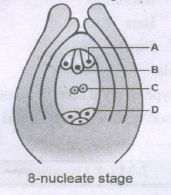
| A | B | C | D |
|---|---|---|---|
| Synergid | Egg | polar nuclei | Antipodals |
| A | B | C | D |
|---|---|---|---|
| Antipodals | Synergid | polar nuclei | Egg |
| A | B | C | D |
|---|---|---|---|
| Egg | Synergid | Antipodals | polar nuclei |
| A | B | C | D |
|---|---|---|---|
| Antipodals | polar nuclei | Egg | Synergid |
3.
Observe the diagram and select the correct option mentioning the parts A, B, C and D
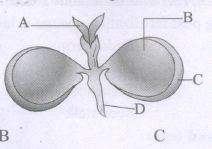
| A | B | C | D |
|---|---|---|---|
| Radicle | Cotyledon | Testa | Plumule |
| A | B | C | D |
|---|---|---|---|
| Plumule | Cotyledon | Testa | Radicle |
| A | B | C | D |
|---|---|---|---|
| Cotyledon | Testa | Plumule | Radicle |
| A | B | C | D |
|---|---|---|---|
| Plumule | Radicle | Testa | Cotyledon |
4.
A mature angiospermic embryo sac is ________________
8 celled and 8 nucleated
8 celled and 8 nucleated
8 celled and 7 nucleated
7 celled and 8 nucleated
5.
Assertion (A): Androecium and Gynoecium are essential whorls of flower
Reason (R): Androecium and Gynoecium assist the reproduction.
A is correct R is incorrect
R explains A
Both A and R are incorrect
Both A and R are correct. R does not explain A
6.
Assertion (A): Fusion of male and female gametes results in zygote.
Reason (R): Product of triple fusion is PEN.
A is correct R is incorrect.
R explains A.
Both A and R are incorrect.
Both A and R are correct. R does not explain A.
7.
Identify the incorrect statement regarding vegetative reproduction.
Only one parent is required for propagation.
New individuals are genetically dissimilar.
Easy mode of reproduction
Variation does not exist.
8.
Statement 1: Apomixis does not involve meiosis and syngamy.
Statement 2: The term Apomixis was introduced by Winkler.
Statement 1 is correct and statement 2 is incorrect.
Statement 1 is incorrect and statement 2 is correct
Both the statements 1 and 2 are correct.
Both the statements 1 and 2 are incorrect.
9.
Assertion (A): Self - pollination is certain in cleistogamous flowers.
Reason (R): Flowers never open and do not expose reproductive organs.
Both A and R are incorrect.
A is correct R is incorrect.
R explains A
Both A and R are correct. R is not correct explanation for A.
10.
Select the wrong statement(s) regarding cross-pollination.
(a) Pollination depends on external agent and so it is certain.
(b) New varieties are produced.
(c) Continuous cross-pollination leads to weaker progeny.
(d) Germination capacity is highly declined.
a and d
b and c
a, band d
a, c and d
11.
Cleavage polyembryony is noticed in _________________
Orchids
Casuarina
Balanophora
Syzygium
12.
Consider the following statement(s)
i) In Protandrous flowers pistil matures earlier
ii) In Protogynous flowers pistil matures earlier
iii) Herkogamy is noticed in unisexual flowers
iv) Distyly is present in Primula
i and ii are correct
ii and iv are correct
ii and iii are correct
i and iv are correct
13.
Transmitting tissue is found in ______.
Micropylar region of ovule
Pollen tube wall
Stylar region of gynoecium
Integument
14.
Match the following
| I) | External fertilization | i) | pollen grain |
| II) | Androecium | ii) | anther wall |
| III) | Male gametophyte | iii) | algae |
| IV) | Primary parietal layer | iv) | stamens |
| I | II | III | IV |
| iv | i | ii | iii |
| I | II | III | IV |
| iii | iv | i | ii |
| I | II | III | IV |
| iii | iv | ii | i |
| I | II | III | IV |
| iii | i | iv | ii |
15.
Choose the correct statement from the following
Gametes are involved in asexual reproduction
Bacteria reproduce asexually by budding
Conidia formation is a method of sexual reproduction
Yeast reproduce by budding
16.
Cite one common feature and one contrast feature shared between apomixis and parthenocarpy
17.
Name the process through which microspore tetrads are formed. What would be the ploidy of the cells of terad?
18.
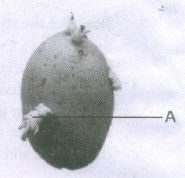
Observe the picture and answer the questions.
(a) Label the part - A
(b) Name the types of vegetative propagule
(c) Give one example for such type of vegetative propagule
19.
Give an account on Helobial endosperm.
20.
How the pollen germination and compatibility is regulated by stigma of Gynoecium?
21.
Give a brief account on pollination process in Zea mays.
22.
Differentiate between chasmogamy and cleistogamy
23.
Briefly explain about the types of tapetum.
24.
What is polyembryony. How it can commercially exploited.
25.
A detached leaf of Bryophyllum produces new plants. How?
26.
Who coined the term Apomixis? Define it
27.
What happens to the following floral parts, after the fertilization process?
(a) Ovary
(b) Secondary nucleus
(c) Outer integument of ovule
(d) Funicle
28.
Name the agents of the following types of pollination
(a) Anemophily
(b) Ornithophily
(c) Chiropterophily
(d) Malacophily
29.
Why pollination in gymnosperm is said to be direct?
30.
Mention the types of ovule seen in the members of
(a) Cactaceae
(b) Leguminosae
(c) Polygonaceae
(d) Primulaceae.
31.
What are the chemical components that make up the wall layers of pollen grains?
32.
Write any four valid points on Androecium
33.
Define totipotency.
34.
Write the names of organisms that undergo the following types of asexual reproduction.
(a) Budding
(b) fragmentation
(c) Regeneration
(d) Gemma cup formation.
35.
‘Pollination in Gymnosperms is different from Angiosperms’ – Give reasons.
36.
List any two strategy adopted by bisexual flowers to prevent self-pollination.
37.
Describe the structure of dicot seed.
38.
Write about the different types of ovules.
39.
Give a comparative account on Anther wall layers
40.
Give a detailed account on parthenocarpy. Add a note on its significance.
41.
What is endosperm. Explain the types.
42.
With a suitable diagram explain the structure of an ovule.
1.
(c)
Epidermis ⟶ endothelium ⟶ middle layers ⟶ tapetum
2.
(a)
| A | B | C | D |
|---|---|---|---|
| Synergid | Egg | polar nuclei | Antipodals |
3.
(b)
| A | B | C | D |
|---|---|---|---|
| Plumule | Cotyledon | Testa | Radicle |
4.
(b)
8 celled and 8 nucleated
5.
(a)
A is correct R is incorrect
6.
(d)
Both A and R are correct. R does not explain A.
7.
(b)
New individuals are genetically dissimilar.
8.
(c)
Both the statements 1 and 2 are correct.
9.
(c)
R explains A
10.
(d)
a, c and d
11.
(a)
Orchids
12.
(b)
ii and iv are correct
13.
(c)
Stylar region of gynoecium
14.
(b)
| I | II | III | IV |
| iii | iv | i | ii |
15.
(d)
Yeast reproduce by budding
16.
Common features: Fertilization (Syngamy) is absent in both apomixis and parthenocarpy.
Contrast features: Parthenocarpic fruits does not develop seeds, whereas in apomixis seeds are developed.
17.
Microspores are formed by the process of microsporogenesis. The cells of microspore tetrad are haploid(n).
18.
(a) A - Bud from eye
(b) Tuber
(c) Solanum tuberosum
19.
Helobial endosperm: Primary Endosperm Nucleus moves towards the base of embryo sac and divides into two nuclei. Cell wall formation takes place leading to the formation of a large micropylar and small chalazal chamber. The nucleus of the micropylar chamber undergoes several free nuclear division whereas that of chalazal chamber may or may not divide. Examples: Hydril/a and Vallisneria.
20.
The receptive surface of the stigma receives the pollen. If the pollen is compatible with the stigma it germinates to form a tube. This is facilitated by the stigmatic fluid in wet stigma and pellicle in dry stigma. These two also decide the incompatibility and compatibility of the pollen through recognition-rejection protein reaction between the pollen and stigma surface.
21.
The maize is monoecious and unisexual. The male inflorescence (tassel) is borne terminally and female inflorescence (cob) laterally at lower levels. Maize pollens are large and heavy and cannot be carried by a light breeze. However, the mild wind shakes the male inflorescence to release the pollen which falls vertically below. The female inflorescence has a long stigma (silk) measuring up to 23 mm in length, which projects beyond leaves. The pollens drop from the tassel is caught by the stigma.
22.
| Chasmogamy | Cleistogamy |
|---|---|
| In chasmogamy, the flowers open and express its mature anthers and stigma for pollination. | In cleistogamy, the pollination occurs without opening of flowers and exposing their sex organs |
| Self-pollination is uncertain | Self-pollination is certain. |
| Depend on pollinating agents | No need of pollinating agents |
| Example: Hibiscus | Example: Commelina |
23.
There are two types of tapetum based on their behavior. They are:
Secretory tapetum (parietal/glandular/ cellular): The tapetum retains the original position and cellular integrity and nourishes the developing microspores.
Invasive tapetum (periplasmodial): The cells lose their inner tangential and radial walls and the protoplast of all tapetal cells coalesces to form a periplasmodium.
24.
Occurrence of more than one embryo in a seed is called polyembryony.
The seedlings formed from the nucellar tissue in citrus are found better clones for orchards. Embryos derived through polyembryony are found virus free.
25.
In Bryophyllum, the leaf is succulent and notched on its margin. Adventitious buds (epiphyllous buds) develop at these notches. They develop into new plants forming a root system. They become independent plants when the leaf gets decayed.
26.
The term Apomixis was introduced by Winkler in the year 1908. It is defined as the substitution of the usual sexual system (Amphimixis) by a form of reproduction which does not involve meiosis and syngamy.
27.
(a) Ovary ⟶ Fruit
(b) Secondary nucleus ⟶ Endosperm
(c) Outer integument of ovule ⟶ Outer seed coat (Testa)
(d) Funicle ⟶ Stalk of the seed
28.
(a) Winds
(b) Birds.
(c) Bats
(d) Snails and slugs
29.
Pollination in gymnosperms is said to be direct as the pollens are deposited directly on the exposed ovules.
30.
(a) Cactaceae - Circinotropous ovule
(b) Leguminosae - Campylotropous ovule
(c) Polygonaceae Orthotropous ovule
(d) Primulaceae - Hemianatropous ovule
31.
Pectin, cellulose, hemicellulose, callose, sporopollenin, pollenkitt and other proteins
32.
(a) Androecium is the male part of a flower
(b) It is made up of stamens
(c) Each stamen possess anther and a filament
(d) Anthers bear pollen grains (male gametophyte)
33.
The genetic ability of a plant cell to produce the entire plant under suitable conditions is said to be totipotency.
34.
(a) Budding - Hydra
(b) Fragmentation - Spirogyra
(c) Regeneration - Planaria
(d) Gemma cup formation - Marchantia
35.
Gymnosperms - Pollination is said to be direct as the pollen are deposited directly on the exposed ovules Angiosperms - Pollination is said to be indirect as the pollen are deposited on the stigma of the pistil.
36.
Dichogamy stamens and stigmas mature at different times (protandry, Protogyny) Herkogamy - Stamens and stigmas are arranged in such a way, self pollination become impossible.
37.
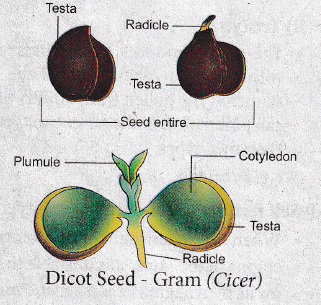
(i) Structure of a Cicer seed as an example for Dicot seed The mature seeds are attached to the fruit wall by a stalk called funiculus.
(ii) The funiculus disappears leaving a scar called hilum. Below the hilum a small pore called micropyle is present.
(iii) It facilitates entry of oxygen and water into the seeds during germination.
(iv) Each seed has a thick outer covering called seed coat.
(v) The seed coat is developed from integuments of the ovule.
(vi) The outer coat is called testa and is hard whereas the inner coat is thin, membranous and is called tegmen.
(vii) In Pea plant the tegmen and testa are fused. Two cotyledons laterally attached to the embryonic axis are present.
(viii) It stores the food materials in pea whereas in other seeds like castor the endosperm contains reserve food and the cotyledons are thin.
(xi) The portion of embryonal axis projecting beyond the cotyledons is called radicle or embryonic root.
(x) The other end of the axis called embryonic shoot is the plumule.
(xi) Embryonal axis above the level of cotyledon is called epicotyl whereas the cylindrical region between the level of cotyledon is called hypocotyl.
(xii) The epicotyl terminates in plumule whereas the hypocotyl ends in radicle.
38.
There are 5 types of ovules.
1. Orthotropous:
Micropyle is at the distal end and the micropyle, the funicle and the chalaza lie in one straight vertical line.
2. Anatropous:
The body of the ovule becomes completely inverted so that the micropyle and funiculus come to lie very close to each other.
E.g: Dicots, Monocots (Common)
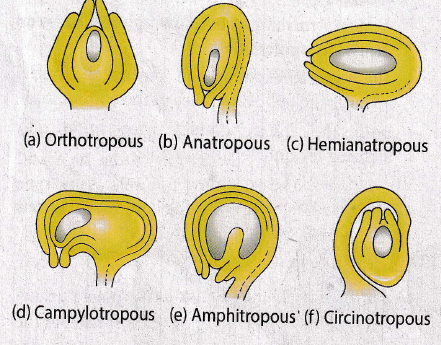
3. Hemianatropous:
The body of the ovule is placed transversely and at right angles to the funicle.
E.g: Primulaceae.
4. Campylotropous:
(i) The body of the ovule at the micropylar end is curved and more or less bean shaped. The embryo sac is slightly curved.
(ii) All the three, hilum, micropyle and chalaza are adjacent to one another, with the micropyle oriented towards the placenta.
E.g: Leguminosae.
5. a) Amphitropous:
The distance between hilum and chalaza is less. The curvature of the ovule leads to horse shoe shaped nucellus.
E.g: Alismataceae.
b) Circinotropous:
Funiculus is very long and surrounds the ovule.
E.g: Cactaceae
39.
Anther wall: The mature anther wall consists of the following layers a. Epidermis
b. Endothecium
c. Middle layers
d. Tapetum.
a. Epidermis: It is single layered and protective in function. The cells undergo repeated anticlinal divisions to cope up with the rapidly enlarging internal tissues.
b. Endothecium: It is generally a single layer of radially elongated cells found below the epidermis. The inner tangential wall develops bands (sometimes radial walls also) of cellulose (sometimes also slightly lignified). The cells are hygroscopic. In the anthers of aquatic plants, saprophytes, cleistogamous flowers, and extreme parasites endothelial differentiation is absent. The cells along the junction of the two sporangia of an anther lobe lack these thickenings. This region is called stomium. This region along with the hygroscopic nature of endothecium helps in the dehiscence of anther at maturity.
c. Middle layers: Two to three layers of cells next to endothecium constitute middle layers. They are generally ephemeral. They disintegrate or get crushed during maturity.
d. Tapetum: It is the innermost layer of the anther wall and attains its maximum development at the tetrad stage of microsporogenesis. It is derived partly from the peripheral wall layer and partly from the connective tissue of the anther lining the anther locule. Thus, the tapetum is dual in origin. It nourishes the developing sporogenous tissue, microspore mother cells, and microspores. The cells of the tapetum may remain uninucleate or may contain more than one nucleus or the nucleus may become polyploid. It also contributes to the wall materials, sporopollenin, pollenkitt, tryphine, and a number of proteins that control incompatibility reaction. Tapetum also controls the fertility or sterility of the microspores or pollen grains.
40.
(i) The production and development of seedless fruit is called parthenocarpy.
(ii) Fruit like structures may develop from the ovary without the act of fertilization. Such fruits are called parthenocarpic fruits
Examples: Seedless-Banana, Grapes, Papaya
(i) Parthenocarpy is of three types
1) Genetic Parthenocarpy
(i) Arises due to hybridization or mutation.
2) Environmental Parthenocarpy
Environmental conditions like frost, fog, low or high temperature induce Parthenocarpy.
Example - low temperature for 3-19 hours induces parthenocarpy in Pear.
3) Chemically induced Parthenocarpy
(i) By the application of growth promoting hormones like auxins and gibberellins.
Significance:
(i) Seedless fruits - Significance in Horticulture have commercial value useful for the preparation of jarns, jellies, sauces, fruit drinks,
(ii) High proportion of edible part is available
41.
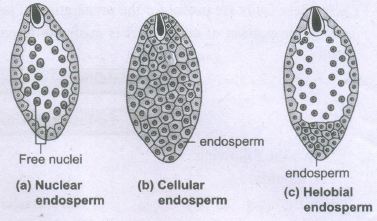
(i) The primary endosperm nucleus divides immediately after fertilization and develops into an endosperm.
(ii) It is a nutritive tissue, and regulatory structure by undergoing repeated mitosis to form triploid (3n) endosperm that nourishes the developing embryo. Depending upon the mode of development three types of endosperm are recognized.
1) Nuclear endosperm:
(i) Primary endosperm, (PEN) nucleus undergoes several mitotic divisions. There is no cell wall formation So free nuclear condition exists in the endosperm.
Example:
Coccinia, Capsella, Arachis
2) Cellular endosperm:
(i) Primary endosperm nucleus divides into two nuclei There is cell wall formation.
(ii) Subsequent division also follows cell wall formation. It is said to be cellular endosperm
Example:
Adoxa, Helianthus, Scoparia.
3) Helobial endosperm:
(i) Primary Endosperm Nucleus moves towards the base of embryo sac.
(ii) Divides into two nuclei cell wall formation occurs forming a large micropylar chamber and a small chalazal chamber.
(iii) The nucleus of micropylar chamber further undergoes several free nuclear divisions. The nucleus of the chalazal chamber may or may not divide.
Example:
Hydrilla, Vallisneria.
42.
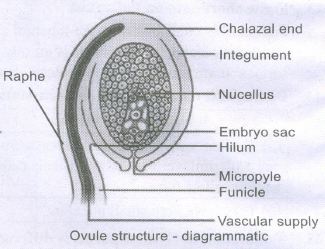
(i) A mature ovule (megasporangium) consist of a stalk and a body
(ii) Funicle - The stalk of the ovule by which it attaches the ovule to the placenta.
(iii) Integuments - one or two protective covering around the nucellus
(iv) Micropyle - Pore present at the tip of the ovule where the integument is absent
(v) Chalaza - The basal region of the body of the ovule where the nucellus, the integument and funicle meet or merge
(vi) Embryosac- The female gametophyte oval sac like structure in the nucellus, toward the micropylar end.

12th Standard Syllabus & Materials
12th Standard
TN 12th Computer Applications களப்பெயர் முறைமை (DNS) Sample Question Papers Study Material - QB365 Set A
NEW12th Standard
TN 12th Computer Applications வலையமைப்பு எடுத்துக்காட்டுகள் மற்றும் நெறிமுறைகள் Sample Question Papers Study Material - QB365 Set A
NEW12th Standard
TN 12th Computer Applications கணினி வலையமைப்பு ஓர் அறிமுகம் Sample Question Papers Study Material - QB365 Set A
NEW12th Standard
TN 12th Computer Applications PHP-உடன் MySQL-ஐ இணைத்தல் Sample Question Papers Study Material - QB365 Set A



Tamilnadu Stateboard 12th Standard Subjects

Maths

Chemistry

Physics
Biology

Computer Science

Business Maths and Statistics

Economics

Commerce

Accountancy

History

Computer Applications
Biology
Computer Technology
Computer Applications
Computer Science
Business Maths and Statistics
Commerce
Economics
Maths
Chemistry
Physics
Computer Technology
History
Accountancy

Tamil

English

French
Tamilnadu Stateboard Standards

