
 100% FREE ACCESS
12th Standard Syllabus & Materials
12th Standard
TN 12th Computer Applications மின்னணு தரவு பரிமாற்றம் Sample Question Papers Study Material - QB365 Set A
NEW12th Standard
TN 12th Computer Applications மின் - வணிக பாதுகாப்பு அமைப்புகள் Sample Question Papers Study Material - QB365 Set A
NEW12th Standard
TN 12th Computer Applications மின்னணு செலுத்தல் முறைகள் Sample Question Papers Study Material - QB365 Set A
NEW12th Standard
TN 12th Computer Applications மின் - வணிகம் Sample Question Papers Study Material - QB365 Set A
NEW12th Standard
TN 12th Computer Applications திறந்த மூல கருத்துருக்கள் Sample Question Papers Study Material - QB365 Set A
NEW12th Standard
TN 12th Computer Applications வலையமைப்பு வடமிடல் Sample Question Papers Study Material - QB365 Set A

Published on: 29/01/2021
12th Standard Bio-Botany English Medium Asexual and Sexual Reproduction in plants Reduced Syllabus Important Questions With Answer Key 2021
Download Tamil Nadu 12th Standard Biology question papers, model tests, one-mark questions, important questions, and public exam papers in PDF format. Free study materials and answer keys for TN State Board students.
Questions + Answers key
Take MCQ Biology Test1.
Pick out the mismatched pair:
Entomophily - Insects
Malacophily - Mammals
Cheiropterophily - Bats
Omithophily - Birds
2.
Identify the correct sequence of anther wall layers from periphery towards core part.
Epidermis ⟶ endothelium ⟶ stomium ⟶ tapetum
Epidermis ⟶ middle layer ⟶ endothecium ⟶ endothelium
Epidermis ⟶ endothelium ⟶ middle layers ⟶ tapetum
Epidermis ⟶ endothelium ⟶ endothecium ⟶ tapetum
3.
In anatropous ovule, the micropyle faces __________________
Right side
Left side
Upward
Downward
4.
Examine the figures and name the respective type of ovule.
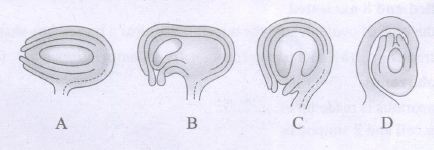
| A | B | C | D |
|---|---|---|---|
| Campylotropous | Amphitropous | Circinotropous | Anatropous |
| A | B | C | D |
|---|---|---|---|
| Anatropous | Hemianatropous | Amphitropous | Campylotropous |
| A | B | C | D |
|---|---|---|---|
| Campylotropous | Circinotropous | Hemianatropous | Anatropous |
| A | B | C | D |
|---|---|---|---|
| Hemianatropous | Campylotropous | Amphitropous | Circinotropous |
5.
Exalbuminous seeds are ________________
Pea, castor, paddy
Paddy, Coconut, Groundnut
Beans, coconut, castor
Groundnut, pea, beans
6.
The egg apparatus is made up of______________
1 egg cell and 2 antipodals
1 egg cell and 2 polar nuclei
1 egg cell and 1 secondary nucleus
1 egg cell and 2 synergids
7.
Identify the parthenocarpic fruit
Banana
Pear
Papaya
More than one option is correct
8.
Identify the incorrect statement.
One seeded fruit of paddy is caryopsis.
Primitive root is called coleorhiza.
Scutellum is a part of mono cot seed.
Embryonic axis above the cotyledon is epicotyl.
9.
Assertion (A): Anemophilous pollination occurs by animals.
Reason (R): Pollen grains are sticky for easy attachment on animals.
A is correct R is incorrect
R explains A.
Both A and R are incorrect.
Both A and Rare correct R does not explain A.
10.
Identify the mismatched pair:
(i) Sucker - Chrysanthemum
(ii) Bulbils - Agave
(iii) Stolon - Fragaria
(iv) Runner - Lilium
i only
ii only
iii only
iv only
11.
Generally, the pollen grains are liberated from another at ___________
2-celled stage
4-celled stage
6-celled stage
8-celled stage
12.
Which of the following characters does not exist in Ornithophilous flowers?
Huge sized flowers
Bright coloured
Scented flowers
Nectar is secreted in large
13.
Which is not a part of mature seed?
Funiculus
Testa and tegmen
hilum
Chalaza
14.
The genetic ability of a plant cell to produce the entire plant is said to be ________________
Multipotency
Totipotency
Pluripotency
Differentiation
15.
Arrange the layers of anther wall from locus to periphery
Epidermis, middle layers, tapetum, endothecium
Tapetum, middle layers, epidermis, endothecium
Endothecium, epidermis, middle layers, tapetum
Tapetum, middle layers endothecium epidermis
16.
Describe the development of monosporic embryo sac.
17.
Describe the development process of male gametophyte.(or) Explain the different mode of entry of pollen tube into the ovule.
18.
Differentiate the structure of Dicot and Monocot seed.
19.
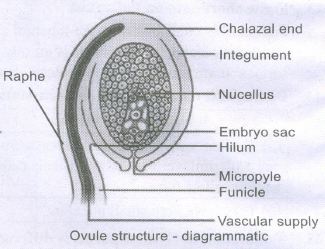
With a suitable diagram explain the structure of an ovule.
20.
Discuss the steps involved in Microsporogenesis.
21.
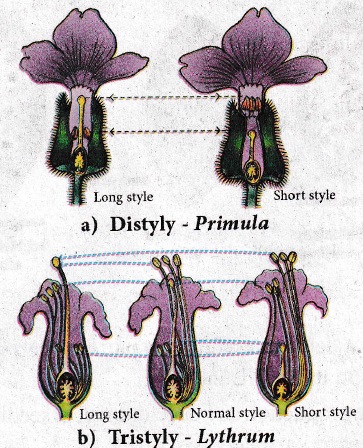
Write short note on Heterostyly.
22.
Discuss the importance of Modern methods in reproduction of plants.
23.
What is scutellum?
24.
What is the product of triple fusion? Mention its ploidy.
25.
Distinguish between anemophilous flowers and ornithophilous flowers
26.
Distinguish between monoecious and dioecious plants.
27.
Define Homogamy with an example
28.
What is integumentary tapetum?
29.
Name the four anther wall layers.
30.
What do you mean by terms 'stock' and 'scion' in grafting technique?
31.
Name the vegetative propagules of the following plants
(a) Allium cepa
(b) Zingiber Officinalis
(c) Agave
(d) Colocasia
32.
Write the names of organisms that undergo the following types of asexual reproduction.
(a) Budding
(b) fragmentation
(c) Regeneration
(d) Gemma cup formation.
33.
What is Cantharophily.
34.
If you break open the coconut fruit, we can observe a fluid part and the white kernel. What does those parts represent?
35.
Arrange the following events in a proper sequence.
Embryogenesis, Zygote formation, Syngamy, Gametogenesis
36.
Give an account on Helobial endosperm.
37.
Double fertilization and triple fusion are correlated terms. Comment.
38.
Geitonogamy is similar to autogamy. Justify the statement.
39.
What do you know about bee pollen?
40.
Where the stomium is located? What is its role?
41.
Distinguish tenuinucellate and crassinucellate ovules.
42.
Why does the zygote divides only after the division of Primary endosperm cell.
1.
(b)
Malacophily - Mammals
2.
(c)
Epidermis ⟶ endothelium ⟶ middle layers ⟶ tapetum
3.
(d)
Downward
4.
(d)
| A | B | C | D |
|---|---|---|---|
| Hemianatropous | Campylotropous | Amphitropous | Circinotropous |
5.
(d)
Groundnut, pea, beans
6.
(d)
1 egg cell and 2 synergids
7.
(d)
More than one option is correct
8.
(b)
Primitive root is called coleorhiza.
9.
(c)
Both A and R are incorrect.
10.
(d)
iv only
11.
(a)
2-celled stage
12.
(c)
Scented flowers
13.
(d)
Chalaza
14.
(b)
Totipotency
15.
(d)
Tapetum, middle layers endothecium epidermis
16.
The functional megaspore is the first cell of the embryo sac or female gametophyte. The megaspore elongates along the micropylar-chalazal axis. The nucleus undergoes a mitotic division. Wall formation does not follow the nuclear division. A large central vacuole now appears between the two daughter nuclei. The vacuole expands and pushes the nuclei towards the opposite poles of the embryo sac. Both the nuclei divide twice mitotically, forming four nuclei at each pole. At this stage, all the eight nuclei are present in a common cytoplasm (free nuclear division). After the last nuclear division, the cell undergoes appreciable elongation, assuming a sac-like appearance. This is followed by the cellular organization of the embryo sac. Of the four nuclei at the micropylar end of the embryo sac, three organize into an egg apparatus, the fourth one is left free in the cytoplasm of the central cell as the upper polar nucleus. Three nuclei of the chalazal end form three antipodal cells whereas the fourth one functions as the lower polar nucleus. Depending on the plant the 2 polar nuclei may remain free or may fuse to form a secondary nucleus (central cell). The egg apparatus is made up of a central egg cell and two synergids, one on each side of the egg cell. Synergids secrete chemotropic substances that help to attract the pollen tube. The special cellular thickening called filiform apparatus of synergids to help in the absorption, conduction of nutrients from the nucellus to embryo sac. It also guides the pollen tube into the egg. Thus, a 7 celled with 8 nucleated embryo sac is formed.
17.
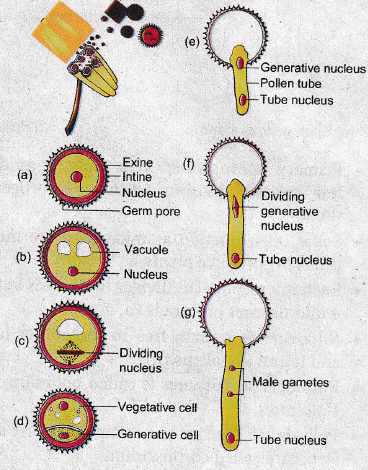
(i) The microspore is the first cell of the male gametophyte and is haploid.
(ii) The development of male gametophyte takes place while they are still in the microsporangium.
(iii) The nucleus of the microspore divides to form a vegetative and a generative nuclei.
(iv) A wall is laid around the generative nucleus resulting in the formation of two unequal cells, a large irregular nucleus bearing with abundant food reserve called vegetative cell and a small generative cell.
(v) At this two celled stage, the pollens are liberated from the anther.
(vi) In some plants, the generative cell again undergoes a division to form two male gametes.
(vii) In these plants, the pollen is liberated at 3 celled stages.
(viii) In 60% of the angiosperms, pollen is liberated in 2 celled stages.
(ix) The growth of the male gametophyte occurs only if the pollen reaches the right stigma.
(x) The pollen on reaching the stigma of absorbs moisture and swells.
(xi) The intine grows as pollen tube through the germ pore.
(xii) In case the pollen is liberated at 2 celled stages the generative cell divides in the pollen into 2 male cells (sperms) after reaching the stigma.
(xiii) The stages in the development of male gametophyte occurs in gynoecium of the plant.
18.
| Dicot Seed | Monocot Seed |
|---|---|
| Seed coat differentiated into outer hard testa, inner thin membranous tegmen. | Seed coat brownish membranous unilayer closely adhered to the grain |
| Two cotyledons, laterally attached to the embryonic axis | Embryo consists of one shield shaped cotyledon, the scutellum |
| The reserve food materials stored either in cotyledon or in endosperm | The reserve food materials stored in the endosperm. |
| Embryonic axis is differentiated into radicle and plumule but not protected by any sheath | Embryonic axis is differentiated into radicle and plumule Radicle is protected by Coleorhiza Plumule is protected by Coleoptile |
| Example - Cicer arientinum | Example - Oryza sativa |
19.
(i) A mature ovule (megasporangium) consist of a stalk and a body
(ii) Funicle - The stalk of the ovule by which it attaches the ovule to the placenta.
(iii) Integuments - one or two protective covering around the nucellus
(iv) Micropyle - Pore present at the tip of the ovule where the integument is absent
(v) Chalaza - The basal region of the body of the ovule where the nucellus, the integument and funicle meet or merge
(vi) Embryosac- The female gametophyte oval sac like structure in the nucellus, toward the micropylar end.
20.
(i) The primary sporogeneous cells undergoes mitotic divisions to form sporogeneous tissue.
(ii) Each cell of the sporogenous tissue is a potential microspore mother cell.
(iii) The microspore mother cell divides meiotically to form four haploid microspores. Microspore soon separates from one another.
(iv) They remain free in the anther locule. Then they develop into pollen grains.
21.
(i) Some plants produce two or three different forms of flowers the length of stamen and style differ in them pollination will take place only between organs of same length.
(ii) So cross pollination is only possible. Distyly (eg) Primula-produces two forms of flowers.
| Pin or long style | Thrum eyed or short style |
| Long stamen | Short stamen |
| Long stigmatic papillae | Small stigmatic papillae |
| Small pollen grains | Large pollen grains |
(iii) Stigma of thrum eyed anther of the pin lie in same level, Anther of the thrum eyed stigma of the pin lie in same level.
(iv) So effective cross pollination occurs, Tristyly - (eg) Lythrum
(v) The plant produces three kinds of flowers having difference in length of stamen and style.
(vi) Pollen from flowers of one type pollinate only the other two types can but not their, own type.
22.
Advantages of modern methods
(i) Plants with desired characteristics can be multiplied rapidly in a short duration.
(ii) Plants produced are genetically identical.
(iii) Tissue culture can be carried out in any season.
(iv) Plants which do not produce viable seeds and seeds that are difficult to germinate can be propagated.
(v) Rare and endangered plants can be propagated. Disease-free plants can be produced cells can be genetically modified and transformed.
23.
In monocot seeds, the embryo is small and consists of single shield-shaped cotyledon known as scutellum present towards the lateral side of the embryonal axis.
24.
The product of triple fusion is Primary Endosperm Nucleus (PEN). It is triploid (3n) in condition.
25.
| Anemophilous Flowers | Ornithophilous Flowers |
|---|---|
| (a) Small sized flowers | Large sized flowers |
| (b) Colorless | Brightly colored |
| (c) Donor produce nectar | Produce large quantity of nectar |
| E.g: Grasses | Bombax |
26.
| Monoecious | Dioecious |
|---|---|
| Male & Female flowers develop on the same plant E.g: Maize |
Male and Female flowers develop on different plants E.g: Papaya |
27.
When the stamens and stigma of a flower mature at the same time it is said to be homogamy. It favours self-pollination to occur. Example: Mirabilis jalapa.
28.
In Asteraceae species, the inner layer of integument get specialized for nourishing the embryosac and this is called integumentary tapetum or endothelium.
29.
(a) Epidermis
(b) Endothecium
(c) Middle layers
(d) Tapetum
30.
In Grafting, parts of two different plants are joined so that they continue to grow as one plant. Of the two plants, the plant which is in contact with the soil is called stock and the plant used for grafting is called Scion.
31.
(a) Allium cepa - Bulb
(b) Zingiber officinal is - Rhizome
(c) Agave - Bulbils
(d) Colocasia - Corm
32.
(a) Budding - Hydra
(b) Fragmentation - Spirogyra
(c) Regeneration - Planaria
(d) Gemma cup formation - Marchantia
33.
Pollination carried out by beetle is called cantharophily.
34.
The fluid part of the coconut represents free-nuclear endosperm and the white kernel represents cellular endosperm.
35.
Gametogenesis ⟶ Syngamy ⟶ Zygote formation ⟶ Embryogenesis
36.
Helobial endosperm: Primary Endosperm Nucleus moves towards the base of embryo sac and divides into two nuclei. Cell wall formation takes place leading to the formation of a large micropylar and small chalazal chamber. The nucleus of the micropylar chamber undergoes several free nuclear division whereas that of chalazal chamber may or may not divide. Examples: Hydril/a and Vallisneria.
37.
The two male gametes released from a male gametophyte are involved in the fertilization. They fertilize two different components of the embryo sac. Since both the male gametes are involved in fertilization, the phenomenon is called double fertilization and is unique to angiosperms. One of the male gametes fuses with the egg nucleus (syngamy) to form Zygote.
The second gamete migrates to the central cell where it fuses with the polar nuclei or their fusion product, the secondary nucleus and forms the primary endosperm nucleus (PEN). Since this involves the fusion of three nuclei, this phenomenon is called triple fusion. This act results in endosperm formation which forms the nutritive tissue for the embryo.
38.
When the pollen deposits on another flower of the same individual plant, it is said to be geitonogamy. It usually occurs in plants which show monoecious condition. It is functionally cross-pollination but is similar to autogamy because the pollen comes from the same plant
39.
(i) Bee pollen is a natural substance with high proteins, carbohydrate, and a trace amount of vitamins and minerals.
(ii) It is used as a dietary supplement as tablets.
(iii) It increases the performance of athletes, racehorses and also heals burn wounds.
40.
In a mature anther, the cells along with junction or the two sporangia of an anther lobe lack cellulose and lignin thickening. This region is called stomium. Stomium along with hygroscopic nature of Endothecium helps in the dehiscence of anther at maturity.
41.
ovule is divided into two types based on the position of the sporogenous cell
| Tenuinucellate type | Crassinucellate type |
|---|---|
| Sporogenous cell is hypodermal with a single layer of nucellar tissue around it. | Sporogenous cell is sub hypodermal |
| Have very small nucellus | Have fairly large nucellus. |
42.
The primary endosperm nucleus divides immediately after fertilization. It develops into an endosperm which is a nutritive tissue and a regulatory structure. The zygote divides only after that to form an embryo so that it can get nourishment from the endosperm that has formed earlier.

12th Standard Syllabus & Materials
12th Standard
TN 12th Computer Applications களப்பெயர் முறைமை (DNS) Sample Question Papers Study Material - QB365 Set A
NEW12th Standard
TN 12th Computer Applications வலையமைப்பு எடுத்துக்காட்டுகள் மற்றும் நெறிமுறைகள் Sample Question Papers Study Material - QB365 Set A
NEW12th Standard
TN 12th Computer Applications கணினி வலையமைப்பு ஓர் அறிமுகம் Sample Question Papers Study Material - QB365 Set A
NEW12th Standard
TN 12th Computer Applications PHP-உடன் MySQL-ஐ இணைத்தல் Sample Question Papers Study Material - QB365 Set A



Tamilnadu Stateboard 12th Standard Subjects

Maths

Chemistry

Physics
Biology

Computer Science

Business Maths and Statistics

Economics

Commerce

Accountancy

History

Computer Applications
Biology
Computer Technology
Computer Applications
Computer Science
Business Maths and Statistics
Commerce
Economics
Maths
Chemistry
Physics
Computer Technology
History
Accountancy

Tamil

English

French
Tamilnadu Stateboard Standards

