
 100% FREE ACCESS
12th Standard Syllabus & Materials
12th Standard
TN 12th Maths Applications of Matrices and Determinants Sample Question Papers Study Material - QB365 Set A
NEW12th Standard
TN 12th Computer Applications மின்னணு தரவு பரிமாற்றம் Sample Question Papers Study Material - QB365 Set A
NEW12th Standard
TN 12th Computer Applications மின் - வணிக பாதுகாப்பு அமைப்புகள் Sample Question Papers Study Material - QB365 Set A
NEW12th Standard
TN 12th Computer Applications மின்னணு செலுத்தல் முறைகள் Sample Question Papers Study Material - QB365 Set A
NEW12th Standard
TN 12th Computer Applications மின் - வணிகம் Sample Question Papers Study Material - QB365 Set A
NEW12th Standard
TN 12th Computer Applications திறந்த மூல கருத்துருக்கள் Sample Question Papers Study Material - QB365 Set A

Published on: 27/08/2022
QB365 provides a detailed and simple solution for every Possible Book Back Questions in Class 12 Biology Subject - Botany - Asexual and Sexual Reproduction in Plants, English Medium. It will help Students to get more practice questions, Students can Practice these question papers in addition to score best marks.
Download Tamil Nadu 12th Standard Biology question papers, model tests, one-mark questions, important questions, and public exam papers in PDF format. Free study materials and answer keys for TN State Board students.
Questions + Answers key
Take MCQ Biology Test1.
Give a detailed account on parthenocarpy. Add a note on its significance.
2.
Differentiate the structure of Dicot and Monocot seed.
3.
What is endosperm. Explain the types.
4.
Give a concise account on steps involved in fertilization of an angiosperm plant.
5.
With a suitable diagram explain the structure of an ovule.
6.
Discuss the steps involved in Microsporogenesis.
7.
8.
Write short note on Heterostyly.
9.
Discuss the importance of Modern methods in reproduction of plants.
10.
Highlight the milestones from the history of plant embryology.
11.
Explain the conventional methods adopted in vegetative propagation of higher plants.
1.
(i) The production and development of seedless fruit is called parthenocarpy.
(ii) Fruit like structures may develop from the ovary without the act of fertilization. Such fruits are called parthenocarpic fruits
Examples: Seedless-Banana, Grapes, Papaya
(i) Parthenocarpy is of three types
1) Genetic Parthenocarpy
(i) Arises due to hybridization or mutation.
2) Environmental Parthenocarpy
Environmental conditions like frost, fog, low or high temperature induce Parthenocarpy.
Example - low temperature for 3-19 hours induces parthenocarpy in Pear.
3) Chemically induced Parthenocarpy
(i) By the application of growth promoting hormones like auxins and gibberellins.
Significance:
(i) Seedless fruits - Significance in Horticulture have commercial value useful for the preparation of jarns, jellies, sauces, fruit drinks,
(ii) High proportion of edible part is available
2.
| Dicot Seed | Monocot Seed |
|---|---|
| Seed coat differentiated into outer hard testa, inner thin membranous tegmen. | Seed coat brownish membranous unilayer closely adhered to the grain |
| Two cotyledons, laterally attached to the embryonic axis | Embryo consists of one shield shaped cotyledon, the scutellum |
| The reserve food materials stored either in cotyledon or in endosperm | The reserve food materials stored in the endosperm. |
| Embryonic axis is differentiated into radicle and plumule but not protected by any sheath | Embryonic axis is differentiated into radicle and plumule Radicle is protected by Coleorhiza Plumule is protected by Coleoptile |
| Example - Cicer arientinum | Example - Oryza sativa |
3.
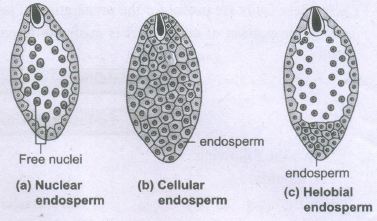
(i) The primary endosperm nucleus divides immediately after fertilization and develops into an endosperm.
(ii) It is a nutritive tissue, and regulatory structure by undergoing repeated mitosis to form triploid (3n) endosperm that nourishes the developing embryo. Depending upon the mode of development three types of endosperm are recognized.
1) Nuclear endosperm:
(i) Primary endosperm, (PEN) nucleus undergoes several mitotic divisions. There is no cell wall formation So free nuclear condition exists in the endosperm.
Example:
Coccinia, Capsella, Arachis
2) Cellular endosperm:
(i) Primary endosperm nucleus divides into two nuclei There is cell wall formation.
(ii) Subsequent division also follows cell wall formation. It is said to be cellular endosperm
Example:
Adoxa, Helianthus, Scoparia.
3) Helobial endosperm:
(i) Primary Endosperm Nucleus moves towards the base of embryo sac.
(ii) Divides into two nuclei cell wall formation occurs forming a large micropylar chamber and a small chalazal chamber.
(iii) The nucleus of micropylar chamber further undergoes several free nuclear divisions. The nucleus of the chalazal chamber may or may not divide.
Example:
Hydrilla, Vallisneria.
4.
The fusion of male and female gamete is called fertilization. Fertilization in angiosperms is double fertilization type.
Pollen germinates on the stigma. Pollen tube produced grows through the style towards the micropyle of the ovule pollen tubes enter into one of the synergids of the embryo sac.
Discharge of male gametes occur syngamy - one gamete and an egg cell fuses to form diploid zygote Triple fusion - The other male gamete fuses with the two haploid female polar nuclei. A triploid primary endosperm nucleus results.
5.
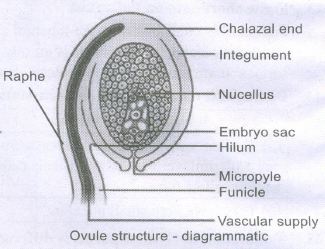
(i) A mature ovule (megasporangium) consist of a stalk and a body
(ii) Funicle - The stalk of the ovule by which it attaches the ovule to the placenta.
(iii) Integuments - one or two protective covering around the nucellus
(iv) Micropyle - Pore present at the tip of the ovule where the integument is absent
(v) Chalaza - The basal region of the body of the ovule where the nucellus, the integument and funicle meet or merge
(vi) Embryosac- The female gametophyte oval sac like structure in the nucellus, toward the micropylar end.
6.
(i) The primary sporogeneous cells undergoes mitotic divisions to form sporogeneous tissue.
(ii) Each cell of the sporogenous tissue is a potential microspore mother cell.
(iii) The microspore mother cell divides meiotically to form four haploid microspores. Microspore soon separates from one another.
(iv) They remain free in the anther locule. Then they develop into pollen grains.
7.
8.
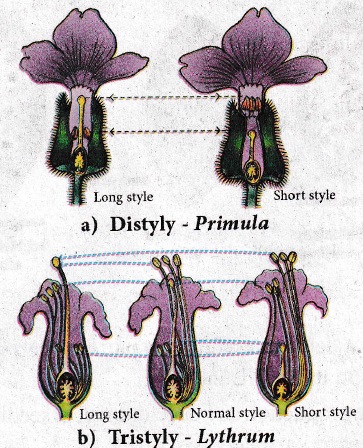
(i) Some plants produce two or three different forms of flowers the length of stamen and style differ in them pollination will take place only between organs of same length.
(ii) So cross pollination is only possible. Distyly (eg) Primula-produces two forms of flowers.
| Pin or long style | Thrum eyed or short style |
| Long stamen | Short stamen |
| Long stigmatic papillae | Small stigmatic papillae |
| Small pollen grains | Large pollen grains |
(iii) Stigma of thrum eyed anther of the pin lie in same level, Anther of the thrum eyed stigma of the pin lie in same level.
(iv) So effective cross pollination occurs, Tristyly - (eg) Lythrum
(v) The plant produces three kinds of flowers having difference in length of stamen and style.
(vi) Pollen from flowers of one type pollinate only the other two types can but not their, own type.
9.
Advantages of modern methods
(i) Plants with desired characteristics can be multiplied rapidly in a short duration.
(ii) Plants produced are genetically identical.
(iii) Tissue culture can be carried out in any season.
(iv) Plants which do not produce viable seeds and seeds that are difficult to germinate can be propagated.
(v) Rare and endangered plants can be propagated. Disease-free plants can be produced cells can be genetically modified and transformed.
10.
1824 - G.B. Amici discovered the pollentube.
1848 - Hofmeister described the structure of pollen tetrad.
1870 - Hanstein described the development of embryo in Capsella and Alisma.
1878 - E. Strasburger reported poly embryony.
1884 - E. Strasburger discovered the process of syngamy.
1898 & 1899 - S.G. Nawaschin and L. Guignard independently, discovered double fertilizations.
11.
Artificial propagation of higher plants used by man for a very long time are called conventional methods
1) Cutting
The cut parts from (root, stem, leaf) parent plant are grown in suitable medium. They grow into new plants
Example:
(i) Root Cutting - Malus.
(ii) Stem Cutting - Hibiscus.
(iii) Leaf cutting - Begonia.
2) Grafting
Parts of two different plants are joined so that they continue to grow as one plant of the two plants the plant which is in contact with the soil is called stock the plant used for grafting is called scion.
Example:
(i) Citrus, Mango.
(ii) There are different types of grafting based on the method of uniting the scion and stock.
Layering
The stem of the parent plant is allowed to develop roots while still intact. After the roots formation rooted part is cut and planted to grow as a new plant.
Example:
Ixora, Jasminum
It is of two types - Mound / Air layering.

12th Standard Syllabus & Materials
12th Standard
TN 12th Computer Applications வலையமைப்பு வடமிடல் Sample Question Papers Study Material - QB365 Set A
NEW12th Standard
TN 12th Computer Applications களப்பெயர் முறைமை (DNS) Sample Question Papers Study Material - QB365 Set A
NEW12th Standard
TN 12th Computer Applications வலையமைப்பு எடுத்துக்காட்டுகள் மற்றும் நெறிமுறைகள் Sample Question Papers Study Material - QB365 Set A
NEW12th Standard
TN 12th Computer Applications கணினி வலையமைப்பு ஓர் அறிமுகம் Sample Question Papers Study Material - QB365 Set A



Tamilnadu Stateboard 12th Standard Subjects

Maths

Chemistry

Physics
Biology

Computer Science

Business Maths and Statistics

Economics

Commerce

Accountancy

History

Computer Applications
Biology
Computer Technology
Computer Applications
Computer Science
Business Maths and Statistics
Commerce
Economics
Maths
Chemistry
Physics
Computer Technology
History
Accountancy

Tamil

English

French
Tamilnadu Stateboard Standards

