
 100% FREE ACCESS
12th Standard Syllabus & Materials
12th Standard
TN 12th Computer Applications மின்னணு தரவு பரிமாற்றம் Sample Question Papers Study Material - QB365 Set A
NEW12th Standard
TN 12th Computer Applications மின் - வணிக பாதுகாப்பு அமைப்புகள் Sample Question Papers Study Material - QB365 Set A
NEW12th Standard
TN 12th Computer Applications மின்னணு செலுத்தல் முறைகள் Sample Question Papers Study Material - QB365 Set A
NEW12th Standard
TN 12th Computer Applications மின் - வணிகம் Sample Question Papers Study Material - QB365 Set A
NEW12th Standard
TN 12th Computer Applications திறந்த மூல கருத்துருக்கள் Sample Question Papers Study Material - QB365 Set A
NEW12th Standard
TN 12th Computer Applications வலையமைப்பு வடமிடல் Sample Question Papers Study Material - QB365 Set A

Published on: 29/08/2022
QB365 provides a detailed and simple solution for every Possible Creative Questions in Class 12 Biology Subject - Botany - Chromosomal Basis of Inheritance, English Medium. It will help Students to get more practice questions, Students can Practice these question papers in addition to score best marks.
Download Tamil Nadu 12th Standard Biology question papers, model tests, one-mark questions, important questions, and public exam papers in PDF format. Free study materials and answer keys for TN State Board students.
Questions + Answers key
Take MCQ Biology Test1.
What is frame shift mutation?
2.
Differentiate Missense mutation from Nonsense mutation.
3.
Explain the sex determination mechanism in Carica papaya.
4.
List any three characteristic features of multiple allele.
5.
Enumerate the uses of Genetic mapping.
6.
Which type of test cross provides the data to construct an efficient genetic map? Explain.
7.
Classify cross over.
8.
How and where chiasma is formed?
9.
What are the three types of synapsis? (or) Give the types of Synapsis.
10.
How crossing over differs from linkage?
11.
Give a short note on incomplete linkage.
12.
State Coupling and Repulsion theory.
13.
Compare Mendelian factors with chromosome.
14.
What are the salient features of the chromosomal theory of inheritance ?
1.
Mutations that result in the addition or deletion of a single base pair of DNA that changes the reading frame for the translation process as a result of which there is complete loss of normal protein structure and function are called Frameshift mutations.
2.
| Mis-sense Mutation | Non-sense Mutation |
| The mutation where the codon for one amino acid is changed into a codon for another amino acid is called Mis-sense or non-synonymous mutations. | The mutations where codon for one amino acid is changed into a termination or stop codon is called Non-sense mutation. |
3.
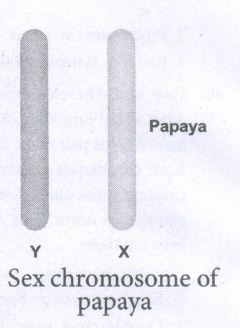
| Genotype | Dominant / recessive | Modification | Sex |
| mm | Homozygous recessive. | Restrict maleness | Female |
| Mlm | Heterozygous. | Induces maleness | Male |
| M2m | Heterozygous. | Induces both the sex | Bisexual (rare) |
| MIMI or M2M2 or MIM2 |
Homozygous / Heterozygous dominant. | Inviable plants | Sterile |
Carica papaya, 2n = 36 (Papaya) has 17 pairs of auto somes and one pair of sex chromosomes. Male papaya plants have XY and female plants have XX. Unlike human sex chromosomes, papaya sex chromosomes look like auto somes and it is evolved from autosome. The sex chromosomes are functionally distinct because the Y chromosome carries the. genes for male organ development and X bears the female organ developmental genes. In papaya sex determination is controlled by three alleles. They are m, M, and M2 of a single gene.
4.
Multiple alleles of a series always occupy the same locus in the homologous chromosome. Therefore, no crossing over occurs within the alleles of a series.
(i) Multiple alleles are always responsible for the same character.
(ii) The wild type alleles of a series exhibit dominant character whereas mutant type will influence dominance or an intermediate phenotypic effect.
(iii) Proterminal synapsis: Pairing starts from the telomeres
(iv) Random synapsis: Pairing may start from anywhere.
5.
(I) It is used to determine gene order, identify the locus of a gene and calculate the distances between genes.
(II) They are useful in predicting results of dihybrid and trihybrid crosses.
(III) It allows the geneticists to understand the overall genetic complexity of particular organism.
6.
A more efficient mapping technique is to construct based on the results of three-point test cross. It refers to analyzing the inheritance patterns of three alleles by test crossing a triple recessive heterozygote with a triple recessive homozygote. It enables to determine the distance between the three alleles and the order in which they are located on the chromosome. Double cross overs can be detected which will provide more accurate map distances.
7.
1. Single cross over: Formation of single chiasma and involves only two chromatids out of four.
2. Double cross over: Formation of two chiasmata and involves two or three or all four strands.
3. Multiple cross over: Formation of more than two chiasmata and crossing over frequency is extremely low.
8.
After tetrad formation, crossing over occurs in pachytene stage. The non-sister chromatids of homologous pair make a contact at one or more points. These points of contact between non-sister chromatids of homologous chromosomes are called Chiasmata (singular-Chiasma). At chiasma, cross-shaped or X-shaped structures are formed, where breaking and rejoining of two chromatids occur. This results in reciprocal exchange of equal and corresponding segments between them.
9.
Pairing of homologous chromosomes during zygotene stage of prophase I of meiosis I is called synapsis. Synapsis of three types:
1. Procentric synapsis: Pairing starts from middle of the chromosome.
2. Proterminal synapsis: Pairing starts from the telomeres.
3. Random synapsis: Pairing may start from anywhere.
10.
| S.No. | Linkage | Crossing over |
| 1. | The genes present on chromosome stay close together. | It leads to separation of linked genes. |
| 2. | It involves same chromosome of homologous chromosome. | It involves exchange of segments between non-sister chromatids of homologous chromosome |
| 3. | It reduces new gene combinations. | It increases variability by forming new gene combinations. Leading to formation of new organism. |
11.
If two linked genes are sufficiently apart, the chances of their separation are possible. As a result, parental and non-parental combinations are observed. The linked genes exhibit some crossing over. This phenomenon is called incomplete linkage. This was observed in maize. It was reported by Hutchinson.
12.
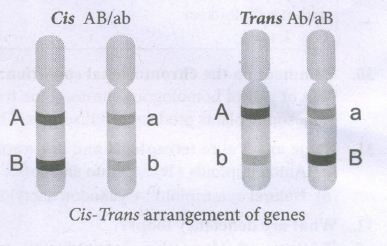
The two dominant alleles or recessive alleles occur in the same homologous chromosomes, tend to inherit together into same gamete are called coupling or cis configuration. If dominant or recessive alleles are present on two different, but homologous chromosomes they inherit apart into different gamete are called repulsion or trans configuration.
13.
| S. No. | Mendelian factors | Chromosomes behaviour |
| 1. | Alleles of a factor occur in pair. | Chromosomes occur in pairs |
| 2. | Similar or dissimilar alleles of a factor separate during the gamete formation. | The homologous chromosomes separate during meiosis. |
| 3. | Mendelian factors can assort independently. | The paired chromosomes can separate independently during meiosis but the linked genes in the same chromosome normally do not assort independently. |
14.
(i) Somatic cells of organisms are derived from the zygote by repeated cell division (mitosis). these consist of two identical sets of chromosomes. One set is received from female parent (maternal) and the other from male parent (paternal). These two chromosomes constitute the homologous pair.
(ii) Chromosomes retain their structural uniqueness and individuality throughout the life cycle of an organism.
(iii) Each chromosome carries specific determiners or Mendelian factors which are now termed as genes.
(iv) The behaviour of chromosomes during the gamete formation (meiosis) provides evidence to the fact that genes or factors are located on chromosomes.

12th Standard Syllabus & Materials
12th Standard
TN 12th Computer Applications களப்பெயர் முறைமை (DNS) Sample Question Papers Study Material - QB365 Set A
NEW12th Standard
TN 12th Computer Applications வலையமைப்பு எடுத்துக்காட்டுகள் மற்றும் நெறிமுறைகள் Sample Question Papers Study Material - QB365 Set A
NEW12th Standard
TN 12th Computer Applications கணினி வலையமைப்பு ஓர் அறிமுகம் Sample Question Papers Study Material - QB365 Set A
NEW12th Standard
TN 12th Computer Applications PHP-உடன் MySQL-ஐ இணைத்தல் Sample Question Papers Study Material - QB365 Set A



Tamilnadu Stateboard 12th Standard Subjects

Maths

Chemistry

Physics
Biology

Computer Science

Business Maths and Statistics

Economics

Commerce

Accountancy

History

Computer Applications
Biology
Computer Technology
Computer Applications
Computer Science
Business Maths and Statistics
Commerce
Economics
Maths
Chemistry
Physics
Computer Technology
History
Accountancy

Tamil

English

French
Tamilnadu Stateboard Standards

