
 100% FREE ACCESS
12th Standard Syllabus & Materials
12th Standard
TN 12th Maths Applications of Matrices and Determinants Sample Question Papers Study Material - QB365 Set A
NEW12th Standard
TN 12th Computer Applications மின்னணு தரவு பரிமாற்றம் Sample Question Papers Study Material - QB365 Set A
NEW12th Standard
TN 12th Computer Applications மின் - வணிக பாதுகாப்பு அமைப்புகள் Sample Question Papers Study Material - QB365 Set A
NEW12th Standard
TN 12th Computer Applications மின்னணு செலுத்தல் முறைகள் Sample Question Papers Study Material - QB365 Set A
NEW12th Standard
TN 12th Computer Applications மின் - வணிகம் Sample Question Papers Study Material - QB365 Set A
NEW12th Standard
TN 12th Computer Applications திறந்த மூல கருத்துருக்கள் Sample Question Papers Study Material - QB365 Set A

Published on: 29/08/2022
QB365 provides a detailed and simple solution for every Possible Creative Questions in Class 12 Biology Subject - Botany - Chromosomal Basis of Inheritance, English Medium. It will help Students to get more practice questions, Students can Practice these question papers in addition to score best marks.
Download Tamil Nadu 12th Standard Biology question papers, model tests, one-mark questions, important questions, and public exam papers in PDF format. Free study materials and answer keys for TN State Board students.
Questions + Answers key
Take MCQ Biology Test1.
What is point mutation? Explain its types.
2.
What are the types of crossing over?
3.
On the account of historical development of chromosome theory who were the scientists involved to propose it?
4.
Give an account on the conditions of Aneuploidy.
5.
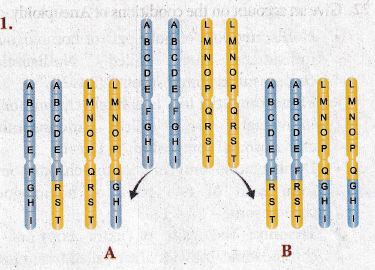
Observe the figure above and answer the following questions.
1. Mention the type of structural chromosomal aberration -Explain.
2. What do both A and B represent?
3. Bring out the differences between A and B
4. What is it also called give reasons?
6.
Explain structural chromosome aberration by inversion.
7.
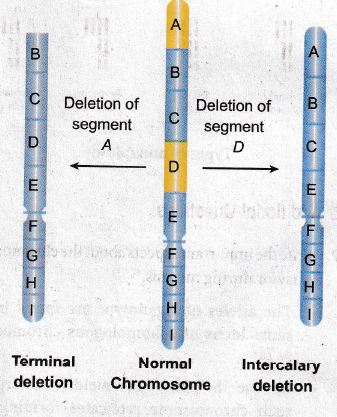
Explain how structural chromosomal aberration occurs of deletion.
8.
How sex is determined in Sphaerocarpos?
9.
How sex is determined in papaya?
10.
What are multiple alleles? Write the characteristics of multiple alleles.
11.
Write the important aspects about the chromosome behavior during meiosis.
12.
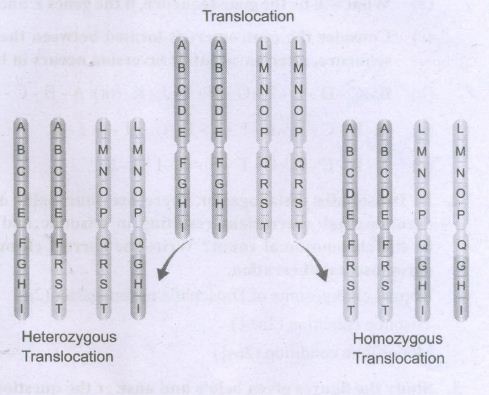
What is translocation? Write about its types.
13.
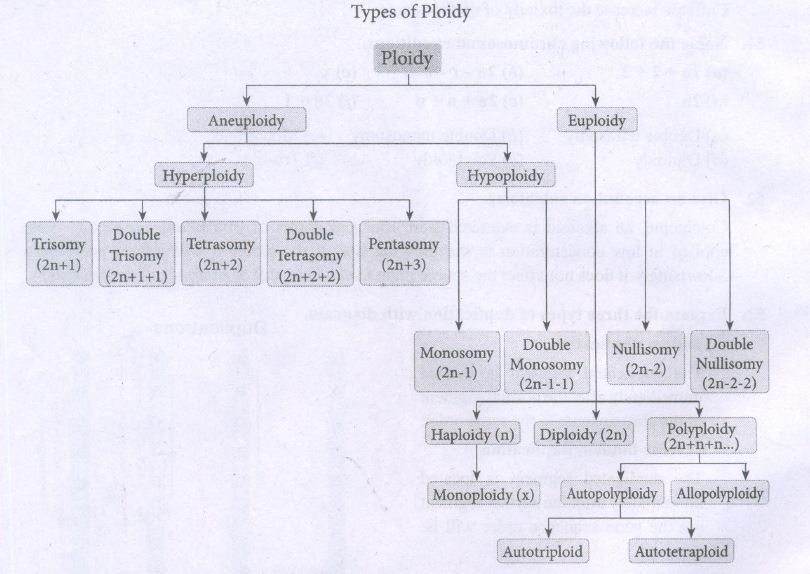
Explain hyperploidy with its types.
14.
Draw a flow chart depicting the various types of ploidy.
15.
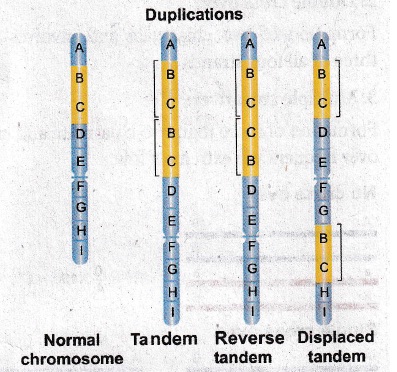
"The process of arrangement if the same order genes more than one in the same chromosome."
1. What is the process known as?
2. Explain its types.
1.
Point mutation
It refers to alterations of single base pairs of DNA or of a small number of adjacent base pairs
Types of point mutations:
Point mutation in DNA are categorised into two main types. They are base pair substitutions and base pair insertions or deletions. Base substitutions are mutations in which there is a change in the DNA such that one base pair is replaced by another.
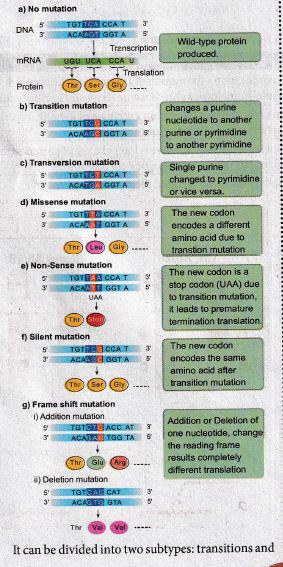
transversions. Addition or deletion mutations are actually additions or deletions of nucleotide pairs and also called base pair addition or deletions. collectively, they are termed indel mutations (for insertion-deletion).
Substitution mutations or indel mutations affect translation. Based on these different types of mutations are given below.
The mutation that changes one codon for an amino acid into another codon for that same amino acid are called Synonymous or silent mutations. The mutation where the codon for one amino acid is changed into a codon for another amino acid is called Missense or non-synonymous mutations. The mutations where codon for one amino acid is changed into a termination or stop codon is called nonsense mutation. Mutations that result in the addition or deletion of a single base pair of DNA that changes the reading frame for the translation process as a result of which there is complete loss of normal protein structure and function are called frameshift mutations.
2.
Types of Crossing Over
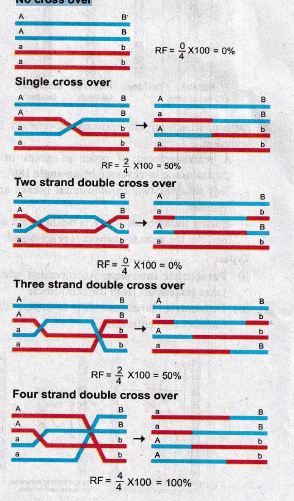
Depending upon the number of chiasmata formed crossing over may be classified into three types.
1. Single cross over:
Formation of single chiasma and involves only two chromatids out of four.
2. Double cross over:
Formation of two chiasmata and involves two or three or all four strands
3. Multiple cross over:
Formation of more than two chiasmata and crossing over frequency is extremely low.
No cross over
3.
Wilhelm Roux (1883) postulated that the chromosomes of a cell are responsible for transferring heredity
Montgomery (1901) was first to suggest occurrence of distinct pairs of chromosomes and he also concluded that maternal chromosomes pair with paternal chromosomes only, during meiosis.
T. Boveri (1902) supported the idea. that the chromosomes contain genetic determiners, and he was largely responsible for developing the chromosomal theory of inheritance
W.S. Sutton (1902), a young American student independently recognized a parallelism (similar) between the behaviour of chromosomes and Mendelian factors during gamete formation.
Sutton and Boveri (1903) independently proposed the chromosome theory of inheritance. Sutton united the knowledge of chromosomal segregation with Mendelian principles and called it chromosomal theory of inheritance.
4.
(i) Nullisomy: loss of both pair of homologous. individuals are called Nullisomics chromosomal composition is (2n-2).
(ii) Monosomy: the loss of a single chromosome Individual are called monosomic chromosomal composition is (2n- 1).
(iii) Double monosomy: missing one chromosome from each of two pairs of homologous chromosome -2n - 1- 1
(iv) Trisomy: the gain of extra copy of a chromosome. Individual are called trisomics - chromosomal composition is 2n + 1.
(v) Tetrasomy: gain of an extra pair of homologous chromosomes.
(vi) Tetrasomics chromosomal composition is 2n + 2.
(vii) Double tetrasomic contains an extra pair of two pairs homologous chromosomes (2n + 2 + 2).
(viii) Pentasomy: Addition of three individual chromosomes from different chromosomal pairs to normal diploid set (2n + 3).
5.
(i) Translocation - the transfer of a segment of chromosome to a non-homologous chromosome.
(ii) Reciprocal translocations.
(iii)
| A | B |
| Homozygous translocation | Heterozygous translocations |
| Both the chromosomes of two pairs are involved in translocation | Only one of the chromosome from each pair of two homologous are involved in translocation |
| Two homologous of each translocated chromosome are identical. | The remaining chromosome is normal |
(iv) it is also called illegitimate crossing over
(1) In crossing over there is an exchange of genetic material between homologous chromosome. But in translocation, there is interchange of chromosome segments in nonhomologous chromosomes.
(2) So translocation is called illegitimate crossing over.
6.
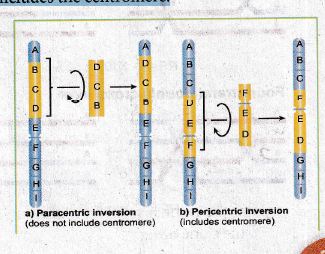
(i) A rearrangement of order of genes in a chromosome by reversed by an angle 180o.
(ii) This involves two chromosomal breaks and reunion.
(iii) During this process, there is neither gain nor loss, but the gene sequences is rearranged.
Types:
(i) Paracentric inversion: An inversion which takes place apart from the centromere
(ii) Pericentric inversion: An inversion that includes the centromere.
7.
(i) Loss of a portion of chromosome is called deletion.
(ii) Cause - occurs due to chemicals, drugs and radiations
(iii) Observed, in - Drosophila and maize.
Types:
(i) Terminal deletion: Single break in any one end of the chromosome.
(ii) Intercalary deletion: It is caused by two breaks and reunion of terminal parts leaving the middle.
8.
Sphaerocarpos donnellii - Bryophyte
(i) The male and female gametophyte haploid organism with 8 chromosomes (n = 8) seven autosomes are similar in both male and female gametophytes.
(ii) The eighth chromosome of female is X - larger than seven autosomes.
(iii) The eighth chromosome of male is Y - smaller than seven autosomes.
(iv) The sporophyte (heterogametic) containing XY-combination produces two types of meiospores some with X and others with Y chromosomes.
(v) Meiospores with X chromosomes produce female gametophyte and those with Y chromosome produces male gametophyte.
9.
(i) Papaya has 17 pairs of autosomes and one pair of sex chromosomes (xy) which look like autosomes. It is evolved from autosomes.
(ii) The sex chromosomes are functionally distinct
(iii) y chromosome carries the genes for male organ development and x chromosome bears the female organ developmental genes.
(iv) In papaya sex determination is controlled by three alleles. They are m, M1 and M2 of a single gene.
| Genotype | Dominant/ recessive | Modification | Sex |
| mm | Homozygous recessive | Restrict maleness | Female |
| M1,m | Heterozygous | Induces maleness | Male |
| M2,m | Heterozygous | Induces both the sex | Bisexual (rare) |
| M1,M1 or M2,M2 or M1,M2 | Homozygous/ Heterozygous dominant | Inviable plants | Sterile |
10.
When three or more allelic forms of a gene occupy the same locus in a pair of homologous chromosomes, they are called multiple alleles.
Characteristics:
(i) Multiple alleles of a series always occupy the same locus in the homologous chromosome So, no crossing over occurs within the alleles of a series.
(ii) Multiple alleles are always responsible for the same character.
(iii) The wild type alleles of a series exhibit dominant character.
(iv) Mutant type will influence dominance or an intermediate Phenotypic effect.
(v) When any two of the mutant multiple alleles are crossed, the phenotype is always mutant type.
11.
(i) The alleles of a genotype are found in the same locus of a homologous chromosome (A/a).
(ii) In the S phase of meiotic interphase each chromosome replicates forming two copies of each allele (AA/aa), one on each chromatid.
(iii) The homologous chromosomes segregate in anaphase I, thereby separating two different alleles (AA) and (aa).
(iv) In anaphase II of meiosis, separation of sister chromatids of homologous chromosomes takes place.
(v) Therefore, each daughter cell (gamete) carries only a single allele of a character (A), (A), (a) and (a).
12.
Translocation
The transfer of a segment of chromosome to a nonhomologous chromosome is called translocation. Translocation should not be confused with crossing over, in which an exchange of genetic material between homologous chromosome takes place. Translocation occurs as a result of interchange of chromosome segments in non-homologous chromosomes. There are three types:
i. Simple translocation
ii. Shift translocation
iii. Reciprocal translocation
i. Simple translocation
A single break is made in only one chromosome. The broken segment gets attached to one end of a non-homologous chromosome. It occurs very rarely in nature.
ii. Shift translocation
Broken segment of one chromosome gets inserted interstitially in a non-homologous chromosome.
iii. Reciprocal translocations
It involves mutual exchange of chromosomal segments between two non homologous chromosomes. It is also called illegitimate crossing over. It is further divided into two types.
a. Homozygous translocation: Both the chromosomes of two pairs are involved in translocation. Two homologous of each translocated chromosomes are identical.
b. Heterozygous translocation: Only one of the chromosome from each pair of two homologous are involved in translocation, while the remaining chromosome is normal.
Translocations playa major role in the formation of species.
13.
Hyperploidy
Addition of one or more chromosomes to diploid sets are called hyperploidy. Diploid set of chromosomes represented as Disomy. Hyperploidy can be divided into three types. They are as follows:
(a) Trisomy
Addition of single chromosome to diploid set is called Simple trisomy (2n+ 1). Trisomies were first reported by Blakeslee (1910) in Datura stramonium (Jimson weed). But later it was reported in Nicotiana, Pisum and Oenothera. Sometimes addition of two individual chromosome from different chromosomal pairs to normal diploid sets are called Double trisomy (2n+ 1+ 1).
(b) Tetrasomy
Addition of a pair or two individual pairs of chromosomes to diploid set is called tetrasomy (2n+2) and Double tetras6my (2n+2+2) respectively. All possible tetrasomics are available
in Wheat.
(c) Pentasomy
Addition of three individual chromosome from different chromosomal pairs to normal diploid set are called pentasomy (2n+3).
14.
15.
The process is known as duplication, a type of structural chromosomal aberration.
Due to duplication some genes are present in more than two copies. It is three types.
i. Tandem duplication
The duplicated segment is located immediately after the normal segment of the chromosome in the same order.
ii Reverse tandem duplication
The duplicated segment is located immediately after the normal segment but the gene sequence order will be reversed.
iii Displaced duplication
The duplicated segment is located in the same chromosome, but away from the normal segment.

12th Standard Syllabus & Materials
12th Standard
TN 12th Computer Applications வலையமைப்பு வடமிடல் Sample Question Papers Study Material - QB365 Set A
NEW12th Standard
TN 12th Computer Applications களப்பெயர் முறைமை (DNS) Sample Question Papers Study Material - QB365 Set A
NEW12th Standard
TN 12th Computer Applications வலையமைப்பு எடுத்துக்காட்டுகள் மற்றும் நெறிமுறைகள் Sample Question Papers Study Material - QB365 Set A
NEW12th Standard
TN 12th Computer Applications கணினி வலையமைப்பு ஓர் அறிமுகம் Sample Question Papers Study Material - QB365 Set A



Tamilnadu Stateboard 12th Standard Subjects

Maths

Chemistry

Physics
Biology

Computer Science

Business Maths and Statistics

Economics

Commerce

Accountancy

History

Computer Applications
Biology
Computer Technology
Computer Applications
Computer Science
Business Maths and Statistics
Commerce
Economics
Maths
Chemistry
Physics
Computer Technology
History
Accountancy

Tamil

English

French
Tamilnadu Stateboard Standards

