
 100% FREE ACCESS
12th Standard Syllabus & Materials
12th Standard
TN 12th Maths Applications of Matrices and Determinants Sample Question Papers Study Material - QB365 Set A
NEW12th Standard
TN 12th Computer Applications மின்னணு தரவு பரிமாற்றம் Sample Question Papers Study Material - QB365 Set A
NEW12th Standard
TN 12th Computer Applications மின் - வணிக பாதுகாப்பு அமைப்புகள் Sample Question Papers Study Material - QB365 Set A
NEW12th Standard
TN 12th Computer Applications மின்னணு செலுத்தல் முறைகள் Sample Question Papers Study Material - QB365 Set A
NEW12th Standard
TN 12th Computer Applications மின் - வணிகம் Sample Question Papers Study Material - QB365 Set A
NEW12th Standard
TN 12th Computer Applications திறந்த மூல கருத்துருக்கள் Sample Question Papers Study Material - QB365 Set A

Published on: 29/08/2022
QB365 provides a detailed and simple solution for every Possible Creative Questions in Class 12 Biology Subject - Botany - Classical Genetics, English Medium. It will help Students to get more practice questions, Students can Practice these question papers in addition to score best marks.
Download Tamil Nadu 12th Standard Biology question papers, model tests, one-mark questions, important questions, and public exam papers in PDF format. Free study materials and answer keys for TN State Board students.
Questions + Answers key
Take MCQ Biology Test1.
Ramu and Somu are farmers. Ramu cultivated the crops by self-fertilization method. Somu cultivate the crops from mixed population.
i) Who will get new variety?
ii) Write the advantages and disadvantages of their selection.
2.
What is variation? Write about it types and add a short note on the importance of variations.
3.
What are the four major sub disciplines of genetics?
4.
Describe mitochondrial inheritance.
5.
List out the Inter-genic or non-allelic interaction.
6.
Explain lethal genes with an example.
7.
8.
Explain Mendel's empirical approach on heredity.
9.
Write an essay on Mendel's life history.
10.
Describe incomplete dominance exhibited by Mirabilis jalapa.
11.
How does the wrinkled gene make Mendel's peas wrinkled? Find out the molecular explanation.
12.
Explain Dihybrid cross in pea plant.
1.
(i) Somu get the new variety
(ii) Somu remove the anthers before fertilization and transfer the pollen from another variety of crop to the stigma of flower where the anthers are removed.
(iii) This results in cross-fertilization which leads to the creation of hybrid new varieties with different traits.
I Self-fertilization:
Advantages:
1. Very few pollen grain can pollinate the flower
2. Pure lines produce offsprings having specific parental traits
3. Less chance of failure of pollination
Disadvantages:
1. Self fertilization leads to inbreeding depression.
2. Health of plant species affected due to inbreeding between same population.
II. Mixed population:
Advantages:
1. Creation of new hybrid varieties.
2. Genetic information of different plants combined
3. It allows genetic diversity in different plant species.
Disadvantages:
1. More amount of pollen grains have to be produced to ensure the pollination.
2. Pollination may fail due to distance barrier.
3. It introduces some undesirable characters.
4. Flowers are totally depend on external agencies for pollination.
2.
Variation:
The organisms belonging to the same natural population or species that shows a difference in the characteristic is called variation. Variation is two types (i) Discontinuous variation and (ii) Continuous variation
1. Discontinuous Variation:
Within a population there are some characteristics which show a limited form of variation. Example: Style length in Primula, plant height of garden pea. In discontinuous variation, the characteristics are controlled by one or two major genes which may have two or more allelic forms. These variations are genetically determined by inheritance factors: Individuals produced by this variation show differences without any intermediate form between them and there is no overlapping between the two phenotypes. The phenotypic expression is unaffected by environmental conditions. This is also called as qualitative inheritance.
2. Continuous Variation:
This variation may be due to the combining effects of environmental and genetic factors. In a population most of the characteristics exhibit a complete gradation, from one extreme to the other without any break. Inheritance of phenotype is determined by the combined effects of many genes, (polygenes) and environmental factors. This is also known as quantitative inheritance. Example: Human height and skin color.
Importance of variations
(i) Variations make some individuals better fitted in the struggle for existence.
(ii) They help the individuals to adapt themselves to the changing environment.
(iii) It provides the genetic material for natural selection
(iv) Variations allow breeders to improve better yield, quicker growth, increased resistance and lesser input
(v) They constitute the raw materials for evolution.
3.
The four major subdisciplines of genetics are
1.Transmission Genetics / Classical Genetics
Deals with the transmission of genes from parents to of springs. The foundation of classical genetics came from the study of hereditary behaviour of seven genes by Gregor Mendel.
2. Molecular Genetics
Deals with the structure and function of a gene at molecular level.
3. Population Genetics
Deals with heredity in groups of individuals for traits which is determined by a few genes.
4. Quantitative Genetics
Deals with heredity of traits in groups of individuals where the traits are governed by many genes simultaneously.
4.
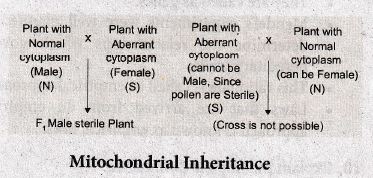
(i) Male sterility found in pearl maize (sorghum Vulgare) - example for mitochondrial cytoplasmic inheritance or cytoplasmic male sterility.
(ii) It is inherited maternally.
(iii) The gene for this inheritance is found in the mitochondrial DNA.
(iv) There are two types of cytoplasm.
(1) normal cytoplasm (N) (Male fertile).
(2) aberrant cytoplasm (S) (Male sterile)
(v) Cytoplasmic genetic male sterility is common in many plant species.
(vi) This sterility is maintained by the influence of both nuclear & cytoplasmic genes
(vii) Even though these genes are nuclear genes, they are distinct from genetic male sterility genes of other plants.
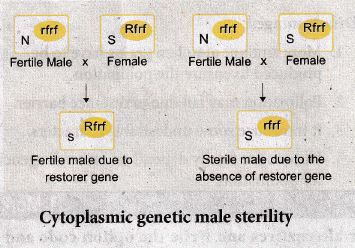
(viii) Because the Rf (restores of fertility) genes do not have any expression of their own, unless the sterile cytoplasm is present.
(ix) Rf genes are required to restore fertility in S cytoplasm, responsible for sterility.
(x) N cytoplasm with rfrf- Fertile pollens.
S cytoplasm with RFRf - Fertile pollens.
S cytoplasm with rfrf - Only male sterile plants.
5.
| S.No | Epistatic interaction | Example | f2 Ratio phenotypic ratio |
| 1. | Dominant epistasis | Fruit colour in summer squash | 12:3:1 |
| 2. | Recessive epistasis | Flower colour of Antirrhinum spp | 9:3:4 |
| 3. | Duplicate genes with cumulative effect |
Fruit shape in summer squash | 9:6:1 |
| 4. | Complementary genes |
Flower colour in sweet peas | 9:7 |
| 5. | Supplementary genes |
Grain colour in Maize | 9:3:4 |
| 6. | inhibitor genes | Leaf colour in rice plants | 13:3 |
| 7. | Duplicate genes | Seed capsule shape (fruit shape) in shepherd's purse Bursa bursa-pastoris | 15:1 |
6.
(i) An allele which has the potential to cause the death of an organism is called a "Lethal Allele".
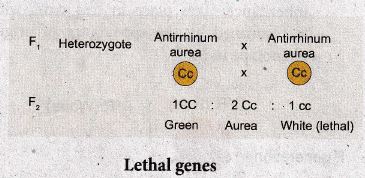
(ii) In 1907, E.Baur reported a lethal gene in snapdragon (Antirrhinum sp.). lt is an example for recessive lethality. In snapdragon there are three kinds of plants.
1. Green plants with chlorophyll (CC).
2. Yellowish green plants with carotenoids are referred to as pale green, golden or aurea plants (Cc).
3. White plants without any chlorophyll (cC).
(iii) When two aurea plants are crossed the F1 progeny has identical phenotypic and genotypic ratio of
1: 2: 1
Green aurea white
(CC) (Cc) (cC)
(iv) Lethality - Death of certain genotype occurs prematurely.
(v) The fully dominant or recessive lethal allele kills the carrier individual only in its homozygous condition.
(vi) So the F2 genotypic ratio will be 2:1 or 1:2 respectively.
7.
8.
(i) Mendel's analytical approach is truly an outstanding scientific achievement.
(ii) His meticulous work & precisely execute breeding experiments.
(iii) He proposed that discrete particulate units of heredity are present & they are transmitted from one generation to the other.
(iv) They are called as genes.
(v) Mendel's experiments were well planned to determine the relationships which govern hereditary traits.
(vi) This rationale is called as empirical approach.
(vii) Laws that are arrived from an empirical approach is known as empirical laws.
9.
(i) The first Geneticist Gregor Johann Mendel unraveled the mystery of heredity.
(ii) He was born on 22 July 1822 in Heinzendorf Silesia, Austria.
(iii) After school education, he studied botany, Physics & Mathematics at University of Vienna.
(iv) He then entered a monastery of St. Thomas at Brunn in Austria & continued his interest in plant hybridization.
(v) Mendel worked as a teacher in a school & performed a series of elegant experiments with pea plants in his garden.
(vi) 1856-1863 was the period of Mendel's hybridization experiments on pea plants.
(vii) Mendel discovered the principles of heredity by studying the inheritance of seven pairs of contrasting traits of pea plant in his garden.
(viii) Mendel crossed and cataloged 24,034 plants through many generations.
(ix) His paper entitled "Experiments on plant hybrids" was published in the proceedings of the Brunn Society of Natural History in 1866.
10.
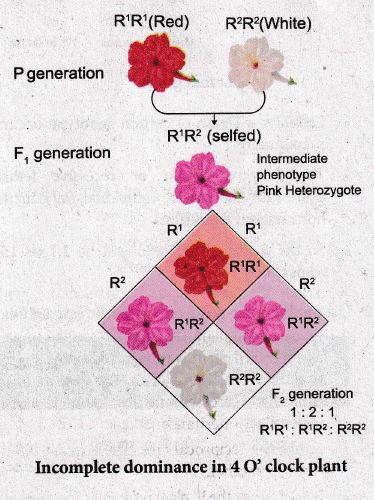
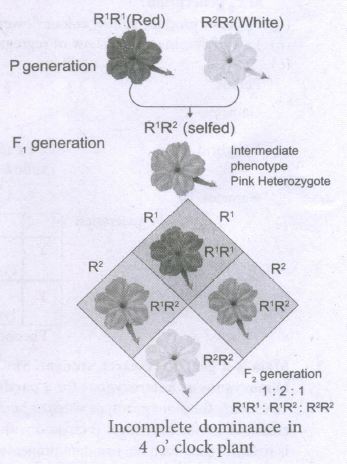
The German Botanist Carl Correns's (1905) Experiment - In 4 0' clock plant, Mirabilis jalapa when the pure breeding homozygous red (R1 R1) parent is crossed with homozygous white (R 2R2), the phenotype of the F1 hybrid is heterozygous pink (R1R2). The F1 heterozygous phenotype differs from both the parental homozygous phenotype. This cross did not exhibit the character of the dominant parent but an intermediate colour pink. When one allele is not completely dominant to another allele it shows incomplete dominance. Such allelic interaction is known as incomplete dominance. F1 generation produces intermediate phenotype pink coloured flower.
When pink coloured plants of F 1 generation were interbred in F2 both phenotypic and genotypic ratios were found to be identical as 1 : 2 : 1(1 red: 2 pink: 1 white). Genotypic ratio is 1 R1R1 : 2 R1R2 : 1 R2R2. From this we conclude that the alleles themselves remain discrete and unaltered proving the Mendel's Law of Segregation. The phenotypic and genotypic ratios are the same. There is no blending of genes. In the F2 generation R1 and R2 genes segregate and recombine to produce red, pink and white in the ratio of 1 : 2 : 1. R 1 allele codes for an enzyme responsible for the formation of red pigment. R2 allele codes for defective enzyme. R1 and R2 genotypes produce only enough red pigments to make the flower pink. Two R1R1 are needed for producing red flowers. Two R2R2 genes are needed for white flowers. If blending had taken place, the original pure traits would not have appeared and all F2 plants would have pink flowers. It is very clear that Mendel's particulate inheritance takes place in this cross which is confirmed by the reappearance of original phenotype in F2.
11.
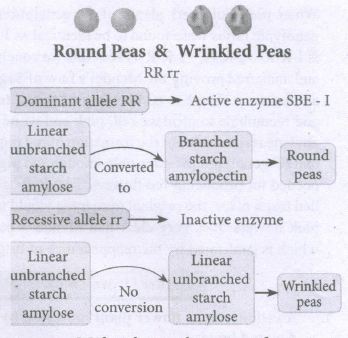
The protein called starch branching enzyme (SBEI) is encoded by the wild-type allele of the gene (RR) which is dominant. When the seed matures, this enzyme SBEI catalyzes the formation of highly branched starch molecules. Normal gene (R) has become interrupted by the insertion of extra piece of DNA (0.8 kb) into the gene, resulting in r allele. In the homozygous mutant form of the gene (rr) which is recessive, the activity of the enzyme SBEI is lost resulting in wrinkled peas. The wrinkled seed accumulates more sucrose and high water content. Hence the osmotic pressure inside the seed rises. As a result, the seed absorbs more water and when it matures it loses water as it dries. So it becomes wrinkled at maturation. When the seed has at least one copy of normal dominant gene heterozygous, the dominant allele helps to synthesize starch, amylopectin an insoluble carbohydrate, with the osmotic balance which minimises the loss of water resulting in smooth structured round seed.
12.
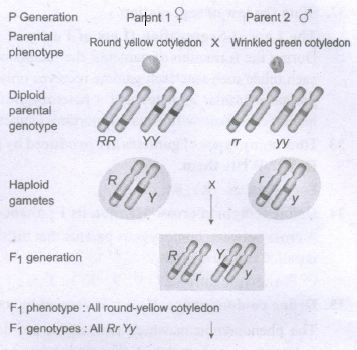
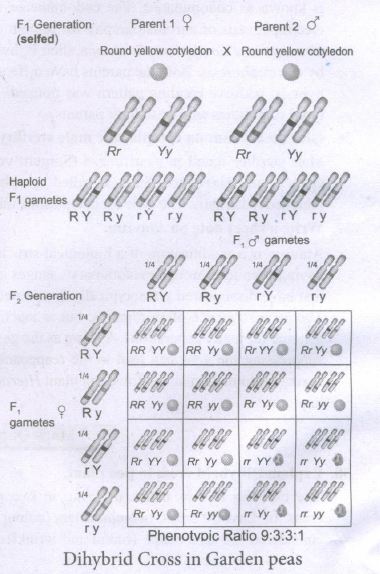
The crossing of two plants differing in two pairs of contrasting traits is called dihybrid cross. In a dihybrid cross, two characters (colour and shape) are considered at a time. Mendel considered the seed shape (round and wrinkled) and cotyledon colour (yellow & green) as the two characters. In seed shape round (R) is dominant over wrinkled (r); in cotyledon colour yellow (Y) is dominant over green (y). Hence the pure breeding round yellow parent is represented by the genotype RRYY and the pure breeding green wrinkled parent is represented by the genotype rryy. During gamete formation the paired genes of a character assort out independently of the other pair. During the F1 x F1 fertilization each zygote with an equal probability receives one of the four combinations from each parent. The resultant gametes thus will be genetically different and they are of the following four types:
1) Yellow round (YR)- 9/16
2) Yellow wrinkled (Yr)- 3/16
3) Green round (yR) - 3/16
4) Green wrinkled(yr) - 1/16
These four types of gametes of F1 dihybrids unite randomly in the process of fertilization and produce sixteen types of individuals in F2 in the ratio of 9 : 3 : 3 : 1 as shown in the figure. Mendel's 9:3:3:1 dihybrid ratio is an ideal ratio based on the probability including segregation, independent assortment and random fertilization. In sexually reproducing organism / plants from the garden peas to human beings, Mendel's findings laid the foundation for understanding inheritance and revolutionized the field of biology. The dihybrid cross and its result led Mendel to propose a second set of generalisations that we called Mendel's Law of independent assortment.

12th Standard Syllabus & Materials
12th Standard
TN 12th Computer Applications வலையமைப்பு வடமிடல் Sample Question Papers Study Material - QB365 Set A
NEW12th Standard
TN 12th Computer Applications களப்பெயர் முறைமை (DNS) Sample Question Papers Study Material - QB365 Set A
NEW12th Standard
TN 12th Computer Applications வலையமைப்பு எடுத்துக்காட்டுகள் மற்றும் நெறிமுறைகள் Sample Question Papers Study Material - QB365 Set A
NEW12th Standard
TN 12th Computer Applications கணினி வலையமைப்பு ஓர் அறிமுகம் Sample Question Papers Study Material - QB365 Set A



Tamilnadu Stateboard 12th Standard Subjects

Maths

Chemistry

Physics
Biology

Computer Science

Business Maths and Statistics

Economics

Commerce

Accountancy

History

Computer Applications
Biology
Computer Technology
Computer Applications
Computer Science
Business Maths and Statistics
Commerce
Economics
Maths
Chemistry
Physics
Computer Technology
History
Accountancy

Tamil

English

French
Tamilnadu Stateboard Standards

