
 100% FREE ACCESS
12th Standard Syllabus & Materials
12th Standard
TN 12th Maths Applications of Matrices and Determinants Sample Question Papers Study Material - QB365 Set A
NEW12th Standard
TN 12th Computer Applications மின்னணு தரவு பரிமாற்றம் Sample Question Papers Study Material - QB365 Set A
NEW12th Standard
TN 12th Computer Applications மின் - வணிக பாதுகாப்பு அமைப்புகள் Sample Question Papers Study Material - QB365 Set A
NEW12th Standard
TN 12th Computer Applications மின்னணு செலுத்தல் முறைகள் Sample Question Papers Study Material - QB365 Set A
NEW12th Standard
TN 12th Computer Applications மின் - வணிகம் Sample Question Papers Study Material - QB365 Set A
NEW12th Standard
TN 12th Computer Applications திறந்த மூல கருத்துருக்கள் Sample Question Papers Study Material - QB365 Set A

Published on: 29/08/2022
QB365 provides a detailed and simple solution for every Possible Creative Questions in Class 12 Biology Subject - Botany - Ecosystem, English Medium. It will help Students to get more practice questions, Students can Practice these question papers in addition to score best marks.
Download Tamil Nadu 12th Standard Biology question papers, model tests, one-mark questions, important questions, and public exam papers in PDF format. Free study materials and answer keys for TN State Board students.
Questions + Answers key
Take MCQ Biology Test1.
What is ecosystem services? Why it is of much importance?
2.
Discuss the three zones of a lentic ecosystem.
3.
Explain the cycling of phosphorus in an ecosystem.
4.
What is biogeochemical cycle? Explain its types.
5.
What does the term 'Eluviation' stands for?
6.
Pyramid of energy is always upright - Justify.
7.
Spindle shaped pyramid of number is noticed in forest ecosystem. Give reasons.
8.
Name the three types of ecological pyramids.
9.
10.
Write a brief note on Detritus food chain.
11.
Explain Grazing food chain with example.
12.
State the second law of thermodynamics.
13.
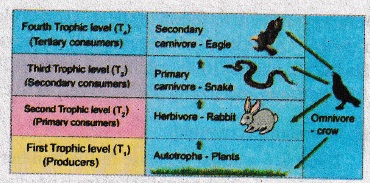
Explain the concept of trophic level in an ecosystem.
14.
List the factors affecting primary productivity.
15.
What is secondary productivity? Explain its types.
1.
Ecosystem services are defined as the benefits that people derive from nature. Study on ecosystem services acts as an effective tool for gaining knowledge on ecosystem benefits and their sustained use. Without such knowledge gain, the fate of any ecosystem will be at stake and the benefits they provide to us in future will become bleak.
2.
There are three zones, littoral, limnetic and profundal. The littoral zone, which is closest to the shore with shallow water region, allows easy penetration of light. It is warm and occupied by rooted plant species. The limnetic zone refers the open water of the pond with an effective penetration of light and domination of planktons. The deeper region of a pond below the limnetic zone is called profundal zone with no effective light penetration and predominance of heterotrophs. The bottom zone of a pond is termed benthic and is occupied by a community of organisms called benthos (usually decomposers).
3.
Phosphorus cycle is a type of sedimentary cycle in which phosphorus is found in the biomolecules like DNA, RNA, ATP, NADP and phospholipid molecules of living organisms. Phosphorus is not abundant in the biosphere, whereas a bulk quantity of phosphorus is present in rock deposits, marine sediments and guano. It is released from these deposits by weathering process. After that, it circulates in lithosphere as well as hydrosphere. The producers absorb phosphorus in the form of phosphate ions, and then it is transferred to each trophic level of food chain through food. Again death of the organisms and degradation by the action of decomposers, the phosphorus is released back into the lithosphere and hydrosphere to maintain phosphorus cycle.
4.
Circulation of nutrients within the ecosystem or biosphere is known as biogeochemical cycles and also called as 'cycling of materials.' There are two basic types,
(I) Gaseous cycle - It includes atmospheric Oxygen, Carbon and Nitrogen cycles.
(II) Sedimentary cycle - It includes the cycles of Phosphorus, Sulphur and Calcium - Which are present as sediments of Earth.
5.
The movement of decomposed, water soluble organic and inorganic compounds from the surface to the lower layer of soil or the carrying away of the same by water is called eluviation.
6.
A graphical representation of energy flow at each successive trophic level in an ecosystem is called pyramids of energy. The bottom of the pyramid of energy is occupied by the producers. There is a gradual decrease in energy transfer at successive tropic levels from producers to the upper levels. Therefore, the pyramid of energy is always upright.
7.
In a forest ecosystem the pyramid of number is spindle in shape, it is because the base (T 1) of the pyramid occupies large sized trees (Producer) which are lesser in number. Herbivores (T2) (Fruit eating birds, elephant and deer) occupying second trophic level, are more in number than the producers. In final trophic level (T4) tertiary consumers (lion) are lesser in number than the secondary consumer (T3) (fox and snake).
8.
(1) pyramid of number
(2) pyramid of biomass
(3) pyramid of energy.
9.
10.
Detritus food chain is a type of food chain which begins with dead organic matter which is an important source of energy. A large amount of organic matter is derived from the dead plants, animals and their excreta. This- type of food chain is present in all ecosystems. The transfer of energy from the dead organic matter, is transferred through a series of organisms called detritus consumers (detritivores)- small carnivores -large (top) carnivores with repeated eating arid being eaten respectively. This is called the detritus food chain.
Fallen leaves ➝ Earth worm ➝ Black bird ➝ Hawk
Detritus Detritivores Small carnivores Top carnivores
11.
Main source of energy for the grazing food chain is the Sun. It begins with the first link, producers (plants). The second link in the food chain is primary consumers (mouse) which get their food from producers. The third link in the food chain is secondary consumers (snake) which get their food from primary consumers. Fourth link in the food chain is tertiary consumers (eagle) which get their food from secondary consumers.
Grass ➝ Mouse ➝ Snake ➝ Eagle
Producers Primary consumers Secondary Consumers Tertiary consumers
12.
Second law of thermodynamics states that energy transformation results in the reduction of the free energy of the system. Usually energy transformation cannot be 100% efficient. As energy is transferred from one organism to another in the form of food, a portion of it is stored as energy in living tissue, whereas a large part of energy is dissipated as heat through respiration. The transfer of energy is irreversible natural process.
13.
A trophic level refers to the position of an organism in the food chain.
The number of trophic level is equal to the number of steps in the food chain.
The green plants (producers) occupying the first trophic level (T1) are called producers
Green plants
The energy produced by the producers is utilized by the plant eaters (herbivores) they are called primary consumers and occupies the second trophic level (T2).
Rabbit
Diagrammatic representation of trophic levels
(i) Herbivores are eaten by carnivores, which occupy the third trophic level (T3).
(ii) snake
(iii) They are also called secondary consumers or primary carnivores.
(iv) Carnivores are eaten by the other carnivores, which occupy the fourth trophic level (T4). They are called the tertiary consumers or secondary carnivores.
(v) Eagle
(vi) Some organisms which eat both plants and animals are called as omnivores (Crow).
(vii) Such organisms may occupy more than one trophic level in the food chain.
14.
Primary productivity depends upon the plant species of an area, their photosynthetic capacity, availability of nutrients, solar radiation, precipitation, soil type, topographic factors (altitude, latitude and direction), and other environmental factors.
15.
The amount of energy stored in the tissues of heterotrophs or consumers is called secondary productivity.
(a) Gross secondary productivity: It is equivalent to the total amount of plant material ingested by the herbivores minus the materials lost as faces.
(b) Net secondary productivity: Storage of energy or biomass by consumers per unit area per unit time, after respiratory loss is called net secondary productivity.

12th Standard Syllabus & Materials
12th Standard
TN 12th Computer Applications வலையமைப்பு வடமிடல் Sample Question Papers Study Material - QB365 Set A
NEW12th Standard
TN 12th Computer Applications களப்பெயர் முறைமை (DNS) Sample Question Papers Study Material - QB365 Set A
NEW12th Standard
TN 12th Computer Applications வலையமைப்பு எடுத்துக்காட்டுகள் மற்றும் நெறிமுறைகள் Sample Question Papers Study Material - QB365 Set A
NEW12th Standard
TN 12th Computer Applications கணினி வலையமைப்பு ஓர் அறிமுகம் Sample Question Papers Study Material - QB365 Set A



Tamilnadu Stateboard 12th Standard Subjects

Maths

Chemistry

Physics
Biology

Computer Science

Business Maths and Statistics

Economics

Commerce

Accountancy

History

Computer Applications
Biology
Computer Technology
Computer Applications
Computer Science
Business Maths and Statistics
Commerce
Economics
Maths
Chemistry
Physics
Computer Technology
History
Accountancy

Tamil

English

French
Tamilnadu Stateboard Standards

