
 100% FREE ACCESS
12th Standard Syllabus & Materials
12th Standard
TN 12th Maths Applications of Matrices and Determinants Sample Question Papers Study Material - QB365 Set A
NEW12th Standard
TN 12th Computer Applications மின்னணு தரவு பரிமாற்றம் Sample Question Papers Study Material - QB365 Set A
NEW12th Standard
TN 12th Computer Applications மின் - வணிக பாதுகாப்பு அமைப்புகள் Sample Question Papers Study Material - QB365 Set A
NEW12th Standard
TN 12th Computer Applications மின்னணு செலுத்தல் முறைகள் Sample Question Papers Study Material - QB365 Set A
NEW12th Standard
TN 12th Computer Applications மின் - வணிகம் Sample Question Papers Study Material - QB365 Set A
NEW12th Standard
TN 12th Computer Applications திறந்த மூல கருத்துருக்கள் Sample Question Papers Study Material - QB365 Set A

Published on: 29/08/2022
QB365 provides a detailed and simple solution for every Possible Book Back Questions in Class 12 Biology Subject - Botany - Ecosystem, English Medium. It will help Students to get more practice questions, Students can Practice these question papers in addition to score best marks.
Download Tamil Nadu 12th Standard Biology question papers, model tests, one-mark questions, important questions, and public exam papers in PDF format. Free study materials and answer keys for TN State Board students.
Questions + Answers key
Take MCQ Biology Test1.
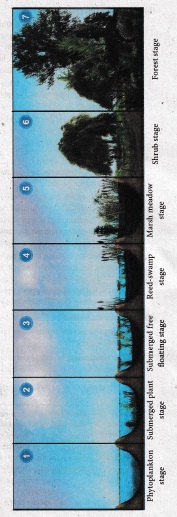
Various stages of succession are given bellow. From that rearrange them accordingly. Find out the type of succession and explain in detail.
Reed-swamp stage, phytoplankton stage, shrub stage, submerged plant stage, forest stage, submerged free floating stage, marsh meadow stage.
2.
Draw a pyramid from following details and explain in brief.
Quantities of organisms are given-Hawks - 50, plants - 1000.rabbit and mouse - 250 + 250, pythons and lizard - 100 + 50 respectively.
3.
Generally in summer the forest are affected by natural fire. Over a period of time it recovers itself by the process of successions .Find out the types of succession and explain.
1.
Type of succession
Hydrosere
(i) The succession in a freshwater ecosystem is also referred to as hydrosere
(ii) Succession in a pond, begins with colonization of the pioneer's like phytoplankton and finally ends with the formation of climax community like forest stage. It includes the following stages
(a) Phytoplankton stage
It is the first stage of succession consisting of the pioneer Community like blue green algae, green algae, diatoms, bacteria, etc.,
The colonization of these organisms enrich the amount of organic matter and nutrients of pond due to their life activities and death.
This favors the development of the next several stages
(b) Submerged plant stage
As the result of death and decomposition of planktons, silt brought from land by rain water, lead to a loose mud formation at the bottom of the pond. Hence, the rooted submerged hydrophytes begin to appear on the new substratum.
Example: Chara, Utricularia, Vallisneria and Hydrilla etc.
The death and decay of these plants will build up the substratum of pond to become shallow. Therefore, this habitat now replaces another group of plants which are of floating type.
(c) Submerged free floating stage
During this stage, the depth of the pond will become almost 2-5 feet
Hence, the rooted hydrophytic plants and with floating large leaves start colonising the pond.
Example: Rooted floating plants like Nelumbo, Nymphaea and Trapa. Some free floating species like Azolla, Lemna, Wolffia and Pistia are also present in this stage.
By death and decomposition of these plants, further the pond becomes more shallow.
Due to this reason, floating plant species is gradually replaced by another species which makes new several stage.
(d) Reed-swamp stage
It is also called an amphibious stage.
During this stage, rooted floating plants are replaced by plants which can live successfully in aquatic as well as aerial environment.
Example: Typha, Phragmites, Sagittaria and Scirpus etc. At the end of this stage, water level is very much reduced, making it unsuitable for the continuous growth of amphibious Plants.
(e) Marsh meadow stage
When the pond becomes swallowed due to decreasing water level
Species of Cyperaceae and Poaceae such as Carex, Iuncus, Cyperus and Eleocharis colonise the area
They form a mat-like vegetation with the help of their much branched root system.
This leads to an absorption and loss of large quantity of water
At the end of this stage, the soil becomes dry and the marshy vegetation disappears gradually and leads to shurb stage
(d) Shrub stage
As the disappearance of marshy vegetation continues, soil becomes dry.
Hence, these areas are now invaded by terrestrial plants like shrubs (Salix and Cornus) and trees (Populus and Alnus).
These plants absorb large quantity of water and make the habitat dry.
Further, the accumulation of humus with a rich flora of microorganisms produce minerals in the soil, ultimately favouring the arrival of new tree species in the area
(e) Forest stage
It is the climax community of hydrosere.
A variety of trees invade the area and develop any one of the diverse type of vegetation.
Example: Temperate mixed forest (Ulmus, Acer and Quercus), Tropical rain forest (Artocarpus and Cinnamomum) and Tropical deciduous forest (Bamboo and Tectona).
In the 7 stages of hydrosere succession, stage 1 is occupied by pioneer community, while the stage 7 is occupied by the climax community. The stages 2 to 6 are occupied by several communities,
2.
Grassland ecosystem : There is a gradual decrease in the number of organisms in each trophic level from producers to primary consumers and then to secondary consumers, and finally to tertiary consumers. Therefore pyramids of number in grassland ecosystem are always upright.
3.
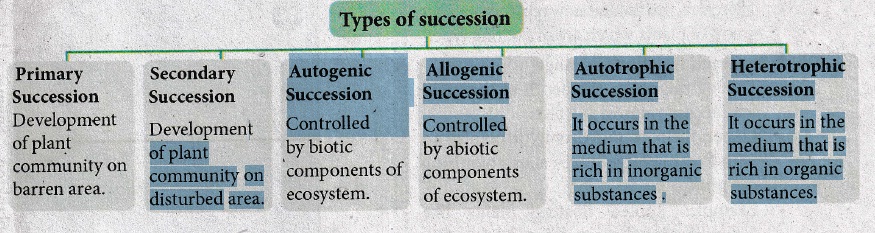
Types of succession
(a) Primary succession
The development of plant community in a barren area where no community existed before is called primary succession.
The plants which colonize first in a barren area is called pioneer species or primary community or primary colonies.
Generally, Primary succession takes a very, long time for the occurrence in any region.
Examples: Microbes, Lichen, Mosses.
The forest destroyed by fire and excessive lumbering may be re-occupied by herbs over period of times.
(b) Secondary succession
The development of a plant community in an area where an already developed community has been destroyed by some natural disturbance (Fire, flood, human activity) is known as secondary succession
Generally, this succession takes less time than the time taken for primary succession.
Example: The forest destroyed by fire and excessive lumbering may be re-occupied by herbs over Period of times.
(c) Autogenic succession
Autogenic succession occurs as a result of biotic factors
The vegetation reacts with its environment and modifies its own environment causing its own replacement by new communities. This is known as autogenic succession.
Example: In forest ecosystem, the larger trees produce broader leaves providing shade to the forest floor area. It affects the shrubs and herbs which require more light (heliophytes) but supports the shade tolerant species (sciophytes) to grow well.
(d) Allogenic succession
Allogeneic succession occurs as a result of abiotic factors.
The replacement of existing community is caused by other external factors (soil erosion, leaching, etc.,) and not by existing organisms.
Example: In a forest ecosystem soil erosion and leaching alter the nutrient value of the soil leading to the change of vegetation in that area.
(e) Autotrophic succession
If the autotrophic organisms like green plants are dominant during the early stages of succession it is called autotrophic succession, this occurs in the habitat which is rich in inorganic substances.
Since, green plants dominate in the beginning of this succession, there is a gradual increase in organic matter and subsequently the energy flow in the ecosystem.
(f) Heterotrophic succession
If heterotrophic organisms like bacteria, fungi, actinomycetes, and animals are dominant during the early stages of succession it is called heterotrophic succession.
Such a succession takes place in organic habitats.
Since heterotrophs dominate in the beginning of such succession, there will be a gradual decrease in the energy content.

12th Standard Syllabus & Materials
12th Standard
TN 12th Computer Applications வலையமைப்பு வடமிடல் Sample Question Papers Study Material - QB365 Set A
NEW12th Standard
TN 12th Computer Applications களப்பெயர் முறைமை (DNS) Sample Question Papers Study Material - QB365 Set A
NEW12th Standard
TN 12th Computer Applications வலையமைப்பு எடுத்துக்காட்டுகள் மற்றும் நெறிமுறைகள் Sample Question Papers Study Material - QB365 Set A
NEW12th Standard
TN 12th Computer Applications கணினி வலையமைப்பு ஓர் அறிமுகம் Sample Question Papers Study Material - QB365 Set A



Tamilnadu Stateboard 12th Standard Subjects

Maths

Chemistry

Physics
Biology

Computer Science

Business Maths and Statistics

Economics

Commerce

Accountancy

History

Computer Applications
Biology
Computer Technology
Computer Applications
Computer Science
Business Maths and Statistics
Commerce
Economics
Maths
Chemistry
Physics
Computer Technology
History
Accountancy

Tamil

English

French
Tamilnadu Stateboard Standards

