
 100% FREE ACCESS
12th Standard Syllabus & Materials
12th Standard
TN 12th Computer Applications மின்னணு தரவு பரிமாற்றம் Sample Question Papers Study Material - QB365 Set A
NEW12th Standard
TN 12th Computer Applications மின் - வணிக பாதுகாப்பு அமைப்புகள் Sample Question Papers Study Material - QB365 Set A
NEW12th Standard
TN 12th Computer Applications மின்னணு செலுத்தல் முறைகள் Sample Question Papers Study Material - QB365 Set A
NEW12th Standard
TN 12th Computer Applications மின் - வணிகம் Sample Question Papers Study Material - QB365 Set A
NEW12th Standard
TN 12th Computer Applications திறந்த மூல கருத்துருக்கள் Sample Question Papers Study Material - QB365 Set A
NEW12th Standard
TN 12th Computer Applications வலையமைப்பு வடமிடல் Sample Question Papers Study Material - QB365 Set A

Published on: 29/08/2022
QB365 provides a detailed and simple solution for every Possible Creative Questions in Class 12 Biology Subject - Botany - Ecosystem, English Medium. It will help Students to get more practice questions, Students can Practice these question papers in addition to score best marks.
Download Tamil Nadu 12th Standard Biology question papers, model tests, one-mark questions, important questions, and public exam papers in PDF format. Free study materials and answer keys for TN State Board students.
Questions + Answers key
Take MCQ Biology Test1.
Short notes on
(a) Plant succession
(b) Pioneers
(c) Seral communities
2.
Explain how to Anthropogenic activities affect ecosystem services.
3.
What is Biogeochemical cycle? Explain.
4.
Describe two types of food chain.
5.
Describe Photosynthetically Active Radiation (PAR).
6.
Explain the comprises of two major ecological components.
7.
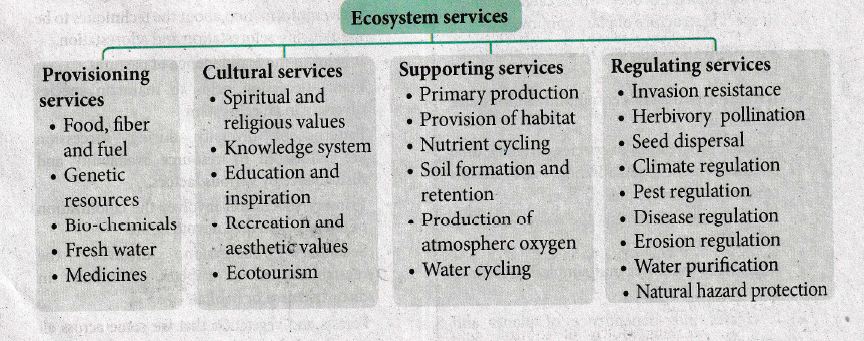
Write a flowchart on the types of ecosystem services.
8.
Define productivity & its type. (or) How to protect the ecosystem? (or) Explain the different classes of productivity of an ecosystem.
9.
Bring out the importance of plant succession.
10.
Write in detail about Autogenic succession and Allogenic succession.
11.
Differentiate Primary succession and Secondary succession.
12.
List out the characteristics of ecological succession.
13.
Write a note on the strategies of ecosystem management.
14.
Write an essay on pond ecosystem.
15.
Explain various steps involved in decomposition (or) Write the steps involved in the mechanism decomposition.
1.
(a) Plant succession
1. A successive replacement of one types of plant community by the other of the same area/ place is known as plant succession.
(b) Pioneers
1. The first individual plants in a barren area are called pioneers.
(c) Seral communities
1. On the other hand, a series of transitional developments of plant communities one after another in a given area are called seral communities.
2.
Anthropogenic activities affect ecosystem services:
(i) The Millennium Ecosystem Assessment (2005) found that "over the past 50 years, humans have changed the ecosystem more rapidly and extensively than in any comparable period of time in human history, largely to meet rapidly growing demands for food, fresh water, medicine, timber, fiber and fuel."
(ii) Generally the following human activities disturb or re-engineer an ecosystem every day.
(iii) Habitat destruction
(iv) Deforestation and overgrazing
(v) Erosion of soils
(vi) Introduction of non-native species
(vii) Overharvesting of plant material
(viii) Pollution of land, water and air
(ix) Runoff pesticides, fertilizers and animal wastes.
3.
Biogeochemical cycle (Nutrient cycle)
Circulation of nutrients within the ecosystem or biosphere is known as biogeochemical cycles and also called as cycling of materials.
Types:
(i) Gaseous cycle:
1. It includes atmospheric Oxygen, Carbon and Nitrogen cycles.
(ii) Sedimentary cycle:
1. it includes the cycles of phosphorus (p), Sulphur (S) and Calcium (Ca) which are present as sediments of earth.
(a) Carbon cycle:
1. The circulation of carbon between organisms and environment is known as the carbon cycle.
2. Carbon is an inevitable part of all biomolecules and is substantially impacted by the change in global climate.
3. Cycling of carbon between organisms and atmosphere in a consequence of two reciprocal processes of photosynthesis and respiration.
4. The releasing of carbon in the atmosphere increases due to burning of fossil fuels, deforestation, forest fire, volcanic eruption and decomposition of dead organics.
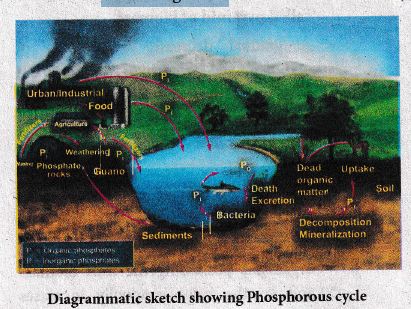
(b) Phosphorus cycle:
1. It is a type of sedimentary cycle.
2. Phosphorus is found in the biomolecules like DNA, RNA, ATP, NADP and phospholipid molecules of living organisms.
3. Phosphorus is not abundant in the biosphere, whereas a bulk quantity of phosphorus is present in rock deposits, marine sediments and guano.
4. It is released from these deposits by weathering.
4.
Types of food chain:
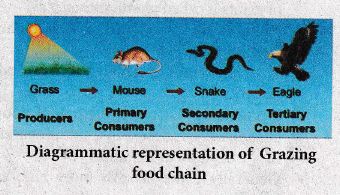
Generally, there are two types of food chain they are (i) Grazing food chain and (ii) Detritus food chain.
(i) Grazing food chain:
1. Main source of energy for the grazing food chain is the Sun.
2. It begins with the first link, producers(Plants).
3. Its secondary link in the food chain is primary consumers (mouses) they depend on producers for food.
4. It's third link in the food chain is secondary consumers (snake) which get their food from primary consumers.
5. Its fourth link in the food chain is tertiary consumers (eagle) which get their food from secondary consumers.
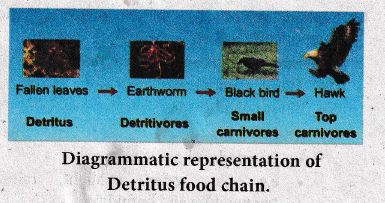
(ii) Detritus food chain:
1. This type of food chain begins with dead organic matter which is an important source of energy.
2. A large amount of organics is derived from the dead plants, animals and their excreta.
3. This type of food chain is present in all ecosystems.
4. The transfer of energy from the dead organic matter is transferred through a series of organisms called detritus consumers (detritivores).
5. Small carnivores - large (top) carnivores with repeated eating and being eaten respectively.
6. This is called the detritus food chain.
5.
(i) The amount of light available for photosynthesis of plants is called photosynthetically.
(ii) PAR is between the range of 400-700 nm wavelength.
(iii) It is essential for photosynthesis and plant growth.
(iv) It is not always constant because of clouds, tree shades, air, dusts, seasons, latitudes and length of the daylight availability.
(v) Generally plants absorb more blue and red light for efficient photosynthesis.
(vi) Of the total sunlight, 34% that reaching the atmosphere is reflected back into the atmosphere, moreover 10% is held by O3. water vapours and atmospheric gases.
(v) And the remaining 56% reaches the earths surface.
(vi) Out of this 56%,only 2 - 10% of the solar energy is used by green plants for photosynthesis while the remaining portion is dissipated as heat.
(vii) PAN is generally reported as millimoles /square meter/second by using silicon photovoltaic detectors which detect only 400 - 700 nm wavelength of light.
(viii) PAR values range from 0 to 3000 millimoles/square meter/second.
(ix) At night PAR is zero and during midday in the summer, PAR often reaches 2000 - 3000 millimoles /square meter/second.
6.
Two major components of ecosystem
(i) Abiotic components
(ii) Biotic components
(i) Abiotic components:
1. It includes climatic factors.
2. e.g. air, water, sunlight, rainfall, temperature and humidity.
3. It includes atmospheric factors.
4. e.g. Soil, air, soil water, and pH of the soil.
5. It also includes topography like latitude, altitude, organics like carbohydrates, proteins, lipids and humid substances and inorganics like C, H, O, N and P.
6. They play a vital role in any ecosystem.
7. The total inorganics present in any ecosystem at a given time is called standing quality (or) stating state.
(ii) Biotic components:
1. It includes all living organics like plants animals, fungi and bacteria.
2. They form the trophic levels of any ecosystem.
3. On the basis of the nutritional relationships, trophic levels of an ecosystem has two components.
(i) Autotrophic components and
(ii) Heterotrophic components.
Autotrophic components:
1. The organisms which can prepare their own food by simple inorganics present in the atmosphere and environment through the photosynthesis.
2. In most of the ecosystems, green plants are the autotrophs and are also called producers.
Heterotrophic components:
1. The organisms consume on the producers are called consumers.
2. Consumers are of two into macromeres and micro consumers.
Macroconsumers:
1. Refer to herbivores, carnivores and omnivores (primary, secondary and tertiary consumers).
Micromeres
1. Refer to decomposers as they decompose the dead plants and dead animals to release organics and inorganics into the environment which are again reused by plants.
2. Example: Bacteria, Actinomycetes and Fungi (saprophytes).
Standing crop
1. The amount of living materials present in a population at any given time is known as standing crop, which may be expressed in terms of number of biomass per unit area.
Biomass
It can be measured as fresh weight or dry weight or carbon weight of organisms. It components are essential to construct the food chain, food web and ecological pyramids.
7.
The varieties of benefits obtained from the ecosystem are generally categorized into the following four types.
8.
(i) The rate of biomass production per unit area in a unit time is called productivity.
(ii) It can be expressed in terms of gm/m2/year or Kcal/m2/year.
(iii) It is classified as given below.
(a) Primary Productivity
(b) Secondary Productivity
(c) Community Productivity
(a) Primary Productivity:
1. The chemical energy or organic matter generated by autotrophs during the process of photosynthesis and chemosynthesis is called primary productivity.
2 It is the source of energy for all organisms, from bacteria to human.
(i) Gross Primary Productivity (GPP)
1. The total amount of food energy or organic matter or biomass produced in an ecosystem by autotrophs through the process of photosynthesis is called gross primary productivity.
(ii) Net Primary Productivity (NPP)
1. The proportion of energy which remains after respiration loss in the plant is called net Primary productivity.
2. It is also called as apparent photosynthesis.
3. Thus the difference between GPP and respiration is known as NPP.
NPP=GPP-Respiration
4. NPP of whole biosphere is estimated to be about 170 billion tons (dry weight) per year.
5. Out of which NPP of oceanic producers is only 55 billion tons per year in unit time.
(b) Secondary productivity :
1. The amount of energy stored in the tissues of heterotrophs or consumers is called secondary productivity.
(i) Gross secondary productivity
1. It is equivalent to the total amount of plant material is ingested by the herbivores minus the materials lost as faeces.
(ii) Net secondary productivity
1. Storage of energy or biomass by consumers per unit area per unit time, after respiratory loss is called net secondary productivity.
(c) Community productivity
1. The rate of net synthesis of organic matter (biomass) by a group of plants per unit area per unit time is known as community productivity.
9.
Significance of Plant Succession
(I) Succession is a dynamic process. Hence an ecologist can access and study the seral stages of a plant community found in a particular area.
(II) The knowledge of ecological succession helps to understand the controlled growth of one or more species in a forest.
(III) Utilizing the knowledge of succession, even dams can be protected by preventing siltation.
(IV) It gives information about the techniques to be used during reforestation and afforestation.
(V) It helps in the maintenance of pastures.
(VI) Plant succession helps to maintain species diversity in an ecosystem.
(VII) Patterns of diversity during succession are influenced by resource availability and disturbance by various factors.
(VIII) Primary succession involves the colonization of habitat of an area devoid of life.
(IX) Secondary succession involves the re-establishment of a plant community in disturbed area or habitat.
(X) Forests and vegetation that we come across all over the world are the result of plant succession.
10.
Autogenic succession
Autogenic succession occurs as a result of biotic factors. The vegetation reacts with its environment and modifies its own environment causing its own replacement by new communities. This is known as autogenic succession.
Example: In forest ecosystem, the larger trees produce broader leaves providing shade to the forest floor area. It affects the shrubs and herbs which require more light (heliophytes) but supports the shade tolerant species (sciophytes) to grow well.
Allogenic succession
Allogenic succession occurs as a result of abiotic factors. The replacement of existing community is caused by other external factors (soil erosion and leaching, etc.,) and not by existing organisms.
Example: In a forest ecosystem soil erosion and leaching alter the nutrient value of the soil leading to the change of vegetation in that area.
11.
| Primary succession | Secondary succession |
| Developing in an barren area. | Developing in disturbed area. |
| Initiated due to a biological or any other external factors. | Starts due to external factors only. |
| No soil, while primary succession starts | It starts where soil covers is already present. |
| Pioneer species come from outside environment. | Pioneer species develop from existing environment. |
| It takes more time to complete. | It takes comparatively less time to complete |
12.
Characteristics of ecological succession
(I) It is a systematic process which causes changes in specific structure of plant community.
(II) It is resultant of changes of abiotic and biotic factors.
(III) It transforms unstable community into a stable community.
(IV) Gradual progression in species diversity, total biomass, niche specialisation, and humus content of soil takes place.
(V) It progresses from simple food chain to complex food web.
(VI) It modifies the lower and simple life form to the higher life forms.
(VII) It creates inter-dependence of plants and animals.
13.
Strategy of ecosystem management
(I) It is used to maintain biodiversity of ecosystems.
(II) It helps in indicating the damaged ecosystem (Some species indicate the health of the ecosystem: such species are called a flagship species).
(III) It is used to recognize the inevitability of ecosystem change and plan accordingly.
(IV) It is one of the tools used for achieving sustainability of ecosystem through sustainable development programme (or projects).
(V) It is also helpful in identifying ecosystems which are in need of rehabilitation.
(VI) It involves collaborative management with government agencies, local population, communities and NGO's.
(VII) It is used to build the capacity of local institutions and community groups to assume responsibility for long term implementation of ecosystem management activities even after the completion of the project.
14.
Abiotic components
A pond ecosystem consists of dissolved inorganic (CO2, O2, Ca, N and Phosphate) and organic substances (amino acids and humic acid) formed from the dead organic matter. The function of pond ecosystem is regulated by few factors like the amount of light, temperature, pH value of water and other climatic conditions.
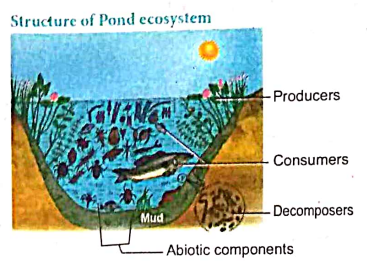
Biotic components
They constitute the producers, variety of consumers and decomposers (microorganisms).
(a) Producers
A variety of phytoplanktons like Oscillatoria, Anabaena, Eudorina, Volvox and Diatoms. Filamentous algae such as Ulothrix, Spirogyra, Cladophora and Oedogonium; floating plants Azolla, Salvia, Pistia, Wolffia and Eichhonia. Sub-merged plants Potamogeton and Phragmitis; Rooted floating plants Nymphaea and Nelumbo; Macrophytes like Typha and Ipomoea, constitute the major producers of a pond ecosystem.
(b) Consumers
The animals represent the consumers of a pond ecosystem include zooplanktons like Paramoecium and Daphnia (primary consumers); Benthos (bottom living animals) like mollusces and annelids; secondary consumers like water beetles and frogs; and tertiary consumers (carnivores) like duck, crane and some top carnivores which include large fish, hawk and man, etc.
(c) Decomposers
They are also called as microconsumers. They help to recycle the nutrients in the ecosystem. These are present in mud water and bottom of the ponds. Example: Bacteria and Fungi. Decomposers perform the process of decomposition in order to enrich the nutrients in the pond ecosystem.
The cycling of nutrients between abiotic and biotic components is evident in the pond ecosystem, making itself self sufficient and self regulating.
15.
Mechanism of decomposition
Decomposition is a step wise process of degradation mediated by enzymatic reactions.
Detritus acts as a raw material for decomposition.
It occurs in the following steps.
(a) Fragmentation - The breaking down of detritus into smaller particles by detritivores like bacteria, fungi and earth worm is known as fragmentation. These detritivores secrete certain substances to enhance the fragmentation process and increase the surface area of detritus particles.
(b) Catabolism - The decomposers produce some extracellular enzymes in their surroundings to break down complex organic and inorganic compounds in to simpler ones. This is called catabolism.
(c) Leaching or Eluviation - The movement of decomposed, water soluble organic and inorganic compounds from the surface to the lower layer of soil or the carrying away of the same by water is called leaching or eluviation.
(d) Humification - It is a process by which simplified detritus is changed into dark coloured amorphous substance called humus. It is highly resistant to microbial action, therefore decomposition is very slow. It is the reservoir of nutrients.
(e) Mineralisation - Some microbes are involved in the release of inorganic nutrients from the humus of the soil, such process is called mineralisation.

12th Standard Syllabus & Materials
12th Standard
TN 12th Computer Applications களப்பெயர் முறைமை (DNS) Sample Question Papers Study Material - QB365 Set A
NEW12th Standard
TN 12th Computer Applications வலையமைப்பு எடுத்துக்காட்டுகள் மற்றும் நெறிமுறைகள் Sample Question Papers Study Material - QB365 Set A
NEW12th Standard
TN 12th Computer Applications கணினி வலையமைப்பு ஓர் அறிமுகம் Sample Question Papers Study Material - QB365 Set A
NEW12th Standard
TN 12th Computer Applications PHP-உடன் MySQL-ஐ இணைத்தல் Sample Question Papers Study Material - QB365 Set A



Tamilnadu Stateboard 12th Standard Subjects

Maths

Chemistry

Physics
Biology

Computer Science

Business Maths and Statistics

Economics

Commerce

Accountancy

History

Computer Applications
Biology
Computer Technology
Computer Applications
Computer Science
Business Maths and Statistics
Commerce
Economics
Maths
Chemistry
Physics
Computer Technology
History
Accountancy

Tamil

English

French
Tamilnadu Stateboard Standards

