
 100% FREE ACCESS
12th Standard Syllabus & Materials
12th Standard
TN 12th Maths Applications of Matrices and Determinants Sample Question Papers Study Material - QB365 Set A
NEW12th Standard
TN 12th Computer Applications மின்னணு தரவு பரிமாற்றம் Sample Question Papers Study Material - QB365 Set A
NEW12th Standard
TN 12th Computer Applications மின் - வணிக பாதுகாப்பு அமைப்புகள் Sample Question Papers Study Material - QB365 Set A
NEW12th Standard
TN 12th Computer Applications மின்னணு செலுத்தல் முறைகள் Sample Question Papers Study Material - QB365 Set A
NEW12th Standard
TN 12th Computer Applications மின் - வணிகம் Sample Question Papers Study Material - QB365 Set A
NEW12th Standard
TN 12th Computer Applications திறந்த மூல கருத்துருக்கள் Sample Question Papers Study Material - QB365 Set A

Published on: 30/08/2022
QB365 provides a detailed and simple solution for every Possible Creative Questions in Class 12 Biology Subject - Botany - Plant Breeding, English Medium. It will help Students to get more practice questions, Students can Practice these question papers in addition to score best marks.
Download Tamil Nadu 12th Standard Biology question papers, model tests, one-mark questions, important questions, and public exam papers in PDF format. Free study materials and answer keys for TN State Board students.
Questions + Answers key
Take MCQ Biology Test1.
Compare Mass selection with pure Iine selection with the help of a schematic diagram.
2.
Give a brief account on polyploidy.
3.
How is the reproductive inherited ability, depending on the nature, origin and adaptability of heterosis can be classified?
4.
What is selection? Write about its types.
5.
Give a brief account on plant introduction.
6.
Write the uses of SLF.
7.
How was green revolution originated in India?
8.
Why should we choose Plant Breeding techniques?
9.
What are the changes in a plant due to domestication?
10.
Explain the steps involved in hybridization.
11.
Give a comparative account on Seaweed liquid fertilizer.
1.
1. (ii) Artificial Selection: It is a human involved process in having better crop from a mixed population where the individuals differ in character. The following are the three main types of artificial selection.
2. a. Mass Selection: In mass selection a large number of plants of similar phenotype or morphological characters are selected and their seeds are mixed together to constitute a new variety. The population obtained from the selected plants would be more uniform than the original population and are not individually tested.
3. After repeated selection for about five to six years, selected seeds are multiplied and distributed to the farmers.
4. The only disadvantage of mass selection is that it is difficult to distinguish the hereditary variation from environmental variation.
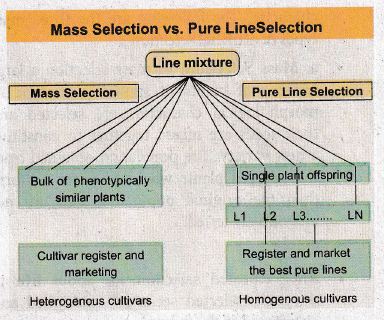
5. b. Pureline selection: Johannsen in 1903 coined the word pure line. It is a collection of plants obtained as result of repeated self-pollination from a single homozygous individual. Hence, a variety formed by this method shows more homozygosity with respect to all genes. The disadvantage of this type is that the new genotypes are never created and they are less adaptable and less stable to the environmental fluctuations.
2.
(i) Majority of flowering plants are diploid (2n). The plants which possess more than two sets of chromosome are called polyploids.
(ii) Polyploidy often exhibit increased hybrid vigour increased heterozygosity, increase the tolerance to both biotic and abiotic stresses, buffering of deleterious mutations.
(iii) When chromosome number is doubled by itself in the same plant, is called autopolyploidy.
(iv) Example: A triploid condition in sugar beets, apples and pear has resulted in the increase in vigour and fruit size, large root size, large leaves, flower, more seeds and sugar content in them.
(v) It also resulted in seedless tomato, apple, watermelon and orange. polyploidy can be induced by the use of colchicine to double the chromosome number.
(vi) Allopolyploids are produced by multiplication of chromosome sets that are initially derived from two different species.
(vii) Example: Triticale (Triticum durum x secale cereale) Raphanobrassica (Brassica oleraceae x Raphanus sativus).
3.
Depending on the nature, origin, adaptability and reproducing ability heterosis can be classified as:
1. i. Euheterosis - This is the true heterosis which is inherited and is further classified as:
2. a. Mutational Euheterosis - Simplest type of euheterosis and results from the sheltering or eliminating of the deleterious, unfavourable often lethal, recessive, mutant genes by their adaptively superior dominant alleles in cross pollinated crops.
3. b. Balanced Euheterosis - Well balanced gene combinations which is more adaptive to environmental conditions and agricultural usefulness.
4. ii. Pseudoheterosis - Also termed as luxuriance. Progeny possess superiority over parents in vegetative growth but not in yield and adaptation, usually sterile or poorly fertile.
5. Mutation means the sudden heritable changes in the genotype or phenotype of an organism. Gene mutations are of considerable importance in plant breeding as they provide essential inputs for evolution as well as for re-combination and selection. It is the only method for improving seedless crops.
4.
1. (i) Selection is the choice of certain individuals from a mixed population for a one or more desirable traits. Selection is the oldest and basic method of plant breeding. There are two main types of Selection.
2. (i) Natural Selection: This is a rule in the nature and results in evolution reflected in the Darwinian principle "survival of the fittest" It takes longer time in bringing about desired variation.
3. (ii) Artificial Selection: It is a human involved process in having better crop from a mixed population where the individuals differ in character. The following are the three main types of artificial selection.
4. a. Mass Selection: In mass selection a large number of plants of similar phenotype or morphological characters are selected and their seeds are mixed together to constitute a new variety. The population obtained from the selected plants would be more uniform than the original population and are not individually tested.
5. After repeated selection for about five to six years, selected seeds are multiplied and distributed to the farmers.
6. The only disadvantage of mass selection is that it is difficult to distinguish the hereditary variation from environmental variation.
7. b. Pureline selection: Johannsen in 1903 coined the word pure line. It is a collection of plants obtained as result of repeated self-pollination from a single homozygous individual. Hence, a variety formed by this method shows more homozygosity with respect to all genes. The disadvantage of this type is that the new genotypes are never created and they are less adaptable and less stable to the environmental fluctuations.
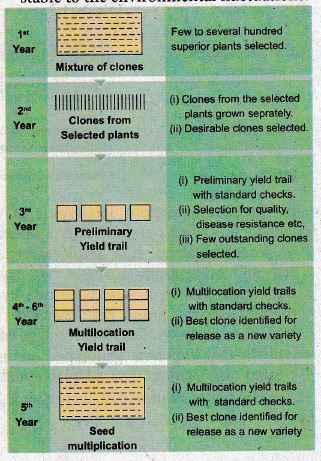
8. C. Clonal Selection: In asexually propagated crop, progenies derived from a plant resemble in genetic constitution with the parent plant as they are mitotically divided.
9. Based on their phenotypic appearance, clonal selection is employed to select improved variety from a mixed population (clones).
10. The selected plants are multiplied through vegetative propagation to give rise to a clone.
11. The genotype of a clone remains unchanged for a long period of time.
5.
(i) Plant introduction may be defined as the introduction of genotypes from a place where it is normally grown to a new place or environment.
(ii) The newly introduced plant has to adapt itself to the new environment.
(iii) This adjustment or adaptation of the introduced plant in the changed environment is called acclimatization.
(iv) All the introductions must be free from presence of weeds, insects and disease causing organisms.
(v) This has to be carefully examined by the process called quarantine, a strict isolation imposed to prevent the spread of disease.
(vi) Introduction may be classified as primary introduction and Secondary introduction.
(1) Primary introduction - When the introduced variety is well adapted to the new environment without any alternation to the original genotype.
(2) Secondary introduction - When the introduced variety is subjected to selection to isolate a superior variety and hybridized with a local variety to transfer one or a few character to them. The botanical garden in different parts of the world also played a significant role in plant introduction.
Example: Tea varieties collected from China and North East India initially grown in Botanical Garden of Kolkata from which appropriate clones have selected and introduced to different parts of India.
6.
(i) Eco friendly.
(ii) Alginates reacts with metals in the soil improve the crumbling in the soil and retain moisture
(iii) Organic gardening gives carbohydrates.
(iv) Has more than 70 minerals, vitamins and enzymes.
(v) Resistance to against frost and diseases.
(vi) Makes the seed to germinate and better root system.
7.
(i) 1940's Green revolution scheme started at Mexico.
(ii) 1960's - developing countries increase the crop yield by introducing high yielding, resistant varieties, increased irrigation, fertilizer application.
(iii) 1940's Scheme introduced in India.
(iv) Dr.B.P. pal (Director of IARI) requested M.S. Swaminathan to arrange Dr. NE Borlaug to visit India. (to obtain dwarf wheat varieties with Norin 10 dwarfing genes from Mexico).
(v) 1963 semi dwarf wheat of Mexico to get Sonora 64, Sonalika and kalyansona.
8.
(i) To increase yield, vigour, fertility, tolerance against salinity, temperature and drought.
(ii) To prevent premature falling of buds and fruits.
(iii) To improve equal maturity.
(iv) To resist pathogens.
(v) To develop photo sensitive and thermos sensitive varieties.
9.
(i) Adaptation various environment and geographical area.
(ii) Uniform flowering and fruiting
(iii) Lack of scattering of seeds
(iv)Increased size of fruits and seeds, yield resistant to disease and Pest.
(v) Perennial to annual habit
(vi) Parthenocarpic fruits (Seedless)
(vii) Colour, appearance, palatability and nutrition.
10.
Steps involved in hybridization are as follows:
1. Selection of Parents: Male and female plants of the desired characters are selected. It should be tested for their homozygosity.
2. Emasculation: It is a process of removal of anthers to prevent self pollination before anthesis (period of opening of a flower).
3. Bagging: The stigma of the flower is protected against any undesirable pollen grains, by covering it with a bag.
4. Crossing: Transfer of pollen grains from selected male flower to the stigma of the female emasculated flower.
5. Harvesting seeds and raising plants: The pollination leads to fertilization and finally seed formation takes place. The seeds are grown into new generation which are called a hybrid.
11.
Seaweed liquid fertilizer (SLF) contains cytokinin, gibberellins, and auxin apart from macro and micro nutrients. Most seaweed-based fertilizers are made from kelp (brown algae) which grows to length of 150 metres. Liquid seaweed fertilizer is not only organic but also eco-friendly. The alginates in the seaweed that reacts with metals in the soil and form long, crosslinked polymers in the soil. These polymers improve the crumbing in the soil, swell up when they get wet and retain moisture for a long time. They are especially useful in organic gardening which provides carbohydrates for plants. Seaweed has more than 70 minerals, vitamins and enzymes. It promotes vigorous growth. Improves resistance of plants to frost and disease. Seeds soaked in seaweed extract germinate much rapidly and develop a better root system.

12th Standard Syllabus & Materials
12th Standard
TN 12th Computer Applications வலையமைப்பு வடமிடல் Sample Question Papers Study Material - QB365 Set A
NEW12th Standard
TN 12th Computer Applications களப்பெயர் முறைமை (DNS) Sample Question Papers Study Material - QB365 Set A
NEW12th Standard
TN 12th Computer Applications வலையமைப்பு எடுத்துக்காட்டுகள் மற்றும் நெறிமுறைகள் Sample Question Papers Study Material - QB365 Set A
NEW12th Standard
TN 12th Computer Applications கணினி வலையமைப்பு ஓர் அறிமுகம் Sample Question Papers Study Material - QB365 Set A



Tamilnadu Stateboard 12th Standard Subjects

Maths

Chemistry

Physics
Biology

Computer Science

Business Maths and Statistics

Economics

Commerce

Accountancy

History

Computer Applications
Biology
Computer Technology
Computer Applications
Computer Science
Business Maths and Statistics
Commerce
Economics
Maths
Chemistry
Physics
Computer Technology
History
Accountancy

Tamil

English

French
Tamilnadu Stateboard Standards

