
 100% FREE ACCESS
12th Standard Syllabus & Materials
12th Standard
TN 12th Maths Applications of Matrices and Determinants Sample Question Papers Study Material - QB365 Set A
NEW12th Standard
TN 12th Computer Applications மின்னணு தரவு பரிமாற்றம் Sample Question Papers Study Material - QB365 Set A
NEW12th Standard
TN 12th Computer Applications மின் - வணிக பாதுகாப்பு அமைப்புகள் Sample Question Papers Study Material - QB365 Set A
NEW12th Standard
TN 12th Computer Applications மின்னணு செலுத்தல் முறைகள் Sample Question Papers Study Material - QB365 Set A
NEW12th Standard
TN 12th Computer Applications மின் - வணிகம் Sample Question Papers Study Material - QB365 Set A
NEW12th Standard
TN 12th Computer Applications திறந்த மூல கருத்துருக்கள் Sample Question Papers Study Material - QB365 Set A

Published on: 29/08/2022
QB365 provides a detailed and simple solution for every Possible Creative Questions in Class 12 Biology Subject - Botany - Plant Tissue Culture, English Medium. It will help Students to get more practice questions, Students can Practice these question papers in addition to score best marks.
Download Tamil Nadu 12th Standard Biology question papers, model tests, one-mark questions, important questions, and public exam papers in PDF format. Free study materials and answer keys for TN State Board students.
Questions + Answers key
Take MCQ Biology Test1.
What are the potential risks and consideration for safety aspects?
2.
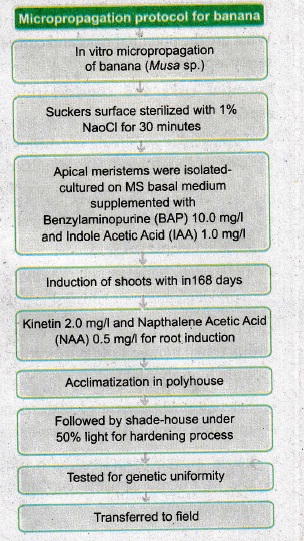
Explain how micropropagation in banana is carried out.
3.
Write an essay on application of plant tissue culture.
4.
5.
What are the techniques involved in PTC (plant tissue culture)?
6.
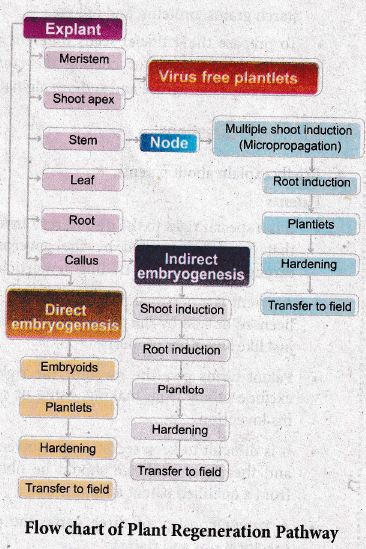
Draw the flowchart to depict plant regeneration Pathway.
7.
Briefly explain about patents.
8.
Enumerate the advantages of Artificial seeds.
9.
Discuss the protocol for micropropagation of banana.
10.
Point out the applications of plant tissue culture.
11.
Explain the steps involved in protoplast culture.
1.
Potential risks and consideration for safety aspects
1. Pathogenicity of living organisms and viruses - natural and genetically modified - to infect humans, animals and plants to cause diseases.
2. Toxicity of allergy associated with microbial production.
3. Increasing number of antibiotic-resistant pathogenic microorganisms.
4. Problems associated with the disposal of spent microbial biomass and purification of effluent from biotechnological process.
5. Safety aspects associated with contamination, infection or mutation of process strains
6. Safety aspects associated with the industrial use of microorganisms containing in vitro recombinants.
2.
3.
Applications of plant Tissue Culture
Plant tissue culture techniques have several applications such as:
1. Improved hybrids production through somatic hybridization.
2. Somatic embryoids can be encapsulated into synthetic seeds (synseeds). These encapsulated seeds or synthetic seeds help in conservation of plant biodiversity.
3. Production of disease resistant plants through meristem and shoot tip culture.
4. Production of stress resistant plants like herbicide tolerant, heat tolerant plants.
5. Micropropagation technique to obtain large numbers of plantlets of both crop and tree species useful in forestry within a short span of time and all through the year.
6. Production of secondary metabolites from cell culture utilized in pharmaceutical, cosmetic and food industries.
4.
5.
1. Sterilization:
(i) Sterilization is the technique employed to get rid of microbes such as bacteria and fungi in the culture medium, vessels and explants.
(i) Maintenance of Aseptic Environment:
1. During in vitro tissue culture maintenance of aseptic environmental conditions should be followed, i.e., sterilization of glassware, forceps, scalpels, and all accessories in wet steam sterilization by autoclaving at 15 psi (121oC) for 15 to 30 minutes or dipping in 70%o ethanol followed by flaming and cooling.
ii. Sterilization of culture room:
1. Floor and walls are washed first with detergent and then with 2% sodium hypochlorite or 95% ethanol. The cabinet of laminar airflow is sterilized by clearing the work surface with 95% ethanol. and then exposure of UV radiation for 15 minutes.
iii Sterilization of Nutrient Media:
1. Culture media are dispensed in glass containers, plugged with non-absorbent cotton or sealed with plastic closures and then sterilized using autoclave at 15 psi (121oC) for 15 to 30 minutes.
2. The plant extracts, vitamins, amino acids and hormones are sterilized by passing through Millipore filter with 0.2 mm pore diameter and then added to sterilized culture medium inside Laminar Airflow Chamber under sterile condition.
iv. Sterilization of Explants:
1. The first exposing the material in running tap water and then treating it in surface sterilization agents like 0.1% mercuric chloride, 70% ethanol under aseptic condition inside the Laminar Air Flow Chamber.
2. Media Preparation
(i) The success of tissue culture lies in the composition of the growth medium, plant growth regulators and culture conditions such as temperature, pH, light and humidity.
(ii) No single medium is capable of maintaining optimum growth of all plant tissues.
(iii) MS nutrient medium (Murashige and Skoog 1962) has carbon sources, with suitable vitamins and hormones.
(iv) The media formulations available for plant tissue culture other than MS are 5 medium (Gamborg et.al 1968), White medium (white I943), Nitsch's medium (Nitsch & Nitsch 1969). For solidification, a gelling agent such as agar is added
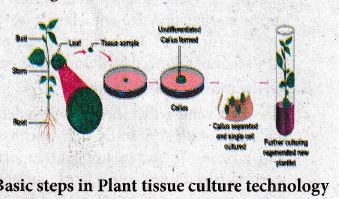
Basic steps in Plant tissue culture technology
3. Culture condition
(i) pH
The pH of medium is normally adjusted between 5.6 to 6.0 for the best result.
(ii) Temperature
The cultures should be incubated normally at constant temperature of 25oC \(\pm\) 2oC for optimal growth.
(iii) Humidity and Light Intensity
The cultures require 50-60% relative humidity and 16 hours of photoperiod by the illumination of cool white fluorescent tubes of approximately 1000 lux.
(iv) Aeration
Aeration to the culture can be provided by shaking the flasks or tubes of liquid culture on automatic shaker or aeration of the medium by passing with filter-sterilized air.
4. Induction of Callus
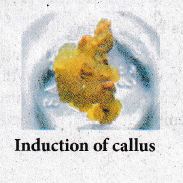
(i) MS nutrient medium supplemented with auxins and incubated at 25oC \(\pm\) 2oC in an alternate light and dark period of 12 hours to induce cell division and soon the upper surface of explant develops into callus.
(ii) Callus is a mass of unorganized growth of plant cells or tissues in invitro culture medium.
(iii) Embryogenesis
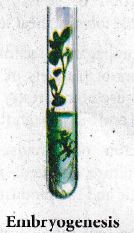
The callus cells undergoes differentiation and produces somatic embryos, known as Embryoids.
6.
Plant Regeneration pathway
From the explants, plants can be regenerated by somatic embryogenesis or organogenesis.
7.
Patents
(i) It is a special right to the discoverer/inventor that has been granted by the government through legislation for trading new articles
(ii) A patent is a personal property which can be licensed or sold by the person or organisation just like any other property.
(iii) Patent terms give the inventor the rights to exclude others from making, using or selling his invention.
(iv) It is difficult to keep secret certain inventions and therefore, guidance should be obtained from a qualified Patent attorney.
(v) A patent consists of three parts: the grant, specifications and claims.
(vi) The grant is filled at the patent office which is not published. It is a signed document, actually the agreement that grants patent right to the inventor.
(vii) The specification and claims are published as a single document which is made public from the patent office. The specification part is narrative in which the subject matter of invention is described as how the invention was carried out.
(viii) The claim specifically defines the scope of the invention to be protected by the patent which the others may not practice.
8.
Advantages of Artificial seeds
Artificial seeds have many advantages over the true seeds as follows:
1. Millions of artificial seeds can be produced at any time at low cost.
2. They provide an easy method to produce genetically engineered plants with desirable traits.
3. It is easy to test the genotype of plants.
4. They can potentially stored for long time under cryopreservation method.
5. Artificial seeds produce identical plants .
6. The period of dormancy of artificial seeds is greatly reduced, hence growth is faster with a shortened life cycle.
9.
Micropropagation protocol for banana
\(\downarrow\)
In vitro micropropagation of banana (Musa sp.)
\(\downarrow\)
Suckers surface sterilized with 1% NaOCl for 30 minutes
\(\downarrow\)
Apical meristems were isolated - cultured on MS basal medium supplemented with Benzylaminopurine (BAP) 10.0 mg/l and Indole Acetic Acid (IAA) 1.0 mg/l
\(\downarrow\)
Induction of shoots within 168 days
\(\downarrow\)
Kinetin 2.0 mg/l and Naphthalene Acetic Acid (NAA) 0.5 mg/l for root induction
\(\downarrow\)
Acclimatization in polyhouse
\(\downarrow\)
Followed by shade-house under 50% light for hardening process
\(\downarrow\)
Tested for genetic Uniformity
\(\downarrow\)
Transferred to field
10.
Plant tissue culture techniques have several applications such as:
i. Improved hybrids production through somatic hybridization.
ii. Somatic embryoids can be encapsulated into synthetic seeds (synseeds). These encapsulated seeds or synthetic seeds help in conservation of plant biodiversity.
iii. Production of disease resistant plants through meristem and shoot tip culture.
iv. Production of stress resistant plants like herbicide tolerant, heat tolerant plants.
v. Micropropagation technique to obtain large numbers of plantlets of both crop and tree species useful in forestry within a short span of time and all through the year.
vi. Production of secondary metabolites from cell culture utilized in pharmaceutical, cosmetic and food industries.
11.
Protoplasts are cells without a cell wall, but bounded by a cell membrane or plasma membrane. Using protoplasts, it is possible to regenerate whole plants from single cells and also develop somatic hybrids. The steps involved in protoplast culture are:
i) Isolation of protoplast: Small bits of plant tissue like leaf tissue are used for isolation of protoplast. The leaf tissue is immersed in 0.5% Macrozyme and 2% Onozuka cellulase enzymes dissolved in 13% sorbitol or mannitol at pH 5.4. It is then incubated overnight at 25°C. After a gentle teasing of cells, protoplasts are obtained, and these are then transferred to 20% sucrose solution to retain their viability. They are then centrifuged to get pure protoplasts as different from debris of cell walls.
ii) Fusion of protoplast: It is done through the use of a suitable fusogen. This is normally PEG (Polyethylene Glycol). The isolated protoplast are incubated in 25 to 30% concentration of PEG with Ca++ ions and the protoplast shows agglutination (the formation of clumps of cells) and fusion.
iii) Culture of protoplast: MS liquid medium is used with some modification in droplet, plating or micro-drop array techniques, Protoplast viability is tested with fluorescein diacetate before the culture. The cultures are incubated in continuous light 1000-2000 lux at 25°C. The cell wall formation occurs within 24-48 hours and the first division of new cells occurs between 2-7 days of culture.
iv) Selection of somatic hybrid cells: The fusion product of protoplasts without nucleus of different cells is called a cybrid. Following this nuclear fusion happen. This process is called somatic hybridization.

12th Standard Syllabus & Materials
12th Standard
TN 12th Computer Applications வலையமைப்பு வடமிடல் Sample Question Papers Study Material - QB365 Set A
NEW12th Standard
TN 12th Computer Applications களப்பெயர் முறைமை (DNS) Sample Question Papers Study Material - QB365 Set A
NEW12th Standard
TN 12th Computer Applications வலையமைப்பு எடுத்துக்காட்டுகள் மற்றும் நெறிமுறைகள் Sample Question Papers Study Material - QB365 Set A
NEW12th Standard
TN 12th Computer Applications கணினி வலையமைப்பு ஓர் அறிமுகம் Sample Question Papers Study Material - QB365 Set A



Tamilnadu Stateboard 12th Standard Subjects

Maths

Chemistry

Physics
Biology

Computer Science

Business Maths and Statistics

Economics

Commerce

Accountancy

History

Computer Applications
Biology
Computer Technology
Computer Applications
Computer Science
Business Maths and Statistics
Commerce
Economics
Maths
Chemistry
Physics
Computer Technology
History
Accountancy

Tamil

English

French
Tamilnadu Stateboard Standards

