
 100% FREE ACCESS
12th Standard Syllabus & Materials
12th Standard
TN 12th Maths Applications of Matrices and Determinants Sample Question Papers Study Material - QB365 Set A
NEW12th Standard
TN 12th Computer Applications மின்னணு தரவு பரிமாற்றம் Sample Question Papers Study Material - QB365 Set A
NEW12th Standard
TN 12th Computer Applications மின் - வணிக பாதுகாப்பு அமைப்புகள் Sample Question Papers Study Material - QB365 Set A
NEW12th Standard
TN 12th Computer Applications மின்னணு செலுத்தல் முறைகள் Sample Question Papers Study Material - QB365 Set A
NEW12th Standard
TN 12th Computer Applications மின் - வணிகம் Sample Question Papers Study Material - QB365 Set A
NEW12th Standard
TN 12th Computer Applications திறந்த மூல கருத்துருக்கள் Sample Question Papers Study Material - QB365 Set A

Published on: 29/08/2022
QB365 provides a detailed and simple solution for every Possible Creative Questions in Class 12 Biology Subject - Botany - Principles and Processes of Biotechnology, English Medium. It will help Students to get more practice questions, Students can Practice these question papers in addition to score best marks.
Download Tamil Nadu 12th Standard Biology question papers, model tests, one-mark questions, important questions, and public exam papers in PDF format. Free study materials and answer keys for TN State Board students.
Questions + Answers key
Take MCQ Biology Test1.
Given below are the three different DNA palindrome sequences. Name the respective restriction enzymes which cleaves those sequences and also mention the microbial sources of the enzymes.
(a) 5'AGCT3'
3'TCGA5'
(b) 5'GGCC3'
3'CCGG5'
(c) 5'GAATTC3'
3'CTTAAG5'
2.
How does shuttle vectors differ from other types of vectors?
3.
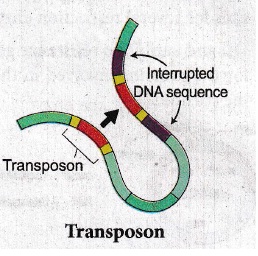
Explain how vector acts as transposon
4.
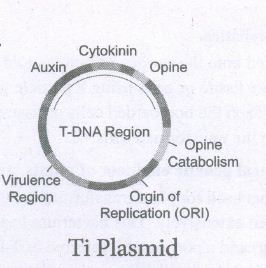
Draw and label Ti plasmid.
5.
Explain the features of a vector.
6.
Give a short note on Alkaline phosphate.
7.
What is the naming procedure for restriction endonuclease? Give an example
8.
Which type of restriction enzyme is widely used in rDNA technology? Why?
9.
Classify restriction enzymes based on their mode of action.
10.
Though SCP is a rich protein source, it has not been widely used as food supplement. Point a reason to support this statement.
11.
Mention any three algal species used for SCP production.
12.
What is SCP? Mention its nutritional value.
13.
What are secondary metabolites? Give two examples.
14.
In the fermentation process, what does upstream and downstream refers to? Explain.
15.
Mention any three historical events which took place in the 21st century for the development of biotechnology.
1.
| DNA Sequence | Restriction Enzyme | Microbial source | |
| a | 5'AGCT3' 3'TCGA5 |
AluI | Arthrobacter luteus |
| b | 5'GGCC3' 3'CCGG5' |
Hae III | Haemophilus aegyptius |
| c | 5'GAATTC3' 3'CTTAAG5' |
EcoRI | Escherichia coli |
2.
The shuttle vectors are plasmids designed to replicate in cells of two different species. These vectors are created by recombinant techniques. The shuttle vectors can propagate in one host and then move into another host without any extra manipulation. Most of the Eukaryotic vectors are Shuttle Vectors
3.
(i) Transposons (Transposable elements or mobile elements) are DNA sequence able to insert itself at a new location in the genome without having any sequence relationship with the target locus and hence transposons are called walking genes or jumping genes.
(ii) They are used as genetic tools for analysis of gene and protein functions, that produce new phenotype on host cell.
(iii) The use of transposons is well studied in Arabidopsis thaliana and bacteria such as Escherichia coli.
4.
5.
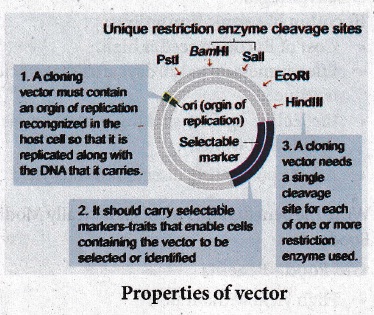
The following are the features that are required to facilitate cloning into a vector.
1. Origin of replication (ori): This is a sequence from where replication starts and piece of DNA when linked to this sequence can be made to replicate within the host cells.
2. Selectable marker: In addition to ori the vector requires a selectable marker, which helps in identifying and eliminating non-transformants and selectively permitting the growth of the transformants.
3. Cloning sites: In order to link the alien DNA, the vector needs to have very few, preferably single, recognition sites for the commonly used restriction enzymes.
6.
Alkaline phosphate is a DNA modifying enzymes and adds or removes specific phosphate group at 5' terminus of double stranded DNA (dsDNA) or single stranded DNA (ssDNA) or RNA. Thus it prevents self ligation. This enzyme is purified from bacteria and calf intestine.
7.
(i) Restriction endonucleases are named by a standard procedure.
(ii) The first letter of the enzymes indicates the genus name, followed by the first two letters of the species, then comes the strain of the organism and finally a roman numeral indicating the order of discovery.
For example, EeoRl is from Escherichia (E) coli (co), strain RY 13 (R) and first endonuclease (I) to be discovered.
8.
Type II enzyme is preferred for use in recombinant DNA technology as they recognise and cut DNA within a specific sequence typically consisting of 4-8 bp.
9.
Based on their mode of action restriction enzymes are classified into Exonucleases and Endonucleases.
a. Exonucleases are enzymes which remove nucleotides one at a time from the end of a DNA molecule. e.g. Bal 31 and Exonuclease III.
b. Endonucleases are enzymes which break the internal phosphodiester bonds within a DNA molecule. e.g. Hind II, EcoRl, Pvul, BamHI and Taql.
10.
Yes, although SCP is a rich protein source it is not widely used by most of the people in countries due to its higher nucleic acid content and slow digestibility.
11.
Spirulina, Chlorella and Chlamydomonas.
12.
Single Cell Protein (SCP) are dried cells of microorganisms that are used as protein supplement in human foods or animal feeds. SCP are rich in proteins, aminoacids, vitamins, carbohydrates, fats and minerals. It is used as food source by Astronauts and Antarctica expedition scientists.
13.
Secondary metabolites are those which are not required for the vital life process of microbes, but have value added nature, this includes antibiotics e.g. -Amphotericin-B (Streptomyces nodosus) and Penicillin (Penicillium chryosogenum).
14.
Upstream process:
All the process before starting of the fermenter such as sterilization of the fermenter, preparation and sterilization of culture medium and growth of the suitable inoculum are called upstream process.
Downstream process:
All the process after the fermentation process is known as the downstream process. This process includes distillation, centrifuging, filtration and solvent extraction. Mostly this process involves the purification of the desired product.
15.
2002 - First crop plant genome sequenced in Oryza sativa.
2003 - Human genome project is completed, providing information on the locations and sequence of human genes on all 46 chromosomes.
2016 - Stem cells injected into stroke patients re-enable patient to walk - Stem cell therapy.

12th Standard Syllabus & Materials
12th Standard
TN 12th Computer Applications வலையமைப்பு வடமிடல் Sample Question Papers Study Material - QB365 Set A
NEW12th Standard
TN 12th Computer Applications களப்பெயர் முறைமை (DNS) Sample Question Papers Study Material - QB365 Set A
NEW12th Standard
TN 12th Computer Applications வலையமைப்பு எடுத்துக்காட்டுகள் மற்றும் நெறிமுறைகள் Sample Question Papers Study Material - QB365 Set A
NEW12th Standard
TN 12th Computer Applications கணினி வலையமைப்பு ஓர் அறிமுகம் Sample Question Papers Study Material - QB365 Set A



Tamilnadu Stateboard 12th Standard Subjects

Maths

Chemistry

Physics
Biology

Computer Science

Business Maths and Statistics

Economics

Commerce

Accountancy

History

Computer Applications
Biology
Computer Technology
Computer Applications
Computer Science
Business Maths and Statistics
Commerce
Economics
Maths
Chemistry
Physics
Computer Technology
History
Accountancy

Tamil

English

French
Tamilnadu Stateboard Standards

