
 100% FREE ACCESS
12th Standard Syllabus & Materials
12th Standard
TN 12th Maths Applications of Matrices and Determinants Sample Question Papers Study Material - QB365 Set A
NEW12th Standard
TN 12th Computer Applications மின்னணு தரவு பரிமாற்றம் Sample Question Papers Study Material - QB365 Set A
NEW12th Standard
TN 12th Computer Applications மின் - வணிக பாதுகாப்பு அமைப்புகள் Sample Question Papers Study Material - QB365 Set A
NEW12th Standard
TN 12th Computer Applications மின்னணு செலுத்தல் முறைகள் Sample Question Papers Study Material - QB365 Set A
NEW12th Standard
TN 12th Computer Applications மின் - வணிகம் Sample Question Papers Study Material - QB365 Set A
NEW12th Standard
TN 12th Computer Applications திறந்த மூல கருத்துருக்கள் Sample Question Papers Study Material - QB365 Set A

Published on: 29/08/2022
QB365 provides a detailed and simple solution for every Possible Creative Questions in Class 12 Biology Subject - Botany - Principles and Processes of Biotechnology, English Medium. It will help Students to get more practice questions, Students can Practice these question papers in addition to score best marks.
Download Tamil Nadu 12th Standard Biology question papers, model tests, one-mark questions, important questions, and public exam papers in PDF format. Free study materials and answer keys for TN State Board students.
Questions + Answers key
Take MCQ Biology Test1.
What are transgenic plants / Genetically modified crops / GM crops? Explain the advantages of herbicide tolerant crops. (or) How to introduce herbicide tolerance capacity into a plant? Write its advantages.
2.
Write about PHB (polyhydroxybutyrate).
3.
Write about PLA (Polylactic acid).
4.
Write about the Genome editing and CRISPR Cas9.
5.
What is Nucleic acid hybridization and blotting technique? Explain.
6.
What are the applications of fermentation in industries? Explain
7.
Briefly explain about the usage of bioreactors.
8.
Explain the procedure of Southern Blotting Technique. Southern Blotting Techniques - DNA
9.
Explain Agarose Gel electrophoresis technique.
10.
Write a note on Replica plating technique.
11.
Explain in detail about various types of direct gene transfer method.
12.
Explain the steps involved in recombinant DNA technology
13.
Give a short notes on Green Fluorescent Protein (GFP)
14.
List out the application of single-cell protein.
15.
Explain how fermentation is done in bioreactor ?
1.
Herbicide Tolerant - Glyphosate:
(i) Weeds are a constant problem in crop fields Weeds not only compete with crops for sunlight, water, nutrients and space but also a carrier for insects and diseases.
(ii) If left uncontrolled, weeds can reduce crop yields significantly.
(iii) Transgenic plants contain a novel DNA introduced into its genome.
(iv) Glyphosate herbicide produced by Monsanto, USA company under the trade name 'Round up' kills plants by blocking the 5-enopyruvate shikirnate-3 phosphate synthase (EPSPS) enzyme, an enzyme involved in the biosynthesis of aromatic amino acids, vitamins and many secondary plant metabolites.
(v) There are several ways by which crops can be modified to be glyphosate-tolerant.
Protocol for Glyphosate tolerant Potato Plant
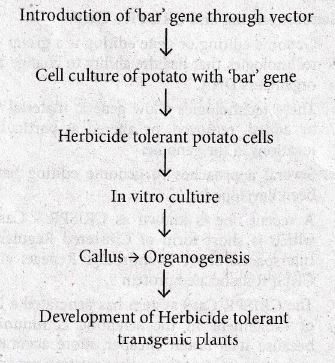
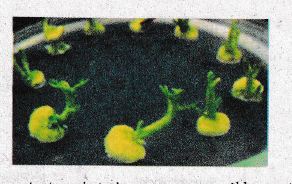
(i) One strategy is to incorporate a soil bacterium gene that produces a glyphosate tolerant form of EPSPS. Another way is to incorporate a different soil bacterium gene that produces a glyphosate degrading enzyme.
Advantages of Herbicide Tolerant Crops
(i) Weed control improves higher crop yields;
(ii) Reduces spray of herbicide;
(iii) Reduces competition between crop plant and weed;
(iv) Use of low toxicity compounds which do not remain active in the soil; and
(v) The ability to conserve soil structure and microbes.
2.
(i) Synthetic polymers are non-degradable and pollute the soil and when burnt add dioxin in the environment which cause cancer.
(ii) So, efforts were taken to provide an alternative eco-friendly biopolymers.
(iii) Polyhydroxyalkanoates (PHAs) and poly hydroxybutyrate (PHB) are group of degradable biopolymers which have several medical applications such as drug delivery, scaffold and heart valves.
(iv) PHAs are biological macromolecules and thermoplastics which are biodegradable and biocompatible.
(v) Several microorganisms have been utilized to produce different types of PHAs including Gram-positive like Bacillus megaterium, Bacillussubtilis and Corynebacterium.
(vi) Glutamicum, Gram- negative bacteria like group of Pseudomonas sp. and Alcaligenes eutrophus.
3.
(i) Polylactic acid or polylactide (PLA) is a biodegradable and bioactive thermoplastic.
(ii) It is an aliphatic polyester derived from renewable resources, such as corn starch, cassava root, chips or starch or sugarcane.
(iii) For the production of PLA, two main monomers are used: lactic acid, and the cyclic diester, lactide.
(iv) The most common route is the ring-opening polymerization of lactide with metal catalysts like tin octoate in solution.
(v) The metal-catalyzed reaction results in equal amount of d and polylactic acid.
4.
Genome editing and CRISPR - Cas9:
(i) Genome editing or gene editing is a group of technologies that has the ability to change an organism's DNA.
(ii) These technologies allow genetic material to be added, removed, or altered at particular locations in the genome.
(iii) Several approaches to genome editing have been developed.
(iv) A recent one is known as CRISPR - Cas9, which is short form of Clustered Regularly Interspaced Short Palindromic Repeats and CRISPR-associated Protein 9.
(v) The CRISPR-Cas9 system has generated a lot of excitement in the scientific community because it is faster, cheaper, more accurate, and more efficient than other existing genome editing methods.
5.
(i) Nucleic Acid Hybridization - Blotting Techniques
(ii) Blotting techniques are widely used analytical tools for the specific identification of desired DNA or RNA fragments from larger number of molecules. Blotting refers to the process of immobilization of sample nucleic acids or solid support (nitrocellulose or nylon membranes.) The blotted nucleic acids are then used as target in the hybridization experiments for their specific detection.
Types of Blotting Techniques:
(i) Southern Blotting: The transfer of DNA from agarose gels to nitrocellulose membrane.
(ii) Northern Blotting: The transfer of RNA to nitrocellulose membrane.
(iii) Western Blotting: Electrophoretic transfer of Proteins to nitrocellulose membrane.
(iv) Southern Blotting Techniques - DNA
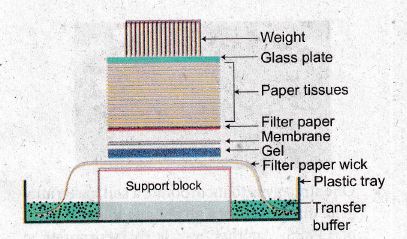
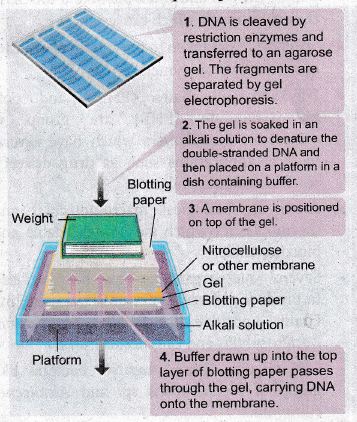
(v) The transfer of denatured DNA from Agarose gel to Nitrocellulose Blotting or Filter paper technique was introduced by Southern in 1975 and this technique is called Southern Blotting Technique.
Northern Blot:
(i) it was found that RNA is not binding to cellulose nitrate. Therefore, Alwin et al. (1979) devised a procedure in which RNA bands are transferred from the agarose gel into nitrocellulose filter paper.
(ii) This transfer of RNA from gel to special filter paper is called Northern Blot hybridization. The filter paper used for Northern blot is Amino Benzyloxymethyl Paper which can be prepared from Whatman 540 paper.
Western Blot:
(i) Refers to the electrophoretic transfer of proteins to blotting Papers.
(ii) Nitrocellulose filter paper can be used for western blot technique. A particular.
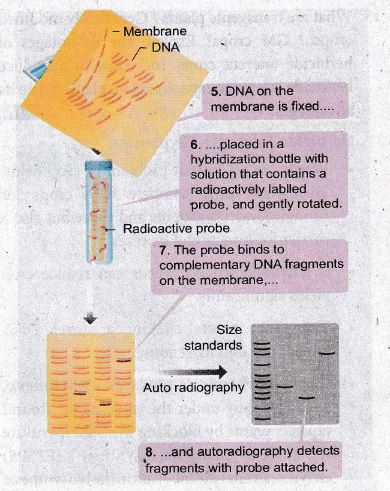
(iii) protein is then identified by probing the blot with a radio-labelled antibody which binds on the specific protein to which the antibody was prepared.
6.
Application of fermentation in industries:
(i) Fermentation has industrial application such as:
1. Microbial biomass production:
(i) Microbial cells (biomass) like algae, bacteria, yeast, fungi are grown, dried and used as source of a complete protein called single cell protein (SCP) which serves as human food or animal feed.
2. Microbial metabolites:
(i) Microbes produce compounds that are very useful to man and animals. These compounds are called metabolites, can be grouped into two categories:
a. Primary metabolites:
(i) Metabolites produced for the maintenance of life process of microbes are known as primary metabolites
(ii) Eg. Ethanol, citric acid, lactic acid, acetic acid.
b. Secondary metabolites:
(i) Secondary metabolites are those which are not required for the vital life process of microbes, but have value added nature, this includes antibiotics.
(ii) e.g -Amphotericin-B (Streptomyces nodosus), Penicillin (Penicillium chryosogenum) Streptomycin (S. grises), Tetracycline (S. aureofacins), alkaloids, toxic pigments, vitamins etc.
3. Microbial enzymes:
(i) When microbes are cultured, they secrete some enzymes into the growth media. These enzymes are industrially used in detergents, food processing, brewing and pharmaceuticals. Eg. protease, amylase, isomerase, and lipase.
4. Bioconversion, biotransformation or modification of the substrate:
The fermenting microbes has the capacity to produce valuable products, eg. conversion of ethanol to acetic acid (vinegar), isopropanol to acetone, sorbitol to sorbose (this is used in the manufacture of vitamin C), sterols to steroids.
7.
Bioreactor (Fermentor)
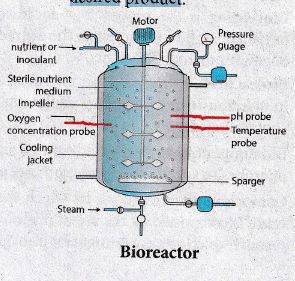
(1) Bioreactor (Fermentor) is a vessel or a container that is designed in such a way that it. can provide an optimum environment in which microorganisms or their enzymes interact with a substrate to produce the required product.
(2) In the bioreactor aeration, agitation, temperature and pH are controlled. Fermentation involves two process namely upstream and downstream process.
(i) Upstream process:
All the process before starting of the fermenter such as sterilization of the fermenter, preparation and sterilization of culture medium and growth of the suitable inoculum are called upstream process.
(ii) Downstreamprocess:
All the process after the fermentation process is known as the downstream process. This process includes distillation, centrifuging, filtration and solvent extraction. Mostly this process involves the purification of the desired product.
8.
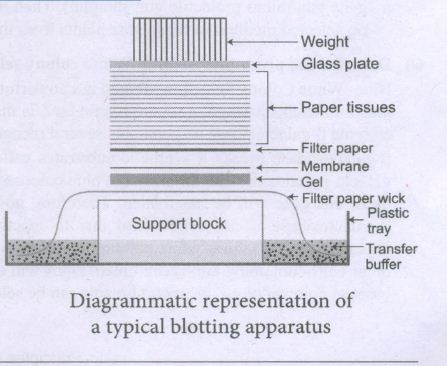
The transfer of denatured DNA from Agarose gel to Nitrocellulose Blotting or Filter Paper technique was introduced by Southern in 1975 and this technique is called Southern Blotting Technique.
steps
The transfer of DNA from agarose gel to nitrocellulose filter paper is achieved by Capillary Action. A buffer Sodium Saline Citrate (SSC) is used, in which DNA is highly soluble, it can be drawn up through the gel into the Nitrocellulose membrane By this process ss-DNA becomes 'Trapped' in the membrane matrix. This DNA is hybridized with a nucleic acid and can be detected by autoradiography. Autoradiography - A technique that captures the image formed in a photographic emulsion due to emission of light or radioactivity from a labelled component placed together with unexposed film.
9.
Agarose Gel Electrophoresis is used mainly for the purification of specific DNA fragments. Agarose is convenient for separating DNA fragments ranging in size from a few hundred to about 20000 base pairs. Polyacrylamide is preferred for the purification of smaller DNA fragments. The gel is complex network of polymeric molecules. DNA molecule is negatively charged molecule - under an electric field DNA molecule migrates through the gel. The electrophoresis is frequently performed with marker DNA fragments of known size which allow accurate size determination of an unknown DNA molecule by interpolation. The advantages of agarose gel electrophoresis are that the DNA bands can be readily detected at high sensitivity. The bands of DNA in the gel are stained with the dye Ethidium Bromide and DNA can be detected as visible fluorescence illuminated in UV light will give orange fluorescence, which can be photographed.
10.
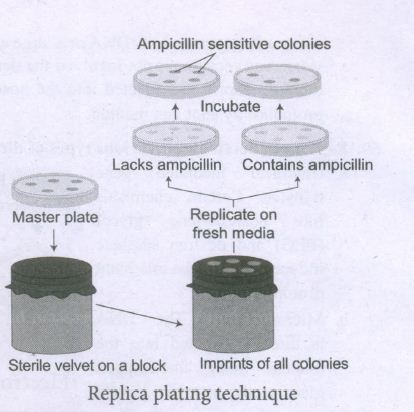
A technique in which the pattern of colonies growing on a culture plate is copied. A sterile filter plate is pressed against the culture plate and then lifted. Then the filter is pressed against a second sterile culture plate. This results in the new plate being infected with cell in the same relative positions as the colonies in the original plate. Usually, the medium used in the second plate will differ from that used in the first. It may include an antibiotic or without a growth factor. In this way, transformed cells can be selected
11.
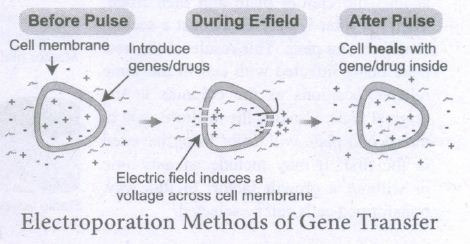
a. Chemical mediated gene transfer: Certain chemicals like polyethylene glycol (PEG) and dextran sulphate induce DNA uptake into plant + protoplasts.
b. Microinjection: The DNA ""+ is directly injected into the nucleus using fine tipped glass needle or micro pipette to transform plant cells. The protoplasts are immobilised on a solid support (agarose on a microscopic slide) or held with a holding pipette under suction.
c. Electroporation Methods of Gene Transfer: A pulse of high voltage is applied to protoplasts, cells or tissues which makes transient pores in the plasma membrane through which uptake of foreign DNA occurs.
d. Liposome mediated method of Gene Transfer: Liposomes the artificial phospholipid vesicles are useful in gene transfer. The gene or DNA is transferred from liposome into vacuole of plant cells. It is carried out by encapsulated DNA into the vacuole. This technique is advantageous because the liposome protects the introduced DNA from being damaged by the acidic pH and protease enzymes present in the vacuole. Liposome and tonoplast of vacuole fusion resulted in gene transfer. This process is called lipofection.
e. Biolistics: The foreign DNA is coated onto the surface of minute gold or tungsten particles (I-311m) and bombarded onto the target tissue or cells using a particle gun (also called as gene gun/micro projectile gun/shotgun). Then the bombarded cells or tissues are cultured on selected medium to regenerate plants from the transformed cells.
12.
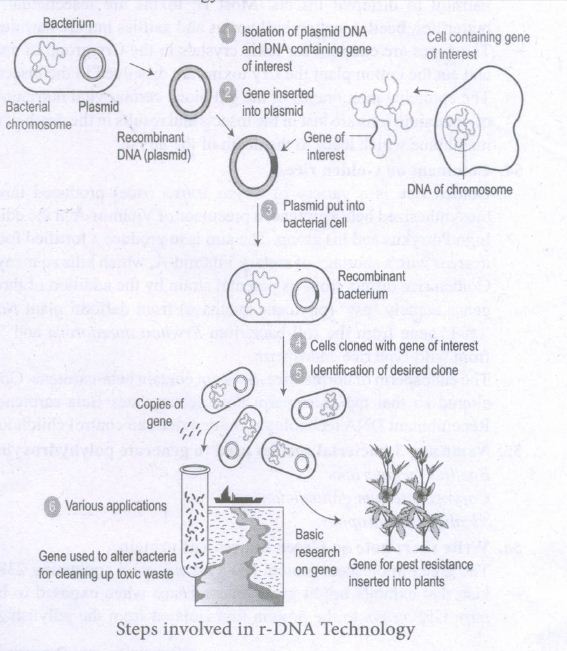
The steps involved in recombinant DNA technology are:
(i) Isolation of a DNA fragment containing a gene of interest that needs to be cloned. This is called an insert.
(ii) Generation of recombinant DNA (rDNA) molecule by insertion of the DNA fragment into a carrier molecule called a vector that can self-replicate within the host cell.
(iii) Selection of the transformed host cells that is carrying the rDNA and allowing them to multiply thereby multiplying the rDNA molecule.
(iv) The entire process thus generates either a large amount of rDNA or a large amount of protein expressed by the insert.
(v) Wherever vectors are not involved the desired gene is multiplied by PCR technique. The multiple copies are injected into the host cell protoplast or it is shot into the host cell protoplast by shot gun method.
13.
(i) The green fluorescent protein (GFP) is a protein containing 238 amino acid residues of 26.9 kDa that exhibits bright green fluorescence when exposed to blue to ultraviolet range (395 nm).
(ii) GFP refers to the protein first isolated from the jellyfish Aequorea victoria.
(iii) GFP is an excellent tool in biology due to its ability to form internal chromophore without requiring any accessory cofactors, gene products, enzymes or substrates other than molecular oxygen.
(iv) In cell and molecular biology, the GFP gene is frequently used as a reporter of expression. It has been used in modified forms to make biosensors.
14.
Applications of Single-Cell Protein:
1. It is used as protein supplement.
2. It is used in cosmetics, products for healthy hair and skin.
3. It is used in poultry as the excellent source of proteins and other nutrients, it is widely used for feeding cattle, birds and fishes, etc.
4. It is used in food industry as aroma carriers, vitamin carrier, emulsifying agents to improve the nutritive value of baked products, in soups, in ready-to-serve-meals, in diet recipes.
5. It is used in industries like paper processing and leather processing as foam stabilizers.
15.
Procedure of Fermentation
a. Depending upon the type of product, bioreactor is selected.
b. A suitable substrate in liquid media is added at a specific temperature, pH and then diluted.
c. The organism (microbe, animal/plant cell, sub-cellular organelle or enzyme) is added to it.
d. Then it is incubated at a specific temperature for the specified time.
e. The incubation may either be aerobic or anaerobic.
f. Withdrawal of product using downstream processing methods.

12th Standard Syllabus & Materials
12th Standard
TN 12th Computer Applications வலையமைப்பு வடமிடல் Sample Question Papers Study Material - QB365 Set A
NEW12th Standard
TN 12th Computer Applications களப்பெயர் முறைமை (DNS) Sample Question Papers Study Material - QB365 Set A
NEW12th Standard
TN 12th Computer Applications வலையமைப்பு எடுத்துக்காட்டுகள் மற்றும் நெறிமுறைகள் Sample Question Papers Study Material - QB365 Set A
NEW12th Standard
TN 12th Computer Applications கணினி வலையமைப்பு ஓர் அறிமுகம் Sample Question Papers Study Material - QB365 Set A



Tamilnadu Stateboard 12th Standard Subjects

Maths

Chemistry

Physics
Biology

Computer Science

Business Maths and Statistics

Economics

Commerce

Accountancy

History

Computer Applications
Biology
Computer Technology
Computer Applications
Computer Science
Business Maths and Statistics
Commerce
Economics
Maths
Chemistry
Physics
Computer Technology
History
Accountancy

Tamil

English

French
Tamilnadu Stateboard Standards

