
 100% FREE ACCESS
12th Standard Syllabus & Materials
12th Standard
TN 12th Computer Applications மின்னணு தரவு பரிமாற்றம் Sample Question Papers Study Material - QB365 Set A
NEW12th Standard
TN 12th Computer Applications மின் - வணிக பாதுகாப்பு அமைப்புகள் Sample Question Papers Study Material - QB365 Set A
NEW12th Standard
TN 12th Computer Applications மின்னணு செலுத்தல் முறைகள் Sample Question Papers Study Material - QB365 Set A
NEW12th Standard
TN 12th Computer Applications மின் - வணிகம் Sample Question Papers Study Material - QB365 Set A
NEW12th Standard
TN 12th Computer Applications திறந்த மூல கருத்துருக்கள் Sample Question Papers Study Material - QB365 Set A
NEW12th Standard
TN 12th Computer Applications வலையமைப்பு வடமிடல் Sample Question Papers Study Material - QB365 Set A

Published on: 29/08/2022
QB365 provides a detailed and simple solution for every Possible Book Back Questions in Class 12 Biology Subject - Botany - Principles of Ecology, English Medium. It will help Students to get more practice questions, Students can Practice these question papers in addition to score best marks.
Download Tamil Nadu 12th Standard Biology question papers, model tests, one-mark questions, important questions, and public exam papers in PDF format. Free study materials and answer keys for TN State Board students.
Questions + Answers key
Take MCQ Biology Test1.
List out the effects of fire to plants.
2.
What is co evolution?
3.
What is thermal stratification? Mention their types.
4.
Water is very essential for life. Write any three features for plants which enable them to survive in water scarce environment.
5.
Mention any two significant roles of predation plays in nature.
6.
List any two adaptive features evolved in parasites enabling them to live successfully on their host?
7.
What is mutualism? Mention any two example where the organisms involved are commercially exploited in modern agriculture.
8.
9.
Distinguish habitat and niche
10.
1.
(i) Ground fire: Which is flameless and subterranean.
(ii) Surface fire: Which consumes the herbs and shrubs.
(iii) Crown fire: Which burns the forest canopy.
Effects of fire
1. Fire has a direct lethal effect on plants.
2. Burning scars are the suitable places for the entry of parasitic fungi and insects.
3. It brings out the alteration of light, rainfall, nutrient cycle, fertility of soil, pH, soil flora and fauna.
4. Some fungi which grow in soil of burnt areas called pyrophilous.
Example: Pyronema confluens
2.
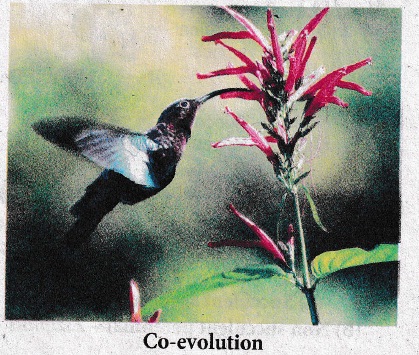
Co-evolution: The interaction between organisms, when continues for generations, involves reciprocal changes in genetic and morphological characters of both organisms. This type of evolution is called co-evolution. It is a kind of co-adaptation and mutual change among interactive species.
3.
Thermal Stratification
It is usually found in aquatic habitat. The change in the temperature profile with increasing depth in a water body is called thermal stratification. There are three kinds of thermal stratifications.
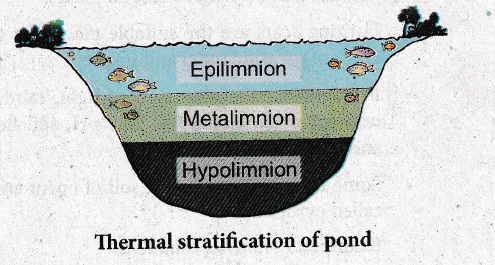
1. Epilimnion - The upper layer of warmer water.
2. Metalimnion - The middle layer with a zone of gradual decrease in temperature.
3. Hypolimnion - The bottom layer of colder water.
4.
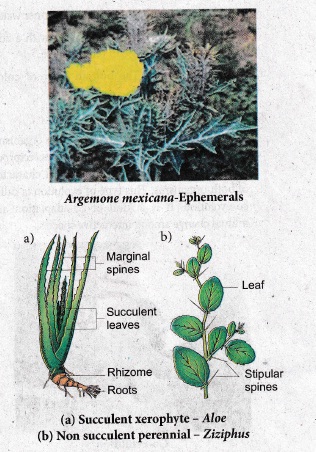
(a) Life cycle is completed within a short period (Ephemerals)
(b) In succulents the stem possess a water storage region
(c) Root hairs & root caps are also well developed
5.
1. Many herbivores are predators. Cattles, camels, goats etc., frequently browse on the tender shoots of herbs, shrubs and trees. Generally annuals suffer more than the perennials. Grazing and browsing may cause remarkable changes in vegetation. Nearly 25 percent of all insects are known as phytophagous (feeds on plant sap and other Parts of Plant).
2. Many defense mechanisms are evolved to avoid their predations by plants. Examples: Calotropis produces highly poisonous cardiac glycosides, tobacco produces nicotine, coffee plants produce caffeine, Cinchona plant produces quinine. Thorns of Bougainvillea, spines of Opuntia, and latex of cacti also protect them from Predators.
6.
1. Cuscuta is a total stem parasite of the host plant Acacia, Duranta and many other plants Cuscuta even gets flower inducing hormone from its host Plant.
2. Balanophora, orobanche and Refflesia are the total root parasites found on higher plants.
7.
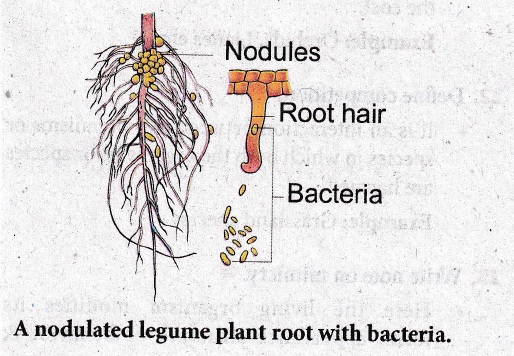
(a) Mutualism: It is an interaction between two species of organisms in which both are benefitted from the obligate association. The following are common examples of mutualism.
(b) Nitrogen fixation : Rhizobium (Bacterium) forms nodules in the roots of leguminous plants and lives symbiotically. The Rhizobium obtains food from leguminous plant and in turn fixes atmospheric nitrogen into nitrate, making it available to host plants.
Other examples:
Water fern (Azolla) and Nitrogen fixing Cyanobacterium (Anabaena) .
8.
9.
The differences between habitat and niche are as follows.
| S. No | Habitat | Niche |
| 1 | A specific physical space occupied by an organism (species). | A functional space occupied by an organism in the same eco-system |
| 2 | Same habitat may be shared by many organisms (species). | A single niche is occupied by a single species. |
| 3 | Habitat specificity is exhibited by organism. | Organisms may change their niche with time and season |
10.

12th Standard Syllabus & Materials
12th Standard
TN 12th Computer Applications களப்பெயர் முறைமை (DNS) Sample Question Papers Study Material - QB365 Set A
NEW12th Standard
TN 12th Computer Applications வலையமைப்பு எடுத்துக்காட்டுகள் மற்றும் நெறிமுறைகள் Sample Question Papers Study Material - QB365 Set A
NEW12th Standard
TN 12th Computer Applications கணினி வலையமைப்பு ஓர் அறிமுகம் Sample Question Papers Study Material - QB365 Set A
NEW12th Standard
TN 12th Computer Applications PHP-உடன் MySQL-ஐ இணைத்தல் Sample Question Papers Study Material - QB365 Set A



Tamilnadu Stateboard 12th Standard Subjects

Maths

Chemistry

Physics
Biology

Computer Science

Business Maths and Statistics

Economics

Commerce

Accountancy

History

Computer Applications
Biology
Computer Technology
Computer Applications
Computer Science
Business Maths and Statistics
Commerce
Economics
Maths
Chemistry
Physics
Computer Technology
History
Accountancy

Tamil

English

French
Tamilnadu Stateboard Standards

