
 100% FREE ACCESS
12th Standard Syllabus & Materials
12th Standard
TN 12th Computer Applications மின்னணு தரவு பரிமாற்றம் Sample Question Papers Study Material - QB365 Set A
NEW12th Standard
TN 12th Computer Applications மின் - வணிக பாதுகாப்பு அமைப்புகள் Sample Question Papers Study Material - QB365 Set A
NEW12th Standard
TN 12th Computer Applications மின்னணு செலுத்தல் முறைகள் Sample Question Papers Study Material - QB365 Set A
NEW12th Standard
TN 12th Computer Applications மின் - வணிகம் Sample Question Papers Study Material - QB365 Set A
NEW12th Standard
TN 12th Computer Applications திறந்த மூல கருத்துருக்கள் Sample Question Papers Study Material - QB365 Set A
NEW12th Standard
TN 12th Computer Applications வலையமைப்பு வடமிடல் Sample Question Papers Study Material - QB365 Set A

Published on: 29/08/2022
QB365 provides a detailed and simple solution for every Possible Creative Questions in Class 12 Biology Subject - Botany - Principles of Ecology, English Medium. It will help Students to get more practice questions, Students can Practice these question papers in addition to score best marks.
Download Tamil Nadu 12th Standard Biology question papers, model tests, one-mark questions, important questions, and public exam papers in PDF format. Free study materials and answer keys for TN State Board students.
Questions + Answers key
Take MCQ Biology Test1.
Explain the role of wind as a vital ecological factor.
2.
Topography influences the climate of an area Discuss.
3.
Describe the morphological and anatomical features of xerophytes. (or) Write the morphological adaptations of xerophytes.
4.
Describe the Morphological and Anatomical characters of Hydrophytes.
5.
What are the adaptation of the wind dispersal plants and Anemochory?
6.
Briefly explain the morphological & anatomical adaptations seen in epiphytes.
7.
List out the morphological & anatomical adaptations in mesophytes.
8.
Explain Intraspecific competition & Interspecific competition.
9.
Explain various types of interaction inclusive of both positive & negative with examples.
10.
Explain the role of edaphic factors on vegetation.
11.
Point out any five morphological adaptations of epiphytes.
12.
What does competition refers to? Classify and describe it.
13.
Explain various edaphic factors that affect vegetation.
1.
Ecological factors
(i) Many organisms, co-exist in an environment. The environment (surrounding) includes physical, chemical and biological components. When a component surrounding an organism affects the life of an organism, it becomes a factor. All such factors together are called environmental factors or ecological factors
(ii) Air in motion is called wind. It is also avital ecological factor. The atmospheric air contains a number of gases, particles and other constituents. The composition of gases in atmosphere is as follows: Nitrogen -78% ,Oxygen -21%, Carbon-di-oxide -0. 03%, Argon and other gases - 0.93%. The other components of wind are water vapour, gaseous pollutants, dust, smoke particles, microorganisms, pollen grains, spokes, etc. Anemometer is the instrument used to measure the speed of wind.
Effects of wind
(i) Wind is an important factor for the formation of rain
(ii) Causes wave formation in lakes and ocean, which promotes aeration of water .
(iii) Strong wind causes soil erosion and reduces soil fertility
(iv) Increases the rate of transpiration
(v) Helps in pollination in anemophilous plants
(vi) It also helps in dispersal of many fruits, seeds, spores, etc.
(vii) Strong wind may cause up-rooting of big trees
(viii) Unidirectional wind stimulates the development of flag forms in trees.
2.
Topographic factors
(i) The surface features of earth are called topography. Topographic influence on the climate of any area is determined by the interaction of solar radiation, temperature, humidity, rainfall, latitude and altitude. It affects the vegetation through climatic variations in small areas (microclimate ) and even changes the soil conditions. Topographic factors
include latitude, altitude, direction of mountain, steepness of mountain etc.
a) Latitudes and altitudes:
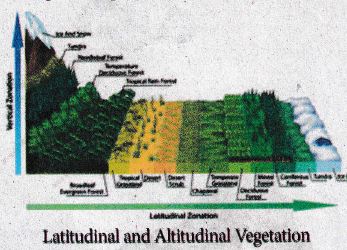
(i) Latitudes represent distance from the equator. Temperature values are maximum at the equator and decrease gradually towards poles. Different types of vegetation occur from equator to poles which are illustrated below.
(ii) Height above the sea level forms the altitude. At high altitudes, the velocity of wind remains high temperature and air pressure decrease while humidity and intensity of light increase. Due to these factors, vegetation at different altitudes varies, showing distinct zonation.
b) Direction of Mountain
(i) North and south faces of mountain or hill possess different types of flora and fauna because they differ in their humidity, rainfall, light intensity, light duration and temperature regions.
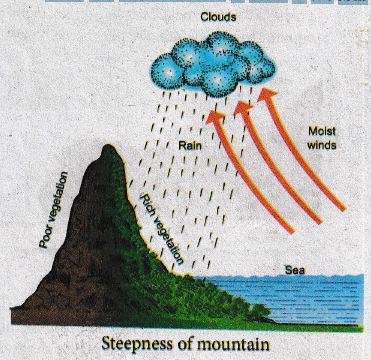
(ii) The two faces of the mountain or hill receive different amount of solar radiation, wind action and rain. Of these two faces, the windward region possesses good vegetation due to heavy rains and the leeward region possesses poor vegetation due to rain shadows (rain deficit).
(iii) Similarly in the soil of aquatic bodies like ponds the center and edge possess different depth of water due to soil slope and different wave actions in the water body. Therefore, different parts of the same area may possess different species of organisms.
c) Steepness of the mountain
(i) The steepness of the mountain or hill allows the rain to run off. As a result the loss of water causes water deficit and quick erosion of the topsoil resulting in poor vegetation. On the other hand, the plains and valleys are rich in vegetation due to the slow drain of surface water and better retention of water in the soil.
3.
(i) Morphological characters:
A. Root:
(i) Root system is well developed and is greater than that of shoot system (Root grows in meters and stem grows in centimeters).
(ii) Root hairs and root caps are also well developed. Example: Cucurbita
B. Stem:
(i) Stems are mostly hard and woody.
(ii) They may be aerial or underground.
(iii) Stems and leaves are covered with wax coating or covered with dense hairs.
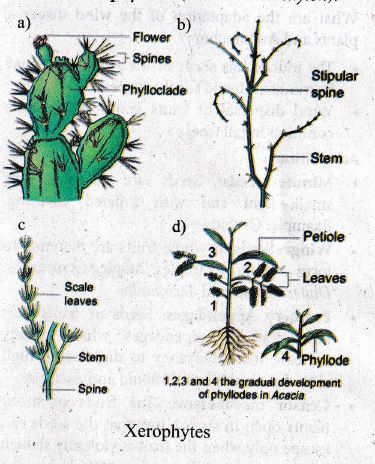
(iv) The entire internodes of the stem are modified into a fleshy leaf structure called phylloclades (or) Cladophyll. Example: Opuntia.
(v) In stem, a single or rarely two internodes modified into fleshy green structure called cladode (Asparagus).
(vi) In some the petiole is modified into a fleshy leaf like structure called phyllode (Acacia melanoxylon).
C. In leaves:
(i) Leaves are generally leathery and shiny to reflect light and heat.
(ii) Stipules are modified into spines. Examples: Euphorbia, Acacia, Ziziphus and Capparis
(iii) The entire leaves are modified into spines (Opuntia) or reduced to scales (Asparagus).
(ii) Anatomical features
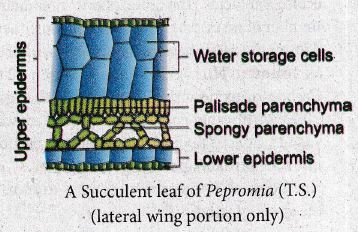
1. Multilayered epidermis with heavy cuticle to reduce transpiration.
2. Hypodermis is sclerenchymatous.
3. Sunken stomata are seen in lower epidermis with hairs in the sunken pits.
4. Scoto active type of stomata found in succulents.
5. Vascular bundles are well developed with the several layers of bundle sheath.
6. Mesophyll is well differentiated into palisade and spongy parenchyma.
7. In succulents the stem has a water storage regions.
Physiological adaptations:
1. Most of these processes are designed to reduce transpiration.
2. Life cycle is completed within a short period (Ephemerals).
4.
(i) Morphological features
(a) These are explained by (A) Root,
(B) Stem and (C) Leaves.
A Root:
(i) No roots in Woffia and Salvinia
(ii) Poorly developed root system is formed in Hydrilla
(iii) Well developed root system is formed in Ranunculus.
B Stem:
(i) It is longer, slender, spongy and flexible in sub-merged hydrophytes.
(ii) Stem is very thick, short stoloniferous and spongy and in rooted floating forms, it is a rhizome.
(iii) Vegetative reproduction occurs through suckers, runners, stolon, root cuttings, tubers, dormant apices and offsets.
C In leaves:
(i) Leaves are thin, long and ribbon-shaped Example: Vallisneria
(ii) Leaves are long and linear Example: Potamogeton
(iii) Leaves are finely dissected Example: Ceratophyllum.
(iv) Floating leaves are large and flat Example: Nymphaea and Nelumbo
(v) Petioles become swollen and spongy. Example: Trapa
(vi) In emergent hydrophytes, the leaves exhibit heterophylly (Submerged Ieaves are dissected and aerial leaves are entire). Example: Ranunculus, Limnophila heterophylle and Sagittaria
(ii) Reproductive features:
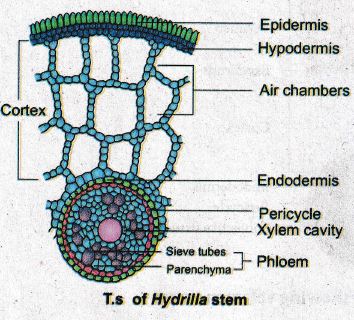
(i) Epidermis:
1. Cuticle is either completely absent or if present it is thin and poorly developed
2. Epidermis is one layered
(ii) Cortex:
1. Cortex is well developed with aerenchyma
(iii) Vascular tissues:
1. Vascular tissues are poorly developed.
2. Vascular tissues are well developed in emergent hydrophytes.
3. Mechanical tissues are usually absent except in some emergent hydroformed.
4. Pith medulla is sclerenchymatous.
5.
(i) The individual seeds or the whole fruit may be modified to aid for the dispersal by wind.
(ii) Wind dispersal of fruits and seeds is quite common in tall trees.
Adaptations:
(i) Minute seeds: Seeds are minute, very small, light and with inflated covering.
Example: Orchids.
(ii) Wings: Seeds or whole fruits are flattened to form a wing. Examples: Maple, Gyrocarpus, Dipterocarpus and Terminalia
(iii) Feathery Appendages: Seeds or fruits may have feathery appendages which greatly increase their buoyancy to disperse to high altitudes. Examples: Vernonia and Asclepias
(iv) Censor mechanisms: The fruits of many plants open in such a way that the seeds can escape only when the fruit is violently shaken by a strong wind. Examples: Aristolochia and Poppy.
6.
Morphological adaptations
(i) Root system is extensively developed. These roots may be of two types. They are Clinging roots and Aerial roots.
(ii) Clinging roots fix the epiphytes firmly on the surface of the supporting objects.
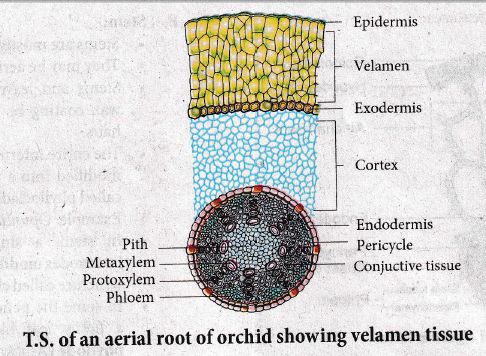
(iii) Aerial roots are green coloured roots which may hang downwardly and absorb moisture from the atmosphere with the help of a spongy tissue called velamen.
(iv) Stem of some epiphytes are succulent and develop pseudobulb or tuber.
(v) Generally the leaves are lesser in number and maybe fleshy and leathery
(vi) Myrmecophily is a common occurrence in the epiphytic vegetation to prevent the predators.
(vii) The fruits and seeds are very small and usually dispersed by wind, insects and birds.
Anatomical adaptations
(i) Multilayered epidermis is present. Inner to the velamen tissue, the peculiar exodermis layer is present.
(ii) Presence of thick cuticle and sunken stomata greatly reduce transpiration.
(iii) Succulent epiphytes contain well developed parenchymatous cells to store water in the form of mucilage.
7.
Morphological adaptations
(i) Root system is well developed with root caps and root hairs.
(ii) Stems are generally aerial, stout and highly branched.
(iii) Leaves are generally large, broad, thin with different shapes.
Anatomical adaptations
(i) Cuticle in aerial parts are moderately developed.
(ii) Epidermis is well developed and stomata of stem and in leaves generally present on both the epidermis.
(iii) Mesophyll is well differentiated into palisade and spongy parenchyma in dicots and isobilateral monocots.
(iv) Vascular and mechanical tissues are fairly developed and well differentiated.
8.
(a) Intraspecific competition:
(i) It is an interaction between individuals of the same species.
(ii) This competition is very severe because all the members of species have similar requirements of food, habitat, pollination etc.
(iii) They also have similar adaptations to fulfill their needs.
(b) Interspecific competition:
(i) It is an interaction between individuals of different species.
(ii) In grassland, many species of grasses grow well as there is little competition when enough nutrients and water is available.
(iii) During drought shortage of water occurs. A life and death competition starts among the different species of grass lands.
(iv) Survival in both these competitions is determined by the quantity of nutrients, availability of water and migration to new areas.
(v) Different species of herbivores larvae and grasshopper competing for fodder or forage plants.
(vi) Trees, shrubs and herbs in a forest struggle for sunlight, water and nutrients and also for pollination and dispersal of fruits and seeds.
(vii) The Utricularia (Bladderwort) competes with tiny fishes for small crustaceans and insects.
9.
Different interactions of plant
| Interaction type combination | Effects | Examples | |||
| 1. positive interaction | |||||
| 1. | Mutualism | (+) | (+) | Both species benefitted | Lichen, Mycorrhiza, etc |
| 2. | Commensalism | (+) | (0) | One species is benefitted and the other species is neither benefitted nor harmed |
orchids, Lianas, etc |
| 2. Negative interaction | |||||
| 4. | Predation | (+) | (-) | One species benefitted, the other species are harmed | Drosera, Nepenthes etc |
| 5. | Parasitism | (+) | (-) | One species benefitted, the other species are harmed | Cuscuta Duranta Viscum etc |
| 6. | Competition | (-) | (-) | Harmful for both | Grassland species |
| 7. | Amensalism | (-) | (0) | Harmful for one, but the other species are unaffected | Penicillium and Staphylococcus |
(+) Benefitted, (-) Harmed (0)Unaffected
10.
(a) Soil moisture: Plants absorbs rainwater and moisture directly from the air
(b) Soil water: Soil water is more important than any other ecological factors affecting the distribution of plants. Rain is the main source of soil water. Capillary water held between pore spaces of soil particles and angles between them is the most important form of water available to the plants.
(c) Soil reactions: Soil may be acidic or alkaline or neutral in their reaction. pH value of the soil solution determines the availability of plant nutrients. The best pH range of the soil for cultivation of crop plants is 5.5 to 6.8.
(d) Soil nutrients: Soil fertility and productivity is the ability of soil to provide all essential plant nutrients such as minerals and organic nutrients in the form of ions.
(e) Soil temperature: Soil temperature of an area plays an important role in determining the geographical distribution of plants. Low temperature reduces use of water and solute absorption by roots.
(f) Soil atmosphere: The spaces left between soil particles are called pore spaces which contains oxygen and carbon-di-oxide.
(g) Soil organisms: Many organisms existing in the soil like bacteria, fungi, algae, protozoans, nematodes, insects, earthworms, etc. arc called soil organisms.
11.
Morphological adaptations:
Root system is extensively developed. These roots may be of two types. They are Clinging roots and Aerial roots.
Clinging roots fix the epiphytes firmly on the surface of the supporting objects.
Aerial roots are green coloured roots which may hang downwardly and absorb moisture from the atmosphere with the help of a spongy tissue called velamen.
1. Stem of some epiphytes are succulent and develop pseudo bulb or tuber.
2. Generally the leaves are lesser in number and may be fleshy and leathery.
3. Myrmecophily is a common occurrence in the epiphytic vegetation to prevent the predators
4. The fruits and seeds are very small and usually dispersed by wind, insects and birds.
12.
Competition: It is an interaction between two organisms or species in which both the organisms or species are harmed. Competition is the severest in population that has irregular distribution. Competition is classified into intraspecific and interspecific.
1. Intraspecific competition: It is an interaction between individuals of the same species. This competition is very severe because all the members of species have similar requirements of food, habitat and pollination etc., and they also have similar adaptations to fulfill their needs.
2. Interspecific competition: It is an interaction between individuals of different species. In grassland, many species of grasses grow well as there is little competition when enough nutrients and water is available. During drought shortage of water occurs. A life and death competition starts among the different species of grass lands. Survival in both these competitions is determined by the quantity of nutrients, availability of water and migration to new areas. Different species of herbivores, larvae and grass hopper competing for fodder or forage plants. Trees, shrubs and herbs in a forest struggle for sunlight, water and nutrients and also for pollination and dispersal of fruits and seeds. The Utricularia (Bladderwort) competes with tiny fishes for small crustaceans and insects.
13.
The important edaphic factors which affect vegetation are as follows:
1. Soil moisture: Plants absorbs rain water and moisture directly from the air.
2. Soil water: Soil water is more important than any other ecological factors affecting the distribution of plants. Rain is the main source of soil water. Capillary water held between pore spaces of soil particles and angles between them is the most important form of water available to the plants.
3. Soil reactions: Soil may be acidic or alkaline or neutral in their reaction. pH value of the soil solution determines the availability of plant nutrients. The best pH range of the soil for cultivation of crop plants is 5.5 to 6.8.
4. Soil nutrients: Soil fertility and productivity is the ability of soil to provide all essential plant nutrients such as minerals and organic nutrients in the form of ions.
5. Soil temperature: Soil temperature of an area plays an important role in determining the geographical distribution of plants. Low temperature reduces use of water and solute absorption by roots.
6. Soil atmosphere: The spaces left between soil particles are called pore spaces which contains oxygen and carbon-di-oxide.
7. Soil organisms: Many organisms existing in the soil like bacteria, fungi, algae, protozoans, nematodes, insects and earthworms, etc., are called soil organisms.

12th Standard Syllabus & Materials
12th Standard
TN 12th Computer Applications களப்பெயர் முறைமை (DNS) Sample Question Papers Study Material - QB365 Set A
NEW12th Standard
TN 12th Computer Applications வலையமைப்பு எடுத்துக்காட்டுகள் மற்றும் நெறிமுறைகள் Sample Question Papers Study Material - QB365 Set A
NEW12th Standard
TN 12th Computer Applications கணினி வலையமைப்பு ஓர் அறிமுகம் Sample Question Papers Study Material - QB365 Set A
NEW12th Standard
TN 12th Computer Applications PHP-உடன் MySQL-ஐ இணைத்தல் Sample Question Papers Study Material - QB365 Set A



Tamilnadu Stateboard 12th Standard Subjects

Maths

Chemistry

Physics
Biology

Computer Science

Business Maths and Statistics

Economics

Commerce

Accountancy

History

Computer Applications
Biology
Computer Technology
Computer Applications
Computer Science
Business Maths and Statistics
Commerce
Economics
Maths
Chemistry
Physics
Computer Technology
History
Accountancy

Tamil

English

French
Tamilnadu Stateboard Standards

