
 100% FREE ACCESS
12th Standard Syllabus & Materials
12th Standard
TN 12th Computer Applications மின்னணு தரவு பரிமாற்றம் Sample Question Papers Study Material - QB365 Set A
NEW12th Standard
TN 12th Computer Applications மின் - வணிக பாதுகாப்பு அமைப்புகள் Sample Question Papers Study Material - QB365 Set A
NEW12th Standard
TN 12th Computer Applications மின்னணு செலுத்தல் முறைகள் Sample Question Papers Study Material - QB365 Set A
NEW12th Standard
TN 12th Computer Applications மின் - வணிகம் Sample Question Papers Study Material - QB365 Set A
NEW12th Standard
TN 12th Computer Applications திறந்த மூல கருத்துருக்கள் Sample Question Papers Study Material - QB365 Set A
NEW12th Standard
TN 12th Computer Applications வலையமைப்பு வடமிடல் Sample Question Papers Study Material - QB365 Set A

Published on: 29/01/2021
12th Standard Bio-Botany English Medium Chromosomal Basis of Inheritance Reduced Syllabus Important Questions 2021
Download Tamil Nadu 12th Standard Biology question papers, model tests, one-mark questions, important questions, and public exam papers in PDF format. Free study materials and answer keys for TN State Board students.
Questions + Answers key
Take MCQ Biology Test1.
Observe the gene sequence and identify the types of aberration ABC BCD E F?
Tandem duplication
Simple duplication
Reverse tandem duplication
Displaced tandem duplication
2.
Assertion (A): Self-sterility is observed in Nicotiana species.
Reason (R): Because the genes are located on chromosome.
A is true R is false
Both A and R are false
A is true, R is not correct explanation for A
R explains A
3.
_____ is called as "Father of Indian Green Revolution".
M.S. Swaminathan
P. Maheswari
Mendel
Nel Jayaraman
4.
Statement 1: In transversion mutation, single purine is changed to pyrimidine.
Statement 2: In transition mutation, a purine replaced by another purine.
Statement 1 is correct and Statement 2 is incorrect
Statement 1 is incorrect and Statement 2 is correct
Both the statements are correct
Both the statements are incorrect
5.
Statement 1: Euploidy involves entire sets of chromosomes
Statement 2: Aneuploidy involves individual chromosomes within a diploid net.
Statement 1 is correct and Statement 2 is incorrect
Statement 1 is incorrect and Statement 2 is correct
Both the statements are correct
Both the statements are incorrect
6.
Sharbati Sonora is a mutant wheat variety which is developed by irradiating the seeds with _________
Thermal neutrons
Gamma radiation
X-rays
UV radiations
7.
Transition type of gene mutation is caused when__________
AC is replaced by GT
AG is replaced by TC
AC is replaced by TG
TC is replaced by AG
8.
Mutation theory was proposed by____________
T. H. Morgan
Hugo de Vries
Alfred Sturtevant
Sutton and Boveri
9.
Which of the following statement(s) is/are wrong with respect to Recombination process?
(i) Mitotic crossing over occurs rarely in somatic cells.
(ii) Syndesis refers to pairing of non-homologous chromosome.
(iii) Procentric synapsis starts from telomeres.
(iv) A Bivalent has four chromatids.
i and iv
ii and i
ii and iii
All the above
10.
The following sequence represents the location of genes in a chromosome. A - B - C - M - R - S - y -Z. Which of the gene pairs will have least chance of getting inherited together?
A and M
Sand Y
M and Z
A and Y
11.
Which is not a feature of the chromosomal theory of inheritance?
Somatic cells of organisms are derived from zygote by repeated meiosis.
Chromosomes retain their structural uniqueness throughout the life of an organism.
Mendelian factors are located in chromosomes
Sutton and Boveri independently proposed the theory.
12.
How many map units separate two alleles A and B if the recombination frequency is 0.09?
900 cM
90 cM
9 cM
0.9 cM
13.
Due to incomplete linkage in maize, the ratio of parental and recombinants are ______.
50:50
7:1:1:7
96.4: 3.6
1:7:7:1
14.
Accurate mapping of genes can be done by three point test cross because increases _____.
Possibility of single cross over
Possibility of double cross over
Possibility of multiple cross over
Possibility of recombination frequency
15.
The A and B genes are 10 cm apart on a chromosome. If an AB/ab heterozygote is testcrossed to ab/ab, how many of each progeny class would you expect out of 100 total progeny?
25 AB, 25 ab, 25 Ab, 25 aB
10 AB, 10 ab
45 AB, 45 ab
45 AB, 45 ab, 5 Ab, 5aB
16.
What is translocation? Write about its types.
17.
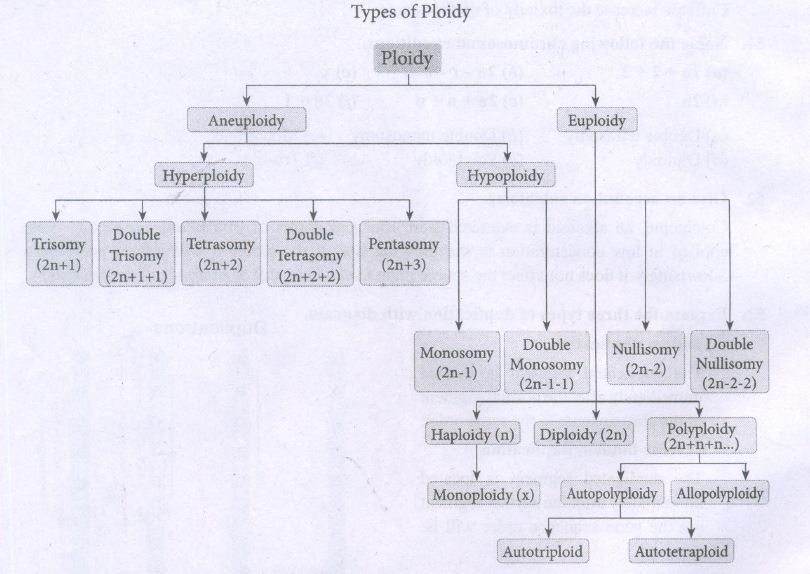
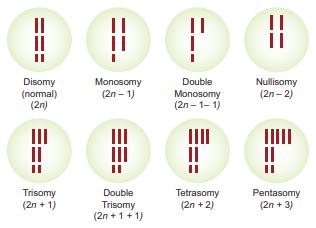
Draw a flow chart depicting the various types of ploidy.
18.
19.
What is gene mapping? Write its uses
20.
21.
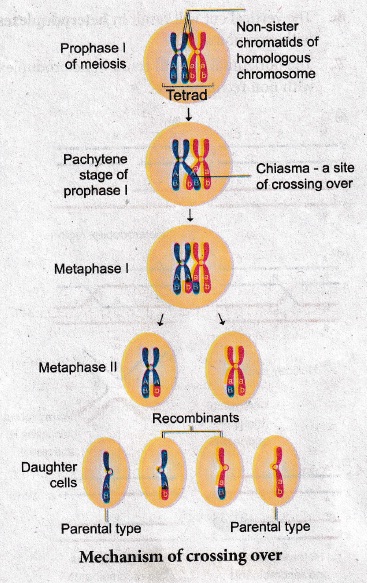
Explain the mechanism of crossing over.
22.
| s.no | gamete types | Number of progenies |
| 1 | ABC | 349 |
| 2 | Abc | 114 |
| 3 | abC | 124 |
| 4 | AbC | 5 |
| 5 | aBc | 4 |
| 6 | aBC | 116 |
| 7 | ABc | 128 |
| 8 | abc | 360 |
i) What is the name of this test cross?
ii) How will you construct gene mapping from the above given data?
iii) Find out the correct order of genes.
23.
If you cross dominant genotype PV/PV male Drosophila with double recessive female and obtain F1 hybrid. Now you cross F1 male with double recessive female.
i) What type of linkage is seen?
ii) Draw the cross with correct genotype.
iii) What is the possible genotype in F2 generation?
24.
In Drosophila melanogaster, there are four pairs of chromosomes. If there occurs chromosomal aberrations resulting in trisomic and monosomic condition, what will be the chromosomal count? Write the correct chromosomal count against respective chromosomal aberration.
25.
Given below is a sequence of alphabets representing the genes of chromosome. Observe it and answer the questions.
A- B - C - D - E - F - G - H - I - J -K.
(a) Write the sequence of genes after the chromosome undergoes terminal deletion of single gene.
(b) What will be the gene sequence, if the genes E and F undergoes tandem duplication?
(c) Consider the centromere is located between the genes F and G and write a gene sequence, after paracentric inversion occurs in between the genes C, D and E.
26.
List out the significance of ploidy.
27.
Why crossing over is important?
28.
Name the following chromosomal conditions.
(a) 2n + 2 + 2
(b) 2n - 1 - 1
(c) x
(d) 2n
(e) 2n + n + n
f) 2n + 1
29.
Differentiate Missense mutation from Nonsense mutation.
30.
Enumerate the uses of Genetic mapping.
31.
How crossing over differs from linkage?
32.
State Coupling and Repulsion theory.
33.
34.
What is recombination? Which is the widely accepted model of DNA recombination ?
35.
Given below are the gene sequences on the chromosome. Compare them with the normal chromosome and identify the type of structural chromosomal aberrations.
Normal Chromosome : A - B - C - D - E- F - G - H - I.
Chromosome 1 : A - B - C - B .C - D - E - F - G - H - I.
Chromosome 2 : A - B - C - D - F - G - H - I
36.
What is ploidy?
37.
Name any four chemical mutagens.
38.
39.
Define terminalization.
40.
What are bivalents? When does this condition is noticed in a cell?
41.
What are linked genes?
42.
Define linkage. Mention its types.
1.
(a)
Tandem duplication
2.
(c)
A is true, R is not correct explanation for A
3.
(a)
M.S. Swaminathan
4.
(a)
Statement 1 is correct and Statement 2 is incorrect
5.
(c)
Both the statements are correct
6.
(b)
Gamma radiation
7.
(a)
AC is replaced by GT
8.
(b)
Hugo de Vries
9.
(c)
ii and iii
10.
(d)
A and Y
11.
(a)
Somatic cells of organisms are derived from zygote by repeated meiosis.
12.
(c)
9 cM
13.
(b)
7:1:1:7
14.
(d)
Possibility of recombination frequency
15.
(d)
45 AB, 45 ab, 5 Ab, 5aB
16.
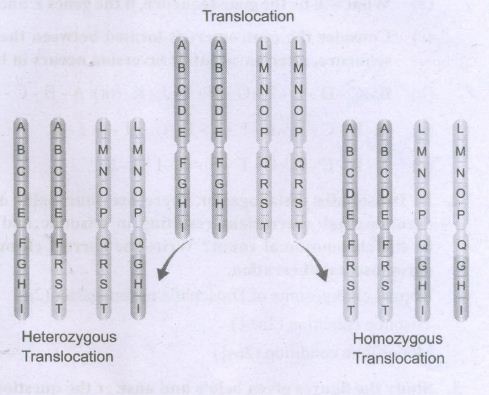
Translocation
The transfer of a segment of chromosome to a nonhomologous chromosome is called translocation. Translocation should not be confused with crossing over, in which an exchange of genetic material between homologous chromosome takes place. Translocation occurs as a result of interchange of chromosome segments in non-homologous chromosomes. There are three types:
i. Simple translocation
ii. Shift translocation
iii. Reciprocal translocation
i. Simple translocation
A single break is made in only one chromosome. The broken segment gets attached to one end of a non-homologous chromosome. It occurs very rarely in nature.
ii. Shift translocation
Broken segment of one chromosome gets inserted interstitially in a non-homologous chromosome.
iii. Reciprocal translocations
It involves mutual exchange of chromosomal segments between two non homologous chromosomes. It is also called illegitimate crossing over. It is further divided into two types.
a. Homozygous translocation: Both the chromosomes of two pairs are involved in translocation. Two homologous of each translocated chromosomes are identical.
b. Heterozygous translocation: Only one of the chromosome from each pair of two homologous are involved in translocation, while the remaining chromosome is normal.
Translocations playa major role in the formation of species.
17.
18.
19.
The diagrammatic representation of position of genes and related distances between the adjacent genes is called gene mapping.
Uses
(i) Used to determine gene order.
(i) Identify the locus of a gene.
(i) Calculate the distance between genes.
(i) Useful in predicting results of dihybrid and trihybrid crosses.
(i) Allows the geneticists to understand the overall genetic complexity of particular organism.
20.
21.
Crossing over is a process that includes four stages.
1. Synapsis
(i) Pairing between two homologous chromosomes is initiated during sub stage zygotene stage of prophase I of meiosis I
(ii) Homologous chromosomes are aligned side by side resulting in the formation of bivalents. It also occurs in zygotene sub-stage of prophase I of meiosis I tetrads.This pairing phenomenon is called synapsis.
2.Tetrad Formation
(i) Each homologous chromosome of a bivalent begin to form two identical sister chromatids.
(ii) They remain held together by a centromere at this stage each bivalent has four chromatids. This stage is called tetrad stage.
3. Cross Over
After tetrad formation, crossing over occurs in pachytene stage.
The non-sister chromatids of homologous pair make a contact at one or more points. These points of contact are called Chiasmata.
At chiasma, X-shaped structures are formed, where breaking and rejoining of two chromatids occur. This results in reciprocal exchange of equal and corresponding segments between them synapsis and chiasma formation are facilitated by protein filaments called synaptonemal complex.
4. Terminalisation
After crossing over, chiasma starts to move towards the terminal end of chromatids known as terminalisation. As a result, complete separation of homologous chromosomes occurs.
22.
(i) Three point test cross.
(ii)
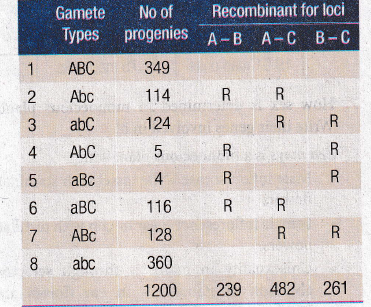
If we analyse the loci of two alleles at a time, starting with AB, since AB and ab are parental genotypes, the recombination will be Ab/aB.
The recombinant frequency for these two alleles can be calculated as follows.
\(RF = \frac{Total\ no.\ of \ recombination}{Total\ no.\ of\ progenies}\times100\)
\(\mathrm{RF}=\frac{114+5+4+116}{1200} \times 100 \)
\(\mathrm{RF}=\frac{239}{1200}=19.91 \)
For A and C loci, the recombinants are Ac / aC - RF will be as follows.
\(\mathrm{RF}=\frac{114+134+116+128}{1200} \times 100 \)
\(\mathrm{RF}=\frac{482}{1200}=40.1 \)
For B and C loci, the recombinants are Bc / bC- RF will be as follows.
\(R F=\frac{124+5+4+128}{1200} \times 100 \)
\(R F=\frac{261}{1200}=21.75 \)
All the loci are linked, because all the RF value is less than 50%. In this A - and C loci show highest RF value, they must be farthest apart. Therefore B locis must lie in between them.
The order of genes should be abc. A genetic map can be drawn as follows.
(iii)

23.
(i) Incomplete linkage
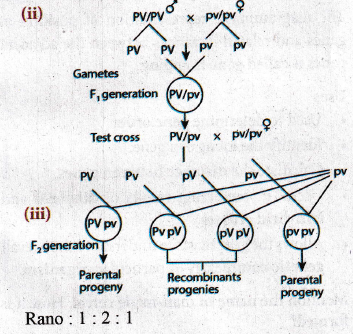
Rano : 1:2:1
24.
Normal chromosome of Drosophila melanogaster (2n) = 8
Trisomic condition (2n+ 1) = 9
Monosomic condition (2n-l) = 7
25.
(a) B - C - D - E - F - G - H - I - J - K (or) A- B - C - D - E - F - G - H - I - J.
(b) A- B - C - D - E - F - E - F - G - H - I - J - K.
(c) A - B - E - D - C - F - G - H - I - J - K.
26.
Many polyploids are more vigorous and more adaptable than diploids.
(i) Many ornamental plants are autotetraploids and have larger flower and longer flowering duration than diploids.
(ii) Autopolyploids usually have increase in fresh weight due to more water content.
(iii) Aneuploids are useful to determine the phenotypic effects of loss or gain of different chromosomes.
(iv) Many angiosperms are allopolyploids and they play a role in an evolution of plants.
27.
1. Exchange of segments leads to new gene combinations which plays an important role in evolution.
2. Studies of crossing over reveal that genes are arranged linearly on the chromosomes.
3. Genetic maps are made based on the frequency of crossing over.
4. Crossing over helps to understand the nature and mechanism of gene action.
5. If a useful new combination is formed it can be used in plant breeding.
28.
(a) Double tetrasomy
(b) Double monosomy
(c) Monoploidy
(d) Diploidy
(e) Polyploidy
(f) Trisomy
29.
| Mis-sense Mutation | Non-sense Mutation |
| The mutation where the codon for one amino acid is changed into a codon for another amino acid is called Mis-sense or non-synonymous mutations. | The mutations where codon for one amino acid is changed into a termination or stop codon is called Non-sense mutation. |
30.
(I) It is used to determine gene order, identify the locus of a gene and calculate the distances between genes.
(II) They are useful in predicting results of dihybrid and trihybrid crosses.
(III) It allows the geneticists to understand the overall genetic complexity of particular organism.
31.
| S.No. | Linkage | Crossing over |
| 1. | The genes present on chromosome stay close together. | It leads to separation of linked genes. |
| 2. | It involves same chromosome of homologous chromosome. | It involves exchange of segments between non-sister chromatids of homologous chromosome |
| 3. | It reduces new gene combinations. | It increases variability by forming new gene combinations. Leading to formation of new organism. |
32.
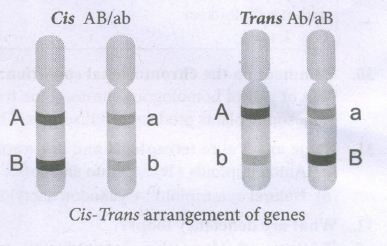
The two dominant alleles or recessive alleles occur in the same homologous chromosomes, tend to inherit together into same gamete are called coupling or cis configuration. If dominant or recessive alleles are present on two different, but homologous chromosomes they inherit apart into different gamete are called repulsion or trans configuration.
33.
34.
Crossing over results in the formation of new combination of characters in an organism called recombinants. In this, segments of DNA are broken and recombined to produce new combinations of alleles. This process is called recombination.
The widely accepted model of DNA recombination during crossing over is Holliday's hybrid DNA model.
35.
Chromosome 1: Tandem duplication.
Chromosome 2: Intercalary deletion.
36.
Sometimes, the chromosome number of somatic cells changed due to addition or elimination of individual chromosome or basic set of chromosomes. This condition in known as ploidy.
37.
(a) Ethyl methanesulphonate (EMS)
(b) Mustard gas
(c) Maganous salt
(d) Formaldehyde
38.
39.
After crossing over, chiasma starts to move towards the terminal end of chromatids. This is known as terminalization. As a result, complete separation of homologous chromosomes occurs.
40.
During zygotene stage of prophase I of meiosis I, homologous chromosomes are aligned side by side resulting in a pair of homologous chromosomes called bivalents.
41.
Genes located close together on the same chromosome and inherited together are called linked genes.
42.
Tendency of genes to remain together during separation of chromosomes is called linkage. Linkage are of 2 types - complete linkage and incomplete linkage.

12th Standard Syllabus & Materials
12th Standard
TN 12th Computer Applications களப்பெயர் முறைமை (DNS) Sample Question Papers Study Material - QB365 Set A
NEW12th Standard
TN 12th Computer Applications வலையமைப்பு எடுத்துக்காட்டுகள் மற்றும் நெறிமுறைகள் Sample Question Papers Study Material - QB365 Set A
NEW12th Standard
TN 12th Computer Applications கணினி வலையமைப்பு ஓர் அறிமுகம் Sample Question Papers Study Material - QB365 Set A
NEW12th Standard
TN 12th Computer Applications PHP-உடன் MySQL-ஐ இணைத்தல் Sample Question Papers Study Material - QB365 Set A



Tamilnadu Stateboard 12th Standard Subjects

Maths

Chemistry

Physics
Biology

Computer Science

Business Maths and Statistics

Economics

Commerce

Accountancy

History

Computer Applications
Biology
Computer Technology
Computer Applications
Computer Science
Business Maths and Statistics
Commerce
Economics
Maths
Chemistry
Physics
Computer Technology
History
Accountancy

Tamil

English

French
Tamilnadu Stateboard Standards

