
 100% FREE ACCESS
12th Standard Syllabus & Materials
12th Standard
TN 12th Computer Applications மின்னணு தரவு பரிமாற்றம் Sample Question Papers Study Material - QB365 Set A
NEW12th Standard
TN 12th Computer Applications மின் - வணிக பாதுகாப்பு அமைப்புகள் Sample Question Papers Study Material - QB365 Set A
NEW12th Standard
TN 12th Computer Applications மின்னணு செலுத்தல் முறைகள் Sample Question Papers Study Material - QB365 Set A
NEW12th Standard
TN 12th Computer Applications மின் - வணிகம் Sample Question Papers Study Material - QB365 Set A
NEW12th Standard
TN 12th Computer Applications திறந்த மூல கருத்துருக்கள் Sample Question Papers Study Material - QB365 Set A
NEW12th Standard
TN 12th Computer Applications வலையமைப்பு வடமிடல் Sample Question Papers Study Material - QB365 Set A

Published on: 29/01/2021
12th Standard Bio-Botany English Medium Classical Genetics Reduced Syllabus Important Questions With Answer Key 2021
Download Tamil Nadu 12th Standard Biology question papers, model tests, one-mark questions, important questions, and public exam papers in PDF format. Free study materials and answer keys for TN State Board students.
Questions + Answers key
Take MCQ Biology Test1.
The 1 : 2 : 1 ratio of co-dominance process Mendel's ___________
Law of dominance
Law of recessiveness
Law of segregation
Law of independent assortment
2.
Factor hypothesis was proposed by _________
Reginald Punnett
W. Bateson
Gregor Mendel
Carl Correns
3.
According to Mendel, which is not a dominant trait?
Wrinkled seeds
Purple flower
Inflated pod form
Axial flower portion
4.
How many genetically different gametes are produced by a plant have genotype TtYyRr?
2
4
6
8
5.
Statement 1: Test cross is done between F1 individual with homozygous recessive
Statement 2: If F 1 individual is homozygous, the rate of a monohybrid cross will be 1:1
Statement 1 is correct & Statement 2 is incorrect
Statement 1 is incorrect & Statement 2 is correct
Both Statements 1 & 2 are correct
Both Statements 1 & 2 are incorrect
6.
Identify the mismatched pair
Chloroplast inheritance - Gregor Mendel
Polygenic inheritance - H. Nilsson
Lethal genes - E. Baur
Incomplete dominance - Carl Correns
7.
Assertion (A): Codominance is an example of intragenic interaction
Reason (R): Interaction takes place between the alleles of the same gene
A and R are correct R explains A
A and R are incorrect
A is correct R is incorrect
A is incorrect R is correct
8.
How many characters studied by Mendel in pisum sativum
Three
Five
Seven
Nine
9.
The term 'Genetics' was introduced by__________
Gregor Mendel
W. Bateson
Hugo de Vries
Carl Correns
10.
“Gametes are never hybrid”. This is a statement of ______.
Law of dominance
Law of independent assortment
Law of segregation
Law of random fertilization
11.
The genes controlling the seven pea characters studied by Mendel are known to be located on how many different chromosomes?
Seven
Six
Five
Four
12.
In a test cross involving F1 dihybrid flies, more parental type offspring were produced than the recombination type offspring. This indicates ______.
The two genes are located on two different chromosomes
Chromosomes failed to separate during meiosis
The two genes are linked and present on the some chromosome
Both of the characters are controlled by more than one gene
13.
The epistatic effect, in which the dihybrid cross 9:3:3:1 between AaBb Aabb is modified as ______.
Dominance of one allele on another allele of both loci
Interaction between two alleles of different loci
Dominance of one allele to another alleles of same loci
Interaction between two alleles of some loci
14.
The genotype of a plant showing the dominant phenotype can be determined by _____.
Back cross
Test cross
Dihybrid cross
Pedigree analysis
15.
Extra nuclear inheritance is a consequence of presence of genes in _____.
Mitrochondria and chloroplasts
Endoplasmic reticulum and mitrochondria
Ribosomes and chloroplast
Lysososmes and ribosomes
16.
What are plasmogenes?
17.
Define lethal alleles.
18.
Provide any four intergenic gene interactions.
19.
How many types of gametes are produced by a dihybrid plant? If the same plant is self-fertilized, how many second-generation offsprings are developed?
20.
Name the first and second law of Mendel.
21.
Define the terms
(i) Emasculation
(ii) Alleles
22.
Name the four major subdisciplines of genetics.
23.
What are multiple alleles?
24.
Define Genetics.
25.
Give the names of the scientists who rediscovered Mendelism
26.
What is meant by true breeding or pure breeding lines / strain?
27.
Describe incomplete dominance exhibited by Mirabilis jalapa.
28.
How does the wrinkled gene make Mendel's peas wrinkled? Find out the molecular explanation.
29.
30.
Explain with an example how single genes affect multiple traits and alleles the phenotype of an organism.
31.
32.
Explain polygenic inheritance with an example.
33.
34.
Explain the law of dominance in monohybrid cross.
35.
Write a short notes on Atavism.
36.
Give an account on cytoplasmic male sterility.
37.
Define co-dominance. How it is proved by using Gossypium species?
38.
Define trihybrid cross. Mention its F 2 phenotypic ratio.
39.
State the law of segregation.
40.
List out the reasons for the selection of pea plant by Mendel.
41.
What is meant by cytoplasmic inheritance
42.
Differentiate incomplete dominance and codominance.
1.
(b)
Law of recessiveness
2.
(b)
W. Bateson
3.
(a)
Wrinkled seeds
4.
(d)
8
5.
(a)
Statement 1 is correct & Statement 2 is incorrect
6.
(a)
Chloroplast inheritance - Gregor Mendel
7.
(a)
A and R are correct R explains A
8.
(c)
Seven
9.
(b)
W. Bateson
10.
(c)
Law of segregation
11.
(a)
Seven
12.
(c)
The two genes are linked and present on the some chromosome
13.
(b)
Interaction between two alleles of different loci
14.
(b)
Test cross
15.
(a)
Mitrochondria and chloroplasts
16.
Plasmogenes are independent, self-replicating, extra-chromosomal units located in cytoplasmic organelles, chloroplast, and mitochondrion.
17.
An allele which has the potential to cause the death of an organism is called a Lethal Allele.
18.
(a) Incomplete dominance
(b) Codominance
(c) Multiple alleles
(d) Pleiotropic genes are common examples for intragenic interaction.
19.
Four different gametes are produced by a dihybrid plant and on selfing, it yield 16 offsprings.
20.
i) The Law of Dominance,
ii) The Law of Segregation
21.
Emasculation: Removal of anthers from the flower
Alleles: Alternate forms of a gene
22.
(a) Classical genetics
(b) Molecular genetics
(c) Population genetic
(d) Quantitative genetics
23.
A group of genes that together determine a characteristic of an organism.
24.
"Genetics" is the branch of biological science which deals with the mechanism of transmission of characters from parents to off springs.
25.
(i) Hugo de Vries of Holland
(ii) Carl Correns of Germany
(iii) Erich von Tschermak of Austria
26.
A true breeding lines means it has undergone continuous self pollination having stable trait inheritance from parent to off spring.
27.
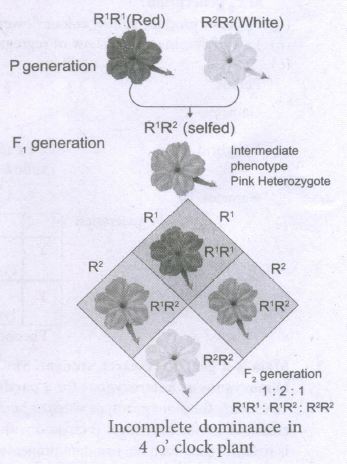
The German Botanist Carl Correns's (1905) Experiment - In 4 0' clock plant, Mirabilis jalapa when the pure breeding homozygous red (R1 R1) parent is crossed with homozygous white (R 2R2), the phenotype of the F1 hybrid is heterozygous pink (R1R2). The F1 heterozygous phenotype differs from both the parental homozygous phenotype. This cross did not exhibit the character of the dominant parent but an intermediate colour pink. When one allele is not completely dominant to another allele it shows incomplete dominance. Such allelic interaction is known as incomplete dominance. F1 generation produces intermediate phenotype pink coloured flower.
When pink coloured plants of F 1 generation were interbred in F2 both phenotypic and genotypic ratios were found to be identical as 1 : 2 : 1(1 red: 2 pink: 1 white). Genotypic ratio is 1 R1R1 : 2 R1R2 : 1 R2R2. From this we conclude that the alleles themselves remain discrete and unaltered proving the Mendel's Law of Segregation. The phenotypic and genotypic ratios are the same. There is no blending of genes. In the F2 generation R1 and R2 genes segregate and recombine to produce red, pink and white in the ratio of 1 : 2 : 1. R 1 allele codes for an enzyme responsible for the formation of red pigment. R2 allele codes for defective enzyme. R1 and R2 genotypes produce only enough red pigments to make the flower pink. Two R1R1 are needed for producing red flowers. Two R2R2 genes are needed for white flowers. If blending had taken place, the original pure traits would not have appeared and all F2 plants would have pink flowers. It is very clear that Mendel's particulate inheritance takes place in this cross which is confirmed by the reappearance of original phenotype in F2.
28.
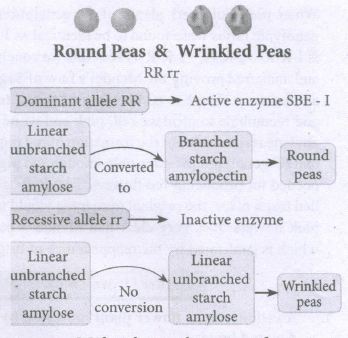
The protein called starch branching enzyme (SBEI) is encoded by the wild-type allele of the gene (RR) which is dominant. When the seed matures, this enzyme SBEI catalyzes the formation of highly branched starch molecules. Normal gene (R) has become interrupted by the insertion of extra piece of DNA (0.8 kb) into the gene, resulting in r allele. In the homozygous mutant form of the gene (rr) which is recessive, the activity of the enzyme SBEI is lost resulting in wrinkled peas. The wrinkled seed accumulates more sucrose and high water content. Hence the osmotic pressure inside the seed rises. As a result, the seed absorbs more water and when it matures it loses water as it dries. So it becomes wrinkled at maturation. When the seed has at least one copy of normal dominant gene heterozygous, the dominant allele helps to synthesize starch, amylopectin an insoluble carbohydrate, with the osmotic balance which minimises the loss of water resulting in smooth structured round seed.
29.
30.
(i) The Pleiotropic gene-influences a number of characters simultaneously & such genes are called pleiotropic gene.
(ii) Mendel noticed pleiotropy while performing breeding experiment with peas (Pisum sativum).
(iii) Peas with purple flowers were cross with white flowers.
(iv) Brown seeds were crossed with light coloured seeds.
(v) Dark spot on the axils of the leaves were crossed with no spot on the axils of the leaves.
(vi) The above characters all were inherited together as a single unit.
(vii) This is due to the pattern on inheritance where the 3 traits were controlled by a single gene with dominant & recessive alleles.
(viii) E.g. Sickle cell anemia.
31.
32.
(i) Polygenic inheritance - Several genes combine to affect a single trait.
(ii) A group of genes that together determine (contribute) a characteristic of an organism is called polygenic inheritance. It gives explanations to the inheritance of continuous traits which are compatible with Mendel's Law.
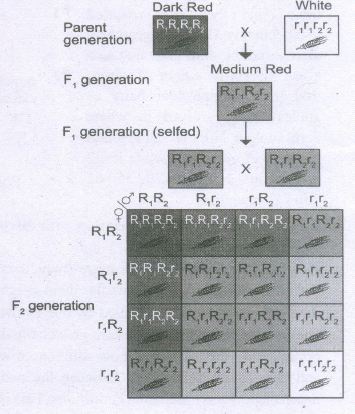
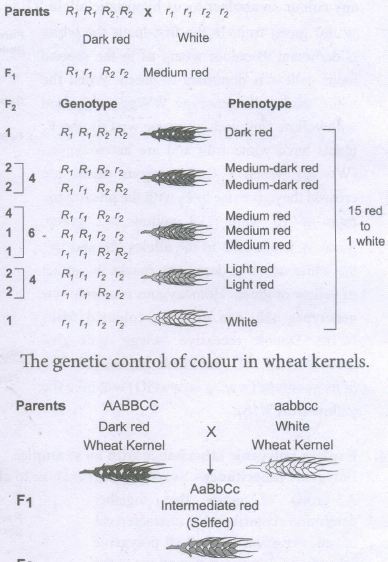
(iii) The first experiment was demonstrated by H. Nilsson - Ehle (1909) in wheat kernels.
(iv) He crossed the two pure breeding wheat varieties dark red & white.
(v) Dark red genotypes R1R1R2R2 and
(vi) white genotypes are r1r1r2r2
(vii) In the F1 generation medium red were obtained R1r1R2r2.
(viii) F1 wheat plant produces four types of gametes R1R2, R1r2, r1R2, r1r2.
(xi) The intensity of the red colour is determined by the number of R genes in the F2 generations.
(x) Four R genes - Dark red kernel.
(xi) Three R genes - Medium dark red kernel
(xii) Two R genes - Medium red kernel
(xiii) One R gene - Light red kernel.
(xiv) Absence of R gene - White kernel.
F2
| 1 | 6 | 15 | 20 | 15 | 6 | 1 |
| Dark red | Moderate red | Red | Intermediate red | light red | very light red | white |
(xv) In F2 generation plants have kernels with wide range of colour variation.
(xvi) This is due to that the genes are segregating and recombination takes place.
(xvii) The cumulative effect of several pairs of gene i interaction gives rise to many shades of kernel colour.
33.
34.
Law of Dominance: The characters were controlled by discrete units called factors which occur in pairs. In a dissimilar pair of factors one member of the pair is dominant & the other is recessive.
(i) This law gives an explanation to the monohybrid cross.
(a) the expression of only one of the parental characters in F1 generation.
(b) the expression of both in the F2 generation
(ii) It also explains the proportion of 3:1 obtained at the F2
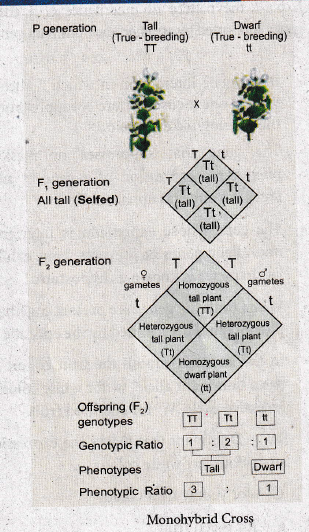
Monohybrid Cross
(i) Monohybrid inheritance is the inheritance of a single character i. e, plant height.
(ii) It involves the inheritance of two alleles of a single gene.
(iii) When the F1 generation was selfed Mendel noticed that 7847 of 1064 F2 plants were tall, while 277of 1064 were dwarf.
(iv) When tall pea plants were pollinated with the pollens from a true breeding dwarf plants, the result was all tall plants.
(v) Dwarf trait appears in the F2 generation.
(vi) When the parental types were reversed, the result was the same - All tall plants.
(vii) Tall (♀) \(\times\) Dwarf (♂) and Tall (♂) \(\times\) Dwarf (♀) mating's are done in both ways.
(viii) It was concluded that the trait is not sex dependent.
(xi) The gene for plant height has two alleles: Tall (T) \(\times\) Dwarf (t). (TT, Tt, Tt: tt)
35.
Atavism is a modification of a biological structure whereby an ancestral trait reappears after having been lost through evolutionary changes in the previous generations. Evolutionary traits that have disappeared phenotypically do not necessarily disappear from an organism's DNA. The gene sequence often remains, but is inactive. Such an unused gene may remain in the genome for many generations. As long as the gene remains intact, a fault in the genetic control suppressing the gene can lead to the reappearance of that character again. Reemergence of sexual reproduction in the flowering plant Hieracium pilosella is the best example for Atavism in plants.
36.
Male sterility found in pearl maize (Sorgum vulgare) is the best example for mitochondrial cytoplasmic inheritance. So it is called cytoplasmic male sterility. In this, male sterility is inherited maternally. The gene for cytoplasmic male sterility is found in the mitochondrial DNA.
37.
The phenomenon in which two alleles are both expressed in the heterozygous individual is known as codominance. The codominance was demonstrated in plants with the help of electrophoresis or chromatography for protein or flavonoid substance. Example: Gossypium hirsutum and Gossypium sturtianum, their F 1 hybrid (amphiploid) was tested for seed proteins by electrophoresis. Both the parents have different banding patterns for their seed proteins. In hybrids, additive banding pattern was noticed. Their hybrid shows the presence of both the types of proteins similar to their parents.
38.
A cross between homozygous parents that differ in three gene pairs (i.e. producing trihybrids) is called trihybrid cross.
F2 Phenotypic ratio - 27: 9 : 9 : 9 : 3 : 3 : 3 : 1
39.
The Law of Segregation (Law of Purity of gametes): Alleles do not show any blending. During the formation of gametes, the factors or alleles of a pair separate and segregate from each other such that each gamete receives only one of the two factors. A homozygous parent produces similar gametes and a heterozygous parent produces two kinds of gametes each having one allele with equal proportion. Gametes are never hybrid.
40.
He chooses pea plant because,
(i) It is an annual plant & bears contrasting characters controlled by a single gene separately.
(ii) Self-fertilization occurred in garden pea plants.
(iii) Mendel used both self-fertilization and cross-fertilization.
(iv) The flowers are large hence emasculation & pollination are very easy for hybridization.
41.
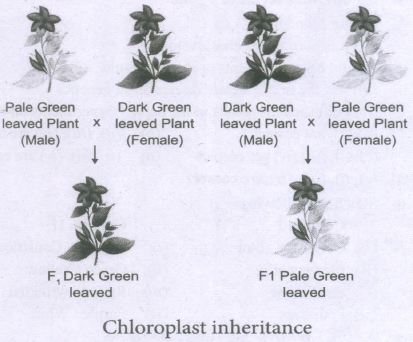
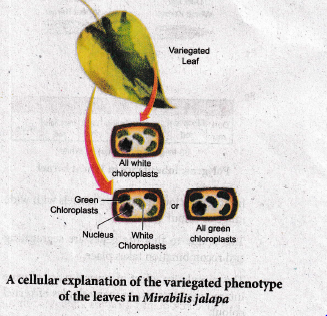
It is based on independent, self-replicating extra chromosomal unit called plasmogene located in the cytoplasmic organelles, chloroplast & Mitochondrion.
42.
| Incomplete Dominance | Co-dominance |
| When one allele is not completely dominant to another allele. | lt occurs due to simultaneous expression of both alleles in the heterozygote. |
| E.g: Flowers colour of Mirabilis Jalapa | E.g: ABO blood group system in human beings. |

12th Standard Syllabus & Materials
12th Standard
TN 12th Computer Applications களப்பெயர் முறைமை (DNS) Sample Question Papers Study Material - QB365 Set A
NEW12th Standard
TN 12th Computer Applications வலையமைப்பு எடுத்துக்காட்டுகள் மற்றும் நெறிமுறைகள் Sample Question Papers Study Material - QB365 Set A
NEW12th Standard
TN 12th Computer Applications கணினி வலையமைப்பு ஓர் அறிமுகம் Sample Question Papers Study Material - QB365 Set A
NEW12th Standard
TN 12th Computer Applications PHP-உடன் MySQL-ஐ இணைத்தல் Sample Question Papers Study Material - QB365 Set A



Tamilnadu Stateboard 12th Standard Subjects

Maths

Chemistry

Physics
Biology

Computer Science

Business Maths and Statistics

Economics

Commerce

Accountancy

History

Computer Applications
Biology
Computer Technology
Computer Applications
Computer Science
Business Maths and Statistics
Commerce
Economics
Maths
Chemistry
Physics
Computer Technology
History
Accountancy

Tamil

English

French
Tamilnadu Stateboard Standards

