
 100% FREE ACCESS
12th Standard Syllabus & Materials
12th Standard
TN 12th Computer Applications மின்னணு தரவு பரிமாற்றம் Sample Question Papers Study Material - QB365 Set A
NEW12th Standard
TN 12th Computer Applications மின் - வணிக பாதுகாப்பு அமைப்புகள் Sample Question Papers Study Material - QB365 Set A
NEW12th Standard
TN 12th Computer Applications மின்னணு செலுத்தல் முறைகள் Sample Question Papers Study Material - QB365 Set A
NEW12th Standard
TN 12th Computer Applications மின் - வணிகம் Sample Question Papers Study Material - QB365 Set A
NEW12th Standard
TN 12th Computer Applications திறந்த மூல கருத்துருக்கள் Sample Question Papers Study Material - QB365 Set A
NEW12th Standard
TN 12th Computer Applications வலையமைப்பு வடமிடல் Sample Question Papers Study Material - QB365 Set A

Published on: 29/01/2021
12th Standard Bio-Botany English Medium Ecosystem Reduced Syllabus Important Questions With Answer Key 2021
Download Tamil Nadu 12th Standard Biology question papers, model tests, one-mark questions, important questions, and public exam papers in PDF format. Free study materials and answer keys for TN State Board students.
Questions + Answers key
Take MCQ Biology Test1.
Statement (I): The first invaded plants in a barren area are called as pioneers.
Statement (II): Marsh meadow stage of hydro sere succession is also called as amphibious stage.
Statement I is correct; Statement II is incorrect.
Statement I is incorrect; Statement II is correct.
Both Statements I and II are correct.
Both Statements I and II are incorrect.
2.
Succession initiating on a sand referred as
Hydrosere
Psammosere
Halosere
Lithosere
3.
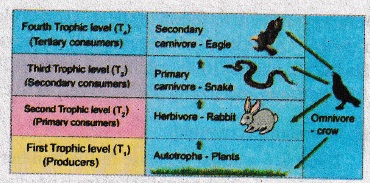
Assertion (A): In forest ecosystem, the pyramid of number is spindle shaped.
Reason (R): Tropical level (Tl) of the pyramid occupies large trees which are maximum in number.
Both A and R are wrong
A is right R is wrong
R explains A
A is right R is not the correct explanation for A
4.
Which type of ecosystem service does the genetic resources comes under?
Provisioning services
Supporting services
Regulating services
Cultural services
5.
Complete the food chain by filling the link X:
Paddy ~ Grasshopper ~ Frog ~ X ~ Hawk
King cobra
Gorilla
Rabbit
Tasmanian wolf
6.
Pyramid of numbers with broad base indicates ______
High population of old individuals
Low population of young individuals
High population of young individuals
Low population of old individuals
7.
Which of the following food chain is in improper sequence?
Plants ~ snake ~ rabbit ~ lizard ~ eagle
Plants ~ grasshopper ~ lizard ~ snake ~ hawk
Plants ~ lizard ~ rabbit ~ snake ~ eagle
Plants ~ rabbit ~ lizard ~ hawk ~ eagle
8.
Which group of organism occupies the third tropic level in an ecosystem?
Primary consumers
Secondary consumers
Secondary carnivores
Omnivores
9.
Photosynthetically Active Radiation ranges between the wavelength of __________
400 - 600 nm
600 - 700 nm
400 - 500 nm
400 - 700 nm
10.
Identify the incorrect option among the following component sequence.
air, water, sunlight and temperature
latitude, altitude, direction of mountain and aptitude
soil air, pH of soil, saltwater and soil moisture
carbohydrate, protein, lipids and humic substances
11.
Which of the following is not a sedimentary cycle
Nitrogen cycle
Phosphorous cycle
Sulphur cycle
Calcium cycle
12.
Significance of food web is / are ______.
it does not maintain stability in nature
it shows patterns of energy transfer
it explains species interaction
b and c
13.
Which one is in descending order of a food chain?
Producers \(\rightarrow \) Secondary consumers \(\rightarrow \) Primary consumers \(\rightarrow \) Tertiary consumers
Tertiary consumers \(\rightarrow \) Primary consumers \(\rightarrow \)Secondary consumers \(\rightarrow \) Producers
Tertiary consumers \(\rightarrow \) Secondary consumers \(\rightarrow \) Primary consumers \(\rightarrow \) Producers
Tertiary consumers \(\rightarrow \) Producers \(\rightarrow \) Primary consumers \(\rightarrow \) Secondary consumers
14.
Which of the following ecosystem has the highest primary productivity?
Pond ecosystem
Lake ecosystem
Grassland ecosystem
Forest ecosystem
15.
Which of the following is / are not a natural ecosystem?
Forest ecosystem
Rice field
Grassland ecosystem
Desert ecosystem
16.
Which kind of organisms constitute the pioneer community and climax community of a Hydrosere succession?
17.
What is meant by Ecosystem resilience?
18.
Biogeochemical cycle comprises both gaseous cycle and sedimentary cycle. How they differ from one another?
19.
Why do we obtain an inverted pyramid in a parasite ecosystem?
20.
Which is the first link in a grazing food chain and a detritus food chain?
21.
State the role of herbivores and microconsumers in a terrestrial ecosystem.
22.
What is meant by productivity of an ecosystem?
23.
Mention any two climatic factors and edaphic factors of an ecosystem.
24.
What will happen if all producers are removed from ecosystem?
25.
26.
Mention any two vital biomolecules that requires phosphorous for their biosynthesis.
27.
Point out any three mangrove ecosystem services.
28.
Explain the cycling of phosphorus in an ecosystem.
29.
What is biogeochemical cycle? Explain its types.
30.
Spindle shaped pyramid of number is noticed in forest ecosystem. Give reasons.
31.
Write a brief note on Detritus food chain.
32.
Explain the concept of trophic level in an ecosystem.
33.
List the factors affecting primary productivity.
34.
Generally human activities are against to the ecosystem, where as a student how will you help to protect ecosystem?
35.
Shape of pyramid in a particular ecosystem is always different in shape. Explain with example.
36.
Bring out the importance of plant succession.
37.
Write in detail about Autogenic succession and Allogenic succession.
38.
Differentiate Primary succession and Secondary succession.
39.
Write a note on the strategies of ecosystem management.
40.
Various stages of succession are given bellow. From that rearrange them accordingly. Find out the type of succession and explain in detail.
Reed-swamp stage, phytoplankton stage, shrub stage, submerged plant stage, forest stage, submerged free floating stage, marsh meadow stage.
41.
Draw a pyramid from following details and explain in brief.
Quantities of organisms are given-Hawks - 50, plants - 1000.rabbit and mouse - 250 + 250, pythons and lizard - 100 + 50 respectively.
42.
Generally in summer the forest are affected by natural fire. Over a period of time it recovers itself by the process of successions .Find out the types of succession and explain.
1.
(a)
Statement I is correct; Statement II is incorrect.
2.
(b)
Psammosere
3.
(b)
A is right R is wrong
4.
(a)
Provisioning services
5.
(a)
King cobra
6.
(b)
Low population of young individuals
7.
(b)
Plants ~ grasshopper ~ lizard ~ snake ~ hawk
8.
(b)
Secondary consumers
9.
(d)
400 - 700 nm
10.
(b)
latitude, altitude, direction of mountain and aptitude
11.
(a)
Nitrogen cycle
12.
(d)
b and c
13.
(c)
Tertiary consumers \(\rightarrow \) Secondary consumers \(\rightarrow \) Primary consumers \(\rightarrow \) Producers
14.
(d)
Forest ecosystem
15.
(b)
Rice field
16.
Phytoplanktons form the pioneer community and a variety of trees makes the climax community of a Hydrosere.
17.
Ecosystem is damaged by disturbances from fire, flood, predation, infection and drought, etc., removing a great amount of biomass. However, ecosystem is endowed with the ability to resist the damage and recover quickly. This ability of ecosystem is called ecosystem resilience or ecosystem robustness.
18.
The components of gaseous cycle are placed in atmosphere E.g: Oxygen in air, whereas in sedimentary cycle, the components are present inion Earth. E.g: Phosphorous in rocks.
19.
The pyramid of number in a parasite ecosystem is always inverted, because it starts with a single tree. Therefore there is gradual increase in the number of organisms in successive tropic levels from producer to tertiary consumers.
20.
(a) The first link of grazing food chain is plants (Producers).
(b) The first link of detritus food chain is dead remains and excreta of plants and animals.
21.
(a) Herbivores acts as primary consumers of producers (Plants).
(b) Microconsumers decomposes the dead ,remains and excreta of plants and animals.
22.
The rate of biomass production per unit area in a unit time is called productivity. It can be expressed in terms of gm /m2 /year or KcaVm2/ year.
23.
(a) Climatic factors: Light and Air.
(b) Edaphic factors: Soil and pH of soil.
24.
If all producers are removed from ecosystem We tend to face the following hurdles.
(i) The Ecosystem cannot be balanced
(ii) The interlocking pattern of food chain is broken
(iii) The movement of energy transfer among the food chain cannot be established
(iv) As the green plants occupying the first trophic level (T1) are producers - it affects majority of the food chain
25.
26.
DNA and ATP
27.
(I) Act as bridge between sea and rivers by balancing sedimentation and soil erosion.
(II) Help to reduce water force during cyclones, tsunamis and high tide periods .
(III) Help in wind break, 02 production, carbon sequestration and prevents salt spray from waves.
28.
Phosphorus cycle is a type of sedimentary cycle in which phosphorus is found in the biomolecules like DNA, RNA, ATP, NADP and phospholipid molecules of living organisms. Phosphorus is not abundant in the biosphere, whereas a bulk quantity of phosphorus is present in rock deposits, marine sediments and guano. It is released from these deposits by weathering process. After that, it circulates in lithosphere as well as hydrosphere. The producers absorb phosphorus in the form of phosphate ions, and then it is transferred to each trophic level of food chain through food. Again death of the organisms and degradation by the action of decomposers, the phosphorus is released back into the lithosphere and hydrosphere to maintain phosphorus cycle.
29.
Circulation of nutrients within the ecosystem or biosphere is known as biogeochemical cycles and also called as 'cycling of materials.' There are two basic types,
(I) Gaseous cycle - It includes atmospheric Oxygen, Carbon and Nitrogen cycles.
(II) Sedimentary cycle - It includes the cycles of Phosphorus, Sulphur and Calcium - Which are present as sediments of Earth.
30.
In a forest ecosystem the pyramid of number is spindle in shape, it is because the base (T 1) of the pyramid occupies large sized trees (Producer) which are lesser in number. Herbivores (T2) (Fruit eating birds, elephant and deer) occupying second trophic level, are more in number than the producers. In final trophic level (T4) tertiary consumers (lion) are lesser in number than the secondary consumer (T3) (fox and snake).
31.
Detritus food chain is a type of food chain which begins with dead organic matter which is an important source of energy. A large amount of organic matter is derived from the dead plants, animals and their excreta. This- type of food chain is present in all ecosystems. The transfer of energy from the dead organic matter, is transferred through a series of organisms called detritus consumers (detritivores)- small carnivores -large (top) carnivores with repeated eating arid being eaten respectively. This is called the detritus food chain.
Fallen leaves ➝ Earth worm ➝ Black bird ➝ Hawk
Detritus Detritivores Small carnivores Top carnivores
32.
A trophic level refers to the position of an organism in the food chain.
The number of trophic level is equal to the number of steps in the food chain.
The green plants (producers) occupying the first trophic level (T1) are called producers
Green plants
The energy produced by the producers is utilized by the plant eaters (herbivores) they are called primary consumers and occupies the second trophic level (T2).
Rabbit
Diagrammatic representation of trophic levels
(i) Herbivores are eaten by carnivores, which occupy the third trophic level (T3).
(ii) snake
(iii) They are also called secondary consumers or primary carnivores.
(iv) Carnivores are eaten by the other carnivores, which occupy the fourth trophic level (T4). They are called the tertiary consumers or secondary carnivores.
(v) Eagle
(vi) Some organisms which eat both plants and animals are called as omnivores (Crow).
(vii) Such organisms may occupy more than one trophic level in the food chain.
33.
Primary productivity depends upon the plant species of an area, their photosynthetic capacity, availability of nutrients, solar radiation, precipitation, soil type, topographic factors (altitude, latitude and direction), and other environmental factors.
34.
(I) Buying and use only ecofriendly products and recycle them.
(II) Growing more trees.
(III) Choosing sustained farm products (vegetables, fruits and greens, etc.)
(IV) Reduce the use of natural resources.
(V) Recycle the waste and reduce the amount of waste you produce.
(VI) Reduce consumption of water and electricity.
(VII) Reduce or eliminate the use of house-hold chemicals and pesticides.
(VIII) Maintain your cars and vehicles properly. (In order to reduce carbon emission).
(IX) Create awareness and educate about ecosystem protection among your friends and family members and ask them to find out solution to minimise this problem.
35.
Pyramid of number
(i) In a forest ecosystem the pyramid of number is different in shape, it is because the base (T 1) of the pyramid occupies large sized trees (producer) which are lesser in number.
(ii) Herbivores (T2) occupying second trophic level, are more in number than the producers (T1).
(iii) In final trophic level (T4) tertiary consumers (lion) are lesser in number than the secondary consumers (T3).
(iv) Therefore, the pyramid of numbers in forest ecosystem looks spindle-shaped.
Pyramid of biomass
(i) In forest ecosystem, there is a gradual decrease in biomass of organisms at successive trophic levels from producers to top carnivores (Tertiary consumer). Therefore, the pyramid of biomass looks upright.
36.
Significance of Plant Succession
(I) Succession is a dynamic process. Hence an ecologist can access and study the seral stages of a plant community found in a particular area.
(II) The knowledge of ecological succession helps to understand the controlled growth of one or more species in a forest.
(III) Utilizing the knowledge of succession, even dams can be protected by preventing siltation.
(IV) It gives information about the techniques to be used during reforestation and afforestation.
(V) It helps in the maintenance of pastures.
(VI) Plant succession helps to maintain species diversity in an ecosystem.
(VII) Patterns of diversity during succession are influenced by resource availability and disturbance by various factors.
(VIII) Primary succession involves the colonization of habitat of an area devoid of life.
(IX) Secondary succession involves the re-establishment of a plant community in disturbed area or habitat.
(X) Forests and vegetation that we come across all over the world are the result of plant succession.
37.
Autogenic succession
Autogenic succession occurs as a result of biotic factors. The vegetation reacts with its environment and modifies its own environment causing its own replacement by new communities. This is known as autogenic succession.
Example: In forest ecosystem, the larger trees produce broader leaves providing shade to the forest floor area. It affects the shrubs and herbs which require more light (heliophytes) but supports the shade tolerant species (sciophytes) to grow well.
Allogenic succession
Allogenic succession occurs as a result of abiotic factors. The replacement of existing community is caused by other external factors (soil erosion and leaching, etc.,) and not by existing organisms.
Example: In a forest ecosystem soil erosion and leaching alter the nutrient value of the soil leading to the change of vegetation in that area.
38.
| Primary succession | Secondary succession |
| Developing in an barren area. | Developing in disturbed area. |
| Initiated due to a biological or any other external factors. | Starts due to external factors only. |
| No soil, while primary succession starts | It starts where soil covers is already present. |
| Pioneer species come from outside environment. | Pioneer species develop from existing environment. |
| It takes more time to complete. | It takes comparatively less time to complete |
39.
Strategy of ecosystem management
(I) It is used to maintain biodiversity of ecosystems.
(II) It helps in indicating the damaged ecosystem (Some species indicate the health of the ecosystem: such species are called a flagship species).
(III) It is used to recognize the inevitability of ecosystem change and plan accordingly.
(IV) It is one of the tools used for achieving sustainability of ecosystem through sustainable development programme (or projects).
(V) It is also helpful in identifying ecosystems which are in need of rehabilitation.
(VI) It involves collaborative management with government agencies, local population, communities and NGO's.
(VII) It is used to build the capacity of local institutions and community groups to assume responsibility for long term implementation of ecosystem management activities even after the completion of the project.
40.
Type of succession
Hydrosere
(i) The succession in a freshwater ecosystem is also referred to as hydrosere
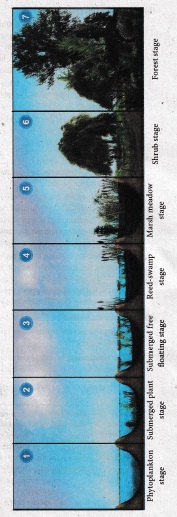
(ii) Succession in a pond, begins with colonization of the pioneer's like phytoplankton and finally ends with the formation of climax community like forest stage. It includes the following stages
(a) Phytoplankton stage
It is the first stage of succession consisting of the pioneer Community like blue green algae, green algae, diatoms, bacteria, etc.,
The colonization of these organisms enrich the amount of organic matter and nutrients of pond due to their life activities and death.
This favors the development of the next several stages
(b) Submerged plant stage
As the result of death and decomposition of planktons, silt brought from land by rain water, lead to a loose mud formation at the bottom of the pond. Hence, the rooted submerged hydrophytes begin to appear on the new substratum.
Example: Chara, Utricularia, Vallisneria and Hydrilla etc.
The death and decay of these plants will build up the substratum of pond to become shallow. Therefore, this habitat now replaces another group of plants which are of floating type.
(c) Submerged free floating stage
During this stage, the depth of the pond will become almost 2-5 feet
Hence, the rooted hydrophytic plants and with floating large leaves start colonising the pond.
Example: Rooted floating plants like Nelumbo, Nymphaea and Trapa. Some free floating species like Azolla, Lemna, Wolffia and Pistia are also present in this stage.
By death and decomposition of these plants, further the pond becomes more shallow.
Due to this reason, floating plant species is gradually replaced by another species which makes new several stage.
(d) Reed-swamp stage
It is also called an amphibious stage.
During this stage, rooted floating plants are replaced by plants which can live successfully in aquatic as well as aerial environment.
Example: Typha, Phragmites, Sagittaria and Scirpus etc. At the end of this stage, water level is very much reduced, making it unsuitable for the continuous growth of amphibious Plants.
(e) Marsh meadow stage
When the pond becomes swallowed due to decreasing water level
Species of Cyperaceae and Poaceae such as Carex, Iuncus, Cyperus and Eleocharis colonise the area
They form a mat-like vegetation with the help of their much branched root system.
This leads to an absorption and loss of large quantity of water
At the end of this stage, the soil becomes dry and the marshy vegetation disappears gradually and leads to shurb stage
(d) Shrub stage
As the disappearance of marshy vegetation continues, soil becomes dry.
Hence, these areas are now invaded by terrestrial plants like shrubs (Salix and Cornus) and trees (Populus and Alnus).
These plants absorb large quantity of water and make the habitat dry.
Further, the accumulation of humus with a rich flora of microorganisms produce minerals in the soil, ultimately favouring the arrival of new tree species in the area
(e) Forest stage
It is the climax community of hydrosere.
A variety of trees invade the area and develop any one of the diverse type of vegetation.
Example: Temperate mixed forest (Ulmus, Acer and Quercus), Tropical rain forest (Artocarpus and Cinnamomum) and Tropical deciduous forest (Bamboo and Tectona).
In the 7 stages of hydrosere succession, stage 1 is occupied by pioneer community, while the stage 7 is occupied by the climax community. The stages 2 to 6 are occupied by several communities,
41.
Grassland ecosystem : There is a gradual decrease in the number of organisms in each trophic level from producers to primary consumers and then to secondary consumers, and finally to tertiary consumers. Therefore pyramids of number in grassland ecosystem are always upright.
42.
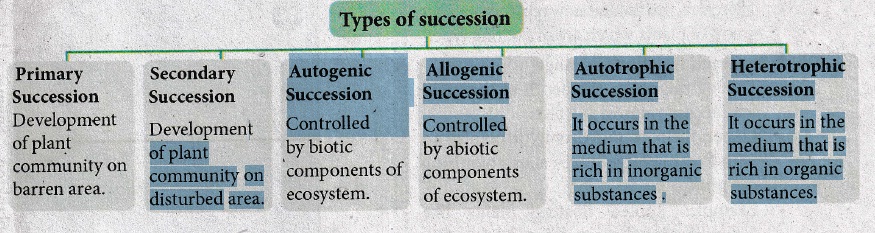
Types of succession
(a) Primary succession
The development of plant community in a barren area where no community existed before is called primary succession.
The plants which colonize first in a barren area is called pioneer species or primary community or primary colonies.
Generally, Primary succession takes a very, long time for the occurrence in any region.
Examples: Microbes, Lichen, Mosses.
The forest destroyed by fire and excessive lumbering may be re-occupied by herbs over period of times.
(b) Secondary succession
The development of a plant community in an area where an already developed community has been destroyed by some natural disturbance (Fire, flood, human activity) is known as secondary succession
Generally, this succession takes less time than the time taken for primary succession.
Example: The forest destroyed by fire and excessive lumbering may be re-occupied by herbs over Period of times.
(c) Autogenic succession
Autogenic succession occurs as a result of biotic factors
The vegetation reacts with its environment and modifies its own environment causing its own replacement by new communities. This is known as autogenic succession.
Example: In forest ecosystem, the larger trees produce broader leaves providing shade to the forest floor area. It affects the shrubs and herbs which require more light (heliophytes) but supports the shade tolerant species (sciophytes) to grow well.
(d) Allogenic succession
Allogeneic succession occurs as a result of abiotic factors.
The replacement of existing community is caused by other external factors (soil erosion, leaching, etc.,) and not by existing organisms.
Example: In a forest ecosystem soil erosion and leaching alter the nutrient value of the soil leading to the change of vegetation in that area.
(e) Autotrophic succession
If the autotrophic organisms like green plants are dominant during the early stages of succession it is called autotrophic succession, this occurs in the habitat which is rich in inorganic substances.
Since, green plants dominate in the beginning of this succession, there is a gradual increase in organic matter and subsequently the energy flow in the ecosystem.
(f) Heterotrophic succession
If heterotrophic organisms like bacteria, fungi, actinomycetes, and animals are dominant during the early stages of succession it is called heterotrophic succession.
Such a succession takes place in organic habitats.
Since heterotrophs dominate in the beginning of such succession, there will be a gradual decrease in the energy content.

12th Standard Syllabus & Materials
12th Standard
TN 12th Computer Applications களப்பெயர் முறைமை (DNS) Sample Question Papers Study Material - QB365 Set A
NEW12th Standard
TN 12th Computer Applications வலையமைப்பு எடுத்துக்காட்டுகள் மற்றும் நெறிமுறைகள் Sample Question Papers Study Material - QB365 Set A
NEW12th Standard
TN 12th Computer Applications கணினி வலையமைப்பு ஓர் அறிமுகம் Sample Question Papers Study Material - QB365 Set A
NEW12th Standard
TN 12th Computer Applications PHP-உடன் MySQL-ஐ இணைத்தல் Sample Question Papers Study Material - QB365 Set A



Tamilnadu Stateboard 12th Standard Subjects

Maths

Chemistry

Physics
Biology

Computer Science

Business Maths and Statistics

Economics

Commerce

Accountancy

History

Computer Applications
Biology
Computer Technology
Computer Applications
Computer Science
Business Maths and Statistics
Commerce
Economics
Maths
Chemistry
Physics
Computer Technology
History
Accountancy

Tamil

English

French
Tamilnadu Stateboard Standards

