
 100% FREE ACCESS
12th Standard Syllabus & Materials
12th Standard
TN 12th Computer Applications மின்னணு தரவு பரிமாற்றம் Sample Question Papers Study Material - QB365 Set A
NEW12th Standard
TN 12th Computer Applications மின் - வணிக பாதுகாப்பு அமைப்புகள் Sample Question Papers Study Material - QB365 Set A
NEW12th Standard
TN 12th Computer Applications மின்னணு செலுத்தல் முறைகள் Sample Question Papers Study Material - QB365 Set A
NEW12th Standard
TN 12th Computer Applications மின் - வணிகம் Sample Question Papers Study Material - QB365 Set A
NEW12th Standard
TN 12th Computer Applications திறந்த மூல கருத்துருக்கள் Sample Question Papers Study Material - QB365 Set A
NEW12th Standard
TN 12th Computer Applications வலையமைப்பு வடமிடல் Sample Question Papers Study Material - QB365 Set A

Published on: 29/09/2020
12th Standard Biology English Medium Important 3 Mark Book Back Questions (New Syllabus) 2020
Download Tamil Nadu 12th Standard Biology question papers, model tests, one-mark questions, important questions, and public exam papers in PDF format. Free study materials and answer keys for TN State Board students.
Questions + Answers key
Take MCQ Biology Test1.
Explain the best suited type followed by plant breeders at present?
2.
Why tRNA is called an adapter molecule?
3.
Define the term Diplospory
4.
What are the ways by which organisms respond to abiotic factors?
5.
Explain the basic concepts involved in plant tissue culture
6.
How does Mutation theory of De Vries differ from Lamarck and Darwin’s view in the origin of new species.
7.
Explain the mechanism of crossing over.
8.
9.
Explain the law of dominance in monohybrid cross.
10.
Differentiate between:
Autoimmune disease and Immunodeficiency disease
11.
If a person drinks a cup of coffee daily it will help him for his health. Is this correct? If it is correct, list out the benefits.
12.
How do sacred groves help in the conservation of biodiversity?
13.
Name of the food chain which is generally present in all type of ecosystem. Explain and write their significance.
14.
Mention any two significant roles of predation plays in nature.
15.
Mention the causes of enhanced use of ultraviolet radiation
16.
What are DNA vaccines?
17.
Why do we find a decrease in biodiversity distribution, if we move from the tropics towards the poles?
18.
Write the key features of organic farming.
19.
What are the strategies to be implemented in India to attain total reproductive health?
20.
What are restriction enzyme. Mention their type with role in Biotechnology.
21.
Give a schematic representation of spermatogenesis and oogenesis in humans.
22.
What is the composition of semen?
23.
What are the cells involved innate immune system.
24.
The unicellular organisms which reproduce by binary fission are considered immortal. Justify
1.
(i) Vegetative propagation is the best suited measure for maintaining hybrid vigour, since the desired characters are not lost and can persist over a Period of time.
(ii) Many breeders believe that its magnitude of heterosis is directly related to the degree of genetic diversity between the two parents.
2.
tRNA on one hand binds to specific amino acids and on the other hand reads the codon of the amino acid bound to it through its anticodon, it is called as adapter molecule.
3.
A diploid embryosac is formed from megaspore mother cell without a regular meiotic division
Example:
Eupatorium, Aerva
4.
Every living organism responds to its environment. There are various ways by which organisms respond to abiotic conditions. The types of response observed are:
Regulate:
1. Some organisms are able to maintain homeostasis by physiological means which ensures constant body temperature, ionic/ osmotic balance. Birds, mammals and a fewer lower vertebrate and invertebrate species are capable of such regulation.
Conform:
1. Most animals cannot maintain a constant internal environment.
2. Their body temperature changes with the ambient temperature.
3. In aquatic animals like fishes, the osmotic concentration of the body fluids changes with that of the ambient water osmotic concentration. Such animals are called conformers. In case of extreme condition, the inhabitants relocate themselves as in-migration
Migrate:
1. Organisms tend to move away temporarily from a stressful habitat to a new, hospitable area and return when the stressful period is over.
2. Birds migrate from Siberia to Vedanthangal in Tamilnadu to escape from the severe winter periods.
Suspend:
1. In certain conditions, if the organism is unable to migrate, it may avoid the stress by becoming inactive.
2. This is seen commonly in bears going into hibernation during winter.
3. Some snails and fish go into aestivation to avoid summer related problems like heat and desiccation.
4. Some lower animal suspend a certain phase of their life cycle which is to as diapause.
5.
Basic concepts of Tissue Culture
Basic concepts of plant tissue culture are totipotency, differentiation, dedifferentiation and redifferentiation.
Totipotency
The property of live plant cells that they have the genetic potential when cultured in nutrient medium to give rise to a complete individual plant.
Differentiation
The process of biochemical and structural changes by which cells become specialized in form and function.
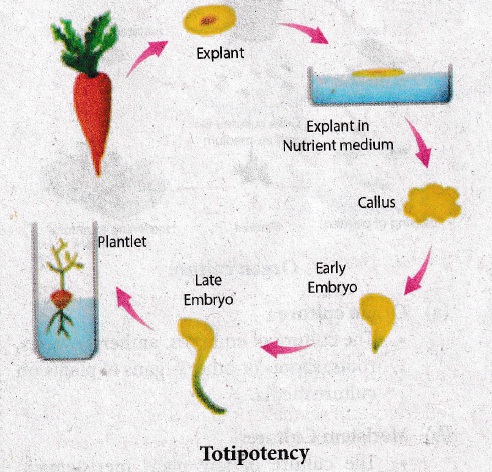
Redifferentiation
The further differentiation of already differentiated cell into another type of cell. For example, when the component cells of callus have the ability to form a whole plant in a nutrient medium, the phenomenon is called redifferentiation.
Dedifferentiation
The phenomenon of the reversion of mature cells to the meristematic state leading to the formation of callus is called dedifferentiation. These two phenomena of redifferentiation and dedifferentiation are the inherent capacities of living plant cells or tissue. This is described as totipotency.
6.
1. Hugo de Vries by his experiment suggest that variations is caused due to mutation among the genetic sequence of an individual.
2. Hugo de vries for the first time gave the term saltation which stands for huge mutation in a single step resulting in speciation.
3. Darwin during his voyage in H.M.S. Beagle he found that living organism share similar features existed from million of years.
4. Evolution is a sequential process that leads to betterment of life forms to cope with change in environment and that is passed to successive generation called as natural selection.
5. Mutation is a random process and direction which is not specific.
7.
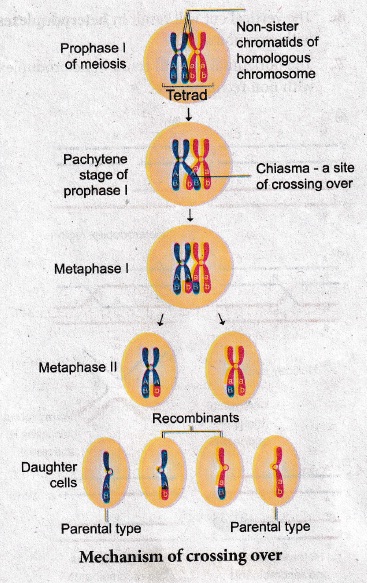
Crossing over is a process that includes four stages.
1. Synapsis
(i) Pairing between two homologous chromosomes is initiated during sub stage zygotene stage of prophase I of meiosis I
(ii) Homologous chromosomes are aligned side by side resulting in the formation of bivalents. It also occurs in zygotene sub-stage of prophase I of meiosis I tetrads.This pairing phenomenon is called synapsis.
2.Tetrad Formation
(i) Each homologous chromosome of a bivalent begin to form two identical sister chromatids.
(ii) They remain held together by a centromere at this stage each bivalent has four chromatids. This stage is called tetrad stage.
3. Cross Over
After tetrad formation, crossing over occurs in pachytene stage.
The non-sister chromatids of homologous pair make a contact at one or more points. These points of contact are called Chiasmata.
At chiasma, X-shaped structures are formed, where breaking and rejoining of two chromatids occur. This results in reciprocal exchange of equal and corresponding segments between them synapsis and chiasma formation are facilitated by protein filaments called synaptonemal complex.
4. Terminalisation
After crossing over, chiasma starts to move towards the terminal end of chromatids known as terminalisation. As a result, complete separation of homologous chromosomes occurs.
8.
9.
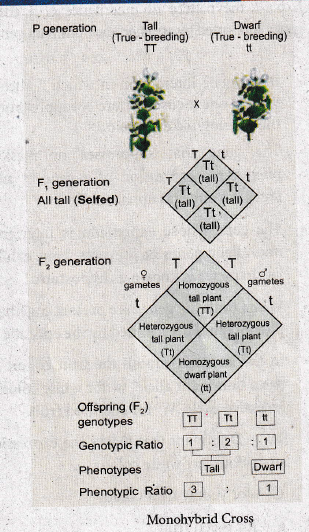
Law of Dominance: The characters were controlled by discrete units called factors which occur in pairs. In a dissimilar pair of factors one member of the pair is dominant & the other is recessive.
(i) This law gives an explanation to the monohybrid cross.
(a) the expression of only one of the parental characters in F1 generation.
(b) the expression of both in the F2 generation
(ii) It also explains the proportion of 3:1 obtained at the F2
Monohybrid Cross
(i) Monohybrid inheritance is the inheritance of a single character i. e, plant height.
(ii) It involves the inheritance of two alleles of a single gene.
(iii) When the F1 generation was selfed Mendel noticed that 7847 of 1064 F2 plants were tall, while 277of 1064 were dwarf.
(iv) When tall pea plants were pollinated with the pollens from a true breeding dwarf plants, the result was all tall plants.
(v) Dwarf trait appears in the F2 generation.
(vi) When the parental types were reversed, the result was the same - All tall plants.
(vii) Tall (♀) \(\times\) Dwarf (♂) and Tall (♂) \(\times\) Dwarf (♀) mating's are done in both ways.
(viii) It was concluded that the trait is not sex dependent.
(xi) The gene for plant height has two alleles: Tall (T) \(\times\) Dwarf (t). (TT, Tt, Tt: tt)
10.
| S.No | Autoimmune disease | Immunodeficiency disease |
| i. | If the immune system of the body fails to distinguish foreign molecules from self, then it reacts destructively against the host's own molecules. This is known as autoimmune disease. |
An immunodeficiency disease results from the failure of one or more components of the immune system which could be due to genetic reasons, radiation, infections etc., |
| ii. | Eg: Multiple sclerosis is a autoimmune disease | Eg: AIDS is a Immunodeficiency disease. |
11.
Caffeine present in the coffee enhances acetylcholine in brain - Iower the incidence of fatty liver diseases, cirrhosis and cancer reduce the risk of type 2 diabetes.
12.
(i) They help for detailed floristic and faunistic studies
(ii) These groves provide a number of ecosystem services to the neighborhood like protecting watershed, fodder, medicinal plants and microclimate control
13.
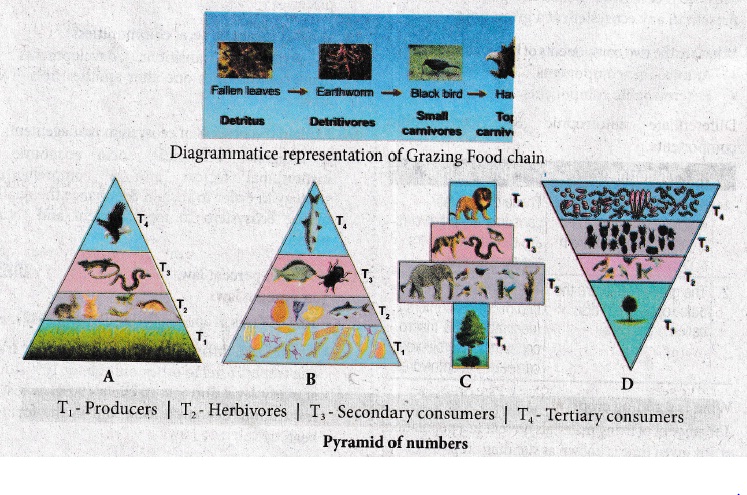
Detritus food chain
(i) This type of food chain begins with dead organic matter which is an important source of energy.
(ii) A large amount of organic matter is derived from the dead plants, animals and their excreta.
(iii) This type of food chain is present in all ecosystems
(iv) The transfer of energy from the dead organic matter is transferred through a series of organisms called detritus consumers. (detrivores)-Small carnivores -large (top) carnivores with repeated eating and being eaten respectively.
14.
1. Many herbivores are predators. Cattles, camels, goats etc., frequently browse on the tender shoots of herbs, shrubs and trees. Generally annuals suffer more than the perennials. Grazing and browsing may cause remarkable changes in vegetation. Nearly 25 percent of all insects are known as phytophagous (feeds on plant sap and other Parts of Plant).
2. Many defense mechanisms are evolved to avoid their predations by plants. Examples: Calotropis produces highly poisonous cardiac glycosides, tobacco produces nicotine, coffee plants produce caffeine, Cinchona plant produces quinine. Thorns of Bougainvillea, spines of Opuntia, and latex of cacti also protect them from Predators.
15.
Effects: UV rays may penetrate deep into the skin and can lead to premature skin aging and wrinkling of skin; suppression of the immune system, skin cancer (melanoma) and chronic effects leading to eye damage. DNA damage can result from free radicals and reactive oxygen and photons can damage the DNA itself.
16.
(i) Genetic immunization by using DNA vaccines is a novel approach that came into being in 1990.
(ii) The immune response of the body is stimulated by a DNA molecule.
(iii) A DNA vaccine consists of a gene encoding an antigen protein, inserted on to a plasmid, and then incorporated into the cells in a target animal.
(iv) DNA instructs the cells to make antigenic molecules which are displayed on its surfaces. This would evoke an antibody response to the free floating antigen secreted by the cells.
(v) The DNA vaccine cannot cause the disease as it contains only copies of a few of its genes.
(vi) DNA vaccines are relatively easy and inexpensive to design and produce.
(vii) Vaccines produced by these new techniques have definite advantages like producing target proteins, long lasting immunity and trigger immune response only against specific pathogens with less toxic effects.
17.
The term biodiversity was introduced by Walter Rosen (1986). Biodiversity is the assemblage of different life forms. Each species is adapted to live in its specific environments.
The changes in climatic conditions are reflected in the distribution and pattern of biodiversity on our planet. The number of species per unit area declines as we move from tropics towards the poles. The Tundra and Taiga of northern Canada, Alaska, northern Europe and Russia possess less than 12 species of trees. The temperate forests of the United states have 20-35 species of trees, while the tropical forests of Panama have over 110 species of trees in a relatively small area.
18.
(i) Protecting soil quality using organic materials and encouraging biological activity.
(ii) Indirect provision of crop nutrients using soil microorganisms.
(iii) Nitrogen fixation in soils using legumes.
(iv) Weed and pest control based on methods like crop rotation, biological diversity, natural predators, organic manures and suitable chemical, thermal and biological interventions.
19.
(i) Creating awareness and providing medical assistance to build a healthy society.
(ii) Introducing sex education in schools to provide information about adolescence and adolescence related changes.
(iii) Educating couples and those in the marriageable age groups about the available birth control methods and family planning norms.
20.
A restriction enzyme or restriction endonuclease is an enzyme that cleaves DNA into fragments at or near specific recognition sites within the molecule known as restriction sites.
Types
(i) Exonucleases - which remove nucleotides one at a time from the end of a DNA molecule. e.g. Bal 31, Exonuclease III.
(ii) Endonucleases - which break the internal phosphodiester bonds within a DNA molecule. e.g. Hind II, EcoRI, PvulI, BamHI, TaqI.
(iii) The restriction enzymes are called as molecular scissors
(iv) They are used in recombinant DNA technology as they recognize & cut DNA within a specific sequence.
21.
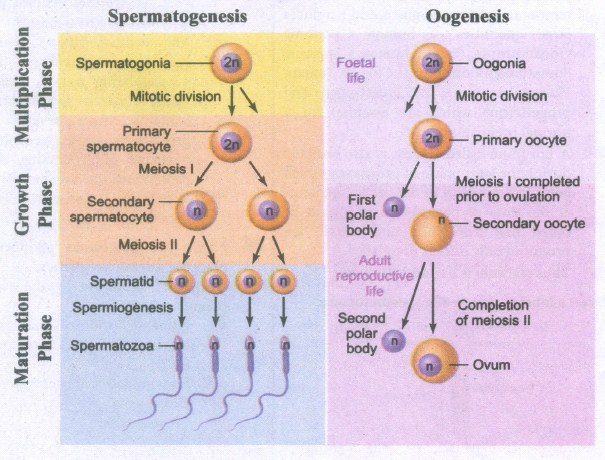
22.
Semen or seminal fluid is a milky white fluid which contains sperms and the seminal plasma, which is secreted from the seminal vesicles, prostate glands and bulbo urethal glands or Cowper's gland.
The semen comprises of Fructose, ascorbic acid, zinc, cholesterol, protein, calcium, chlorine, blood group antigens, citric acid, DNA, magnesium, Vitamin B12, phosphorous, sodium, potassium, uric acid,lactic acid, nitrogen, and other nutrients for the sperms.
23.
(i) Certain types of leukocytes (WBCs), such as polymorphonuclear leucocytes (PMNL), neutrophils, monocytes, and natural killer cells [NK cells] (a type of lymphocytes) in the blood as well as macrophages in tissues can phagocytose and destroy microbes
(ii) Besides the phagocytes there are natural killer cells (NK cells) in the body which kills virus infected and some tumor cells.
(iii) These cells are categorized under the cellular barriers.
24.
1. In unicellular organism there is no special structure for reproduction.
2. In binary fission the entire parent body constitute the reproductive unit and disappears when its division into two daughter unicellular cell is completed.
3. These two daughter cells function as two new individuals.
4. There is no remains of parent body cell and parent cannot be said to have died.
5. In fact after binary fission parent continues living as two daughter individual.
Hence, the unicellular organisms which undergo binary fission are called immortal (no natural death).

12th Standard Syllabus & Materials
12th Standard
TN 12th Computer Applications களப்பெயர் முறைமை (DNS) Sample Question Papers Study Material - QB365 Set A
NEW12th Standard
TN 12th Computer Applications வலையமைப்பு எடுத்துக்காட்டுகள் மற்றும் நெறிமுறைகள் Sample Question Papers Study Material - QB365 Set A
NEW12th Standard
TN 12th Computer Applications கணினி வலையமைப்பு ஓர் அறிமுகம் Sample Question Papers Study Material - QB365 Set A
NEW12th Standard
TN 12th Computer Applications PHP-உடன் MySQL-ஐ இணைத்தல் Sample Question Papers Study Material - QB365 Set A



Tamilnadu Stateboard 12th Standard Subjects

Maths

Chemistry

Physics
Biology

Computer Science

Business Maths and Statistics

Economics

Commerce

Accountancy

History

Computer Applications
Biology
Computer Technology
Computer Applications
Computer Science
Business Maths and Statistics
Commerce
Economics
Maths
Chemistry
Physics
Computer Technology
History
Accountancy

Tamil

English

French
Tamilnadu Stateboard Standards

