
 100% FREE ACCESS
12th Standard Syllabus & Materials
12th Standard
TN 12th Computer Applications மின்னணு தரவு பரிமாற்றம் Sample Question Papers Study Material - QB365 Set A
NEW12th Standard
TN 12th Computer Applications மின் - வணிக பாதுகாப்பு அமைப்புகள் Sample Question Papers Study Material - QB365 Set A
NEW12th Standard
TN 12th Computer Applications மின்னணு செலுத்தல் முறைகள் Sample Question Papers Study Material - QB365 Set A
NEW12th Standard
TN 12th Computer Applications மின் - வணிகம் Sample Question Papers Study Material - QB365 Set A
NEW12th Standard
TN 12th Computer Applications திறந்த மூல கருத்துருக்கள் Sample Question Papers Study Material - QB365 Set A
NEW12th Standard
TN 12th Computer Applications வலையமைப்பு வடமிடல் Sample Question Papers Study Material - QB365 Set A

Published on: 29/09/2020
12th Standard Biology English Medium Important 5 Mark Book Back Questions (New Syllabus 2020)
Download Tamil Nadu 12th Standard Biology question papers, model tests, one-mark questions, important questions, and public exam papers in PDF format. Free study materials and answer keys for TN State Board students.
Questions + Answers key
Take MCQ Biology Test1.
What is vaccine? What are its types?
2.
3.
4.
Draw a pyramid from following details and explain in brief.
Quantities of organisms are given-Hawks - 50, plants - 1000.rabbit and mouse - 250 + 250, pythons and lizard - 100 + 50 respectively.
5.
6.
What is the primary purpose of the Kyoto Protocol?
7.
Mention any three similarities found common in Neanderthal man and Homo sapiens.
8.
9.
How is the two stage process of protein synthesis advantageous?
10.
Discuss the genic balance mechanism of sex determination with reference to Drosophila.
11.
12.
Differentiate between the following:
(a) Binary fission in amoeba and multiple fission in Plasmodium
(b) Budding in yeast and budding in Hydra
(c) Regeneration in lizard and Planaria
13.
14.
15.
16.
Describe Population Age Distribution
17.
Alien species invasion is a threat to endemic species – substantiate this statement.
18.
When does antibiotic resistance develop?
19.
What do you know about Germplasm conservation. Describe it.
20.
Amniocentesis, the foetal sex determination test, is banned in our country, Is it necessary? Comment.
21.
Explain the role of oxytocin and relaxin in parturition and lactation.
22.
A patient was hospitalized with fever and chills. Merozoites were observed in her blood. What is your diagnosis?
1.
A vaccine is a biological preparation that provides active acquired immunity to a particular disease and resembles a diseasecausing microorganism and is often made from weakened or atlenuated or killed forms of the microbes, their toxins, or one of its surface proteins. The vaccines are classified as first, second and third generation vaccines.
2.
3.
4.
Grassland ecosystem : There is a gradual decrease in the number of organisms in each trophic level from producers to primary consumers and then to secondary consumers, and finally to tertiary consumers. Therefore pyramids of number in grassland ecosystem are always upright.
5.
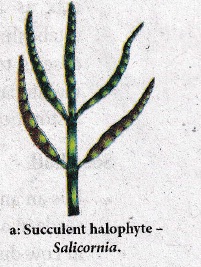
6.
The main goal of the Kyoto protocol is to control emissions of the main Anthropogenic (human-emitted) greenhouse gases (GHGs) in ways that reflect underlying national difference in GHG emission, wealth and capacity to make the reductions.
7.
Similarities found in Neanderthal man and Homo sapiens.
(i) They knew to protect their bodies. Neanderthal man used animal hides to protect their bodies.
(ii) They knew the use of fire.
(iii) They buried their dead.
8.
9.
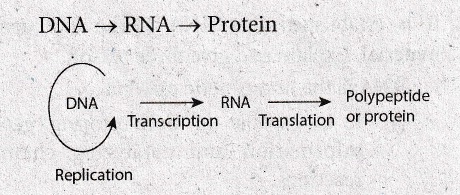
1. The process protein synthesis actually consists of two stages-transcription and translation.
2. In eukaryotic cells, transcription takes place in the nucleus. During transcription, DNA is used as a template to make a molecule of messenger RNA (mRNA). The molecule of mRNA then leaves the nucleus and reaches ribosome in the cytoplasm, where translation occurs.
3. During translation, the genetic code in mRNA is read and used to make a protein.
4. These two processes are summedup by the central dogma of molecular biology
10.
(i) Genic balance mechanisms of sex determination in Drosophila was first studied by C. B. Bridges.
(ii) In Drosophila, the presence of Y chromosome is essential for the fertility of male sex, but does not determine the male sex.
(iii) The gene for femaleness is located on the X chromosome and those for maleness are located on the autosomes.
(iv) When geneticist C. B. Bridges, working with Drosophila, crossed a triploid (3n) female with a normal male, he observed many combinations of autosomes and sex chromosomes in the offspring.
(v) He suggested that sex In Drosophila is determined by the balance between the genes for femaleness located on the 'X' chromosomes and those for maleness located on the 'autosomes". Hence the sex of an individual is determined by the ratio of its X chromosome to that of its autosome sets. This ratio is termed sex index and is expressed as:
\(Sex \ index=\frac { Number \ of \ X \ Chromosomes }{ Number \ of \ Y \ Chromosomes } \left( \cfrac { X }{ A } \right) \)
(vi) Change in this ratio leads to a changed sex phenotype. The results obtained from a cross between triploid female Drosophila (3A:3X) with a diploid male (2A: XY) is shown in below.
(vii) Bridges classical cross of a triploid (3A+XXX) female fly and a diploid (2A+XY) male fly ♀ ♂
Triploid ♀ Diploid ♂
Parent 3A + XXX 2A + XY
Gametes (2A + XX) (A + X) (A + X) (A + Y)
(2A +X) (A+XX)
| A + X | A + Y | |
|---|---|---|
| 2A + XX | 3A + XXX Triploid Female |
3A + XXY Triploid Intersex |
| 2A + X | 3A + XX Triploid Intersex |
3A + XY Super Male |
| A + XX | 2A + XXX Super female |
2A+ XXY Diploid Female |
| A + X | 2A + XX Diploid Female |
2A + XY Diploid Male |
Different doses of X chromosomes and autosome sets and their effect in sex determination in Drosphild
| Phenotype | Number of 'X' Chromosomes (X) |
Number of Autosome sets (A) |
\(Sex \ Index=\frac { Number \ of \ X \ Chromosomes }{ Number \ of \ autosome \ sets } \) | |
|---|---|---|---|---|
| Metafemale/ Super female | 3 | 2 | 3/2 = 1.5 | |
| Normal Female | Teraploid | 4 | 4 | 4/4 = 1.0 |
| Triploid | 3 | 3 | 3/3 = 1.0 | |
| Diploid | 2 | 2 | 2/2 = 1.0 | |
| Haploid | 1 | 1 | 1/1 = 1.0 | |
| Inter sex | 2 | 3 | 2/3 = 0.67 | |
| Normal male | 1 | 2 | 1/2 = 0.50 | |
| Meta male / super male | 1 | 3 | 1/3 = 0.53 | |
A sex-switch gene in Drosophila directs female development. This gene, Sex-lethal (SxL) located on the X chromosome, has two states of activity. When it is 'on' it directs female development and when it is 'off' maleness ensures. Other genes located on the X chromosome and autosomes regulate this sex-switch gene. However, the Y- chromosome of Drosophila is required for male fertility.
11.
12.
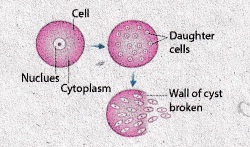
(a)
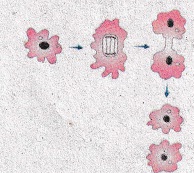
| Binary Fission in Amoeba | Multiple fission in Plasmodium |
| lt results in the production of two individuals from a single parent. | It results in the production of several individuals |
| lt occurs under favourable conditions | It occurs both under favourable and unfavourable conditions |
| Nucleus of the parent cell divides only once to form two daughter nuclei | Nucleus of the parent cell undergoes repeated divisions to form a number of daughter nuclei |
| Cytoplasm divides after nuclear division | Cytoplasm does not divide after each nuclear division but divides during favourable condition |
| No part of parent body is left unused (e,g: Amoeba) | A part of the body (covering and residuai cytoplasm) is left unused. (e,g: Paramecium) |
 |
 |
(b) Budding in yeast and budding in hydra
| Budding in Yeast | Budding in Hydra |
| During budding the cell wall of the parent cell bulges out in the form of an out growth as bud | During budding the ectoderm cells increase and form a small elevation on the body surface as bud. |
| The parent nucleus divides into two daughter nuclei one of which migrates into bud. | Ectoderm and endoderm are pushed out to form the bud. The bud contains an interior lumen in continuation with parent's gastro vascular cavity (coelenteron) |
| As the bud enlarges and is fully formed, it is separated from the parentcell and grows into mature yeast. Sometimes a bud may produce another bud over it which is still attached to parent cell forming a false mycelium (or) pseudomycelium | The bud enlarges, develops a mouth and a circle of tentacles at its free end. When fully grown, the bud constricts at the base and finally separates from the parent body and leads an independent life |
(c) Regeneration is regrowth in the injured region
| Regeneration in Lizard | Regeneration in Planaria |
| This type of regeneration comes under epimorphosis type. | This type of regeneration comes under morphallaxis type |
| Several body parts can develop. | When the body is cut into several pieces, each piece can regenerate the lost parts and develops into a whole individual |
13.
14.
15.
16.
(i) The proportion of the age groups in a population is its age distribution attribute.
(ii) This determines the reproductive status of the population at the given time and is an indicator of the future population size.
(iii) Usually a rapidly growing population will have larger proportion of young individuals.
(iv) A stable population will have an even distribution of various age classes.
(v) A declining population tends to have a larger proportion of older individuals
17.
(i) The introduction of the Nile Perch into Lake Victoria led to the extinction of more than 200 species of cichlid fish in that lake.
(ii) Introduction of African catfish Clarias gariepinus for aquaculture poses a threat to the indigenous catfishes in indian rivers.
18.
(i) Antibiotic resistance occurs when bacteria develop the ability to defeat the drug designed to kill or inhibit their growth.
(ii) It is one of the most acute threats to public health.
(iii) Antibiotic resistance is accelerated by the misuse and overuse of antibiotics, as well as poor infection prevention control.
(iv) Antibiotics should be used only when prescribed by a certified health professional. When the bacteria become resistant, antibiotics cannot fight against them and the bacteria multiply.
(v) Narrow spectrum antibiotics are preferred over broad spectrum antibiotics. They effectively and accurately target specific pathogenic organisms and are less likely to cause resistance.
(vi) "Superbug" is a term used to describe strains of bacteria that are resistant to the majority of antibiotics commonly used today.
19.
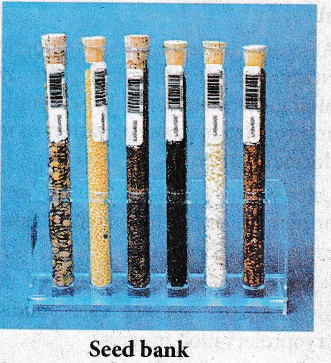
Germplasm Conservation
1. Germplasm conservation refers to the conservation of living genetic resources like pollen, seeds or tissue of plant material maintained for the purpose of selective plant breeding, preservation in live condition and used for many research works.
2. Germplasm conservation resources is a part of collection of seeds and pollen that are stored in seed or pollen banks, so as to maintain their viability and fertility for any later use such as hybridization and crop improvement.
3. Germplasm conservation may also involve a gene bank, DNA bank of elite breeding lines of plant resources for the maintenance of biological diversity and also for food security.
20.
1. Amniocentesis is the pre-natal diagnostic technique in which a sample of amniotic fluid from the womb of a pregnant woman is taken during early stages of embryonic development and the cells are cultured and analysed synthetically.
2. Any chromosomal disorder or a metabolic error can be detected and if necessary MTP can be advised.
3. But this technique is misused for knowing the sex of the foetus followed by female foeticide.
4. Female foeticide refers to aborting the female in the mother's womb.
5. In order to prevent female foeticide and infanticide, Government of India has taken various steps like PCPNDT Act .(preconception and prenatal diagnostic technique act-1994) enacted to ban the identification of sex and to prevent the use of prenatal diagnostic techniques for selective abortion.
21.
Relaxin
(i) It is a hormone secreted by the placenta and also by the corpus luteum during pregnancy.
(ii) It promotes parturition by relaxing the pelvic joints and by dilation of cervical ligaments with continued powerful contractions.
Oxytocin:
(i) It causes the "Let-Down" reflex.
(ii) The actual ejection of milk from the alveoli of the mammary glands.
(iii) During lactation, oxytocin also stimulates the recently emptied uterus to contract, helping it to return to pre-pregnancy size..
22.
Blood cells (RBC) get infected :
(i) Atoxin hemozoin and eiythrocytic debris into the blood stream resulting in malarial paroxysms-shivering chills, high fever followed by sweating.
(ii) Fever and chills are caused partly by malarial toxins that induce macrophages to release tumour necrosis factor (TNF\(\alpha\)) and interleukin.

12th Standard Syllabus & Materials
12th Standard
TN 12th Computer Applications களப்பெயர் முறைமை (DNS) Sample Question Papers Study Material - QB365 Set A
NEW12th Standard
TN 12th Computer Applications வலையமைப்பு எடுத்துக்காட்டுகள் மற்றும் நெறிமுறைகள் Sample Question Papers Study Material - QB365 Set A
NEW12th Standard
TN 12th Computer Applications கணினி வலையமைப்பு ஓர் அறிமுகம் Sample Question Papers Study Material - QB365 Set A
NEW12th Standard
TN 12th Computer Applications PHP-உடன் MySQL-ஐ இணைத்தல் Sample Question Papers Study Material - QB365 Set A



Tamilnadu Stateboard 12th Standard Subjects

Maths

Chemistry

Physics
Biology

Computer Science

Business Maths and Statistics

Economics

Commerce

Accountancy

History

Computer Applications
Biology
Computer Technology
Computer Applications
Computer Science
Business Maths and Statistics
Commerce
Economics
Maths
Chemistry
Physics
Computer Technology
History
Accountancy

Tamil

English

French
Tamilnadu Stateboard Standards

