
 100% FREE ACCESS
12th Standard Syllabus & Materials
12th Standard
TN 12th Maths Applications of Matrices and Determinants Sample Question Papers Study Material - QB365 Set A
NEW12th Standard
TN 12th Computer Applications மின்னணு தரவு பரிமாற்றம் Sample Question Papers Study Material - QB365 Set A
NEW12th Standard
TN 12th Computer Applications மின் - வணிக பாதுகாப்பு அமைப்புகள் Sample Question Papers Study Material - QB365 Set A
NEW12th Standard
TN 12th Computer Applications மின்னணு செலுத்தல் முறைகள் Sample Question Papers Study Material - QB365 Set A
NEW12th Standard
TN 12th Computer Applications மின் - வணிகம் Sample Question Papers Study Material - QB365 Set A
NEW12th Standard
TN 12th Computer Applications திறந்த மூல கருத்துருக்கள் Sample Question Papers Study Material - QB365 Set A

Published on: 29/09/2020
12th Standard Biology English Medium Important 5 Mark Creative Questions (New Syllabus 2020)
Download Tamil Nadu 12th Standard Biology question papers, model tests, one-mark questions, important questions, and public exam papers in PDF format. Free study materials and answer keys for TN State Board students.
Questions + Answers key
Take MCQ Biology Test1.
Give a detailed account of a transcription unit.
2.
Point out the effects of Noise pollution
3.
Describe the stages of Sewage treatment process
4.
Describe the structure of lymph node with a labeled diagram
5.
Explain Agarose Gel electrophoresis technique.
6.
Describe incomplete dominance exhibited by Mirabilis jalapa.
7.
Give the characteristic features of Anemophilous plants.
8.
Write a note on the strategies of ecosystem management.
9.
Point out any five morphological adaptations of epiphytes.
10.
Enumerate the advantages of Artificial seeds.
11.
Give a comparative account on Seaweed liquid fertilizer.
12.
Draw a table mentioning binominals, family name, useful part and their medical uses of any five local medicinal plants
13.
Explain about the objections to Darwinism.
14.
Write the general strategies in conservation?
15.
What is infertility and write its causes.
16.
List the differences between R selected and K selected species.
17.
Write a note a extra embryonic membranes.
18.
Explain the creation of Dolly
19.
Explain the events in life cycle of plasmodium in the secondary host/Man
20.
List the salient features of genetic code.
21.
Write notes on binary fission in animals.
22.
Write a note on different types of antigen antibody reactions.
23.
Write a note on allosomal chromosomal abnormalities.
24.
List out the significance of ploidy.
25.
Write short notes on Bio-monitoring.
1.
A transcriptional unit in DNA is defined by three regions, a promoter, the structural gene, and a terminator. The promoter is located towards the 5' end. It is a DNA sequence that provides binding site for RNA polymerase. The presence of promoter in a transcription unit defines the template and coding strands. The terminator region located towards the 3' end of the coding strand contains a DNA sequence that causes the RNA polymerase to stop transcribing. In eukaryotes the promoter has AT-rich regions called TATA box (Goldberg- Rogness box) and in prokaryotes, this region is called Pribnow box. Besides promoter, eukaryotes also require an enhancer. The two strands of the DNA in the structural gene of a transcription unit have opposite polarity. DNA dependent RNA polymerase catalyses the polymerization in only one direction, the strand that has the polarity 3'\(\rightarrow\)5' acts as a template, and is called the template strand. The other strand which has the polarity 5'\(\rightarrow\)3' has a sequence same as RNA (except thymine instead of uracil) and is displaced during transcription. This strand is called coding strand.
The structural gene may be monocistronic (eukaryotes) or polycistronic (prokaryotes). In eukaryotes, each mRNA carries only a single gene and encodes information for only a single protein and is called monocistronic mRNA. In prokaryotes, clusters of related genes, known as operon, often found next to each other on the chromosome are transcribed together to give a single mRNA and hence are polycistronic.
2.
1. According to the USEPA (United States Environmental Protection Agency) there are direct links between noise and health. Heart disease, high blood pressure, stress related illness, sleep disruption, hearing loss (deafness), and productivity loss are the problems related to noise pollution.
2. Increased stress and tension, nervousness, irritability, anxiety, depression and panic attacks.
3. Peptic ulcer, severe head ache and memory loss.
4. Marine animals are affected by noise-pollution from offshore activities and port activities.
5. Fire crackers frighten animals. Birds are often affected by increased air traffic.
3.
Sewage treatment is usually performed in the following three stages
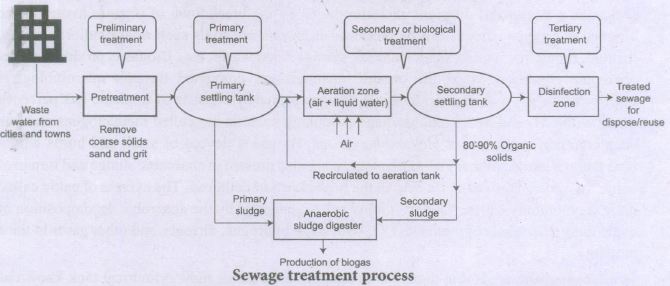
Primary treatment: Primary treatment involves the physical removal of solid and particulate organic and inorganic materials from the sewage through filtration and sedimentation. Floating debris is removed by sequential filtration. Then the grit (soil and small pebbles) are removed by sedimentation. All solids that settle form the primary sludge and the supernatant forms the effluent. The effluent from the primary settling tank is taken for secondary treatment.
Secondary treatment or biological treatment: The primary effluent is passed into large aeration tanks where it is constantly agitated mechanically and air is pumped into it. This allows vigorous growth of useful aerobic microbes into floc (masses of bacteria associated with fungal filaments to form mesh like structures). While growing, these microbes consume the major part of the organic matter in the effluent. This significantly reduces the BOD (Biochemical oxygen demand or Biological oxygen demand). BOD refers to the amount of the oxygen that would be consumed, if all the organic matter in one litre of water were oxidized by bacteria. The sewage water is treated till the BOD is reduced. The greater the BOD of the waste water more is its polluting potential. Once the BOD of sewage water is reduced significantly, the effluent is then passed into a settling tank where the bacterial "floes" are allowed to sediment. This sediment is called activated sludge. A small part of activated sludge is pumped back into the aeration tank to serve as the inoculum. The remaining major part of the sludge is pumped into large tanks called anaerobic sludge digesters. Here, the bacteria which grow anaerobically, digest the bacteria and the fungi in the sludge. During this digestion, bacteria produce a mixture of gases such as methane, hydrogen sulphide and CO2. These gases form biogas and can be used as a source of energy.
Tertiary treatment: Tertiary treatment is the final process that improves the quality of the waste water before it is reused, recycled or released into natural water bodies. This treatment removes the remaining inorganic compounds and substances, such as nitrogen and phosphorus. UV is an ideal disinfectant for wastewater since it does not alter the water quality - except for inactivating microorganisms. UV is a chemical free process that can completely replace the existing chlorination system and also inactivates chlorine-resistant microorganisms like Cryptosporidium and Giardia.
4.
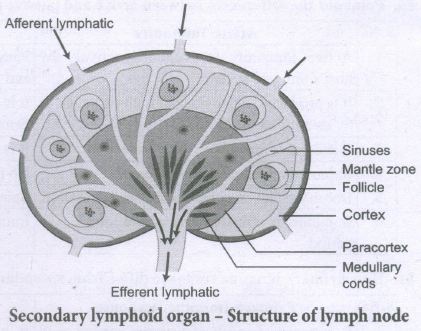
Lymph node has three zones. They are the cortex, paracortex, and medulla. The outer most layer of the lymph node is called cortex, which consists of B-lymphocytes, macrophages, and follicular dendritic cells. The paracortex zone is beneath the cortex, which is richly populated by T lymphocytes and interdigitating dendritic cells. The innermost zone is called the medulla which is sparsely populated by lymphocytes, but many of them are plasma cells, which actively secrete antibody molecules. As the lymph enters, it slowly percolates through the cortex, paracortex, and medulla, giving sufficient chance for the phagocytic cells and dendritic cells to trap the antigen brought by the lymph. The lymph leaving a node carries enriched antibodies secreted by the medullary plasma cells against the antigens that enter the lymph node. Sometimes visible swelling of lymph nodes occurs due to active immune response and increased the concentration of lymphocytes. Thus swollen lymph nodes may signal an infection. There are several groups of lymph nodes. The most frequently enlarged lymph nodes are found in the neck, under the chin, in the armpits, and in the groin.
5.
Agarose Gel Electrophoresis is used mainly for the purification of specific DNA fragments. Agarose is convenient for separating DNA fragments ranging in size from a few hundred to about 20000 base pairs. Polyacrylamide is preferred for the purification of smaller DNA fragments. The gel is complex network of polymeric molecules. DNA molecule is negatively charged molecule - under an electric field DNA molecule migrates through the gel. The electrophoresis is frequently performed with marker DNA fragments of known size which allow accurate size determination of an unknown DNA molecule by interpolation. The advantages of agarose gel electrophoresis are that the DNA bands can be readily detected at high sensitivity. The bands of DNA in the gel are stained with the dye Ethidium Bromide and DNA can be detected as visible fluorescence illuminated in UV light will give orange fluorescence, which can be photographed.
6.
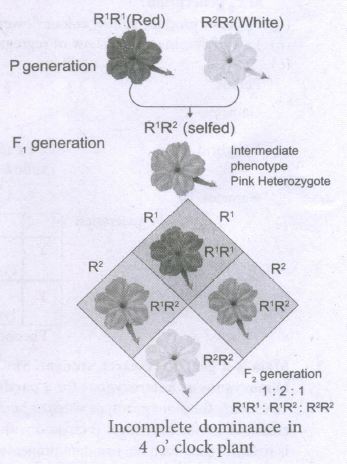
The German Botanist Carl Correns's (1905) Experiment - In 4 0' clock plant, Mirabilis jalapa when the pure breeding homozygous red (R1 R1) parent is crossed with homozygous white (R 2R2), the phenotype of the F1 hybrid is heterozygous pink (R1R2). The F1 heterozygous phenotype differs from both the parental homozygous phenotype. This cross did not exhibit the character of the dominant parent but an intermediate colour pink. When one allele is not completely dominant to another allele it shows incomplete dominance. Such allelic interaction is known as incomplete dominance. F1 generation produces intermediate phenotype pink coloured flower.
When pink coloured plants of F 1 generation were interbred in F2 both phenotypic and genotypic ratios were found to be identical as 1 : 2 : 1(1 red: 2 pink: 1 white). Genotypic ratio is 1 R1R1 : 2 R1R2 : 1 R2R2. From this we conclude that the alleles themselves remain discrete and unaltered proving the Mendel's Law of Segregation. The phenotypic and genotypic ratios are the same. There is no blending of genes. In the F2 generation R1 and R2 genes segregate and recombine to produce red, pink and white in the ratio of 1 : 2 : 1. R 1 allele codes for an enzyme responsible for the formation of red pigment. R2 allele codes for defective enzyme. R1 and R2 genotypes produce only enough red pigments to make the flower pink. Two R1R1 are needed for producing red flowers. Two R2R2 genes are needed for white flowers. If blending had taken place, the original pure traits would not have appeared and all F2 plants would have pink flowers. It is very clear that Mendel's particulate inheritance takes place in this cross which is confirmed by the reappearance of original phenotype in F2.
7.
Anemophilous plants have the following characteristic features:
(i) The flowers are produced in pendulous, catkin-like or spike inflorescence.
(ii) The axis of inflorescence elongates so that the flowers are brought well above the leaves.
(iii) The perianth is absent or highly reduced.
(iv) The flowers are small, inconspicuous, colourless, not scented, do not secrete nectar.
(v) The stamens are numerous, filaments are long, exerted and versatile.
(vi) Anthers produce enormous quantities of pollen grains compared to a number of ovules available for pollination. They are minute, light and dry so that they can be carried to long distances by wind.
(vii) In some plants, anthers burst violently and release the pollen into the air. Example: Urtica.
(viii) Stigmas are comparatively large, protruding, sometimes branched and feathery, adapted to catch the pollen grains. Generally, a single ovule is present.
(ix) The plant produces flowers before the new leaves appear, so the pollen can be carried without hindrance of leaves.
8.
Strategy of ecosystem management
(I) It is used to maintain biodiversity of ecosystems.
(II) It helps in indicating the damaged ecosystem (Some species indicate the health of the ecosystem: such species are called a flagship species).
(III) It is used to recognize the inevitability of ecosystem change and plan accordingly.
(IV) It is one of the tools used for achieving sustainability of ecosystem through sustainable development programme (or projects).
(V) It is also helpful in identifying ecosystems which are in need of rehabilitation.
(VI) It involves collaborative management with government agencies, local population, communities and NGO's.
(VII) It is used to build the capacity of local institutions and community groups to assume responsibility for long term implementation of ecosystem management activities even after the completion of the project.
9.
Morphological adaptations:
Root system is extensively developed. These roots may be of two types. They are Clinging roots and Aerial roots.
Clinging roots fix the epiphytes firmly on the surface of the supporting objects.
Aerial roots are green coloured roots which may hang downwardly and absorb moisture from the atmosphere with the help of a spongy tissue called velamen.
1. Stem of some epiphytes are succulent and develop pseudo bulb or tuber.
2. Generally the leaves are lesser in number and may be fleshy and leathery.
3. Myrmecophily is a common occurrence in the epiphytic vegetation to prevent the predators
4. The fruits and seeds are very small and usually dispersed by wind, insects and birds.
10.
Advantages of Artificial seeds
Artificial seeds have many advantages over the true seeds as follows:
1. Millions of artificial seeds can be produced at any time at low cost.
2. They provide an easy method to produce genetically engineered plants with desirable traits.
3. It is easy to test the genotype of plants.
4. They can potentially stored for long time under cryopreservation method.
5. Artificial seeds produce identical plants .
6. The period of dormancy of artificial seeds is greatly reduced, hence growth is faster with a shortened life cycle.
11.
Seaweed liquid fertilizer (SLF) contains cytokinin, gibberellins, and auxin apart from macro and micro nutrients. Most seaweed-based fertilizers are made from kelp (brown algae) which grows to length of 150 metres. Liquid seaweed fertilizer is not only organic but also eco-friendly. The alginates in the seaweed that reacts with metals in the soil and form long, crosslinked polymers in the soil. These polymers improve the crumbing in the soil, swell up when they get wet and retain moisture for a long time. They are especially useful in organic gardening which provides carbohydrates for plants. Seaweed has more than 70 minerals, vitamins and enzymes. It promotes vigorous growth. Improves resistance of plants to frost and disease. Seeds soaked in seaweed extract germinate much rapidly and develop a better root system.
12.
| S.No | Common Name | Botanical Name | Family | Plant Part Used | Medicinal Uses |
| 1 | Holy basil | Ocimum Sanctum | Lamiaceae | Leaves and Roots | The leaves are stimulant, antiseptic, antihypertensive and anti-bacterial and expectorant used in bronchitis. Decoction of roots is given as a diaphoretic in malarial fever. |
| 2 | Indian Phyllanthus | Phyllanthus emblica | Phyllanthaceae | Fruit | It is a potent rejuvenator and immune modulator. It has a anti-ageing properties. It helps to promote longevity, enhance digestion, treat constipation and reduce fever and cough. |
| 3 | Indian Acalypha | Acalypha indica | Euphorbiaceae | Leaves | Used to cure skin diseases caused by ringworms. Powdered leaves are used to cure bedsores and infected wounds |
| 4 | Vilvam | Aegle marmelos | Rutaceae | Fruit | The unripe fruit is used to treat problems of stomach indigestion. It kills intestinal parasites. |
| 5 | Veldt grape | Cissus quandran-gularis | Vitaceae | Stem and Root | Paste obtained from the and powdered stem and root root of this plant is used in bone fractures. Whole plant is useful to treat asthma and stomach troubles. |
13.
Objections to Darwinism: Some objections raised against Darwinism were -
(i) Darwin failed to explain the mechanism of variation.
(ii) Darwinism explains the survival of the fittest but not the arrival of the fittest.
(iii) He focused on small fluctuating variations that are mostly non-heritable.
(iv) He did not distinguish between somatic and germinal variations.
(v) He could not explain the occurrence of vestigial organs, over specialization of some organs like large tusks in extinct mammoths, oversized antlers in the extinct Irish deer, etc.,
14.
General strategies in conservation:
(i) identify and protect all threatened species
(ii) identify and conserve in protected areas the wild relatives of all the economically important organisms
(iii) identify and protect critical habitats for feeding, breeding, nursing, resting of each species
(iv) resting, feeding and breeding places of the organisms should be identified and protected
(v) Air, water and soil should be conserved on priority basis
(vi) Wildlife Protection Act should be implemented
(vii) There are two aspects of conservation strategies
(1) In-situ conservation
(2) Ex-situ conservation
15.
Inability to conceive or produce children even after unprotected sexual cohabitation is called infertility. That is, the inability of a man to produce sufficient numbers or quality of sperm to impregnate a woman or inability of a woman to become pregnant or maintain a pregnancy. The causes for infertility are tumours formed in the pituitary or reproductive organs, inherited mutations of genes responsible for the biosynthesis of sex hormones, malformation of the cervix or fallopian tubes and inadequate nutrition before adulthood. Long-term stress damages many aspects of health especially the menstrual cycle. Ingestion of toxins (heavy metal cadmium), heavy use of alcohol, tobacco and marijuana, injuries to the gonads and aging also cause infertility.
Other causes of infertility:
(i) Pelvic inflammatory disease (PID), uterine fibroids and endometriosis are the most common causes of infertility in women.
(ii) Low body fat or anorexia in women. i.e. a psychiatric eating disorder characterised by the fear of gaining weight.
(iii) Undescended testes and swollen veins (varicocele) in scrotum. Tight clothing in men may raise the temperature in the scrotum and affect sperm production.
(iv) Under developed ovaries or testes.
(v) Female may develop antibodies against her partner's sperm.
(vi) Males may develop an autoimmune response to their own sperm.
16.
| S.No | R selected species | K selected species |
|---|---|---|
| 1. | Smaller sized organisms. | Larger sized organisms. |
| 2. | Produce many offspring | Produce few offspring |
| 3. | Mature early | Late maturity with extended parental care |
| 4. | Short life expectancy | Long life expectancy |
| 5. | Each individual reproduces only once or few times in their life time | Can reproduce more than once in lifetime |
| 6. | Only few reach adulthood | Most individual reach maximum life span |
| 7. | Unstable environment density independent | Stable environment, density dependent |
17.
The extra embryonic membranes namely the amnion, yolk sac allantois and chorion protect the embryo from dessication, mechanical shock and help in the absorption of nutrients and exchange of gases.
Amnion
The amnion is a double layered translucent membrane filled with the amniotic fluid. It provides a buoyant environment to protect the developing embryo from injury, regulates the temperature of the foetus and provides a medium in which the foetus can move.
Yolk sac:
The yolk sac forms a part of the gut and is the source of the earliest blood cells and blood vessels.
Allantois:
The allantois is an extra embryonic membrane which forms a small out pocketing of embryonic tissue at the caudal end of the yolk sac. It is the structural base for the umbilical cord that links the embryo to the placenta and ultimately it becomes part of the urinary bladder.
Chorion:
The chorion is the outermost membrane which encloses the embryo and all other membranes and also helps in the formation of the placenta.
Chorionic Villi:
The trophoblast cells in the blastocyst send out several finger like projections called chorionic villi carrying foetal blood and are surrounded by sinuses that contain maternal blood. The chorionic villi and the uterine tissues form the disc-shaped placenta.
Placenta:
Placenta is a temporary endocrine organ formed during pregnancy and it connects the foetus to the uterine wall through the umbilical cord. It is the organ by which the nutritive, respiratory and excretory functions are fulfilled.
18.
(i) Dolly was the first mammal (Sheep) clone developed by Ian Wilmut and Campbell in 1997. Dolly, the transgenic clone was developed by the nuclear transfer technique and the phenomenon of totipotency. Totipotency refers to the potential of a cell to develop different cells, tissues, organs and finally an organism
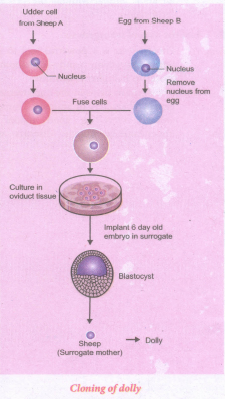
(ii) The mammary gland udder cells (somatic cells) from a donor sheep (ewe) were isolated and subjected to starvation for 5 days. The udder cells could not undergo normal growth cycle, entered a dormant stage and became totipotent. An ovum (egg cell) was taken from another sheep (ewe)) and its nucleus was removed to form an enucleated ovum. The dormant mammary gland cell/udder cell and the enucleated ovum were fused. The outer membrane of the mammary cell was ruptured allowing the ovum to envelope the nucleus. The fused cell was implanted into another ewe which served as a surrogate mother. Five months later dolly was born. Dolly was the first animal to be cloned from a differentiated somatic cell taken from an adult animal without the process.
19.
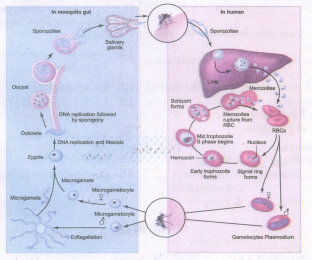
(i) Plasmodium vivax is a digenic parasite, involving two hosts, man as the secondary host and female Anopheles mosquito as the primary host. The life cycle of Plasmodium involves three phases namely schizogony, gamogony and sporogony (f.g)
(ii) The parasite first enters the human blood stream through the bite of an infected female Anopheles mosquito. As it feeds, the mosquito injects the saliva containing the sporozites.
(iii) The sporozoites within the blood stream enter the hepatic cells of the liver and undergoes multiple asexual fission (schizogony). This produces merozoites which are released from liver cells.
(iv) The merozoites penetrate the RBC's. Inside the RBC of Blood, the merozoite of Plasmodium to develop as unicellular trophozoites. The trophozoite grows in size and a central vacuole develops pushing them to one side of cytoplasm and becomes the signet ring stage.
(v)The trophozoite nucleus then divides asexually to produce the The schizont divides and produces on nucleated merozoites.
(vi) Eventually the erythrocyte lyses, releasing the merozoites and haemozoin toxin into the blood stream to infect other erythrocytes. Lysis of red blood cells results in cycles of fever and other symptoms. This erythrocytic stage is cyclic and repeats itself approximately every 48 to72 or longer depending on the species of Plasmodium involved. The sudden release of merozoites triggers an attack on the RBCs.
(vii) Occasionally, merozoites differentiate into macrogametocytes and microgametocytes When these are ingested by a mosquito, they develop into male and female gametes respectively
In the mosquito's gut, the infected erythrocytes lyse and male and female gametes fertilize to form a diploid zygote called ookinete. The ookinete migrates to the mosquito's gut wall and develops into an oocyte.
The oocyte undergoes meiosis by a process called sporogony to form sporozoites. These sporozoites migrate to the salivary glands of the mosquito. The cycle is now completed and when the mosquito bites another human host, the sporozoites are injected and the cycle begins a new.
The pathological changes caused by malaria, affect not only the erythrocytes but also the spleen and other visceral organs. Incubation period of malaria is about 12 days. The early symptoms of malaria are headache, nausea and muscular pain. The classic symptoms first develop with the synchronized release of merozoites, hemozoin toxin and erythrocyte debris into the bloodstream resulting in malarial paroxysms - shivering chills, high fever followed by sweating. Fever and chills are caused partly by malarial toxins that induce macrophages to release tumor necrosis factor (TNF-a) and interleukin.
20.
The salient features of genetic code are as follows:
(i) The genetic codon is a triplet code and 61 codons code for amino acids and 3 codons do not code for any amino acid and function as stop codon (Termination).
(ii) The genetic code is universal. It means that all known living systems use nucleic acids and the same three base codons (triplet codon) direct the synthesis of protein from amino acids. for example, the mRNA (UUU) codon codes for phenylalanine in all cells of all organisms. some exceptions are reported in prokaryotic, mitochondrial and chloroplast genomes. However similarities are more common than differences. Most part of the genetic code is universal in prokaryotes and eukaryotes.
(iii) A non-overlapping codon means that the same letter is not used for two different codons. for instance, the nucleotide sequence GUU GUC represents only two codons.
(iv) It is comma less, which means that the message would be read directly from one end to the other i.e., no punctuation are needed between two codes.
(v) A degenerate code means that more than one triplet codon could code for a specific amino acid. for example, codons GUU, GCU, GUA and GUG code for valine.
(vi) Non-ambiguous code means that one codon will code for one amino acid.
(vii) The code is always read in a fixed direction i.e. from 5'⟶3' direction called polarity.
(viii) AUG has dual functions. It acts as a initiator codon and also codes for the amino acid methionine.
(ix) UAA, UAG (tyrosine) and UGA (tryptophan) codons are designated as termination (stop) codons and also are known as "non-sense" codons.
21.
In binary fission, the parent organism divides into two halves and each half forms a daughter individual. The nucleus divides first amitotically or mitotically (karyokinesis), followed by the division of the cytoplasm (cytokinesis). The resultant offsprings are genetically identical to the parent. Depending on the plane of fission, binary fission is of the following types
(i) Simple irregular binary fission
(ii) Transverse binary fission
(iii) Longitudinal binary fission
(iv) Oblique binary fission
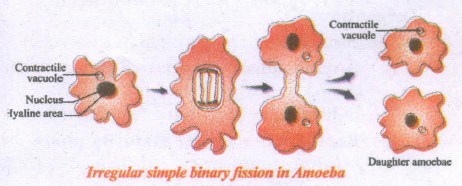
(i) Simple irregular binary fission is seen in Amoeba like irregular shaped organisms, where the plane of division is hard to observe. The contractile vacuoles cease to function and disappear. The nucleoli disintegrate and the nucleus divides mitotically. The cell then constricts in the middle, so the cytoplasm divides and forms two daughter cells.
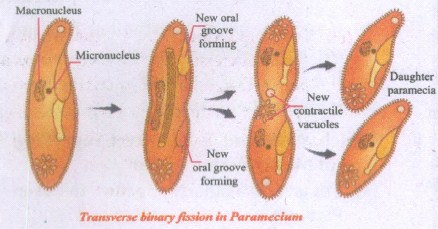
(ii) In Transverse binary fission, the plane of the division runs along the transverse axis of the individual. E.g. Paramecium and Planaria. In Paramecium the macronucleus divides by amitosis and the micronucleus divides by mitosis.
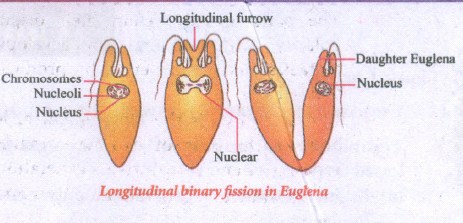
(iii) In Longitudinal binary fission the nucleus and the cytoplasm divides in the longitudinal axis of the organism. In flagellates, the flagellum is retained usually by one daughter cell. The basal granule is divided into two and the new basal granule forms a flagellum in the other daughter individual. E.g. Vorticella and Euglena.
(iv) In Oblique binary fission the plane of division is oblique. It is seen in dinoflagellates. E.g. Ceratium.
22.
The different types of antigen-antibody reaction are:
(i) Precipitin: The reaction between soluble antigen and antibody leads to visible precipitate formation, which is called precipitin reaction. Antibodies that bring about precipitate formation on reacting with antigens are called as precipitins.
(ii) Agglutinstion: Whenever a particulate antigen interacts with its antibody, it would result in clumping or agglutination of the particulate antigen, which is called agglutination reaction. The antibody involved in bringing about agglutination reaction is called agglutinin.
(iii) Opsonisation: Opsonisation or enhanced attachment is the process by which a pathogen is marked of ingestion and destruction by a phagocyte. Opsonisation involves the binding of an opsonin i.e., antibody, to a receptor on the pathogen's cell membrane. After opsonin binds to the membrane, phagocytesare attracted to the pathogen. So, opsonisation is a process in which pathogens are coated with a substance called an opsonin, marking the pathogen out for destruction by the immune system. This results in a much more efficient phagocytosis.
(iv) Neutralization: The neutralization reactions are the reactions or antigenantibody that involve the climinai ion of harmful effects of bacterial exotoxins or a virus by specific antibodies. These neutralizing substances i.e., antibodies are known as antitoxins. This specific antibody is produced by a host cell in response to a bacterial exotoxin or corresponding toxoid.
23.
Mitotic or meiotic non-disjunction of sex chromosomes causes allosomal abnormalities. Several sex chromosomal abnormalities have been detected. Eg. Klinefelter's syndrome and Turner's syndrome.
i) Klinefelter's Syndrome (XXY Males)
This genetic disorder is due to the presence of an additional copy of the X chromosome resulting in a karyotype of 47,XXY. Persons with this syndrome have 47 chromosomes (44AA+XXY). They are usually sterile males, tall, obese, with long limbs, high pitched voice, under developed genitalia and have feeble breast (gynecomastia) development.
(ii) Turner's Syndrome (XO Females)
This genetic disorder is due to the loss of a X chromosome resulting in a karyotype of 45, X. Persons with this syndrome have 45 chromosomes (44 auto somes and one X chromosome) (44AA+XO) and are sterile females. Low stature, webbed neck, under developed breast, rudimentary gonads lack of menstrual cycle during puberty, are the main symptoms of this syndrome.
24.
Many polyploids are more vigorous and more adaptable than diploids.
(i) Many ornamental plants are autotetraploids and have larger flower and longer flowering duration than diploids.
(ii) Autopolyploids usually have increase in fresh weight due to more water content.
(iii) Aneuploids are useful to determine the phenotypic effects of loss or gain of different chromosomes.
(iv) Many angiosperms are allopolyploids and they play a role in an evolution of plants.
25.
The act of observing and assessing the current state and ongoing changes in ecosystem, biodiversity components, landscape including natural habitats, populations and species. An agricultural drone is an unmanned aerial vehicle applied to farming in order to help increased crop production and monitor crop growth. Agricultural drones let farmers see their fields from the sky. This bird’s eye-view can reveal many issues such as irrigation problems, soil variation and pest and fungal infestations. It is also used for cost effective safe method of spraying pesticides and fertilizers, which proves very easy and non-harmful.

12th Standard Syllabus & Materials
12th Standard
TN 12th Computer Applications வலையமைப்பு வடமிடல் Sample Question Papers Study Material - QB365 Set A
NEW12th Standard
TN 12th Computer Applications களப்பெயர் முறைமை (DNS) Sample Question Papers Study Material - QB365 Set A
NEW12th Standard
TN 12th Computer Applications வலையமைப்பு எடுத்துக்காட்டுகள் மற்றும் நெறிமுறைகள் Sample Question Papers Study Material - QB365 Set A
NEW12th Standard
TN 12th Computer Applications கணினி வலையமைப்பு ஓர் அறிமுகம் Sample Question Papers Study Material - QB365 Set A



Tamilnadu Stateboard 12th Standard Subjects

Maths

Chemistry

Physics
Biology

Computer Science

Business Maths and Statistics

Economics

Commerce

Accountancy

History

Computer Applications
Biology
Computer Technology
Computer Applications
Computer Science
Business Maths and Statistics
Commerce
Economics
Maths
Chemistry
Physics
Computer Technology
History
Accountancy

Tamil

English

French
Tamilnadu Stateboard Standards

