
 100% FREE ACCESS
12th Standard Syllabus & Materials
12th Standard
TN 12th Computer Applications மின்னணு தரவு பரிமாற்றம் Sample Question Papers Study Material - QB365 Set A
NEW12th Standard
TN 12th Computer Applications மின் - வணிக பாதுகாப்பு அமைப்புகள் Sample Question Papers Study Material - QB365 Set A
NEW12th Standard
TN 12th Computer Applications மின்னணு செலுத்தல் முறைகள் Sample Question Papers Study Material - QB365 Set A
NEW12th Standard
TN 12th Computer Applications மின் - வணிகம் Sample Question Papers Study Material - QB365 Set A
NEW12th Standard
TN 12th Computer Applications திறந்த மூல கருத்துருக்கள் Sample Question Papers Study Material - QB365 Set A
NEW12th Standard
TN 12th Computer Applications வலையமைப்பு வடமிடல் Sample Question Papers Study Material - QB365 Set A

Published on: 29/09/2020
12th Standard Biology English Medium Model 3 Mark Book Back Questions (New Syllabus) 2020
Download Tamil Nadu 12th Standard Biology question papers, model tests, one-mark questions, important questions, and public exam papers in PDF format. Free study materials and answer keys for TN State Board students.
Questions + Answers key
Take MCQ Biology Test1.
Differentiate between:
Primary and secondary immune responses
2.
How do sacred groves help in the conservation of biodiversity?
3.
Shape of pyramid in a particular ecosystem is always different in shape. Explain with example.
4.
Give the characters of a Biome ?
5.
Why does ozone hole form over Antarctica?
6.
What are transgenic animals? Give examples
7.
Compare and Contrast the insitu and exsitu conservation. (or) What are the differences between in-situ and ex-situ conservation ?
8.
Justify the role of microbes as a bio-fertilizer
9.
How will you identify a vector ?
10.
A low level of expression of lac operon occurs at all the windows for treatment of various genetic disorders. Justify the statement
11.
What is the composition of semen?
12.
Brief about female heterogamety.
13.
14.
Why are the offsprings of oviparous animal at a greater risk as compared to offsprings of viviparous organisms?
15.
What is meant by cytoplasmic inheritance
16.
What is endothelium
17.
Write the origin and area of cultivation of green gram and red gram.
18.
19.
Taking the example of Peppered moth, explain the action of natural selection. What do you call the above phenomenon?
20.
Explain the mechanism of crossing over.
21.
Why do submerged plants receive weak illumination than exposed floating plants in a lake?
22.
Give the examples for micro propagation performed plants .
23.
Differentiate foeticide and infanticide
1.
| S.No | Primary immune responses | secondary immune responses |
| i. | It occurs as a result of primary contact with an antigen. |
It occurs as a result of second and subsequent contacts with the same antigen. |
| ii. | Antibody level reaches peak in 7 to 10 days | Antibody level reaches peak in 3 to 5 days. |
| iii. | Prolonged period isrequired to establish immunity | It establishes immunity in a short time. |
| iv. | There is rapid decline in antibody level. | Antibody level remains high for longer period. |
| v. | It appears mainly in the lymph nodes and spleen. |
It, appears mainly in the bone marrow followed by the spleen and lymph nodes. |
2.
(i) They help for detailed floristic and faunistic studies
(ii) These groves provide a number of ecosystem services to the neighborhood like protecting watershed, fodder, medicinal plants and microclimate control
3.
Pyramid of number
(i) In a forest ecosystem the pyramid of number is different in shape, it is because the base (T 1) of the pyramid occupies large sized trees (producer) which are lesser in number.
(ii) Herbivores (T2) occupying second trophic level, are more in number than the producers (T1).
(iii) In final trophic level (T4) tertiary consumers (lion) are lesser in number than the secondary consumers (T3).
(iv) Therefore, the pyramid of numbers in forest ecosystem looks spindle-shaped.
Pyramid of biomass
(i) In forest ecosystem, there is a gradual decrease in biomass of organisms at successive trophic levels from producers to top carnivores (Tertiary consumer). Therefore, the pyramid of biomass looks upright.
4.
Characters of biome
(i) Location, geographical position (Latitude, Longitude)
(ii) Climate and physiochemical environment
(iii) Predominant plant and animal life
(iv) Boundaries between biomes are not always sharply defined. Transition or transient zones are seen as in case of grassland and forest biomes.
5.
Ozone hole is the area above Antarctica, where the ozone layer is the thinnest.
6.
1. The foreign DNA that is introduced is called the transgene and the animals that are produced by DNA manipulations are called transgenic animals or the genetically engineered or genetically modified organisms.
2. Transgenic animals are also used for producing products useful for mankind. E.g: Transgenic cow (rosie), which produced human protein enriched milk (2.4 g/L).
3. The milk contained the human alpha lactalbumin and was nutritionally a more balanced product for human babies than natural cow's milk.
7.
Insitu and Exsitu are two types of biodiversity conservation strategies.
| S. No | Insitu Conservation | Exsitu Conservation |
|---|---|---|
| i) | It is the on-site conservation or the conservation of genetic resources in natural populations of plant or animal species. | This is a conservation strategy which involves placing of threatened animals and plants in special care locations for their protection. |
| ii) | It is the process of protecting an endangered plant or animal species in its natural habitat, either by protecting or restoring the habitat itself or by defending the species from predators. | It helps in recovering populations or preventing their extinction under simulated conditions that closely resemble their natural habitats. |
| iii) | National Parks, Biosphere Reserve, Wild Life Sanctuaries form insitu conservation strategies. | Zoological parks and Botanical gardens are common exsitu conservation programs. |
8.
(i) Bio-fertilizers are formulation of living microorganisms that enrich the nutrient quality of the soil. They increase physico - chemical properties of soils such as soil structure, texture, water holding capacity, cation exchange capacity and pH by providing several nutrients and sufficient organic matter.
(ii) The main sources of bio-fertilizers are bacteria, fungi and cyanobacteria. Rhizobium is a example for symbiotic nitrogen fixing bacteria. This bacterium infects the root nodules of leguminous plants and fixes atmospheric nitrogen into organic forms. Azospirillum and Azotobacter are free living bacteria that fix atmospheric nitrogen and enrich the nitrogen content of soil.
(iii) A symbiotic association between a fungus and the roots of the plants is called mycorrhiza. The fungal symbiont in these associations absorbs the phosphorus from soil and transfers to the plant. Plants having such association show other benefits such as resistance to root-borne pathogens, tolerance to salinity, drought, enhances plant growth and developments. For example, genus Glomus form mycorrhiza.
(iv) Cyanobacteria (or) blue green algae (BGA) are prokaryotic free-living organisms which can fix nitrogen. Oscillatoria, Nostoc, Anabaena, Tolypothrix are well known nitrogen fixing cyanobacteria. In water logged paddy fields Cyanobacteria multiply and fix molecular nitrogen. Cyanobacteria secrete growth promoting substances like indole-3-acetic acid, indole-3-butyric acid, naphthalene acetic acid, amino acids, proteins, vitamins which promotes plant growth and production.
(v) Biofertilizers are commonly used in organic farming methods.
(vi) This process involves the use of biological materials, avoiding synthetic substances to maintain soil fertility and ecological balance thereby minimizing pollution and wastage.
9.
Properties of Vectors:
1. Vectors are able to replicate autonomously to produce multiple copies of them along with their DNA insert in the host cell.
2. It should be small in size and of low molecular weight, less than 10 Kb (kilo base pair) in size so that entry/transfer into host cell is easy.
3. Vector must contain an origin of replication so that it can independently replicate within the host.
4. It should contain a suitable marker such as antibiotic resistance, to permit its detection in transformed host cell.
5. Vector should have unique target sites for integration with DNA insert and should have the ability to integrate with DNA insert it carries into the genome of the host cell. Most of the commonly used cloning vectors have more than one restriction site. These are Multiple Cloning Site (MCS) or polylinker. Presence of MCS facilitates the use of restriction enzyme of choice.
10.
In the complete absence of lac operon permease will not be synthesized which is essential for transport of lactose from the medium into the cells, then it cannot act as an inducer. Hence, cannot relieve the lac operon from its repressed state.
11.
Semen or seminal fluid is a milky white fluid which contains sperms and the seminal plasma, which is secreted from the seminal vesicles, prostate glands and bulbo urethal glands or Cowper's gland.
The semen comprises of Fructose, ascorbic acid, zinc, cholesterol, protein, calcium, chlorine, blood group antigens, citric acid, DNA, magnesium, Vitamin B12, phosphorous, sodium, potassium, uric acid,lactic acid, nitrogen, and other nutrients for the sperms.
12.
1. In this method of sex determination, the homogametic male possesses two 'X' chromosomes as in certain insects and certain vertebrates like fishes, reptiles and birds producing a single type of gamete.
2. The female sex consists of a single 'Y' chromosome. Thus the females are heterogametic and produce two types of eggs.
3. To avoid confusion with the XX-XO and XX-XY trues of sex determination, the alphabets 'Z' and 'W 'are used here instead of X and Y respectively.
4. Heterogametic females are of two types, ZO-ZZ type and ZW-ZZ type.
13.
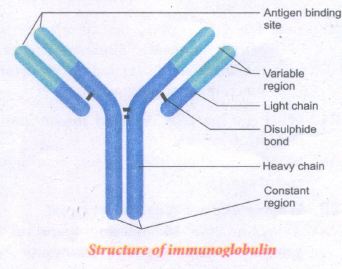
14.
Oviparous animals lay eggs outside their body. These eggs are exposed to various environmental conditions and may be eaten by predators also. They face lot of risks until the young ones hatche. But the offsprings of viviparous animals are more safe and protected in the maternal womb until they are born.
15.
It is based on independent, self-replicating extra chromosomal unit called plasmogene located in the cytoplasmic organelles, chloroplast & Mitochondrion.
16.
In some species (unitegmic, tenuinucellate) the inner layer of integument becomes specialized, The layer is nutritive in function for the embryosac. This layer is called endothelium or integumentary tapetum.
Example:
Asteraceae.
17.
| S.No | Common Name | Botanical name | Origin and area |
| 1 | RED GRAM | Cajanus cajan | Southern India, cultivated in Maharashtra, Andhra Pradesh, Madhya Pradesh Karnataka and Gujarat |
| 2 | GREEN GRAM | Vigna radiate | State of Maharashtra. Cultivated in Madhya Pradesh, Karnata and Tamil Nadu. |
18.
19.
1. Natural selection can be explained clearly through Industrial melanism.
2. Industrial melanism is classical case of natural selection exhibited by the peppered moth.
Biston Betularia
1. These were available in two colours, white and black. Before industrialization peppered moth both white and black coloured were common in England (Manchester).
2. Pre-industrialization witnessed white coloured background of the wall of buildings hence the white coloured moths escaped from their predators.
3. Post Industrialization the tree trunks become dark due to smoke and soot let out from the lndustries.
4. The black moths camouflaged on the dark bark of the trees and the white moths were easily identified by their predators (birds).
5. Hence the dark coloured moth population was selected and their number increased when compared to the white moths nature offered positive selection pressure to the black coloured moths.
6. The above proof shows that in a population organisms that can adapt will service and produce more progenies resulting in increase in population through natural selection.
20.
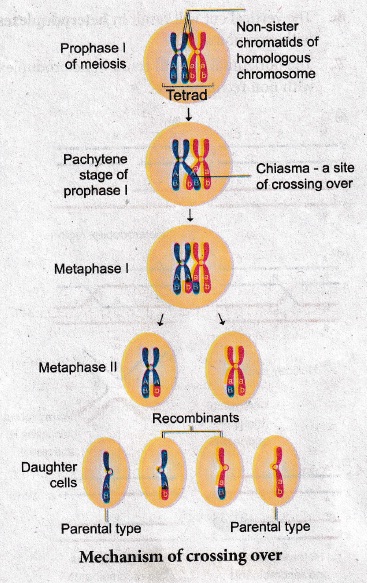
Crossing over is a process that includes four stages.
1. Synapsis
(i) Pairing between two homologous chromosomes is initiated during sub stage zygotene stage of prophase I of meiosis I
(ii) Homologous chromosomes are aligned side by side resulting in the formation of bivalents. It also occurs in zygotene sub-stage of prophase I of meiosis I tetrads.This pairing phenomenon is called synapsis.
2.Tetrad Formation
(i) Each homologous chromosome of a bivalent begin to form two identical sister chromatids.
(ii) They remain held together by a centromere at this stage each bivalent has four chromatids. This stage is called tetrad stage.
3. Cross Over
After tetrad formation, crossing over occurs in pachytene stage.
The non-sister chromatids of homologous pair make a contact at one or more points. These points of contact are called Chiasmata.
At chiasma, X-shaped structures are formed, where breaking and rejoining of two chromatids occur. This results in reciprocal exchange of equal and corresponding segments between them synapsis and chiasma formation are facilitated by protein filaments called synaptonemal complex.
4. Terminalisation
After crossing over, chiasma starts to move towards the terminal end of chromatids known as terminalisation. As a result, complete separation of homologous chromosomes occurs.
21.
Submerged plants are unable to obtain full illumination because a lot of sunlight is absorbed by overlying layers of water this is not the case for exposed floating plants that receive sunlight directly.
22.
Pineapple, banana, strawberry and potato.
23.
| Foeticide | Infanticide |
| It refers to aborting the female in the mother's womb. |
It refers to killing the female child after her birth |

12th Standard Syllabus & Materials
12th Standard
TN 12th Computer Applications களப்பெயர் முறைமை (DNS) Sample Question Papers Study Material - QB365 Set A
NEW12th Standard
TN 12th Computer Applications வலையமைப்பு எடுத்துக்காட்டுகள் மற்றும் நெறிமுறைகள் Sample Question Papers Study Material - QB365 Set A
NEW12th Standard
TN 12th Computer Applications கணினி வலையமைப்பு ஓர் அறிமுகம் Sample Question Papers Study Material - QB365 Set A
NEW12th Standard
TN 12th Computer Applications PHP-உடன் MySQL-ஐ இணைத்தல் Sample Question Papers Study Material - QB365 Set A



Tamilnadu Stateboard 12th Standard Subjects

Maths

Chemistry

Physics
Biology

Computer Science

Business Maths and Statistics

Economics

Commerce

Accountancy

History

Computer Applications
Biology
Computer Technology
Computer Applications
Computer Science
Business Maths and Statistics
Commerce
Economics
Maths
Chemistry
Physics
Computer Technology
History
Accountancy

Tamil

English

French
Tamilnadu Stateboard Standards

