
 100% FREE ACCESS
12th Standard Syllabus & Materials
12th Standard
TN 12th Computer Applications மின்னணு தரவு பரிமாற்றம் Sample Question Papers Study Material - QB365 Set A
NEW12th Standard
TN 12th Computer Applications மின் - வணிக பாதுகாப்பு அமைப்புகள் Sample Question Papers Study Material - QB365 Set A
NEW12th Standard
TN 12th Computer Applications மின்னணு செலுத்தல் முறைகள் Sample Question Papers Study Material - QB365 Set A
NEW12th Standard
TN 12th Computer Applications மின் - வணிகம் Sample Question Papers Study Material - QB365 Set A
NEW12th Standard
TN 12th Computer Applications திறந்த மூல கருத்துருக்கள் Sample Question Papers Study Material - QB365 Set A
NEW12th Standard
TN 12th Computer Applications வலையமைப்பு வடமிடல் Sample Question Papers Study Material - QB365 Set A

Published on: 29/09/2020
12th Standard Biology English Medium Model 5 Mark Creative Questions (New Syllabus 2020)
Download Tamil Nadu 12th Standard Biology question papers, model tests, one-mark questions, important questions, and public exam papers in PDF format. Free study materials and answer keys for TN State Board students.
Questions + Answers key
Take MCQ Biology Test1.
Explain Oparin - Haldane hypothesis on evolution.
2.
Describe Hershey and Chase experiment. What is concluded by their experiment?
3.
List out the effects of air pollution.
4.
How microbes are used in Gobar gas production?
5.
Why Tropical regions are rich in biodiversity?
6.
Describe the role of PCR in clinical field.
7.
Explain Agarose Gel electrophoresis technique.
8.
Describe the structure of human ovary.
9.
What is translocation? Write about its types.
10.
Given an account on following terms.
(a) Hologamy
(b) Isogamy
(c) Anisogamy
(d) Merogamy
(e) Paedogamy
11.
Describe incomplete dominance exhibited by Mirabilis jalapa.
12.
Describe the development of monosporic embryo sac.
13.
Write in detail about Autogenic succession and Allogenic succession.
14.
Explain various edaphic factors that affect vegetation.
15.
Write a comparative note on Carbon Foot Print (CFP).
16.
Give a detailed account on anyone fibre yielding plant.
17.
Explain any five techniques of Assisted Reproductive Technology (ART).
18.
Write a note on grassland biome.
19.
Explain the events in life cycle of plasmodium in the secondary host/Man
20.
Write a note on different types of antigen antibody reactions.
21.
Write a note on thalassemia.
1.
According to the theory of chemical evolution, primitive organisms in the primordial environment of the Earth evolved spontaneously from inorganic substances and physical forces such as lightning, UV radiations, volcanic activities, etc. Oparin (1924) suggested that the organic compounds could have undergone a series of reactions leading to more complex molecules. He proposed that the molecules formed colloidal aggregates or 'coacervates' in an aqueous environment. The coacervates were able to absorb and assimilate organic compounds from the environment. Haldane (1929) proposed that the primordial sea served as a vast chemical laboratory powered by solar energy. The atmosphere was oxygen free and the combination of CO2, NH3 and UV radiations gave rise to organic compounds. The sea became a 'hot' dilute soup containing large populations of organic monomers and polymers. They envisaged that groups of monomers and polymers acquired lipid membranes and further developed into the first living cell. Haldane coined the term prebiotic soup and this became the powerful symbol of the Oparin-Haldane view on the origin of life (1924-1929). Oparin and Haldane independently suggested that if the primitive atmosphere was reducing and if there was appropriate supply of energy such as lightning or UV light then a wide range of organic compounds can be synthesized.
2.
Alfred Hershey and Martha Chase (1952) conducted experiments on bacteriophages that infect bacteria. Phage T2 is a virus that infects the bacterium Escherichia coli. When phages (virus) are added to bacteria, they adsorb to the outer surface, some material enters the bacterium, and then later each bacterium lyses to release a large number of progeny phage. Hershey and Chase wanted to observe whether it was DNA or protein that entered the bacteria. All nucleic acids contain phosphorus and contain sulphur (in the amino acid cysteine and methionine). Hershey and Chase designed an experiment using radioactive isotopes of Sulphur (35S) and phosphorus (32P) to keep separate track of the viral protein and nucleic acids during the infection process. The phages were allowed to infect bacteria in culture medium which containing the radioactive isotopes 35Sor 32p. The bacteriophage that grew in the presence of 35Shad labelled proteins and bacteriophages grown in the presence of 32p had labelled DNA. The differential labelling thus enabled them to identify DNA and proteins of the phage. Hershey and Chase mixed the labelled phages with unlabeled E. coli and allowed bacteriophages to attack and inject their genetic material. Soon after infection (before lysis of bacteria), the bacterial cells were gently agitated in a blender to loosen the adhering phase particles. It was observed that only 32p was found associated with bacterial cells and 35S was in the surrounding medium and not in the bacterial cells. When phage progeny was studied for radioactivity, it was found that it carried only 32p and not 35S. These results clearly indicate that only DNA and not protein coat entered the bacterial cells. Hershey and Chase thus conclusively proved that it was DNA, not protein, which carries the hereditary information from virus to bacteria.
3.
1. Affects all organisms as they depend on the atmosphere for respiration.
2. Causes irritation in the throat, nose, lungs and eyes. It causes breathing problems and aggravates existing health conditions such as emphysema and asthma.
3. Contaminated air reduces the body's defense mechanism and decreases the body's capacity to fight other infections in the respiratory system.
4. Frequent exposure to polluted air increases the risk of cardiovascular diseases. Breathing air that is filled with fine particulate matter can induce hardening of the arteries, triggering cardiac arrhythmia or even a heart attack.
5. People who exercise outdoors can sometimes be susceptible to adverse effects of air pollution because it involves deeper and faster breathing. Hence it is advisable to walk or jog in the mornings in places with ample tree cover .
6. Gas leaks can be lethal or affect the quality of air in the affected area .
7. CO in the atmosphere interferes with O2 transport since haemoglobin has greater affinity for carbon monoxide. At low concentration it causes headache and blurred vision. In higher concentration, it can lead to coma and death.
4.
Biogas is a mixture of different gases produced by the breakdown of organic matter in the absence of oxygen. Biogas can be produced from raw materials such as agricultural wastes, manure, municipal wastes, plant material, sewage, food waste, etc., Biogas is produced under the anaerobic condition when the organic materials are converted through microbiological reactions into gas and organic fertilizer. Biogas primarily consists of methane (63 percent), along with CO2 and hydrogen. Methane-producing bacteria are called methanogens and one such common bacterium is Methanobacterium. Biogas is devoid of smell and bums with a blue flame without smoke. The Methanogens are also present in anaerobic sludge and rumen of cattle. In the rumen, these bacteria help in the breakdown of cellulose. The excreta of cattle called dung is commonly called "Gobar". Gobar gas is generated by the anaerobic decomposition of cattle dung. It consists of methane, CO2 with some hydrogen, nitrogen and other gases in trace amounts.
In a biogas plant, anaerobic digestion is carried out in an airtight cylindrical tank known as digester. It is made up of concrete bricks and cement or steel. Bio-wastes are collected and a slurry of dung is fed into this digester. It has a side opening into which organic materials for digestion are incorporated for microbial activity. Anaerobic digestion is accomplished in three stages: solubilisation, acidogenesis, and methanogens. The outlet is connected to a pipe to supply biogas. The slurry is drained through another outlet and is used as fertilizer. Biogas is used for cooking and lighting. The technology of biogas production was developed in India mainly due to the efforts of the Indian Agricultural Research Institute (IARl) and Khadi and Village Industries Commission (KVIC).
5.
The reasons for the richness of biodiversity in the Tropics are:
(i) Warm tropical regions between the tropic of Cancer and Capricorn on either side of equator possess congenial habitats for living organisms.
(ii) Environmental conditions of the tropics are favourable not only for speciation but also for supporting both variety and number of organisms.
(iii) The temperatures vary between 25°C to 35°C, a range in which most metabolic activities of living organisms occur with ease and efficiency.
(iv) The average rainfall is often more than 200 mm per year.
(v) Climate, seasons, temperature, humidity, photoperiods are more or less stable and encourage both variety and numbers.
(vi) Rich resource and nutrient availability.
6.
PCR In Clinical Diagnosis: The specificity and sensitivity of PCR is useful for the diagnosis of inherited disorders (genetic diseases), viral diseases, bacterial diseases, etc., The diagnosis and treatment of a particular disease often requires identifying a particular pathogen. Traditional methods of identification involve culturing these organisms from clinical specimens and performing metabolic and other tests to identify them.
The concept behind PCR based diagnosis of infectious diseases is simple - if the pathogen is present in a clinical specimen its DNA will be present. Its DNA has unique sequences that can be detected by PCR, often using the clinical specimen (for example, blood, stool, spinal fluid, or sputum) in the PCR mixture. PCR is also employed in the prenatal diagnosis of inherited diseases by using chorionic villi samples or cells from amniocentesis. Diseases like sickle cell anemia, p-thalassemia and phenylketonuria can be detected by PCR in these samples. cDNA from PCR is a valuable tool for diagnosis and monitoring retroviral infections - egoTuberculosis by Mycobacterium tuberculosis.
Several virally induced cancers, like cervical cancer caused by Papilloma virus can be detected by peR. Sex of human beings and live stocks, embryos fertilized invitro can be determined by PCR by using primers and DNA probes specific for sex chromosomes. PCR technique is also used to detect sexlinked disorders in fertilized embryos.
7.
Agarose Gel Electrophoresis is used mainly for the purification of specific DNA fragments. Agarose is convenient for separating DNA fragments ranging in size from a few hundred to about 20000 base pairs. Polyacrylamide is preferred for the purification of smaller DNA fragments. The gel is complex network of polymeric molecules. DNA molecule is negatively charged molecule - under an electric field DNA molecule migrates through the gel. The electrophoresis is frequently performed with marker DNA fragments of known size which allow accurate size determination of an unknown DNA molecule by interpolation. The advantages of agarose gel electrophoresis are that the DNA bands can be readily detected at high sensitivity. The bands of DNA in the gel are stained with the dye Ethidium Bromide and DNA can be detected as visible fluorescence illuminated in UV light will give orange fluorescence, which can be photographed.
8.
(i) Ovaries are the primary female sex organ producing eggs (ovum).
(ii) They are located one on each side of lower abdomen (pelvis).
(iii) The ovary is attached in pelvic wall uterus by an ovarian ligament called mesovarium.
(iv) It is an elliptical structure of 2-4 cm long
(v) Each ovary is covered by thin cuboidal germinal epithelium encloses ovarian stroma.
(vi) Below germinal epithelium is a dense connective tissue called tunica albuginea.
(vii) The stroma is differentiated into an outer cortex and an inner medulla.
(viii) The cortex is dense and granular due to follicular cells at varying development stages.
(ix) The medulla is a loose connective tissue with blood vessels, lymph vessels and nerve fibres.
9.
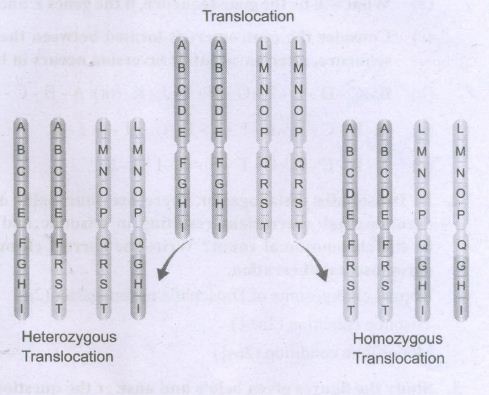
Translocation
The transfer of a segment of chromosome to a nonhomologous chromosome is called translocation. Translocation should not be confused with crossing over, in which an exchange of genetic material between homologous chromosome takes place. Translocation occurs as a result of interchange of chromosome segments in non-homologous chromosomes. There are three types:
i. Simple translocation
ii. Shift translocation
iii. Reciprocal translocation
i. Simple translocation
A single break is made in only one chromosome. The broken segment gets attached to one end of a non-homologous chromosome. It occurs very rarely in nature.
ii. Shift translocation
Broken segment of one chromosome gets inserted interstitially in a non-homologous chromosome.
iii. Reciprocal translocations
It involves mutual exchange of chromosomal segments between two non homologous chromosomes. It is also called illegitimate crossing over. It is further divided into two types.
a. Homozygous translocation: Both the chromosomes of two pairs are involved in translocation. Two homologous of each translocated chromosomes are identical.
b. Heterozygous translocation: Only one of the chromosome from each pair of two homologous are involved in translocation, while the remaining chromosome is normal.
Translocations playa major role in the formation of species.
10.
(a) Hologamy: In Hologamy, the adult individuals do not produce gametes, but they themselves act as gametes and fuse to form new individuals.
E.g: Trichonympha
(b) Isogamy: Fusion of morphologically & physiologically similar gametes.
E.g: Monocystis
(c) Anisogamy: Fusion of morphologically & physiologically dissimilar gametes.
Eg: Vertebrates.
(d) Merogamy: Fusion of small-sized morphologically different gametes (microgametes)
(e) Paedogamy: Fusion of young individuals produced immediately after the mitotic division of adult parent cell.
11.
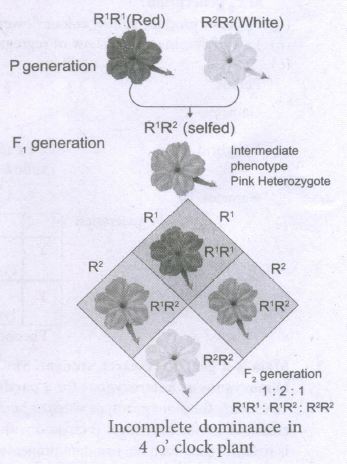
The German Botanist Carl Correns's (1905) Experiment - In 4 0' clock plant, Mirabilis jalapa when the pure breeding homozygous red (R1 R1) parent is crossed with homozygous white (R 2R2), the phenotype of the F1 hybrid is heterozygous pink (R1R2). The F1 heterozygous phenotype differs from both the parental homozygous phenotype. This cross did not exhibit the character of the dominant parent but an intermediate colour pink. When one allele is not completely dominant to another allele it shows incomplete dominance. Such allelic interaction is known as incomplete dominance. F1 generation produces intermediate phenotype pink coloured flower.
When pink coloured plants of F 1 generation were interbred in F2 both phenotypic and genotypic ratios were found to be identical as 1 : 2 : 1(1 red: 2 pink: 1 white). Genotypic ratio is 1 R1R1 : 2 R1R2 : 1 R2R2. From this we conclude that the alleles themselves remain discrete and unaltered proving the Mendel's Law of Segregation. The phenotypic and genotypic ratios are the same. There is no blending of genes. In the F2 generation R1 and R2 genes segregate and recombine to produce red, pink and white in the ratio of 1 : 2 : 1. R 1 allele codes for an enzyme responsible for the formation of red pigment. R2 allele codes for defective enzyme. R1 and R2 genotypes produce only enough red pigments to make the flower pink. Two R1R1 are needed for producing red flowers. Two R2R2 genes are needed for white flowers. If blending had taken place, the original pure traits would not have appeared and all F2 plants would have pink flowers. It is very clear that Mendel's particulate inheritance takes place in this cross which is confirmed by the reappearance of original phenotype in F2.
12.
The functional megaspore is the first cell of the embryo sac or female gametophyte. The megaspore elongates along the micropylar-chalazal axis. The nucleus undergoes a mitotic division. Wall formation does not follow the nuclear division. A large central vacuole now appears between the two daughter nuclei. The vacuole expands and pushes the nuclei towards the opposite poles of the embryo sac. Both the nuclei divide twice mitotically, forming four nuclei at each pole. At this stage, all the eight nuclei are present in a common cytoplasm (free nuclear division). After the last nuclear division, the cell undergoes appreciable elongation, assuming a sac-like appearance. This is followed by the cellular organization of the embryo sac. Of the four nuclei at the micropylar end of the embryo sac, three organize into an egg apparatus, the fourth one is left free in the cytoplasm of the central cell as the upper polar nucleus. Three nuclei of the chalazal end form three antipodal cells whereas the fourth one functions as the lower polar nucleus. Depending on the plant the 2 polar nuclei may remain free or may fuse to form a secondary nucleus (central cell). The egg apparatus is made up of a central egg cell and two synergids, one on each side of the egg cell. Synergids secrete chemotropic substances that help to attract the pollen tube. The special cellular thickening called filiform apparatus of synergids to help in the absorption, conduction of nutrients from the nucellus to embryo sac. It also guides the pollen tube into the egg. Thus, a 7 celled with 8 nucleated embryo sac is formed.
13.
Autogenic succession
Autogenic succession occurs as a result of biotic factors. The vegetation reacts with its environment and modifies its own environment causing its own replacement by new communities. This is known as autogenic succession.
Example: In forest ecosystem, the larger trees produce broader leaves providing shade to the forest floor area. It affects the shrubs and herbs which require more light (heliophytes) but supports the shade tolerant species (sciophytes) to grow well.
Allogenic succession
Allogenic succession occurs as a result of abiotic factors. The replacement of existing community is caused by other external factors (soil erosion and leaching, etc.,) and not by existing organisms.
Example: In a forest ecosystem soil erosion and leaching alter the nutrient value of the soil leading to the change of vegetation in that area.
14.
The important edaphic factors which affect vegetation are as follows:
1. Soil moisture: Plants absorbs rain water and moisture directly from the air.
2. Soil water: Soil water is more important than any other ecological factors affecting the distribution of plants. Rain is the main source of soil water. Capillary water held between pore spaces of soil particles and angles between them is the most important form of water available to the plants.
3. Soil reactions: Soil may be acidic or alkaline or neutral in their reaction. pH value of the soil solution determines the availability of plant nutrients. The best pH range of the soil for cultivation of crop plants is 5.5 to 6.8.
4. Soil nutrients: Soil fertility and productivity is the ability of soil to provide all essential plant nutrients such as minerals and organic nutrients in the form of ions.
5. Soil temperature: Soil temperature of an area plays an important role in determining the geographical distribution of plants. Low temperature reduces use of water and solute absorption by roots.
6. Soil atmosphere: The spaces left between soil particles are called pore spaces which contains oxygen and carbon-di-oxide.
7. Soil organisms: Many organisms existing in the soil like bacteria, fungi, algae, protozoans, nematodes, insects and earthworms, etc., are called soil organisms.
15.
Every human activity leaves a mark just like our footprint. This Carbon footprint is the total amount of greenhouse gases produced by human activities such as agriculture, industries, deforestation, waste disposal, burning fossil fuels directly or indirectly. It can be measured for an individual, family, organization like industries, state level or national level. It is usually estimated and expressed in equivalent tons of CO2 per year. The burning of fossil fuels releases CO2 and other greenhouse gases. In turn, these emissions trap solar energy and thus increase the global temperature resulting in ice melting, submerging of low lying areas and imbalance in nature Iike cyclones, tsunamis, and extreme weather conditions. To reduce the carbon footprint we can follow some practices like
(i) Eating indigenous fruits and products
(ii) Reduce use of your electronic devices
(iii) Reduce traveling
(iv) Do not buy fast and preserved, processed, packed foods.
(v) Plant a garden
(vi) Less consumption of meat and seafood. Poultry requires little space, nutrients and less pollution comparing cattle farming.
(vii) reduce the use of Laptops (when used for 8 hours, it releases nearly 2 kg. of CO2 annually)
(viii) Line dry your clothes. (Example: If you buy imported fruit like kiwi, indirectly it increases CFP. How? The fruit has traveled a long distance in shipping or airliner thus emitting tons of CO2)
16.
Jute
Botanical name : Corchorus spp.
Family: Malvaceae
Origin and Area of cultivation: Jute is derived from the two cultivated species (1) Core horns capsularis and (2) Colittorius is of African origin whereas C. Capsularis, is believed to Indo Burmaese origin. It is an important cultivated commercial crop in Gangetic plains of India and Bangladesh.
Uses: It is one of the largest exported fibre material of India. The jute industry occupies an important place in the national economy Of India. Jute is used for 'safe' packaging in view of being natural, renewable, bio-degradable and eco-friendly product. It is used in bagging and wrapping textile. About 75% of the jute produced is used for manufacturing sacks and bags. It is also used in manufacture of blankets, rags, curtains etc. It is also being used as a textile fibre in recent years.
17.
A collection of procedures which includes the handling of gametes and/or embryos outside the body to achieve a pregnancy is known as Assisted Reproductive Technology. ART includes
(i) Intra - uterine insemination : This is a procedure to treat infertile men with low sperm count. The semen is collected either from the husband or from a healthy donor and is introduced into the uterus through the vagina by a catheter after stimulating the ovaries to produce more ova. The sperms swim towards the fallopian tubes to fertilize the egg, resulting normal pregnancy.
(ii) Zygote intra - fallopian transfer(ZIFT)
The zygote is allowed to divide to form 8 celled blastomere and transferred to the fallopian tube by laparoscopy. The zygote continues its natural divisions and migrates towards the uterus where it gets implanted.
(iii) Intra uterine transfer (iUT)
Embryo with more than 8 blastomeres is inserted into uterus to complete its further development.
(iv) Gamete Intra-falloplan transfer(GIFT)
Transfer of an ovum collected from a donor into the fallopian tube. In this, the eggs are collected from the ovaries and placed with the sperms in one of the fallopian tubes. The zygote travels toward the uterus and gets implanted in the inner lining of the uterus.
(v) Intra-cytoplasmic sperm injection (ICS):
In this method, only one sperm is injected into the focal point of the egg to fertilize. The sperm is carefully injected into the
cytoplasm of the egg. Fertilization occursin 75% - 85% of eggs injected with the sperms. The zygote is allowed to divide to form an 8 celled blastomere and then transferred to the uterus to develop a protective pregnancy.
18.
(i) Grasslands occur in temperate and in the tropical regions.
(ii) They have hot summers, cold winters, and irregular rainfall.
(iii) Often they are characterized by high winds.
(iv) The low irregular rainfall is the factor which makes the difference between a temperate deciduous forest and a temperate grassland.
(v) Herbivores like antelope, bison, wild horse, jack rabbit, ground squirrel and prairie dogs are abundant.
(vi) Predators include coyotes, foxes, hawks and snakes.
(vi) In India, fauna of grasslands includes Elephant, Gaur, Rhino, Antelope.
(vii) Flora of grasslands include purple needle grass, wild oats, foxtail, ryegrass and buffalo grass.
19.
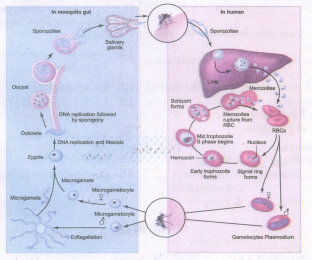
(i) Plasmodium vivax is a digenic parasite, involving two hosts, man as the secondary host and female Anopheles mosquito as the primary host. The life cycle of Plasmodium involves three phases namely schizogony, gamogony and sporogony (f.g)
(ii) The parasite first enters the human blood stream through the bite of an infected female Anopheles mosquito. As it feeds, the mosquito injects the saliva containing the sporozites.
(iii) The sporozoites within the blood stream enter the hepatic cells of the liver and undergoes multiple asexual fission (schizogony). This produces merozoites which are released from liver cells.
(iv) The merozoites penetrate the RBC's. Inside the RBC of Blood, the merozoite of Plasmodium to develop as unicellular trophozoites. The trophozoite grows in size and a central vacuole develops pushing them to one side of cytoplasm and becomes the signet ring stage.
(v)The trophozoite nucleus then divides asexually to produce the The schizont divides and produces on nucleated merozoites.
(vi) Eventually the erythrocyte lyses, releasing the merozoites and haemozoin toxin into the blood stream to infect other erythrocytes. Lysis of red blood cells results in cycles of fever and other symptoms. This erythrocytic stage is cyclic and repeats itself approximately every 48 to72 or longer depending on the species of Plasmodium involved. The sudden release of merozoites triggers an attack on the RBCs.
(vii) Occasionally, merozoites differentiate into macrogametocytes and microgametocytes When these are ingested by a mosquito, they develop into male and female gametes respectively
In the mosquito's gut, the infected erythrocytes lyse and male and female gametes fertilize to form a diploid zygote called ookinete. The ookinete migrates to the mosquito's gut wall and develops into an oocyte.
The oocyte undergoes meiosis by a process called sporogony to form sporozoites. These sporozoites migrate to the salivary glands of the mosquito. The cycle is now completed and when the mosquito bites another human host, the sporozoites are injected and the cycle begins a new.
The pathological changes caused by malaria, affect not only the erythrocytes but also the spleen and other visceral organs. Incubation period of malaria is about 12 days. The early symptoms of malaria are headache, nausea and muscular pain. The classic symptoms first develop with the synchronized release of merozoites, hemozoin toxin and erythrocyte debris into the bloodstream resulting in malarial paroxysms - shivering chills, high fever followed by sweating. Fever and chills are caused partly by malarial toxins that induce macrophages to release tumor necrosis factor (TNF-a) and interleukin.
20.
The different types of antigen-antibody reaction are:
(i) Precipitin: The reaction between soluble antigen and antibody leads to visible precipitate formation, which is called precipitin reaction. Antibodies that bring about precipitate formation on reacting with antigens are called as precipitins.
(ii) Agglutinstion: Whenever a particulate antigen interacts with its antibody, it would result in clumping or agglutination of the particulate antigen, which is called agglutination reaction. The antibody involved in bringing about agglutination reaction is called agglutinin.
(iii) Opsonisation: Opsonisation or enhanced attachment is the process by which a pathogen is marked of ingestion and destruction by a phagocyte. Opsonisation involves the binding of an opsonin i.e., antibody, to a receptor on the pathogen's cell membrane. After opsonin binds to the membrane, phagocytesare attracted to the pathogen. So, opsonisation is a process in which pathogens are coated with a substance called an opsonin, marking the pathogen out for destruction by the immune system. This results in a much more efficient phagocytosis.
(iv) Neutralization: The neutralization reactions are the reactions or antigenantibody that involve the climinai ion of harmful effects of bacterial exotoxins or a virus by specific antibodies. These neutralizing substances i.e., antibodies are known as antitoxins. This specific antibody is produced by a host cell in response to a bacterial exotoxin or corresponding toxoid.
21.
(i) Thalassemia is an autosomal recessive disorder. It is caused by gene mutation resulting in excessive destruction of RBC's due to the formation of abnormal haemoglobin molecules. Normally haemoglobin is composed of four polypeptide chains, two ph and two bet globin chains. Thalassemia patients have defects in either the alpha or beta globin chain causing the production of abnormal haemoglobin molecules resulting in anaemia.
(ii) Thalassemia. is classified into alpha and beta based on which chain of haemoglobin molecule is affected. It is controlled by two closely linked genes HBAI and HBA2 on chromosome 16.Mutation or deletion of one or more of the four alpha gene alleles causes Alpha Thalassemia. In Beta Thalassemia, production of beta globin chain is affected. It is controlled by a single gene (HBB) on chromosome 11. It is the most common type of Thalassemia and is also known as Cooley's anaemia. In this disorder the alpha chain production is increased and damages the membranes of RBC

12th Standard Syllabus & Materials
12th Standard
TN 12th Computer Applications களப்பெயர் முறைமை (DNS) Sample Question Papers Study Material - QB365 Set A
NEW12th Standard
TN 12th Computer Applications வலையமைப்பு எடுத்துக்காட்டுகள் மற்றும் நெறிமுறைகள் Sample Question Papers Study Material - QB365 Set A
NEW12th Standard
TN 12th Computer Applications கணினி வலையமைப்பு ஓர் அறிமுகம் Sample Question Papers Study Material - QB365 Set A
NEW12th Standard
TN 12th Computer Applications PHP-உடன் MySQL-ஐ இணைத்தல் Sample Question Papers Study Material - QB365 Set A



Tamilnadu Stateboard 12th Standard Subjects

Maths

Chemistry

Physics
Biology

Computer Science

Business Maths and Statistics

Economics

Commerce

Accountancy

History

Computer Applications
Biology
Computer Technology
Computer Applications
Computer Science
Business Maths and Statistics
Commerce
Economics
Maths
Chemistry
Physics
Computer Technology
History
Accountancy

Tamil

English

French
Tamilnadu Stateboard Standards

