
 100% FREE ACCESS
12th Standard Syllabus & Materials
12th Standard
TN 12th Computer Applications மின்னணு தரவு பரிமாற்றம் Sample Question Papers Study Material - QB365 Set A
NEW12th Standard
TN 12th Computer Applications மின் - வணிக பாதுகாப்பு அமைப்புகள் Sample Question Papers Study Material - QB365 Set A
NEW12th Standard
TN 12th Computer Applications மின்னணு செலுத்தல் முறைகள் Sample Question Papers Study Material - QB365 Set A
NEW12th Standard
TN 12th Computer Applications மின் - வணிகம் Sample Question Papers Study Material - QB365 Set A
NEW12th Standard
TN 12th Computer Applications திறந்த மூல கருத்துருக்கள் Sample Question Papers Study Material - QB365 Set A
NEW12th Standard
TN 12th Computer Applications வலையமைப்பு வடமிடல் Sample Question Papers Study Material - QB365 Set A

Published on: 29/01/2021
12th Standard Biology English Medium principles and processes of Bio-technology Reduced Syllabus Important Questions 2021
Download Tamil Nadu 12th Standard Biology question papers, model tests, one-mark questions, important questions, and public exam papers in PDF format. Free study materials and answer keys for TN State Board students.
Questions + Answers key
Take MCQ Biology Test1.
Statement 1: DNA is a hydrophobic molecule.
Statement 2: T-DNA is a part of E-coli plasmid.
Statement 1 is correct and Statement 2 is also correct.
Statement 1 is correct and Statement 2 is incorrect.
Both the statements are incorrect.
Statement 1 is incorrect and Statement 2 is correct.
2.
Select the correct restriction enzyme which breaks the phosphodiester bond within a DNA molecule.
(i) Ba131
(ii) Hind II
(iii) BamHI
(iv) Pvul
i and iii
i, ii and iii
ii, iii and iv
i only
3.
Identify the incorrect statement:
French chemist Louis Pasteur demonstrated the fermentation.
Fermentor is a vessel providing optimal condition for microbial action.
Solvent extraction is an upstream process of fermentation.
Distillation and filtration comes under down stream process.
4.
Which of the following person coined the term biotechnology?
Ernst Hoppe
Stanley Cohen
Ian Wilmet
Karl Ereky
5.
An antibiotic gene in a vector usually helps in the selection of ______.
Competent cells
Transformed cells
Recombinant cells
None of the above
6.
An analysis of chromosomal DNA using the southern hybridisation technique does not use _____.
Electrophoresis
Blotting
Autoradiography
Polymerase Chain Reaction
7.
Which one of the following is not correct statement
Ti plasmid causes the bunchy top disease
Multiple cloning site is known as Polylinker
Non viral method transfection of Nucleic acid in cell
Polylactic acid is a kind of biodegradable and bioactive thermoplastic.
8.
Assertion (A): Agrobacterium tumefaciens is popular in genetic engineering because this bacterium is associated with the root nodules of all cereals and pulse crops
Reason(R): A gene incorporated in the bacterial chromosomal genome gets automatically transferred to the cross with which bacterium is associated.
Both assertion and reason are true. But reason is correct explanation of assertion.
Both assertion and reason are true. But reason is not correct explanation of assertion.
Assertion is true, but reason is false.
Assertion is false, but reason is true
Both assertion and reason are false.
9.
10.
Consider the following statements:
I. Recombinant DNA technology is popularly known as genetic engineering is a stream of biotechnology which deals with the manipulation of genetic materials by man invitro
II. pBR322 is the first artificial cloning vector developed in 1977 by Boliver and Rodriguez from E.coli plasmid
III. Restriction enzymes belongs to a class of enzymes called nucleases.
Choose the correct option regarding above statements
I & II
I & III
II & III
I,II & III
11.
Explain the procedure of Southern Blotting Technique. Southern Blotting Techniques - DNA
12.
Explain Agarose Gel electrophoresis technique.
13.
Explain the steps involved in recombinant DNA technology
14.
Explain how fermentation is done in bioreactor ?
15.
16.
Write the advantages of herbicide tolerant crops
17.
18.
Mention the application of Biotechnology.
19.
How do you use the biotechnology in modern practice?
20.
Explain a method for screening of recombinant Plasmid
21.
How turmeric biopiracy is prevented by Indian Government?
22.
What is antibiotic resistant marker.
23.
How does shuttle vectors differ from other types of vectors?
24.
What is the naming procedure for restriction endonuclease? Give an example
25.
What is SCP? Mention its nutritional value.
26.
Mention any three historical events which took place in the 21st century for the development of biotechnology.
27.
28.
How will you identify a vector ?
29.
What are restriction enzyme. Mention their type with role in Biotechnology.
30.
You are working in a biotechnology lab with a bacterium namely E.coli. How will you cut the nucleotide sequence? explain it.
31.
Observe the given flow chart and complete it.
32.
Define the terms (i) Bioventing (ii) Bioaugmentation
33.
What is Biopharming?
34.
Write an palindrome sequence of DNA.
35.
How microbial enzymes are produced? Mention its significance.
36.
Define fermentation.
37.
Write about the modern biotechnology.
38.
What are the enzymes you can used to cut terminal end and internal phospho di ester bond of nucleotide sequence?
1.
(c)
Both the statements are incorrect.
2.
(c)
ii, iii and iv
3.
(c)
Solvent extraction is an upstream process of fermentation.
4.
(d)
Karl Ereky
5.
(b)
Transformed cells
6.
(d)
Polymerase Chain Reaction
7.
(a)
Ti plasmid causes the bunchy top disease
8.
(a)
Both assertion and reason are true. But reason is correct explanation of assertion.
9.
(d)
10.
(d)
I,II & III
11.
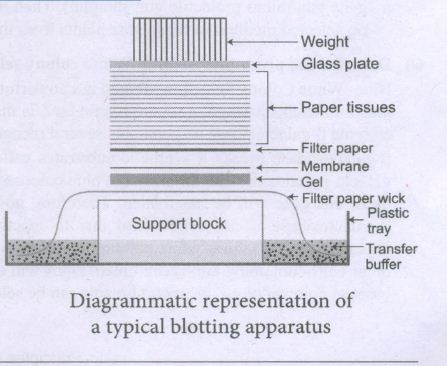
The transfer of denatured DNA from Agarose gel to Nitrocellulose Blotting or Filter Paper technique was introduced by Southern in 1975 and this technique is called Southern Blotting Technique.
steps
The transfer of DNA from agarose gel to nitrocellulose filter paper is achieved by Capillary Action. A buffer Sodium Saline Citrate (SSC) is used, in which DNA is highly soluble, it can be drawn up through the gel into the Nitrocellulose membrane By this process ss-DNA becomes 'Trapped' in the membrane matrix. This DNA is hybridized with a nucleic acid and can be detected by autoradiography. Autoradiography - A technique that captures the image formed in a photographic emulsion due to emission of light or radioactivity from a labelled component placed together with unexposed film.
12.
Agarose Gel Electrophoresis is used mainly for the purification of specific DNA fragments. Agarose is convenient for separating DNA fragments ranging in size from a few hundred to about 20000 base pairs. Polyacrylamide is preferred for the purification of smaller DNA fragments. The gel is complex network of polymeric molecules. DNA molecule is negatively charged molecule - under an electric field DNA molecule migrates through the gel. The electrophoresis is frequently performed with marker DNA fragments of known size which allow accurate size determination of an unknown DNA molecule by interpolation. The advantages of agarose gel electrophoresis are that the DNA bands can be readily detected at high sensitivity. The bands of DNA in the gel are stained with the dye Ethidium Bromide and DNA can be detected as visible fluorescence illuminated in UV light will give orange fluorescence, which can be photographed.
13.
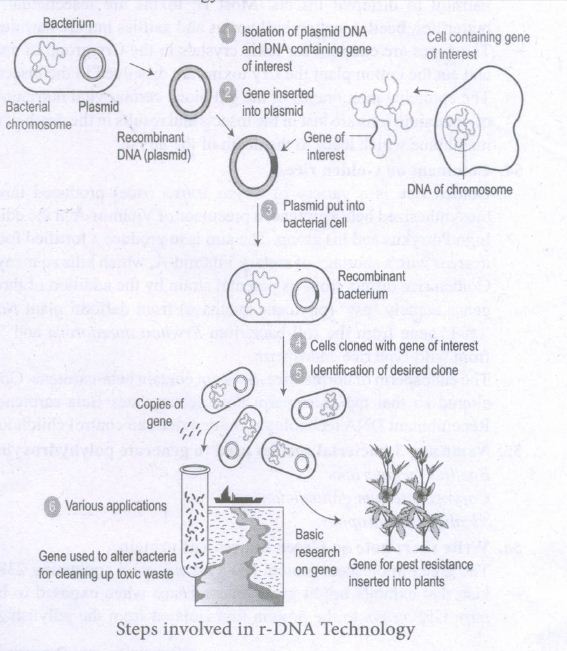
The steps involved in recombinant DNA technology are:
(i) Isolation of a DNA fragment containing a gene of interest that needs to be cloned. This is called an insert.
(ii) Generation of recombinant DNA (rDNA) molecule by insertion of the DNA fragment into a carrier molecule called a vector that can self-replicate within the host cell.
(iii) Selection of the transformed host cells that is carrying the rDNA and allowing them to multiply thereby multiplying the rDNA molecule.
(iv) The entire process thus generates either a large amount of rDNA or a large amount of protein expressed by the insert.
(v) Wherever vectors are not involved the desired gene is multiplied by PCR technique. The multiple copies are injected into the host cell protoplast or it is shot into the host cell protoplast by shot gun method.
14.
Procedure of Fermentation
a. Depending upon the type of product, bioreactor is selected.
b. A suitable substrate in liquid media is added at a specific temperature, pH and then diluted.
c. The organism (microbe, animal/plant cell, sub-cellular organelle or enzyme) is added to it.
d. Then it is incubated at a specific temperature for the specified time.
e. The incubation may either be aerobic or anaerobic.
f. Withdrawal of product using downstream processing methods.
15.
16.
Advantages of Herbicide Tolerant Crops:
1. Weed control improves higher crop yields;
2. Reduces spray of herbicide;
3. Reduces competition between crop plant and weed;
4. Use of low toxicity compounds which do not remain active in the soil; and
5. The ability to conserve soil structure and microbes.
17.
18.
Applications of Biotechnology
1. Biotechnology is one of the most important applied interdisciplinary sciences of the 21st century. It is the trusted area that enables us to find the beneficial way of life.
2. Biotechnology has wide applications in various sectors like agriculture, medicine, environment and commercial industries.
3. This science has an invaluable outcome like transgenic varieties of plants e.g. transgenic cotton (Bt-cotton), rice, tomato, tobacco, cauliflower, potato and banana.
4. The development of transgenics as pesticide resistant, stress resistant and disease resistant varieties of agricultural crops is the immense outcome of biotechnology.
5. The synthesis of human insulin and blood protein in E.coli and utilized for insulin deficiency disorder in human is a breakthrough in biotech industries in medicine.
6. The synthesis of vaccines, enzymes, antibiotics, dairy products and beverages are the products of biotech industries.
7. Biochip based biological computer is one of the successes of biotechnology.
8. Genetic engineering involves genetic manipulation, tissue culture involves aseptic cultivation of totipotent plant cell into plant clones under controlled atmospheric conditions.
9. Single cell protein from Spirulina is utilized in food industries.
10. Production of secondary metabolites, biofertilizers, biopesticides and enzymes.
11. Biomass energy, biofuel, bioremediation and phytoremediation for environmental biotechnology.
19.
Modern biotechnology
(i) There are two main features of this technology, that differentiated it from the conventional technology are its
i) ability to change the genetic material for getting new products with specific requirements through recombinant DNA technology
ii) ownership of the newly developed technology and its social impact.
(ii) Modern biotechnology embraces all methods of genetic modification by recombinant DNA and cell fusion technology.
The major focus of biotechnology are
(i) Fermentation for production of acids, enzymes, alcohols, antibiotics, fine chemicals, vitamins and toxins
(ii) Biomass for bulk production of single cell protein , alcohol, and biofuel
(iii) Enzymes as biosensors, in processing industry
(iv) Biofuels for production of hydrogen, alcohol, methane
(v) Microbial inoculants as biofertilizer, and nitrogen fixers
(vi) Plant and animal cell culture for production of secondary metabolites, monoclonal antibodies
(vii) Recombinant DNA technology for production of fine chemicals, enzymes, vaccines, growth hormones, antibiotics, and interferon.
(viii) Process engineering - tools of biotechnology is used for effluent treatment , water recycling.
20.
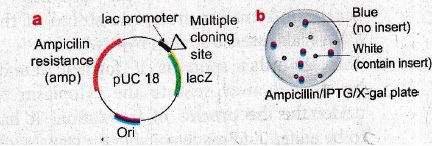
(i) Blue- White Colony Selection Method is a powerful method used for screening of recombinant plasmid.
(ii) In this method, a reporter gene lacZ is inserted in the vector.
(iii) The lacZ encodes the enzyme β-galactosidase and contains several recognition sites for restriction enzyme.
(iv) β-galactosidase breaks a synthetic substrates called X-gal (5-bromo - 4 -chloroindolyl- β-D-galactose- pyranoside) into an insoluble blue coloured product.
(v) If a foreign gene is inserted into lacZ, this gene will be inactivated. Therefore, no-blue colour will develop (white) because β-galactosidase is not synthesized due to inactivation of lacZ.
(vi)Therefore, the host cell containing r-DNA form white coloured colonies on the medium contain X-gal, whereas the other cells containing non-recombinant DNA will develop the blue coloured colonies.
(vii) On the basis of colony colour, the recombinants can be selected.
21.
The United States Patent and Trademark Office, in the year 1995 granted patent to the method of use of turmeric as an antiseptic agent. Turmeric has been used by the Indians as a home remedy for the quick healing of the wounds and also for purpose of healing rashes. The journal article published by the Indian Medical Association, in the year 1953 wherein this remedy was mentioned. Therefore, in this way it was proved that the use of turmeric as an antiseptic is not new to the world and is not a new invention, but formed a part of the traditional knowledge of the Indians. The objection in this case US patent and trademark office was upheld and traditional knowledge of the Indians was protected.
22.
An antibiotic resistance marker is a gene that produces a protein that provides cells with resistance to an antibiotic. Bacteria with transformed DNA can be identified by growing on a medium containing an antibiotic. Recombinants will grow on these medium as they contain genes encoding resistance to antibiotics such as ampicillin, chloramphenicol, tetracycline or kanamycin, etc., while others may not be able to grow in these media, hence it is considered useful selectable marker.
23.
The shuttle vectors are plasmids designed to replicate in cells of two different species. These vectors are created by recombinant techniques. The shuttle vectors can propagate in one host and then move into another host without any extra manipulation. Most of the Eukaryotic vectors are Shuttle Vectors
24.
(i) Restriction endonucleases are named by a standard procedure.
(ii) The first letter of the enzymes indicates the genus name, followed by the first two letters of the species, then comes the strain of the organism and finally a roman numeral indicating the order of discovery.
For example, EeoRl is from Escherichia (E) coli (co), strain RY 13 (R) and first endonuclease (I) to be discovered.
25.
Single Cell Protein (SCP) are dried cells of microorganisms that are used as protein supplement in human foods or animal feeds. SCP are rich in proteins, aminoacids, vitamins, carbohydrates, fats and minerals. It is used as food source by Astronauts and Antarctica expedition scientists.
26.
2002 - First crop plant genome sequenced in Oryza sativa.
2003 - Human genome project is completed, providing information on the locations and sequence of human genes on all 46 chromosomes.
2016 - Stem cells injected into stroke patients re-enable patient to walk - Stem cell therapy.
27.
28.
Properties of Vectors:
1. Vectors are able to replicate autonomously to produce multiple copies of them along with their DNA insert in the host cell.
2. It should be small in size and of low molecular weight, less than 10 Kb (kilo base pair) in size so that entry/transfer into host cell is easy.
3. Vector must contain an origin of replication so that it can independently replicate within the host.
4. It should contain a suitable marker such as antibiotic resistance, to permit its detection in transformed host cell.
5. Vector should have unique target sites for integration with DNA insert and should have the ability to integrate with DNA insert it carries into the genome of the host cell. Most of the commonly used cloning vectors have more than one restriction site. These are Multiple Cloning Site (MCS) or polylinker. Presence of MCS facilitates the use of restriction enzyme of choice.
29.
A restriction enzyme or restriction endonuclease is an enzyme that cleaves DNA into fragments at or near specific recognition sites within the molecule known as restriction sites.
Types
(i) Exonucleases - which remove nucleotides one at a time from the end of a DNA molecule. e.g. Bal 31, Exonuclease III.
(ii) Endonucleases - which break the internal phosphodiester bonds within a DNA molecule. e.g. Hind II, EcoRI, PvulI, BamHI, TaqI.
(iii) The restriction enzymes are called as molecular scissors
(iv) They are used in recombinant DNA technology as they recognize & cut DNA within a specific sequence.
30.
(i) ECORI is from Escherichia ( E ) coli (co), strain RY 13 (R) & first endonuclease (I) to be discovered.
(ii) It contains 2 different antibiotics resistance genes & recognition site for several restriction enzymes.
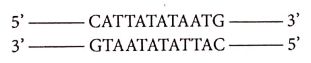
(iii) This sequence is referred to as a restriction site & is generally -palindromic which means that the sequence in both DNA strands at this site read same in 5' - 3' direction & in-the 3'-5' direction.
(iv) The exact kind of cleavage produced by a restriction enzyme is important in the design of a gene cloning experiment.
(v) Some cleave both strands of DNA through the centre resulting in blunt or flush end.
(vi) These are known as symmetric cuts.
(vii) Some enzymes cut in a way producing protruding & recessed ends known as sticky or cohesive end.
(viii) These are known as staggered or asymmetric cuts.
31.
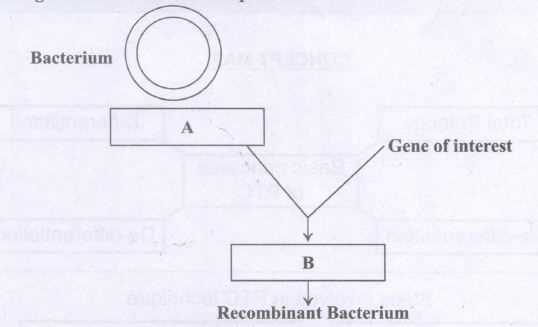
A. Plasmid
B. rDNA / chimeric DNA
32.
(i) Bioventing is the process that increases the oxygen or air flow to accelerate the degradation of environmental pollutants.
(ii) Bioaugmentation is the addition of selected microbes to speed up degradation process.
33.
Biopharming also known as molecular pharming is the production and use of transgenic plants genetically engineered to produce pharmaceutical substances for use of human beings. This is also called "molecular farming or pharming". These plants are different from medicinal plants which are naturally available.
34.
5' CATTATATAATG 3'
3' GTAATATATTAC 5'
35.
When microbes are cultured, they secrete some enzymes into the growth media. These enzymes are industrially used in detergents, food processing, brewing and pharmaceuticals.
E.g. Protease, amylase, isomerase, and lipase.
36.
Fermentation refers to the metabolic process in which organic molecules (normally glucose) are converted into acids, gases, or alcohol in the absence of oxygen or any electron transport chain with oxygen.
37.
There are two main features of modem biotechnology, that differentiated it from the conventional technology are its:
(i) ability to change the genetic material for getting new products with specific requirement through recombinant DNA technology
(ii) ownership of the newly developed technology and its social impact.
38.
Restriction endonuclease. e.g: Hind II, EcoR I, Pvul, Bam H I, Taq I.

12th Standard Syllabus & Materials
12th Standard
TN 12th Computer Applications களப்பெயர் முறைமை (DNS) Sample Question Papers Study Material - QB365 Set A
NEW12th Standard
TN 12th Computer Applications வலையமைப்பு எடுத்துக்காட்டுகள் மற்றும் நெறிமுறைகள் Sample Question Papers Study Material - QB365 Set A
NEW12th Standard
TN 12th Computer Applications கணினி வலையமைப்பு ஓர் அறிமுகம் Sample Question Papers Study Material - QB365 Set A
NEW12th Standard
TN 12th Computer Applications PHP-உடன் MySQL-ஐ இணைத்தல் Sample Question Papers Study Material - QB365 Set A



Tamilnadu Stateboard 12th Standard Subjects

Maths

Chemistry

Physics
Biology

Computer Science

Business Maths and Statistics

Economics

Commerce

Accountancy

History

Computer Applications
Biology
Computer Technology
Computer Applications
Computer Science
Business Maths and Statistics
Commerce
Economics
Maths
Chemistry
Physics
Computer Technology
History
Accountancy

Tamil

English

French
Tamilnadu Stateboard Standards

