
 100% FREE ACCESS
12th Standard Syllabus & Materials
12th Standard
TN 12th Maths Applications of Matrices and Determinants Sample Question Papers Study Material - QB365 Set A
NEW12th Standard
TN 12th Computer Applications மின்னணு தரவு பரிமாற்றம் Sample Question Papers Study Material - QB365 Set A
NEW12th Standard
TN 12th Computer Applications மின் - வணிக பாதுகாப்பு அமைப்புகள் Sample Question Papers Study Material - QB365 Set A
NEW12th Standard
TN 12th Computer Applications மின்னணு செலுத்தல் முறைகள் Sample Question Papers Study Material - QB365 Set A
NEW12th Standard
TN 12th Computer Applications மின் - வணிகம் Sample Question Papers Study Material - QB365 Set A
NEW12th Standard
TN 12th Computer Applications திறந்த மூல கருத்துருக்கள் Sample Question Papers Study Material - QB365 Set A

Published on: 29/01/2021
12th Standard Bio-Botany English Medium Principles Of Ecology Reduced Syllabus Important Questions 2021
Download Tamil Nadu 12th Standard Biology question papers, model tests, one-mark questions, important questions, and public exam papers in PDF format. Free study materials and answer keys for TN State Board students.
Questions + Answers key
Take MCQ Biology Test1.
Assertion (A) : Plains and valleys are rich in vegetation
Reason (R): Slow drain of surface water and better water retention is noticed.
A is true R is false
R explains A
A and R are false
A and R are true. But R does not explains A
2.
Statement 1: Ephemerals are drought evaders.
Statement 2: They are not true xerophytes.
Statement 1 is correct. Statement 2 is incorrect.
Statement 1 is incorrect. Statement 2 is correct.
Both the statements are correct.
Both the statements are incorrect
3.
Statement 1: Holoparasites depend totally on other organisms for nutrition.
Statement 2: Durnta is holoparasite.
Statement 1 is correct. Statement 2 is incorrect.
Statement 1 is incorrect. Statement 2 is correct
Both the statements are correct.
Both the statements are incorrect
4.
Autecology deals with the study of ___________.
Community
Population
Individual species
Niche of species
5.
Match the following and choose the correct combination from the options given below:
| Column I (Interaction) | Column II (Examples) |
| I. Mutualism II. Commensalism III. Parasitism IV. Predation V. Amensalism |
i) Trichoderma and Penicillium ii) Balanophora, Orobanche iii) Orchids and Ferns iv) Lichen and Mycorrhiza v) Nepenthes and Diaonaea |
| I | II | III | IV | V |
| i | ii | iii | iv | v |
| I | II | III | IV | V |
| ii | iii | iv | v | i |
| I | II | III | IV | V |
| iii | iv | v | i | ii |
| I | II | III | IV | V |
| iv | iii | ii | v | i |
6.
In a fresh water environment like pond, rooted autotrophs are ______.
Nymphaea and typha
Ceratophyllum and Utricularia
Wolffia and pistia
Azolla and lemna
7.
A free living nitrogen fixing cyanobacterium which can also form symbiotic association with the water fern Azolla ______.
Nostoc
Anabaena
chlorella
Rhizobium
8.
Column I represent the size of the soil particles and Column II represents type of soil components. Which of the following is correct match for the Column I and Column II
| Column - I | Column - II |
| I) 0.2 to 2.00 mm | i) Slit Soil |
| II) Less than 0.002 mm | ii) Clayey Soil |
| III) 0.002 to 0.02 mm | iii) Sandy Soil |
| IV) 0.002 to 0.2 mm | iv) Loamy Soil |
| I | II | III | IV |
| ii | iii | iv | i |
| I | II | III | IV |
| iv | i | iii | ii |
| I | II | III | IV |
| iii | ii | i | iv |
None of the above
9.
10.
11.
Read the given statements and select the correct option.
i) Loamy soil is best suited for plant growth as it contains a mixture of silt, sand and clay.
ii) The process of humification is slow in case of organic remains containing a large amount of lignin and cellulose.
iii) Capillary water is the only water available to plant roots as it is present inside the micropores.
iv) Leaves of shade plant have more total chlorophyll per reaction centre, low ratio of chl a and chl b are usually thinner leaves.
i, ii and iii only
ii, iii and iv only
i, ii and iv only
ii and iii only
12.
Which of the given plant produces cardiac glycosides?
Calotropis
Acacia
Nepenthes
Utricularia
13.
Read the given statements and select the correct option.
i) Hydrophytes possess aerenchyma to support themselves in water.
ii) Seeds of Viscum are positively photoblastic as they germinate only in presence of light.
iii) Hygroscopic water is the only soil water available to roots of plant growing in soil as it is present inside the micropores.
iv) High temperature reduces use of water and solute absorption by roots
i, ii, and iii only
ii, iii and iv
ii and iii only
i and ii only
14.
A specific place in an ecosystem, where an organism lives and performs its functions is _____.
habitat
niche
landscape
biome
15.
Arrange the correct sequence of ecological hierarchy starting from lower to higher level.
Individual organism → Population Landscape → Ecosystem
Landscape → Ecosystem → Biome → Biosphere
community → Ecosystem → Landscape → Biome
Population → organism → Biome → Landscape
16.
Point out any two morphological adaptations noticed in the roots of hydrophytes.
17.
Mention any four topographic factors that affect vegetation.
18.
Given below are few types of plants. Mention their habitats.
(a) Halophytes
(b) Chasmophytes
(c) Cryophytes
(d) Psammophytes.
19.
Compare Euryhaline organisms with stenohaline organisms.
20.
What are ecological factors?
21.
What is Niche?
22.
What is myrmecophily?
23.
How is rhytidome act as the structural defence by plants against fire?
24.
Why do submerged plants receive weak illumination than exposed floating plants in a lake?
25.
Lichen is considered as a good example of obligate mutualism. Explain.
26.
What is Phytoremediation ?
27.
Define ecology.
28.
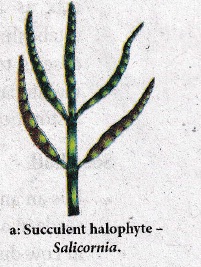
Point out the Anatomical adaptations exhibited by the Halophytes.
29.
What are epiphytes? Explain their characteristic features
30.
Explain briefly about the three types of fire.
31.
Differentiate habitat from niche.
32.
List out the effects of fire to plants.
33.
Water is very essential for life. Write any three features for plants which enable them to survive in water scarce environment.
34.
List any two adaptive features evolved in parasites enabling them to live successfully on their host?
35.
Distinguish habitat and niche
36.
Point out any five morphological adaptations of epiphytes.
37.
Explain various edaphic factors that affect vegetation.
38.
39.
40.
Enumerate the anatomical adaptations of xerophytes.
41.
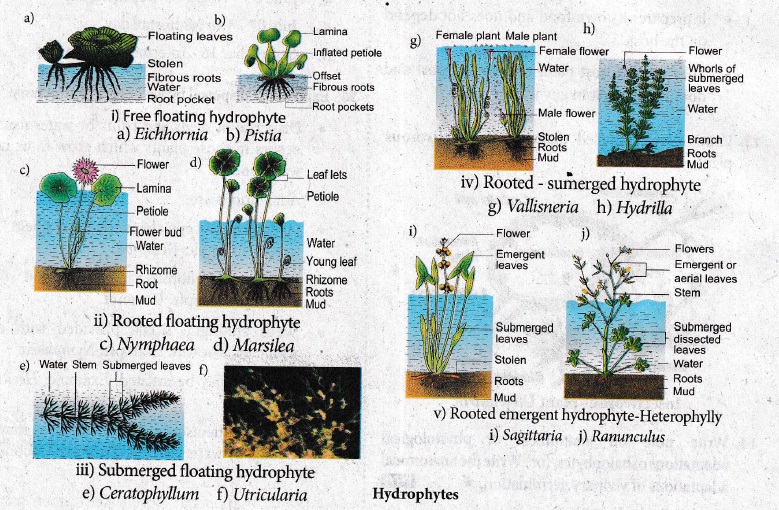
Explain different types of hydrophytes with examples.
42.
Describe the mutual relationship between the fig and wasp and comment on the phenomenon that operates in this relationship.
1.
(b)
R explains A
2.
(c)
Both the statements are correct.
3.
(c)
Both the statements are correct.
4.
(c)
Individual species
5.
(d)
| I | II | III | IV | V |
| iv | iii | ii | v | i |
6.
(a)
Nymphaea and typha
7.
(b)
Anabaena
8.
(c)
| I | II | III | IV |
| iii | ii | i | iv |
9.
(a)
10.
(c)
11.
(a)
i, ii and iii only
12.
(a)
Calotropis
13.
(d)
i and ii only
14.
(b)
niche
15.
(c)
community → Ecosystem → Landscape → Biome
16.
1. Roots are totally absent in Wolffia and Salvinia or poorly developed in Hydrilla or well developed in Ranunculus.
2. The root caps are replaced by root pockets. Example: Eichhornia
17.
(a) Latitude
(b) Altitude
(c) Direction of mountain and
(d) Steepness of mountain.
18.
(a) Halophytes: Plants living in saline soils.
(b) Chasmophytes: Plants living in rocky crevices.
(c) Cryophytes: Plants living in ice surface.
(d) Psammophytes: Plants living in sandy soils
19.
Euryhaline: Organisms which can live in water with wide range of salinity. Examples: Marine algae and marina angiosperms.
Stenohaline: Organisms which can withstand only small range of salinity. Example: Plants of estuaries.
20.
The environment (surrounding) includes physical, chemical and biological components. When a component surrounding an organism affects the life of an organism, it becomes a factor. All such factors together are called environmental factors or ecological factors.
21.
An ecological niche refers to an organism's place in the biotic environment and its functional role in an ecosystem.
22.
1. Sometimes, ants take their shelter on some trees such as mango, litchi, jamun, acacia etc.
2. These ants act as body guards of the plants against any disturbing agent and the plants in turn provide food and shelter to these ants.
3. This phenomenon is known as Myrmecophily.
Example: Acacia and, Acacia ants.
23.
1. The outer bark of trees which extends to the last formed periderm is called rhytidome.
2. It is composed of multiple layers of suberized periderm, cortical & phloem tissues.
3. It protects the stem against fire, water loss, invasion of insects & prevents infection by microorganisms.
24.
Submerged plants are unable to obtain full illumination because a lot of sunlight is absorbed by overlying layers of water this is not the case for exposed floating plants that receive sunlight directly.
25.
1. Lichen is a mutual association of an alga & a fungus.
2. It is an interaction between two species of organisms in which both are benefitted from the obligate association.
26.
Certain plants can also be used to remove cadmium from contaminated soil, this is known as phytoremediation.
Example: Eichhornia
27.
1. It deals with the study of environment in relation to organisms.
2. It can be studied by considering individual organisms, population, community, biome or biosphere and their environment.
28.
Anatomical adaptations:
1. Epidermal cells of stem is heavily cutinized, almost squarish and are filled with oil and tannins.
2. 'Star' shaped sclereids and 'H' shaped heavy thickened spicules that provide mechanical strength to cortex are present in the stem.
3. The leaves may be dorsiventral or isobilateral with salt secreting glands.
29.
The plants which are found growing on other plants without harming them are called epiphytes. They are commonly found in tropical rain forest.
The epiphytic higher plant (Orchids) gets its nutrients and water from the atmosphere with the help of their hygroscopic roots which contain special type of spongy tissue called Velamen. So it prepares its own food and does not depend on the host. They use the host plant only for support and does not harm.
30.
1. Ground fire - Which is flame less and subterranean.
2. Surface fire - Which consumes the herbs and shrubs.
3. Crown fire - Which burns the forest canopy.
31.
| S. No. | Habitat | Niche |
| 1 | A specific physical space occupied by an organism (species). | A functional space occupied by an organism in the same eco-system. |
| 2 | Same habitat may be shared by many organisms (species). | A single niche is occupied by a single species. |
| 3 | Habitat specificity is exhibited by organism. | Organisms may change their niche with time and season |
32.
(i) Ground fire: Which is flameless and subterranean.
(ii) Surface fire: Which consumes the herbs and shrubs.
(iii) Crown fire: Which burns the forest canopy.
Effects of fire
1. Fire has a direct lethal effect on plants.
2. Burning scars are the suitable places for the entry of parasitic fungi and insects.
3. It brings out the alteration of light, rainfall, nutrient cycle, fertility of soil, pH, soil flora and fauna.
4. Some fungi which grow in soil of burnt areas called pyrophilous.
Example: Pyronema confluens
33.
(a) Life cycle is completed within a short period (Ephemerals)
(b) In succulents the stem possess a water storage region
(c) Root hairs & root caps are also well developed
34.
1. Cuscuta is a total stem parasite of the host plant Acacia, Duranta and many other plants Cuscuta even gets flower inducing hormone from its host Plant.
2. Balanophora, orobanche and Refflesia are the total root parasites found on higher plants.
35.
The differences between habitat and niche are as follows.
| S. No | Habitat | Niche |
| 1 | A specific physical space occupied by an organism (species). | A functional space occupied by an organism in the same eco-system |
| 2 | Same habitat may be shared by many organisms (species). | A single niche is occupied by a single species. |
| 3 | Habitat specificity is exhibited by organism. | Organisms may change their niche with time and season |
36.
Morphological adaptations:
Root system is extensively developed. These roots may be of two types. They are Clinging roots and Aerial roots.
Clinging roots fix the epiphytes firmly on the surface of the supporting objects.
Aerial roots are green coloured roots which may hang downwardly and absorb moisture from the atmosphere with the help of a spongy tissue called velamen.
1. Stem of some epiphytes are succulent and develop pseudo bulb or tuber.
2. Generally the leaves are lesser in number and may be fleshy and leathery.
3. Myrmecophily is a common occurrence in the epiphytic vegetation to prevent the predators
4. The fruits and seeds are very small and usually dispersed by wind, insects and birds.
37.
The important edaphic factors which affect vegetation are as follows:
1. Soil moisture: Plants absorbs rain water and moisture directly from the air.
2. Soil water: Soil water is more important than any other ecological factors affecting the distribution of plants. Rain is the main source of soil water. Capillary water held between pore spaces of soil particles and angles between them is the most important form of water available to the plants.
3. Soil reactions: Soil may be acidic or alkaline or neutral in their reaction. pH value of the soil solution determines the availability of plant nutrients. The best pH range of the soil for cultivation of crop plants is 5.5 to 6.8.
4. Soil nutrients: Soil fertility and productivity is the ability of soil to provide all essential plant nutrients such as minerals and organic nutrients in the form of ions.
5. Soil temperature: Soil temperature of an area plays an important role in determining the geographical distribution of plants. Low temperature reduces use of water and solute absorption by roots.
6. Soil atmosphere: The spaces left between soil particles are called pore spaces which contains oxygen and carbon-di-oxide.
7. Soil organisms: Many organisms existing in the soil like bacteria, fungi, algae, protozoans, nematodes, insects and earthworms, etc., are called soil organisms.
38.
39.
40.
The plants which are living in dry or xeric condition are known as Xerophytes.
Xerophytic habitat can be of two different types They are:
(a) physical dryness: In these habitats, soil has a little amount of water due to the inability of the soil to hold water because of low rainfall.
(b) physiological dryness: In these habitats, water is sufficiently present but plants are unable to absorb it because of the absence of capillary spaces. Example: Plants in salty and acidic soil.
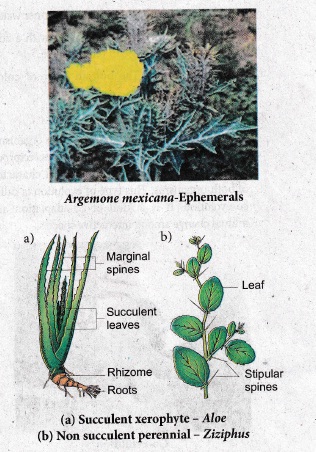
Based on adaptive characters xerophytes are classified into three categories. They are Ephemerals, Succulents and Non - succulent plants.
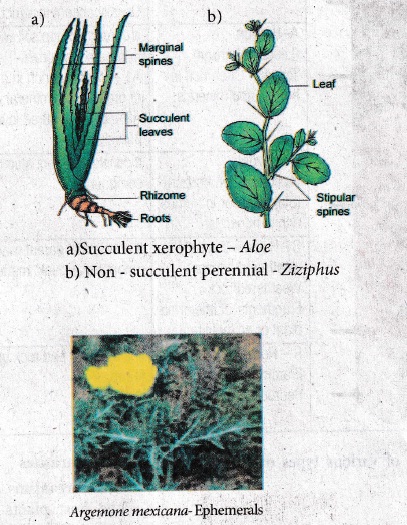
(i) Ephemerals: These are also called drought escapers or drought evaders. These plants complete their life cycle within a short period (single season). These are not true xerophytes. Examples: Argemone, Mollugo, Tribulus and Tephrosia.
(ii) Succulents: These are also called drought enduring plants. These plants store water in their plant parts during the dry period. These plants develop certain adaptive characters to resist extreme ,drought conditions. Examples: Opuntia, Aloe, Bryophyllum and Begonia.
(iii) Non succulents: These are also called drought resistant plants ( true xerophytes). They face both external and internal dryness. They have many adaptations to resist dry conditions. Examples: Casuarina, Nerium, Zizyphus and Acacia.
41.
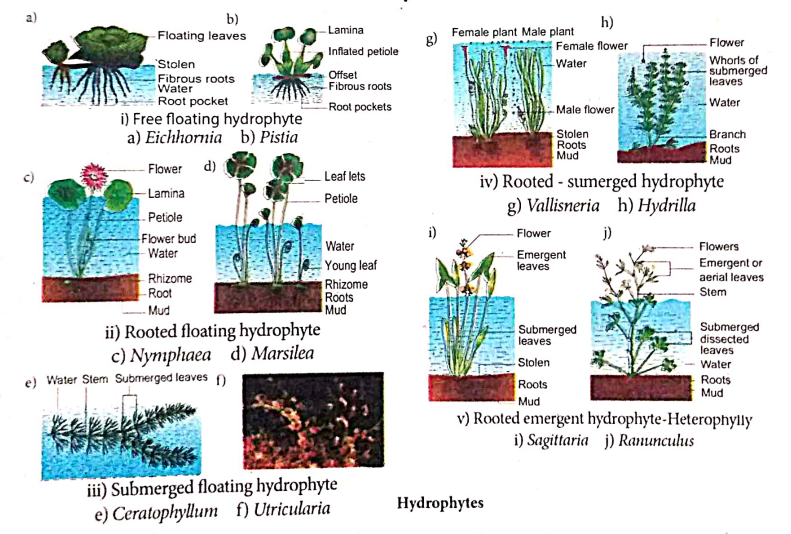
i. Free floating hydrophytes: These plants float freely on the surface of water. They remain in contact with water and air, but not with soil. Examples: Eichhornia, Pistia and Wolffia (smallest flowering plant).
ii. Rooted floating hydrophytes: In these plants, the roots are fixed in mud, but their leaves and flowers are floating on the surface of water. These plants are in contact with soil, water and air. Examples: Nelumbo, Nymphaea, Potomogeton and Marsilea. Lotus seeds showing highest longevity in plant kingdom.
iii. Submerged floating hydrophytes: These plants are completely submerged in water and not in contact with soil and air. Examples: Ceratophyllum and Utricularia.
iv. Rooted-submerged hydrophytes: These plants are completely submerged in water and rooted in soil and not in contact with air. Examples: Hydrilla, Vallisneria and Isoetes.
v. Amphibious hydrophytes (Rooted emergent hydrophytes): These plants are adapted to both aquatic and terrestrial modes of life. They grow in shallow water. Examples: Ranunculus, Typha and Sagittaria.
42.
1. In many species of fig trees, there is a one-to one relationship with the pollinator species of wasp. It means that a given fig species can be pollinated only by its 'partner' wasp species & no other species.
2. The female wasp uses the fruit not only as an oviposition (egg, laying) site but uses the developing seeds within the fruit for nourishing its larvae.
3. The wasp pollinates the fig inflorescence while searching for suitable egg-laying sites.
4. In return for the favour of pollination the fig offers the wasp, some of its developing seeds, as food for the developing wasp larvae.
5. The relationship that operates here is co-evolution.

12th Standard Syllabus & Materials
12th Standard
TN 12th Computer Applications வலையமைப்பு வடமிடல் Sample Question Papers Study Material - QB365 Set A
NEW12th Standard
TN 12th Computer Applications களப்பெயர் முறைமை (DNS) Sample Question Papers Study Material - QB365 Set A
NEW12th Standard
TN 12th Computer Applications வலையமைப்பு எடுத்துக்காட்டுகள் மற்றும் நெறிமுறைகள் Sample Question Papers Study Material - QB365 Set A
NEW12th Standard
TN 12th Computer Applications கணினி வலையமைப்பு ஓர் அறிமுகம் Sample Question Papers Study Material - QB365 Set A



Tamilnadu Stateboard 12th Standard Subjects

Maths

Chemistry

Physics
Biology

Computer Science

Business Maths and Statistics

Economics

Commerce

Accountancy

History

Computer Applications
Biology
Computer Technology
Computer Applications
Computer Science
Business Maths and Statistics
Commerce
Economics
Maths
Chemistry
Physics
Computer Technology
History
Accountancy

Tamil

English

French
Tamilnadu Stateboard Standards

