
 100% FREE ACCESS
12th Standard Syllabus & Materials
12th Standard
TN 12th Computer Applications மின்னணு தரவு பரிமாற்றம் Sample Question Papers Study Material - QB365 Set A
NEW12th Standard
TN 12th Computer Applications மின் - வணிக பாதுகாப்பு அமைப்புகள் Sample Question Papers Study Material - QB365 Set A
NEW12th Standard
TN 12th Computer Applications மின்னணு செலுத்தல் முறைகள் Sample Question Papers Study Material - QB365 Set A
NEW12th Standard
TN 12th Computer Applications மின் - வணிகம் Sample Question Papers Study Material - QB365 Set A
NEW12th Standard
TN 12th Computer Applications திறந்த மூல கருத்துருக்கள் Sample Question Papers Study Material - QB365 Set A
NEW12th Standard
TN 12th Computer Applications வலையமைப்பு வடமிடல் Sample Question Papers Study Material - QB365 Set A

Published on: 29/01/2021
12th Standard Bio-Botany English Medium Principles Of Ecology Reduced Syllabus Important Questions With Answer Key 2021
Download Tamil Nadu 12th Standard Biology question papers, model tests, one-mark questions, important questions, and public exam papers in PDF format. Free study materials and answer keys for TN State Board students.
Questions + Answers key
Take MCQ Biology Test1.
Earth day is observed on
April 22nd
March 21st
July 07th
September 16th
2.
Assertion (A) : Plains and valleys are rich in vegetation
Reason (R): Slow drain of surface water and better water retention is noticed.
A is true R is false
R explains A
A and R are false
A and R are true. But R does not explains A
3.
Statement 1: Holoparasites depend totally on other organisms for nutrition.
Statement 2: Durnta is holoparasite.
Statement 1 is correct. Statement 2 is incorrect.
Statement 1 is incorrect. Statement 2 is correct
Both the statements are correct.
Both the statements are incorrect
4.
Identify the indicators of fire.
Pucinia
Pyricularia
Pyronema
Peziza
5.
The study of soil is called as __________
Lithotripsy
Lithosphere
Pedology
Pedigree analysis
6.
The ideal soil for Cultivation is:
Loamy soil
Clayey soil
Sandy soil
Silt soil
7.
Strong, sharp spines that get attached to animal’s feet are found in the fruits of ______.
Argemone
Ecballium
Heritier
Crossandra
8.
In a fresh water environment like pond, rooted autotrophs are ______.
Nymphaea and typha
Ceratophyllum and Utricularia
Wolffia and pistia
Azolla and lemna
9.
Mycorrhiza promotes plant growth by _______.
Serving as a plant growth regulators
Absorbing inorganic ions from soil
Helping the plant in utilizing atmospheric nitrogen
Protecting the plant from infection
10.
11.
Ophrys an orchid resembling the female of an insect so as to able to get pollinated is due to phenomenon of ______.
Myrmecophily
Ecological equivalents
Mimicry
None of these
12.
13.
14.
Read the given statements and select the correct option.
i) Loamy soil is best suited for plant growth as it contains a mixture of silt, sand and clay.
ii) The process of humification is slow in case of organic remains containing a large amount of lignin and cellulose.
iii) Capillary water is the only water available to plant roots as it is present inside the micropores.
iv) Leaves of shade plant have more total chlorophyll per reaction centre, low ratio of chl a and chl b are usually thinner leaves.
i, ii and iii only
ii, iii and iv only
i, ii and iv only
ii and iii only
15.
Ecology is the study of an individual species is called
i) Community ecology
ii) Autecology
iii) Species ecology
iv) Synecology
i only
ii only
i and iv only
ii and iii only
16.
Name any two positive interactions with an example for each.
17.
Given below are few types of plants. Mention their habitats.
(a) Halophytes
(b) Chasmophytes
(c) Cryophytes
(d) Psammophytes.
18.
What is Albedo effect?
19.
Define
(a) Autecology
(b) Synecology
20.
What is ecological hierarchy?
21.
Explain Raunkiaer classification in the world’s vegetation based on the temperature.
22.
How is anemochory differ from zoochory?
23.
What is seed ball?
24.
Why do submerged plants receive weak illumination than exposed floating plants in a lake?
25.
What is Phytoremediation ?
26.
‘Green algae are not likely to be found in the deepest strata of the ocean’. Give at least one reason.
27.
What is ecological hierarchy? Name the levels of ecological hierarchy.
28.
Point out the Anatomical adaptations exhibited by the Halophytes.
29.
What is co-evolution? Explain with example.
30.
Mention any two species that exhibits protective mimicry.
31.
Direction of mountain determines the richness of vegetation - Justify.
32.
Explain briefly about the three types of fire.
33.
What is thermal stratification? Explain its types.
34.
Mention any two significant roles of predation plays in nature.
35.
What is mutualism? Mention any two example where the organisms involved are commercially exploited in modern agriculture.
36.
37.
Distinguish habitat and niche
38.
Point out any five morphological adaptations of epiphytes.
39.
Explain various edaphic factors that affect vegetation.
40.
41.
Enumerate the anatomical adaptations of xerophytes.
42.
1.
(a)
April 22nd
2.
(b)
R explains A
3.
(c)
Both the statements are correct.
4.
(c)
Pyronema
5.
(c)
Pedology
6.
(a)
Loamy soil
7.
(a)
Argemone
8.
(a)
Nymphaea and typha
9.
(b)
Absorbing inorganic ions from soil
10.
(d)
11.
(c)
Mimicry
12.
(a)
13.
(c)
14.
(a)
i, ii and iii only
15.
(d)
ii and iii only
16.
(a) Mutualism - E.g: Lichen
(b) Commensalism - E.g: Orchids.
17.
(a) Halophytes: Plants living in saline soils.
(b) Chasmophytes: Plants living in rocky crevices.
(c) Cryophytes: Plants living in ice surface.
(d) Psammophytes: Plants living in sandy soils
18.
Gases let out to atmosphere causes climatic change. Emission of dust and aerosols from industries, automobiles, forest fire, SO2 and DMS (dimethyl sulphur) play an important role in disturbing the temperature level of any region. Aerosols with small particles is reflecting the solar radiation entering the atmosphere. This is known as Albedo effect.
19.
(a) Autecology is the ecology of an individual species and is also called species ecology.
(b) Synecology is the ecology of a population or community with one or more species and also called as community ecology.
20.
The interaction of organisms with their environment results in the establishment of grouping of organisms which is called ecological hierarchy.
21.
Based on the temperature prevailing in an area, Raunkiaer classified the world's vegetation into the following four types.
(i) Megatherms
(ii) Mesotherms
(iii) Microtherms
(iv) Hekistotherms
22.
| S. No | Anemochory | Zoochory |
| a | Dispersal of seeds or fruits by wind. | Dispersal of seeds or fruits by animals |
| b | Seeds are minute or may have wings. | Seeds or fruit surface may have hooks or sicky glandular hairs are seen. |
23.
It is a technique of encasing seeds in a mixture of clay & soil humus & scattering them on to suitable ground, not planting of trees manually.
24.
Submerged plants are unable to obtain full illumination because a lot of sunlight is absorbed by overlying layers of water this is not the case for exposed floating plants that receive sunlight directly.
25.
Certain plants can also be used to remove cadmium from contaminated soil, this is known as phytoremediation.
Example: Eichhornia
26.
The blue green light have short wavelength & penetrates into the water. Green algae is unable to use that component of light. Blue light can penetrate up to 500 ft depth therefore algae are unlikely to survive below that depth.
27.
The interaction of organisms with their environment results in the establishment of grouping of organisms
Levels of ecological hierarchy
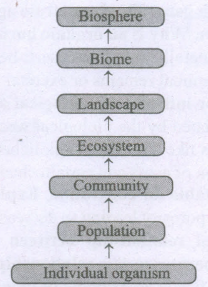
28.
Anatomical adaptations:
1. Epidermal cells of stem is heavily cutinized, almost squarish and are filled with oil and tannins.
2. 'Star' shaped sclereids and 'H' shaped heavy thickened spicules that provide mechanical strength to cortex are present in the stem.
3. The leaves may be dorsiventral or isobilateral with salt secreting glands.
29.
The interaction between organisms, when continues for generations, involves reciprocal changes in genetic and morphological characters of both organisms. This type of evolution is called Co-evolution. It is a kind of co-adaptation and mutual change among interactive species.
Examples:
1. Corolla length and proboscis length of butterflies and moths (Habenaria and Moth).
2. Bird's beak shape and flower shape and size.
30.
(a) Carausium morosus (Stick insect)
(b) Phylliumfrondosum (Leaf insect).
31.
North and south faces of mountain or hill possess different types of flora and fauna because they differ in their humidity, rainfall, light intensity, light duration and temperature regions. The two faces of the mountain or hill receive different amount of solar radiation, wind action and rain. Of these two faces, the windward region possesses good vegetation due to heavy rains and the leeward region possesses poor vegetation due to rain shadows (rain deficit).
32.
1. Ground fire - Which is flame less and subterranean.
2. Surface fire - Which consumes the herbs and shrubs.
3. Crown fire - Which burns the forest canopy.
33.
Thermal stratification is usually found in aquatic habitat. The change in the temperature profile with increasing depth in a water body is called thermal stratification. There are three kinds of thermal stratifications.
1. Epilimnion - The upper layer of warmer water.
2. Metalimnion - The middle layer with a zone of gradual decrease in temperature.
3. Hypolimnion - The bottom layer of colder water.
34.
1. Many herbivores are predators. Cattles, camels, goats etc., frequently browse on the tender shoots of herbs, shrubs and trees. Generally annuals suffer more than the perennials. Grazing and browsing may cause remarkable changes in vegetation. Nearly 25 percent of all insects are known as phytophagous (feeds on plant sap and other Parts of Plant).
2. Many defense mechanisms are evolved to avoid their predations by plants. Examples: Calotropis produces highly poisonous cardiac glycosides, tobacco produces nicotine, coffee plants produce caffeine, Cinchona plant produces quinine. Thorns of Bougainvillea, spines of Opuntia, and latex of cacti also protect them from Predators.
35.
(a) Mutualism: It is an interaction between two species of organisms in which both are benefitted from the obligate association. The following are common examples of mutualism.
(b) Nitrogen fixation : Rhizobium (Bacterium) forms nodules in the roots of leguminous plants and lives symbiotically. The Rhizobium obtains food from leguminous plant and in turn fixes atmospheric nitrogen into nitrate, making it available to host plants.
Other examples:
Water fern (Azolla) and Nitrogen fixing Cyanobacterium (Anabaena) .
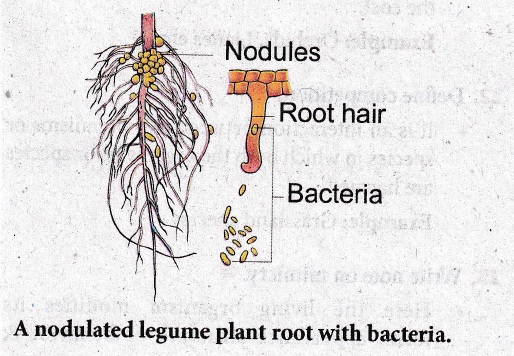
36.
37.
The differences between habitat and niche are as follows.
| S. No | Habitat | Niche |
| 1 | A specific physical space occupied by an organism (species). | A functional space occupied by an organism in the same eco-system |
| 2 | Same habitat may be shared by many organisms (species). | A single niche is occupied by a single species. |
| 3 | Habitat specificity is exhibited by organism. | Organisms may change their niche with time and season |
38.
Morphological adaptations:
Root system is extensively developed. These roots may be of two types. They are Clinging roots and Aerial roots.
Clinging roots fix the epiphytes firmly on the surface of the supporting objects.
Aerial roots are green coloured roots which may hang downwardly and absorb moisture from the atmosphere with the help of a spongy tissue called velamen.
1. Stem of some epiphytes are succulent and develop pseudo bulb or tuber.
2. Generally the leaves are lesser in number and may be fleshy and leathery.
3. Myrmecophily is a common occurrence in the epiphytic vegetation to prevent the predators
4. The fruits and seeds are very small and usually dispersed by wind, insects and birds.
39.
The important edaphic factors which affect vegetation are as follows:
1. Soil moisture: Plants absorbs rain water and moisture directly from the air.
2. Soil water: Soil water is more important than any other ecological factors affecting the distribution of plants. Rain is the main source of soil water. Capillary water held between pore spaces of soil particles and angles between them is the most important form of water available to the plants.
3. Soil reactions: Soil may be acidic or alkaline or neutral in their reaction. pH value of the soil solution determines the availability of plant nutrients. The best pH range of the soil for cultivation of crop plants is 5.5 to 6.8.
4. Soil nutrients: Soil fertility and productivity is the ability of soil to provide all essential plant nutrients such as minerals and organic nutrients in the form of ions.
5. Soil temperature: Soil temperature of an area plays an important role in determining the geographical distribution of plants. Low temperature reduces use of water and solute absorption by roots.
6. Soil atmosphere: The spaces left between soil particles are called pore spaces which contains oxygen and carbon-di-oxide.
7. Soil organisms: Many organisms existing in the soil like bacteria, fungi, algae, protozoans, nematodes, insects and earthworms, etc., are called soil organisms.
40.
41.
The plants which are living in dry or xeric condition are known as Xerophytes.
Xerophytic habitat can be of two different types They are:
(a) physical dryness: In these habitats, soil has a little amount of water due to the inability of the soil to hold water because of low rainfall.
(b) physiological dryness: In these habitats, water is sufficiently present but plants are unable to absorb it because of the absence of capillary spaces. Example: Plants in salty and acidic soil.
Based on adaptive characters xerophytes are classified into three categories. They are Ephemerals, Succulents and Non - succulent plants.
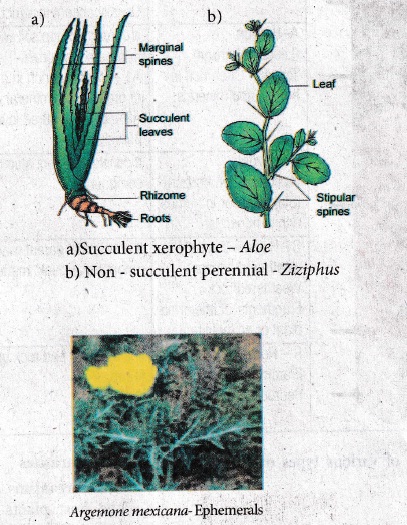
(i) Ephemerals: These are also called drought escapers or drought evaders. These plants complete their life cycle within a short period (single season). These are not true xerophytes. Examples: Argemone, Mollugo, Tribulus and Tephrosia.
(ii) Succulents: These are also called drought enduring plants. These plants store water in their plant parts during the dry period. These plants develop certain adaptive characters to resist extreme ,drought conditions. Examples: Opuntia, Aloe, Bryophyllum and Begonia.
(iii) Non succulents: These are also called drought resistant plants ( true xerophytes). They face both external and internal dryness. They have many adaptations to resist dry conditions. Examples: Casuarina, Nerium, Zizyphus and Acacia.
42.
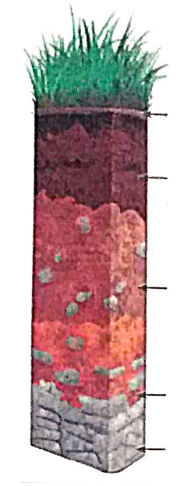 Horizon Description O-Horizon (Organic horizon) Humus It consists of fresh or partially decomposed organic matter.
12th Standard Syllabus & Materials
12th Standard
TN 12th Computer Applications களப்பெயர் முறைமை (DNS) Sample Question Papers Study Material - QB365 Set A
NEW12th Standard
TN 12th Computer Applications வலையமைப்பு எடுத்துக்காட்டுகள் மற்றும் நெறிமுறைகள் Sample Question Papers Study Material - QB365 Set A
NEW12th Standard
TN 12th Computer Applications கணினி வலையமைப்பு ஓர் அறிமுகம் Sample Question Papers Study Material - QB365 Set A
NEW12th Standard
TN 12th Computer Applications PHP-உடன் MySQL-ஐ இணைத்தல் Sample Question Papers Study Material - QB365 Set A



Tamilnadu Stateboard 12th Standard Subjects

Maths

Chemistry

Physics
Biology

Computer Science

Business Maths and Statistics

Economics

Commerce

Accountancy

History

Computer Applications
Biology
Computer Technology
Computer Applications
Computer Science
Business Maths and Statistics
Commerce
Economics
Maths
Chemistry
Physics
Computer Technology
History
Accountancy

Tamil

English

French
Tamilnadu Stateboard Standards

