
 100% FREE ACCESS
12th Standard Syllabus & Materials
12th Standard
TN 12th Computer Applications மின்னணு தரவு பரிமாற்றம் Sample Question Papers Study Material - QB365 Set A
NEW12th Standard
TN 12th Computer Applications மின் - வணிக பாதுகாப்பு அமைப்புகள் Sample Question Papers Study Material - QB365 Set A
NEW12th Standard
TN 12th Computer Applications மின்னணு செலுத்தல் முறைகள் Sample Question Papers Study Material - QB365 Set A
NEW12th Standard
TN 12th Computer Applications மின் - வணிகம் Sample Question Papers Study Material - QB365 Set A
NEW12th Standard
TN 12th Computer Applications திறந்த மூல கருத்துருக்கள் Sample Question Papers Study Material - QB365 Set A
NEW12th Standard
TN 12th Computer Applications வலையமைப்பு வடமிடல் Sample Question Papers Study Material - QB365 Set A

Published on: 29/01/2021
12th Standard Biology English Medium Reduced Syllabus Model Question paper - 2021 Part - 1
Download Tamil Nadu 12th Standard Biology question papers, model tests, one-mark questions, important questions, and public exam papers in PDF format. Free study materials and answer keys for TN State Board students.
Questions + Answers key
Take MCQ Biology Test1.
Some organisms are able to maintain homeostasis by physical means _______
Conform
Regulate
Migrate
Suspend.
2.
3.
Match the following and choose the correct combination from the options given below:
| Column I (Interaction) | Column II (Examples) |
| I. Mutualism II. Commensalism III. Parasitism IV. Predation V. Amensalism |
i) Trichoderma and Penicillium ii) Balanophora, Orobanche iii) Orchids and Ferns iv) Lichen and Mycorrhiza v) Nepenthes and Diaonaea |
| I | II | III | IV | V |
| i | ii | iii | iv | v |
| I | II | III | IV | V |
| ii | iii | iv | v | i |
| I | II | III | IV | V |
| iii | iv | v | i | ii |
| I | II | III | IV | V |
| iv | iii | ii | v | i |
4.
Which among the following awards instituted by the Government of India for individuals or communities from rural areas that have shown extraordinary courage and dedication in protecting Wildlife?
Indira Gandhi Paryavaran Puraskar
Medini Puruskar Yojana
Amrita Devi Bishnoi Award
Pitambar Pant National Award
5.
Cyclosporin – A is an immunosuppressive drug produced from _______
Aspergillus niger
Manascus purpureus
Penicillium notatum
Trichoderma polysporum
6.
7.
8.
Which of the following is the correct sequence of event with reference to the central dogma?
Transcription, Translation, Replication
Transcription, Replication, Translation
Duplication, Translation, Transcription
Replication, Transcription, Translation
9.
The glandular accessory organ which produces the largest proportion of semen is ______.
Seminal vesicle
Bulbourethral gland
Prostate gland
Mucous gland
10.
11.
Exo-erythrocytic schizogony of Plasmodium takes place in _______
RBC
Leucocytes
Stomach
Liver
12.
In which type of parthenogenesis are only males produced?
Arrhenotoky
Thelytoky
Amphitoky
Both a and b
13.
Which of the following is true about Rh factor in the offspring of a parental combination DdxDd (both Rh positive)?
All will be Rh-positive
Half will be Rh positive
About ¾ will be Rh negative
About one fourth will be Rh negative
14.
Extra nuclear inheritance is a consequence of presence of genes in _____.
Mitrochondria and chloroplasts
Endoplasmic reticulum and mitrochondria
Ribosomes and chloroplast
Lysososmes and ribosomes
15.
Identify the correctly matched pair.
Tuber - Allium Cepa
Sucker - Pistia
Rhizome - Musa
Stolon - Zingiber
16.
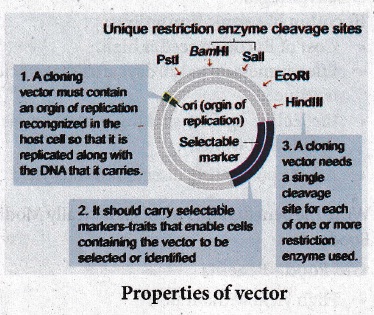
Explain the features of a vector.
17.
Differentiate Missense mutation from Nonsense mutation.
18.
Nutrients are retained in the ecosystem. Discuss how and name the process through which it is achieved?
19.
What does the terms specification and claim refers with respect to patents?
20.
Provide an example for each of the following agricultural components. (i) Bio pesticide (ii) Green manure crop (iii) Bio-FertiIizer
21.
Write short notes on Bio-monitoring.
22.
Give a brief account on In-situ conservation
23.
24.
Select the correct term from the bracket and complete the given branching tree
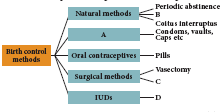
(Barriers, Lactational amenorrhoea, CuT, Tubectomy)
25.
26.
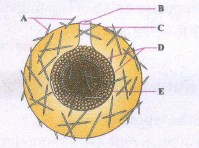
Identify the parts marked as A, B, C, D and E for the below diagram.
27.
28.
At what stage of development are the gametes formed in new born male and female?
29.
Enumerate the steps involved in producing transgenic animals.
30.
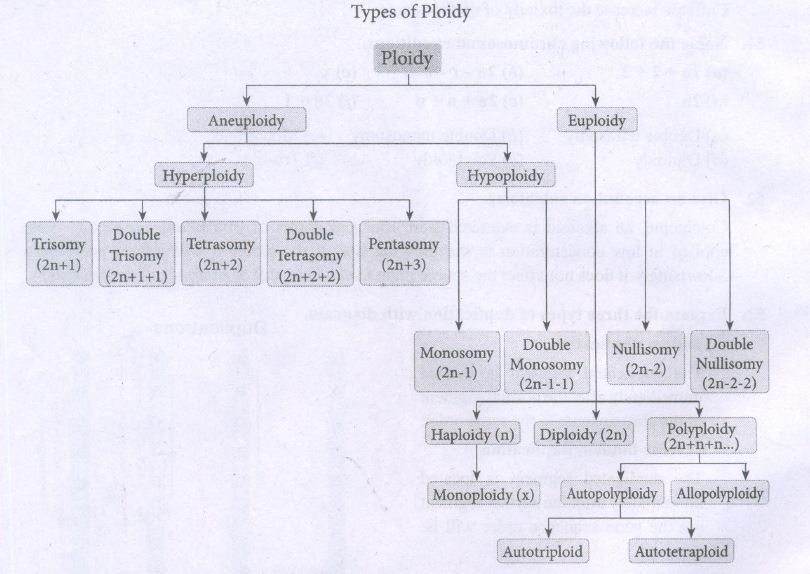
Draw a flow chart depicting the various types of ploidy.
31.
List out the characteristics of ecological succession.
32.
Explain the stepwise preparation of Bio-pest repellent from the leaves of Azadirachta indica
1.
(b)
Regulate
2.
(b)
3.
(d)
| I | II | III | IV | V |
| iv | iii | ii | v | i |
4.
(c)
Amrita Devi Bishnoi Award
5.
(d)
Trichoderma polysporum
6.
(b)
7.
(c)
8.
(d)
Replication, Transcription, Translation
9.
(a)
Seminal vesicle
10.
(b)
11.
(d)
Liver
12.
(a)
Arrhenotoky
13.
(d)
About one fourth will be Rh negative
14.
(a)
Mitrochondria and chloroplasts
15.
(c)
Rhizome - Musa
16.
The following are the features that are required to facilitate cloning into a vector.
1. Origin of replication (ori): This is a sequence from where replication starts and piece of DNA when linked to this sequence can be made to replicate within the host cells.
2. Selectable marker: In addition to ori the vector requires a selectable marker, which helps in identifying and eliminating non-transformants and selectively permitting the growth of the transformants.
3. Cloning sites: In order to link the alien DNA, the vector needs to have very few, preferably single, recognition sites for the commonly used restriction enzymes.
17.
| Mis-sense Mutation | Non-sense Mutation |
| The mutation where the codon for one amino acid is changed into a codon for another amino acid is called Mis-sense or non-synonymous mutations. | The mutations where codon for one amino acid is changed into a termination or stop codon is called Non-sense mutation. |
18.
Nutrients will retain in the ecosystem through biogeochemical cycles. Various nutrients present in soil and atmosphere enter the organism at various trophic levels through food and other process and are cycled back to their origin. Thus the nutrients are not lost but retained in the ecosystem.
19.
The specification part is narrative in which the subject matter of invention is described as how the invention was carried out.
The claim specifically defines the scope of the invention to be protected by the patent which the others may not practice.
20.
(i) Bio pesticide - E.g. Trichoderma species
(ii) Green manure - E.g. Crotalaria juncea
(iv) Bio fertilizer - E.g. Azolla
21.
The act of observing and assessing the current state and ongoing changes in ecosystem, biodiversity components, landscape including natural habitats, populations and species. An agricultural drone is an unmanned aerial vehicle applied to farming in order to help increased crop production and monitor crop growth. Agricultural drones let farmers see their fields from the sky. This bird’s eye-view can reveal many issues such as irrigation problems, soil variation and pest and fungal infestations. It is also used for cost effective safe method of spraying pesticides and fertilizers, which proves very easy and non-harmful.
22.
In-situ conservation means conservation and management of genetic resources in their natural habitats. Here the plant or animal species are protected within the existing habitat. Forest trees, medicinal and aromatic plants under threat are conserved by this method. This is carried out by the community or by the State conservation which includes wildlife, National park, and Biosphere reserve. The ecologically unique and biodiversity-rich regions are legally protected as wildlife sanctuaries, National parks and Biosphere reserves. Megamalai, Sathyamangalam wildlife, Guindy and Periyar National park, and Western Ghats, Nilgiris, Agasthyamalai, and Gulf of Mannar are the biosphere reserves of Tamil Nadu.
23.
24.
A - Barrier methods
B - Lactational amenorrhoea
C - Tubectomz
D - CuT
25.
26.
A - Monaxon spicules
B - Micropyle
C - Outer membrane
D - Archaeocytes
E - Inner membrane
27.
28.
Development of female gamete is called oogenesis. Oogenesis starts at the beginning of puberty.
Development of male gamete is called spermatogenesis. Spermatogenesis starts at puberty
29.
The various steps involved in the production of transgenic organisms are,
(i) Identification and separation of desired gene.
(ii) Selection of a vector (generally a virus) or direct transmission.
(iii) Combining the desired gene with the vector.
(iv) Introduction of transferred vector into cells, tissues, embryo or mature individual.
(v) Demonstration of integration and expression of foreign gene in transgenic tissue or animals. Transgenic animals such as mice, rat, rabbit, pig, cow, goat, sheep and fish have been produced.
30.
31.
Characteristics of ecological succession
(I) It is a systematic process which causes changes in specific structure of plant community.
(II) It is resultant of changes of abiotic and biotic factors.
(III) It transforms unstable community into a stable community.
(IV) Gradual progression in species diversity, total biomass, niche specialisation, and humus content of soil takes place.
(V) It progresses from simple food chain to complex food web.
(VI) It modifies the lower and simple life form to the higher life forms.
(VII) It creates inter-dependence of plants and animals.
32.
Botanical pest repellent and insecticide made with the dried leaves of Azadirachta indica Preparation of Bio-pest repellent
(i) Pluck leaves from the neem tree and chop the leaves finely.
(ii) The chopped up leaves were put in a 50-liter container and fill to half with water; put the lid on and leave it for 3 days to brew.
(iii) Using another container, strain the mixture which has brewed for 3 days to remove the leaves, through fine mesh sieve. The filtrate can be sprayed on the plants to repel pests.
(iv) To make sure that the pest repellent sticks to the plants, add 100 ml of cooking oil and the same amount of soap water. (The role of the soap water is to break down the oil, and the role of the oil is to make it stick to the leaves).
(v) The stewed leaves from the mixture can be used in the compost heap or around the base of the plants.

12th Standard Syllabus & Materials
12th Standard
TN 12th Computer Applications களப்பெயர் முறைமை (DNS) Sample Question Papers Study Material - QB365 Set A
NEW12th Standard
TN 12th Computer Applications வலையமைப்பு எடுத்துக்காட்டுகள் மற்றும் நெறிமுறைகள் Sample Question Papers Study Material - QB365 Set A
NEW12th Standard
TN 12th Computer Applications கணினி வலையமைப்பு ஓர் அறிமுகம் Sample Question Papers Study Material - QB365 Set A
NEW12th Standard
TN 12th Computer Applications PHP-உடன் MySQL-ஐ இணைத்தல் Sample Question Papers Study Material - QB365 Set A



Tamilnadu Stateboard 12th Standard Subjects

Maths

Chemistry

Physics
Biology

Computer Science

Business Maths and Statistics

Economics

Commerce

Accountancy

History

Computer Applications
Biology
Computer Technology
Computer Applications
Computer Science
Business Maths and Statistics
Commerce
Economics
Maths
Chemistry
Physics
Computer Technology
History
Accountancy

Tamil

English

French
Tamilnadu Stateboard Standards

