
 100% FREE ACCESS
12th Standard Syllabus & Materials
12th Standard
TN 12th Computer Applications மின்னணு தரவு பரிமாற்றம் Sample Question Papers Study Material - QB365 Set A
NEW12th Standard
TN 12th Computer Applications மின் - வணிக பாதுகாப்பு அமைப்புகள் Sample Question Papers Study Material - QB365 Set A
NEW12th Standard
TN 12th Computer Applications மின்னணு செலுத்தல் முறைகள் Sample Question Papers Study Material - QB365 Set A
NEW12th Standard
TN 12th Computer Applications மின் - வணிகம் Sample Question Papers Study Material - QB365 Set A
NEW12th Standard
TN 12th Computer Applications திறந்த மூல கருத்துருக்கள் Sample Question Papers Study Material - QB365 Set A
NEW12th Standard
TN 12th Computer Applications வலையமைப்பு வடமிடல் Sample Question Papers Study Material - QB365 Set A

Published on: 29/09/2020
12th Standard Biology English Medium Sample 3 Mark Book Back Questions (New Syllabus) 2020
Download Tamil Nadu 12th Standard Biology question papers, model tests, one-mark questions, important questions, and public exam papers in PDF format. Free study materials and answer keys for TN State Board students.
Questions + Answers key
Take MCQ Biology Test1.
2.
How does an orchid ophrys ensures its pollination by bees ?
3.
Differentiate foeticide and infanticide
4.
Why tRNA is called an adapter molecule?
5.
Name the hormones produced from the placenta during pregnancy.
6.
What is Cantharophily.
7.
Explain the basic concepts involved in plant tissue culture
8.
Explain stabilizing, directional and disruptive selection with examples
9.
What is male heterogamety?
10.
Give reasons for the following:
(a) Some organisms like honey bees are called parthenogenetic animals
(b) A male honey bee has 16 chromosomes where as its female has 32 chromosomes
11.
Explain the law of dominance in monohybrid cross.
12.
Differentiate between:
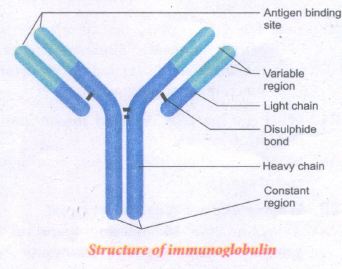
Humoral and CMI immunity
13.
If a person drinks a cup of coffee daily it will help him for his health. Is this correct? If it is correct, list out the benefits.
14.
How do sacred groves help in the conservation of biodiversity?
15.
16.
Why does ozone hole form over Antarctica?
17.
Differentiate between Somatic cell gene therapy and germline gene therapy
18.
Compare and Contrast the insitu and exsitu conservation. (or) What are the differences between in-situ and ex-situ conservation ?
19.
Write the key features of organic farming.
20.
What are restriction enzyme. Mention their type with role in Biotechnology.
21.
22.
1.
2.
The plant, Ophrys orchid, the flower looks like a female insect to attract the make insect to get pollinated by the male insect.
3.
| Foeticide | Infanticide |
| It refers to aborting the female in the mother's womb. |
It refers to killing the female child after her birth |
4.
tRNA on one hand binds to specific amino acids and on the other hand reads the codon of the amino acid bound to it through its anticodon, it is called as adapter molecule.
5.
Human Chorionic Gonadotropin (hCG), Human Chorionic Somatotropin (hCS) (or) Human Placental Lactogen (hPL), oestrogens and progesterone.
6.
Pollination carried out by beetle is called cantharophily.
7.
Basic concepts of Tissue Culture
Basic concepts of plant tissue culture are totipotency, differentiation, dedifferentiation and redifferentiation.
Totipotency
The property of live plant cells that they have the genetic potential when cultured in nutrient medium to give rise to a complete individual plant.
Differentiation
The process of biochemical and structural changes by which cells become specialized in form and function.
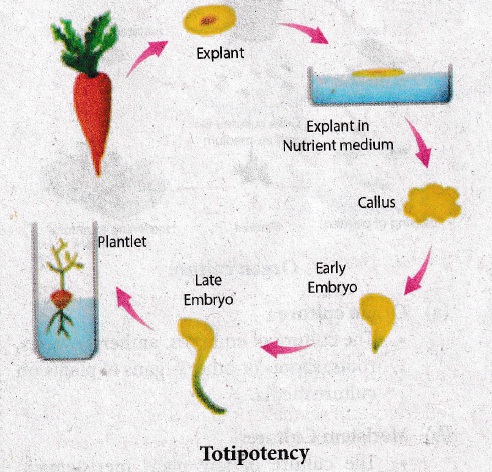
Redifferentiation
The further differentiation of already differentiated cell into another type of cell. For example, when the component cells of callus have the ability to form a whole plant in a nutrient medium, the phenomenon is called redifferentiation.
Dedifferentiation
The phenomenon of the reversion of mature cells to the meristematic state leading to the formation of callus is called dedifferentiation. These two phenomena of redifferentiation and dedifferentiation are the inherent capacities of living plant cells or tissue. This is described as totipotency.
8.
(i) Stabilizing selection (centripetal selection):
1. This type of selection operates in a stable environment.
2. The organisms with average phenotypes survive where as the extreme individuals from both the ends are eliminated.
3. There is no speciation but the phenotypic stability is maintained within the population over generation.
4. For example, measurements of sparrows that survived the storm clustered around the mean and the sparrows that failed to survive the storm clustered around the extremes of the variation showing stabilizing selection.
(ii) Directional selection:
1. The environment which undergoes gradual change is subjected to directional selection.
2. This type of selection removes the individuals from one end towards the other end of phenotypic distribution.
3. For example size differences between male and female alike extremely but different in body weight.
4. Females show directional selection in reflection to body weight.
(iii) Disruptive selection (centrifugal selection)
1. Under homogenous environmental changes into heterogenous environment this type of selection is operational.
2. The organisms of both the extreme phenotypes are selected whereas individuals with average phenotypes are eliminated. This results in splitting of the population into sub-population/species. This is rare form of selection but leads to the formation of two or more different species.
3. It is also called adaptive radiation (e. g.) Darwin finches -beak size in relation to seed size inhabiting Galapagos islands.
9.
Heterogametic Males:
In this method of sex determination the males are heterogametic producing dissimilar gametes while females are homogametic producing similar gametes.
It is of kinds XX-XO type and XX-XY type.
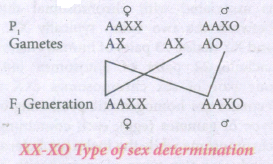
(i) XX-XO Type
(a) This method of sex determination is seen in bugs and some insects such as cockroaches and grasshoppers.
(b) The female with two X chromosomes are homogametic (XX) while the males with only one X chromosome are heterogametic (XO).
(c) The presence of an unpaired X chromosomes determines the male sex. The males with unpaired 'X' chromosome produce two types of sperms, one half with X chromosome and other half without X chromosome.
(d) The sex of the offspring depends upon the sperm that fertilizes the egg.
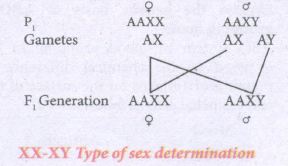
(ii) XX-XV type (Lygaeu Type):
This method of sex determination is seen in human beings and in Drosophila.
(a) The females are homogametic with XX chromosome, while the males are heterogametic with X and Y chromosome.
(b) Homogametic females produce only one kind of egg, each with one X chromosome, while the heterogametic males produce two kinds of sperms some with X chromosome and some with Y chromosome.
(c) The sex of the embryo depends on the fertilizing sperm. An egg fertilized by an 'X' bearing sperm produces a female, if fertilized by a 'Y' bearing sperm, a male is produced.
10.
(a) Some organisms like honeybees are called parthenogenetic animals.
1. In case of honeybees both haploid and diploid individuals formed, as a result of incomplete parthenogenesis.
2. Both sexual reproduction and parthenogenesis are inclusive.
3. Fertilized eggs (zygote) give rise to queen and workers (both are females) by the process of sexual reproduction.
4. Unfertilized eggs (ova) of females develop into drones (males) by the process of parthenogenesis.
(b) A male honeybee has 16 chromosomes where as its female has 32 chromosomes
1. It is because of haplodiploidy which is a sex determination system, in which males develop from unfertilized eggs (parthenogenesis) and are haploid (16n) and females develop frorn fertilized eggs and are diploid (32n) (sexual reproduction).
2. As unfertilized egg carries only half number of chromosome as compared to fertilized egg.
Therefore male honeybees have 16 chromosomes where as female has 32 chromosomes.
11.
Law of Dominance: The characters were controlled by discrete units called factors which occur in pairs. In a dissimilar pair of factors one member of the pair is dominant & the other is recessive.
(i) This law gives an explanation to the monohybrid cross.
(a) the expression of only one of the parental characters in F1 generation.
(b) the expression of both in the F2 generation
(ii) It also explains the proportion of 3:1 obtained at the F2
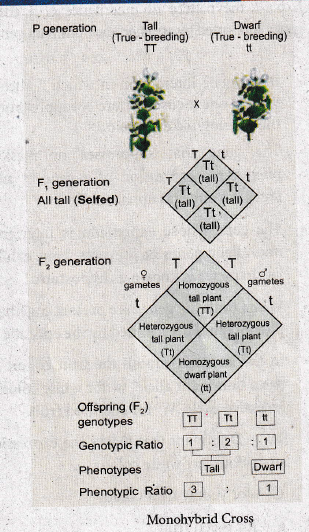
Monohybrid Cross
(i) Monohybrid inheritance is the inheritance of a single character i. e, plant height.
(ii) It involves the inheritance of two alleles of a single gene.
(iii) When the F1 generation was selfed Mendel noticed that 7847 of 1064 F2 plants were tall, while 277of 1064 were dwarf.
(iv) When tall pea plants were pollinated with the pollens from a true breeding dwarf plants, the result was all tall plants.
(v) Dwarf trait appears in the F2 generation.
(vi) When the parental types were reversed, the result was the same - All tall plants.
(vii) Tall (♀) \(\times\) Dwarf (♂) and Tall (♂) \(\times\) Dwarf (♀) mating's are done in both ways.
(viii) It was concluded that the trait is not sex dependent.
(xi) The gene for plant height has two alleles: Tall (T) \(\times\) Dwarf (t). (TT, Tt, Tt: tt)
12.
| S.No | Humoral Immunity | Cell mediated immunity |
| i. | When Pathogens are destroyed by the production of antibodies, it is known as antibody mediated or hurmoral immunity. |
When Pathogens are destroyed by cells without producing antibodies it is known as cell mediated immunity. |
| ii. | This is brought about by B cells with the aid of antigen presenting cells and T helper cells. |
This is brought about by T cells, macrophages and natural killer cells |
13.
Caffeine present in the coffee enhances acetylcholine in brain - Iower the incidence of fatty liver diseases, cirrhosis and cancer reduce the risk of type 2 diabetes.
14.
(i) They help for detailed floristic and faunistic studies
(ii) These groves provide a number of ecosystem services to the neighborhood like protecting watershed, fodder, medicinal plants and microclimate control
15.
16.
Ozone hole is the area above Antarctica, where the ozone layer is the thinnest.
17.
| S.No. | SOMATIC CELL GENE THERAPY | GERMLINE GENE THERAPY |
|---|---|---|
| i. | Therapeutic genes transferred into the somatic cells. | Therapeutic genes transferred into the germ cells. |
| ii. | Introduction of genes into bone marrow cells, blood cells, skin cells, etc., | Genes introduced into eggs and sperms. |
| iii. | Will not be inherited in later generations. | Heritable and passed on to later generations. |
18.
Insitu and Exsitu are two types of biodiversity conservation strategies.
| S. No | Insitu Conservation | Exsitu Conservation |
|---|---|---|
| i) | It is the on-site conservation or the conservation of genetic resources in natural populations of plant or animal species. | This is a conservation strategy which involves placing of threatened animals and plants in special care locations for their protection. |
| ii) | It is the process of protecting an endangered plant or animal species in its natural habitat, either by protecting or restoring the habitat itself or by defending the species from predators. | It helps in recovering populations or preventing their extinction under simulated conditions that closely resemble their natural habitats. |
| iii) | National Parks, Biosphere Reserve, Wild Life Sanctuaries form insitu conservation strategies. | Zoological parks and Botanical gardens are common exsitu conservation programs. |
19.
(i) Protecting soil quality using organic materials and encouraging biological activity.
(ii) Indirect provision of crop nutrients using soil microorganisms.
(iii) Nitrogen fixation in soils using legumes.
(iv) Weed and pest control based on methods like crop rotation, biological diversity, natural predators, organic manures and suitable chemical, thermal and biological interventions.
20.
A restriction enzyme or restriction endonuclease is an enzyme that cleaves DNA into fragments at or near specific recognition sites within the molecule known as restriction sites.
Types
(i) Exonucleases - which remove nucleotides one at a time from the end of a DNA molecule. e.g. Bal 31, Exonuclease III.
(ii) Endonucleases - which break the internal phosphodiester bonds within a DNA molecule. e.g. Hind II, EcoRI, PvulI, BamHI, TaqI.
(iii) The restriction enzymes are called as molecular scissors
(iv) They are used in recombinant DNA technology as they recognize & cut DNA within a specific sequence.
21.
22.

12th Standard Syllabus & Materials
12th Standard
TN 12th Computer Applications களப்பெயர் முறைமை (DNS) Sample Question Papers Study Material - QB365 Set A
NEW12th Standard
TN 12th Computer Applications வலையமைப்பு எடுத்துக்காட்டுகள் மற்றும் நெறிமுறைகள் Sample Question Papers Study Material - QB365 Set A
NEW12th Standard
TN 12th Computer Applications கணினி வலையமைப்பு ஓர் அறிமுகம் Sample Question Papers Study Material - QB365 Set A
NEW12th Standard
TN 12th Computer Applications PHP-உடன் MySQL-ஐ இணைத்தல் Sample Question Papers Study Material - QB365 Set A



Tamilnadu Stateboard 12th Standard Subjects

Maths

Chemistry

Physics
Biology

Computer Science

Business Maths and Statistics

Economics

Commerce

Accountancy

History

Computer Applications
Biology
Computer Technology
Computer Applications
Computer Science
Business Maths and Statistics
Commerce
Economics
Maths
Chemistry
Physics
Computer Technology
History
Accountancy

Tamil

English

French
Tamilnadu Stateboard Standards

