
 100% FREE ACCESS
12th Standard Syllabus & Materials
12th Standard
TN 12th Computer Applications மின்னணு தரவு பரிமாற்றம் Sample Question Papers Study Material - QB365 Set A
NEW12th Standard
TN 12th Computer Applications மின் - வணிக பாதுகாப்பு அமைப்புகள் Sample Question Papers Study Material - QB365 Set A
NEW12th Standard
TN 12th Computer Applications மின்னணு செலுத்தல் முறைகள் Sample Question Papers Study Material - QB365 Set A
NEW12th Standard
TN 12th Computer Applications மின் - வணிகம் Sample Question Papers Study Material - QB365 Set A
NEW12th Standard
TN 12th Computer Applications திறந்த மூல கருத்துருக்கள் Sample Question Papers Study Material - QB365 Set A
NEW12th Standard
TN 12th Computer Applications வலையமைப்பு வடமிடல் Sample Question Papers Study Material - QB365 Set A

Published on: 29/09/2020
12th Standard Biology English Medium Sample 5 Mark Book Back Questions (New Syllabus 2020)
Download Tamil Nadu 12th Standard Biology question papers, model tests, one-mark questions, important questions, and public exam papers in PDF format. Free study materials and answer keys for TN State Board students.
Questions + Answers key
Take MCQ Biology Test1.
Describe Population Age Distribution
2.
Alien species invasion is a threat to endemic species – substantiate this statement.
3.
4.
It is established that RNA is the first genetic material. Justify giving reasons.
5.
List the common withdrawal symptoms of drugs and alcohol abuse.
6.
Distinguish tenuinucellate and crassinucellate ovules.
7.
A person is infected by HIV. How will you diagnose for AIDS?
8.
9.
List out the new breeding techniques involved in developing new traits in plant breeding.
10.
What are the effects of deforestation and benefits of agroforestry?
11.
Draw a pyramid from following details and explain in brief.
Quantities of organisms are given-Hawks - 50, plants - 1000.rabbit and mouse - 250 + 250, pythons and lizard - 100 + 50 respectively.
12.
13.
Describe how deforestation might contribute to global warming
14.
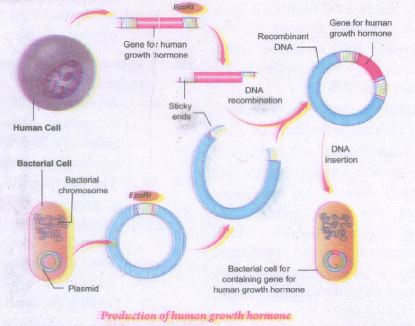
Explain the steps involved in the production of recombinant hGH
15.
Write short notes on the following.
a) Brewer's yeast
b) Ideonella sakaiensis
c) Microbial fuel cells
16.
Open Book Assessment
‘Healthy reproduction, legally checked birth control measures and proper family planning programmes are essential for the survival of mankind’ Justify
17.
18.
The following is the illustration of the sequence of ovarian events (a-i) in a human female.
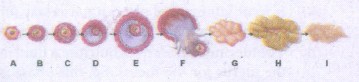
a) Identify the figure that illustrates ovulation and mention the stage of oogenesis it represents.
b) Name the ovarian hormone and the pituitary hormone that have caused the above-mentioned events.
c) Explain the changes that occurs in the uterus simultaneously in anticipation.
d) Write the difference between C and H.
19.
What is extra chromosomal inheritance?
20.
21.
Differentiate between the following:
(a) Binary fission in amoeba and multiple fission in Plasmodium
(b) Budding in yeast and budding in Hydra
(c) Regeneration in lizard and Planaria
22.
23.
How does Neanderthal man differ from the modern man in appearance?
1.
(i) The proportion of the age groups in a population is its age distribution attribute.
(ii) This determines the reproductive status of the population at the given time and is an indicator of the future population size.
(iii) Usually a rapidly growing population will have larger proportion of young individuals.
(iv) A stable population will have an even distribution of various age classes.
(v) A declining population tends to have a larger proportion of older individuals
2.
(i) The introduction of the Nile Perch into Lake Victoria led to the extinction of more than 200 species of cichlid fish in that lake.
(ii) Introduction of African catfish Clarias gariepinus for aquaculture poses a threat to the indigenous catfishes in indian rivers.
3.
4.
RNA is said to be as the first genetic material because
1. RNA can directly code for protein synthesis of protein and hence can easily expresses the character. It is the genetic material in many viruses.
2. RNA can also act as a catalyst; there are some important biothemical reactions in living systems that are catalyzed, by RNAs and not as proteins.
3. Many essential life processes like splicing translation, etc have evolved around RNA.
5.
(i) Mild tremors to convulsions.
(ii) Severe agitation and fits.
(iii) Depressed mood.
(iv) Anxiety.
(v) Nervousness.
(vi) Restlessness.
(vii) Irritability.
(viii) Insomnia.
(ix) Dryness of throat.
6.
ovule is divided into two types based on the position of the sporogenous cell
| Tenuinucellate type | Crassinucellate type |
|---|---|
| Sporogenous cell is hypodermal with a single layer of nucellar tissue around it. | Sporogenous cell is sub hypodermal |
| Have very small nucellus | Have fairly large nucellus. |
7.
A simpl blood tes is available that can determine wheth r the person has been, infected with HIV. The ELISA test (Enzyme Linked ImmunoSorbent Assay) detects the presence of HIV antibodies. It is a preliminary test: Western blot test is more reliable and a confirmatory test. It detects the viral core proteins.r lf both tests detect the presence ofl:he antibodies, the person is corfsidered to be HIV positive. The vaccines are classified as first, second and third generation vaccines.
(i) First generation vaccine is further subdivided into live attenuated vaccine, killed vaccine and toxoids.
(a) Live attenuated vaccines use the weakened (attenuated), aged, less virulent form of the virus. E.g. Measles, mumps and rubella (MMR) vaccine and the Varicella (chickenpox) vaccine.
(b) Killed (inactivated) vaccines are killed or inactivated by heat and other methods. E.g. Salk's polio vaccine.
(c) Toxoid vaccines contain a toxin or chemical secreted by the bacteria or virus. They make us immune to the harmful effects of the infection, instead of to the infection itself. E.g. DPT vaccine (Diphtheria, Pertussis and Tetanus).
(ii) Second generation vaccine contains the pure surface antigen of the pathogen. E.g. Hepatitis- B vaccine.
(iii) Third generation vaccine contains the purest and the highest potency vaccines which are synthetic in generation. The latest revolution in vaccine is DNA vaccine or recombinant vaccine.
8.
9.
(i) Hybridization, Mutation breeding, Polyploid breeding, Breeding for developing resistance to diseases, Biofortification, Breeding for resistance to insect pests, New Breeding Techniques (NBT) such as.
(ii) CRISPR/ Cas (Cutting and modifying the genome during the repair process by tool).
(iii) ODM: Oligonucleotide - directed mutagenesis
(iv) Transferring a gene from an identical or closely related species (Cisgenesis).
(v) Organising processes that alter gene activity without altering the DNA itself (Epigenetic methods).
10.
Effects of deforestation:
(i) Burning of forest wood release stored carbon, a negative impact just opposite of carbon sequestration,
(ii) Trees and plants bind the soil particles. The removal of forest cover increases soil erosion and decreases soil fertility. Deforestation in dry areas leads to the formation of deserts.
(iii) The amount of runoff water increases soil erosion and also creates flash flooding, thus reducing moisture and humidity.
(iv) The alteration of local precipitation patterns leading to drought conditions in many regions. It triggers adverse climatic conditions and alters water cycle in the ecosystem.
(v) It decreases the bio-diversity significantly as their habitats are disturbed and disruption of natural cycles.
(vi) Loss of livelihood for forest dwellers and rural people.
(vii) Increased global warming and account for one-third of total CO2 emission.
(viii) Loss of life support resources, fuel, medicinal herbs, and wild edible fruits.
Benefits of agroforestry:
(i) It is an answer to the problem of soil and water conservation and also to stabilize the soil (salinity and water table) reduce landslide and water run-off problem.
(ii) Nutrient cycling between species improves and organic matter is maintained.
(iii) Trees provide a micro climate for crops and maintain O2 - CO2 balanced, atmospheric temperature and relative humidity.
(iv) Suitable for dry land where rainfall is minimum and hence it is a good system for alternate land use pattern.
(v) Multipurpose tree varieties like Acacia are used for wood pulp, tanning, paper, and firewood industries.
(vi) Agroforestry is recommended for the following purposes. It can be used as Farm Forestry for the extension of forests, mixed forestry, shelterbelts, and linear strip plantation.
11.
Grassland ecosystem : There is a gradual decrease in the number of organisms in each trophic level from producers to primary consumers and then to secondary consumers, and finally to tertiary consumers. Therefore pyramids of number in grassland ecosystem are always upright.
12.
13.
(i) When trees are cut down and burnt or allowed to rot, their stored carbon is released into the air as carbon dioxide. This adds to the carbon dioxide content of the air. Carbon dioxide is a major greenhouse gas. The increase in concentration of carbon dioxide in the air increases the greenhouse effect and thereby causes global warming. It has been estimated that 25-30% of the greenhouse gases released into the atmosphere each year is because of deforestation.
(ii) Trees act as carbon sink since they utilize carbon dioxide for photosynthesis. When trees are cut down, the carbon footprint increases. This, in turn leads to global warming.
14.
(i) Human growth hormones somatostatin and somatotropin such as are peptide hormones secreted by the pituitary gland that helps in the growth and development by increasing the uptake of amino acids and promoting protein synthesis. Deficiency of human growth hormone causes dwarfism, which could be treated by injecting hGH extracted from the human pituitary glands.
(ii) Using recombinant DNA technology hGH can be produced. The gene for hGH is isolated from the human pituitary gland cells.
(iii) The isolated gene is inserted into a plasmid vector and then is transferred into E. coli.
(iv) The recombinant E. coli then starts producing human growth hormone. The recombinant E. coli are isolated from the culture and mass production ofhGH is carried out by fermentation technology.
(v) A recombinant form of a human growth hormone called somatropin is used as a drug to treat growth disorders in children.
15.
(a) Brewer's yeast:
(i) Saccharomyces cerevisiae commonly called brewer's yeast.
(ii) It is used for fermenting malted cereals and fruit juices to produce various alcoholic beverages.
(iii) Wine is made from the fermentation of grape juice.
(iv) Grape juice is fermented by various strains of Saccharomyces cerevisiae into alcohol.
(v) Beer is produced from germinated barley malt grain by Saccharowces carlsbergensis or Saccharomyces cerevisiae.
(vi) Rum is made from fermented sugarcane or molasses or directly from sugarcane juice by Saccharomyces cerevisiae.
(vii) Whisky is a type of distilled alcoholic beverage made from fermented grain mash.
(viii) It is the major producer- of ethanol (C2H5OH)
(ix) It is used as industrial alcohol and also used for laboratory and fuel purposes.
(x) It is used for commercial production of enzymes.
(b) Ideonella sakaiensis:
(i) Ideonella sakaiensis is currently tried for recycling of PET plastics.
(ii) These bacteria use PETase and MHETase enzymes to breakdown PET plastic into terephthalic acid and ethylene glycol.
(c) Microbial fuel cells (MFC)
1. Microbial fuel cells work by allowing bacteria to oxidize and reduce organic molecules.
2. Bactedal respiration is basically one big redox reaction in which electrons are being moved around.
3. A MFC consists of an anode and a cathode separated by a proton exchange membrane.
4. Microbes at the anode oxidize the organic fuel generating protons which pass through the membrane to the cathode and the electrons pass through the anode to the external circuit to generate current.
16.
1. Reproductive health refers not only to healthy reproductive functions, but to the total well being of physical mental emotional, behavioural and social aspects of reproduction.
2. People having physically and functionally normal reproductive organs and exhibit normal behavioural and emotional interactions among themselves in all reproduction-related aspects are considered reproductively healthy.
3. 214 million women of reproductive age in developing countries who wants to avoid pregnancy are not using a modern contraceptive method.
4. Some family planning methods, such as condoms help prevent the transmission of HIV and other sexual transmitted infections.
5. Family planning contraception reduces the need for abortion, especially unsafe abortion.
6. Family planning reinforces people's rights to determine the number and spacing of their children.
7. By preventing unintended pregnancy, family planning/contraception prevents deaths of mothers and children.
8. Family planning is the key to slowing unsustainable population growth and the resulting negative impacts on the economy, environment and National and Regional development efforts.
17.
18.
(a) The figure 'F' represent ovulation.
Stage of oogenesis - Ovulatory or luteal stage of oogenesis
(b) (i) The ovarian hormone is progesterone which is released during ovulation.
(ii) The pituitary hormones are the follicle-stimulating hormone (FSH) and Luteinizing hormone (LSH) which are released during and ovulation from anterior pituitary gland.
(c) The endometrium of the uterus gets thickened and blood supply to the endometrium increase.
(d) Figure 'C' represents the secondary follicle and figure h represents the degenerating corpus luteum.
| Secondary follicle | Corpus luteurn |
| lt is surrounded by layers of granulosa cells | Absence of granulosa cells |
| Theca layer is present | Theca layer is absent. |
19.
(i) Certain characters are controlled by nonnuclear genomes found in chloroplast, mitochondria, infective agents and plasmids. These characters do not reveal Mendelian pattern of inheritance.
(ii) The inheritance of the extra chromosomal genes are found to exhibit maternal influence.
(iii) Although both male and female parents contribute equally to the zygote in terms of chromosomal genes, the female parent usually contributes the zygote's initial cytoplasm and organelles, since the sperms contain very little cytoplasm. If there are hereditary units in the cytoplasm, these will be transmitted to the offsprings through the egg, so the offsprings exhibit maternal effect.
(iv) The cytoplasmic extranuclear genes have a characteristic pattern of inheritance which do not resemble the genes of nuclear chromosomes and is known as extra chromosomal or extra nuclear or cytoplasmic inheritance and exhibit maternal influence.
(v) In extra nuclear inheritance, male and female parents contribute equally their nuclear genes to the progeny but do not make equal contribution of' extra chromosomal genes hence, the crosses can yield different (or) non Mendelian results. Extra chromosomal inheritance in Limnaea peregra.
(vi) Limnaea peregra is a freshwater snail. The shell of these animals are spirally coiled. The coiling of the shell is clockwise (dextral) or anticlockwise (sinistral).
(vii) Both type of coilings are produced by two. different types of genetically controlled cleavages namely, dextral cleavage and sinistral cleavage.
(viii) In Limnaea, dextral coiling is normal and Sinistral coiling is a mutant character.
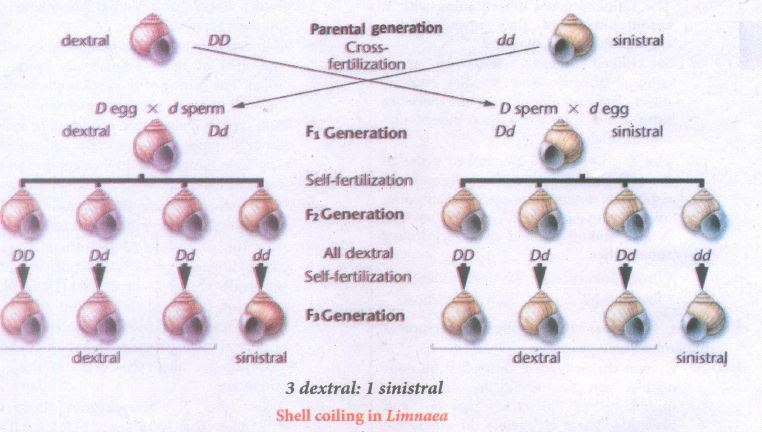
(ix) Direction of coiling is determined by a pair of nuclear genes, D( dextral) and d (sinistral). The gene for dextral (D) being dominant over sinistral coiling (d). In Fig. a dextral snail provides the eggs and a sinistral snail provides the sperm. The offsprings are all dextral (Dd), in the F1 generation.
(x) When the F1 heterozygous dextral individual (Dd) were self crossed the F2 generation showed dextral coiling with genotype of IDD, 2Dd and l dd.
(xi) When a reciprocal cross is made the F1 individuals have Dd genotype but are coiled sinistrally, as in the female parent. In both the crosses the Flare phenotypically similar to the female parent, though the offsprings in both crosses have the same genotype Dd. This is because the genotype of the maternal parent determines the phenotype of the offspring.
(xii) When the F1 sinistral individuals were self crossed, the shell coiling in the F2 generation, were all dextral. This is because the genes do not segregate in the F2 generation. Only in the F3 generation segregation occurs in the ratio of 3 dextral: 1 sinistral.
(xiii) Reasons: The type of cleavage depends on the organization of the egg which is established before the maturation division of the oocyte nucleus and by the influence of the maternal genotype.
(xiv) The direction of coiling of the shell depends upon the orientation of the mitotic spindle during the first cleavage.
(xv) Obviously, maternal control affects only one generation. In each generation the coiling is dependent on the maternal genotype.
20.
21.
(a)
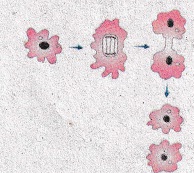
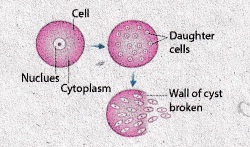
| Binary Fission in Amoeba | Multiple fission in Plasmodium |
| lt results in the production of two individuals from a single parent. | It results in the production of several individuals |
| lt occurs under favourable conditions | It occurs both under favourable and unfavourable conditions |
| Nucleus of the parent cell divides only once to form two daughter nuclei | Nucleus of the parent cell undergoes repeated divisions to form a number of daughter nuclei |
| Cytoplasm divides after nuclear division | Cytoplasm does not divide after each nuclear division but divides during favourable condition |
| No part of parent body is left unused (e,g: Amoeba) | A part of the body (covering and residuai cytoplasm) is left unused. (e,g: Paramecium) |
 |
 |
(b) Budding in yeast and budding in hydra
| Budding in Yeast | Budding in Hydra |
| During budding the cell wall of the parent cell bulges out in the form of an out growth as bud | During budding the ectoderm cells increase and form a small elevation on the body surface as bud. |
| The parent nucleus divides into two daughter nuclei one of which migrates into bud. | Ectoderm and endoderm are pushed out to form the bud. The bud contains an interior lumen in continuation with parent's gastro vascular cavity (coelenteron) |
| As the bud enlarges and is fully formed, it is separated from the parentcell and grows into mature yeast. Sometimes a bud may produce another bud over it which is still attached to parent cell forming a false mycelium (or) pseudomycelium | The bud enlarges, develops a mouth and a circle of tentacles at its free end. When fully grown, the bud constricts at the base and finally separates from the parent body and leads an independent life |
(c) Regeneration is regrowth in the injured region
| Regeneration in Lizard | Regeneration in Planaria |
| This type of regeneration comes under epimorphosis type. | This type of regeneration comes under morphallaxis type |
| Several body parts can develop. | When the body is cut into several pieces, each piece can regenerate the lost parts and develops into a whole individual |
22.
23.
(i) Neanderthal human was found in Neander Valley, Germany with a brain size of 1400 cc and lived between 34,000 - 1,00,000 years ago.
(ii) They differ from the modern. human in having semierect posture, flat cranium, sloping forehead, thin large orbits, heavy brow ridges, protruding jaws and no chin.

12th Standard Syllabus & Materials
12th Standard
TN 12th Computer Applications களப்பெயர் முறைமை (DNS) Sample Question Papers Study Material - QB365 Set A
NEW12th Standard
TN 12th Computer Applications வலையமைப்பு எடுத்துக்காட்டுகள் மற்றும் நெறிமுறைகள் Sample Question Papers Study Material - QB365 Set A
NEW12th Standard
TN 12th Computer Applications கணினி வலையமைப்பு ஓர் அறிமுகம் Sample Question Papers Study Material - QB365 Set A
NEW12th Standard
TN 12th Computer Applications PHP-உடன் MySQL-ஐ இணைத்தல் Sample Question Papers Study Material - QB365 Set A



Tamilnadu Stateboard 12th Standard Subjects

Maths

Chemistry

Physics
Biology

Computer Science

Business Maths and Statistics

Economics

Commerce

Accountancy

History

Computer Applications
Biology
Computer Technology
Computer Applications
Computer Science
Business Maths and Statistics
Commerce
Economics
Maths
Chemistry
Physics
Computer Technology
History
Accountancy

Tamil

English

French
Tamilnadu Stateboard Standards

