
 100% FREE ACCESS
12th Standard Syllabus & Materials
12th Standard
TN 12th Computer Applications மின்னணு தரவு பரிமாற்றம் Sample Question Papers Study Material - QB365 Set A
NEW12th Standard
TN 12th Computer Applications மின் - வணிக பாதுகாப்பு அமைப்புகள் Sample Question Papers Study Material - QB365 Set A
NEW12th Standard
TN 12th Computer Applications மின்னணு செலுத்தல் முறைகள் Sample Question Papers Study Material - QB365 Set A
NEW12th Standard
TN 12th Computer Applications மின் - வணிகம் Sample Question Papers Study Material - QB365 Set A
NEW12th Standard
TN 12th Computer Applications திறந்த மூல கருத்துருக்கள் Sample Question Papers Study Material - QB365 Set A
NEW12th Standard
TN 12th Computer Applications வலையமைப்பு வடமிடல் Sample Question Papers Study Material - QB365 Set A

Published on: 27/08/2022
QB365 provides a detailed and simple solution for every Possible Creative Questions in Class 12 Biology Subject - Zoology - Biodiversity and its Conservation, English Medium. It will help Students to get more practice questions, Students can Practice these question papers in addition to score best marks.
Download Tamil Nadu 12th Standard Biology question papers, model tests, one-mark questions, important questions, and public exam papers in PDF format. Free study materials and answer keys for TN State Board students.
Questions + Answers key
Take MCQ Biology Test1.
Describe the consumptive use value of biodiversity as food, drugs an medicines, fuel and fibre with suitable examples.
2.
Can you think of a scientific explanation, besides analogy used by Paul Ehrlich, for the direct relationship between diversity and stability of a ecosystem?
3.
How can you, as an individual, prevent the loss of biodiversity?
4.
Elaborate how invasion by an alien species reduces the species diversity of an area.
5.
Mention the reasons for the richness biodiversity in the tropics.
6.
Give comparative account on ex-situ conservation.
7.
Explain in detail about various types of extinctions.
8.
Point out any 5 functional attributions of biodiversity.
9.
What is the significance of slope of regression in a species area relationship?
10.
Why Tropical regions are rich in biodiversity?
11.
Give an account on genetic diversity and community diversity.
12.
Write the general strategies in conservation?
13.
Write a note on gene banks
14.
Write a note on extinction and its types
15.
‘Stability of a community depends upon its species diversity’ Justify the statement.
1.
(i) Biological resources are the basis of life forms on this planet. The countries with maximum biodiversity possess better potential to compete with the rest of the world. Biodiversity has great economic importance to mankind due to its many uses, some of which with consumptive value are following.
(ii) Food is obtained from biodiversity sources like livestock forestry and fish. Biodiversity in modern agriculture is beneficial due as a source of new crops. e.g., just three cereals crops like wheat, rice and maize account for about 55% of protein and 60% of calories in humans.
(iii) Drugs such as morphine (Papaver somniferum), quinine (Cinchona ledgeriana), reseroine (Rauwolfia vomitaria), belladonna (Atropa belladonna), aconite (acotinum, napallus) wintergreen and birth bark (Gaultheria procumbens) are derived from plants.
(iv) About 70-80% of entire population is dependent on plants or its extract for medicine penicillin (Pencillium notatum), tetracycline (bacteria), digitalin (Digitalis) are some example of medicinal plants.
(v) Plant like Chorchorus, Gossypium are sources of fibre while Jatropha is a source of biofuels Fossils fuels (e.g, petroleum) are obtained from fossils of organisms.
2.
(i) Scientific explanation for the direct relationship between diversity and stability of a ecosystem could be as follows.
(ii) Imagine a forest area, where diverse species of plants are growing.
(iii) Plants harbour a variety of insects on which a lot of bird species would depend for their food.
(iv) If a specific plant species dies, the related insect population will be affected that would lead to food unavailability for the birds.
(v) In addition, if the plant species was a nitrogen fixer, the death of these plants would mean no replenishment of soil with nitrogen.
(vi) This will obviously affect the other plants as well.
(vii) So, in the cycle continues, the whole habitat/ecosystem will be negatively affected.
3.
(a) Biodiversity is the occurrence of different type of species, habitat, ecosystem, genetic genepool in a particular place and various parts of earth.
(b) As an individual, biodiversity can be conserved with conservation strategies and management of both biotic and abiotic resources.
(c) Some of the conservation strategies are as follows:
(i) Protection of useful animals and plants in their natural habitat or in situ conservation.
(ii) Preservation of critical habitats like feeding and breeding areas and resting area endangered species to promote their growth and multiplication.
(iii) Hunting should be banned or regulated
(iv) Habitat of migratory animals should be protected by bilateral or multilateral agreements.
(v) People should be made aware of the importance of biodiversity and its conservation.
(vi) Over exploitation of natural resources must be avoided.
(vii) Biodiversity plays an important role in maintaining and sustaining supply of goods and services.
(viii) Conservation of biodiversity ensures well being of all the living creatures and their future generations.
4.
(i) When alien species are introduced unintentionally or deliberately in a habitat, some of them can cause decline or extinction of indigenous species, e.g., extensive environmental damage caused and threat posed to our native species by invasive weed species like carrot grass (parthenium), Lantana and water hyacinth (Eichhornia). Another example of exotic species invasion is Nile perch, a large predator fish.
(ii) When this alien species was introduced into lake of Victoria in East Africa, it started feeding on native, cichlid fish.
(iii) As a result indigenous cichlid fish became extinct and due to scarcity of food, predator Nile perch died too.
5.
(i) The reasons for the richness of biodiversity the tropics are: Warm tropical regions between the tropics of Cancer and Capricorn on either of equator possess congenial habitats living organisms.
(ii), Environmental conditions of the tropics are favorable not only for special but also for supporting both variety number of organisms. J
(iii) The temperatures vary between 25o to 35oC, a range in which most meta activities of living organisms occur ease and efficiency.
(iv)The average rainfall is often more 200 mm per year. .
(v) Climate, seasons, temperature, humid photoperiods are more or less stable encourage both variety and numbers.
(vi) Rich resource and nutrient availability.
(vii) Rich resource and nutrient availability.
6.
Ex-Situ Conservation :
It is conservation of selected rare plants/ animals in places outside their natural homes. It includes offsite collections and gene banks. Offsite Collections: They are live collections of wild and domesticated species in Botanical gardens, Zoological parks, Wildlife safari parks, Arborata (gardens with trees and shrubs). The organisms are well maintained for captive breeding programmes. As a result, many animals which have become extinct in the world continue to be maintained in Zoological Parks. As the number increases in captive breeding, the individuals are selectively released in the wild. In this way the Indian crocodile and gangetic dolphin have been saved from extinction.
Gene Banks:
Gene banks are a type of biorepository which preserve genetic materials. Seeds of different genetic strains of commercially important plants can be stored for long periods in seed banks, gametes of threatened species can be preserved in viable and fertile condition for long periods using cryopreservation techniques. However, it is not economically feasible to conserve all biological wealth and all the ecosystems. The number of species required to be saved from extinction far exceeds the conservation efforts.
7.
There are three types of Extinctions
i. Natural extinction: It is a slow process of replacement of existing species with better adapted species due to changes in environmental conditions, evolutionary changes, predators and diseases. A small population can get extinct sooner than the large population due to inbreeding depression (less adaptivity and variation)
ii. Mass extinction: The Earth has experienced quite a few mass extinctions due to environmental catastrophes. Amass extinction occurred about 225 million years ago during the Permian, where 90% of shallow water marine invertebrates disappeared .
iii. Anthropogenic extinctions: These are abetted by human activities like hunting, habitat destruction, over exploitation, urbanization and industrialization. Some examples of extinctions are Dodo of Mauritius and Steller's sea cow of Russia. Amphibians seem to be at higher risk of extinction because of habitat destruction. The most serious aspect of the loss of biodiversity is the extinction of species. The unique information contained in its genetic material (DNA) and the niche it possesses are lost forever.
8.
The major functional attributes are:
1. continuity of nutrient cycles or biogeochemical cycles (N2' C, H20, P, S cycles)
2. soil formation, conditioning or maintenance of soil health (fertility) by soil microbial diversity along with the different trophic members
3. increases ecosystem productivity and provide food resources
4. act as water traps, filters, water flow regulators and water purifiers (forest cover and vegetation)
5. climate stability (forests are essential for rainfall, temperature regulation, C02 absorption, which in turn regulate the density and type of vegetation)
6. forest resource management and sustainable development
9.
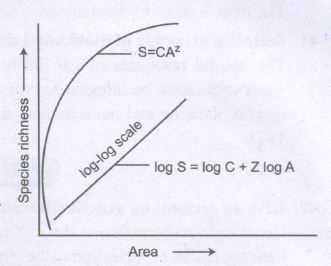
German Naturalist and Geographer Alexander von Humboldt explored the wilderness of south American jungles and found that within a region the species richness increased with increasing area but upto a certain limit. The relationship between species richness and area for a wide variety of taxa (angiosperm plants, birds, bats and freshwater fishes) turned out to be the rectangular hyperbola. On a logarithmic scale, the relationship is a straight line described by the equation.
where
log S = log C + Z log A
S = Species richness
A = Area
Z = Slope of the line
(regression coefficient)
C = Y-intercept
Regression coefficient Z generally has a value of 0.1-0.2 regardless of taxonomic group or region. However, in case of the species - area relationship in very large areas like entire continents; the slope of the line appears to be much steeper (Z-value in the range of 0.6-1.2). For example, in case of the fruit eating (frugivorous) birds and mammals in the tropical forests of different continents, the slope is found to be a steeper line.
10.
The reasons for the richness of biodiversity in the Tropics are:
(i) Warm tropical regions between the tropic of Cancer and Capricorn on either side of equator possess congenial habitats for living organisms.
(ii) Environmental conditions of the tropics are favourable not only for speciation but also for supporting both variety and number of organisms.
(iii) The temperatures vary between 25°C to 35°C, a range in which most metabolic activities of living organisms occur with ease and efficiency.
(iv) The average rainfall is often more than 200 mm per year.
(v) Climate, seasons, temperature, humidity, photoperiods are more or less stable and encourage both variety and numbers.
(vi) Rich resource and nutrient availability.
11.
Genetic diversity refers to the differences in genetic make-up (number and types of genes) between distinct species and to the genetic variation within a single species, also covers genetic variation between distinct populations of the same species. Genetic diversity can be measured using a variety of molecular techniques. India has more than 50,000 genetic variants of Paddy and 1000 variants of Mango. Variation of genes of a species increases with diversity in size and habitat. It results in the formation of different races, varieties and subspecies. Rouwolfia vomitaria, a medicinal plant growing in different ranges of the Himalayas shows differences in the potency and concentration of the active ingredient reserpine due to genetic diversity Genetic diversity helps in developing adaptations to changing environmental conditions. Community/Ecosystem diversity is the variety of habitats, biotic communities, and ecological processes in the biosphere. It is the diversity at ecosystem level due to diversity of niches, trophic levels and ecological processes like nutrient cycles, food webs, energy flow and several biotic interactions. India with its alpine meadows, rain forests, mangroves, coral reefs, grass lands and deserts has one of the greatest ecosystem diversity on Earth.
12.
General strategies in conservation:
(i) identify and protect all threatened species
(ii) identify and conserve in protected areas the wild relatives of all the economically important organisms
(iii) identify and protect critical habitats for feeding, breeding, nursing, resting of each species
(iv) resting, feeding and breeding places of the organisms should be identified and protected
(v) Air, water and soil should be conserved on priority basis
(vi) Wildlife Protection Act should be implemented
(vii) There are two aspects of conservation strategies
(1) In-situ conservation
(2) Ex-situ conservation
13.
(i) Gene banks are a type of biorepository which preserve genetic materials. Seeds of different genetic strains of commercially important plants can be stored in long periods in seed banks, gametes of threatened species can be preserved in viable and fertile condition for long periods using cryopreservation techniques.
(ii) However, it is not economically feasible to conserve all biological wealth and all the ecosystems. The number of species required to be saved from extinction far exceeds the conservation efforts.
14.
Species is considered extinct when none of its members are alive anywhere in the world. If individuals of a species remain alive only in captivity or other human controlled conditions, the species is said to be extinct in the wild. In both of these situations, the species would be considered globally extinct. A species in considered to be locally extinct when it is no longer found in an area it once inhabited but is still found elsewhere in the wild.
Types of extinctions:
(i) Natural extinction is a slow process of replacement of existing species with better adapted species due to changes in environmental conditions, evolutionary changes, predators and diseases. A small population can get extinct sooner than the large population due to inbreeding depression (less adaptivity and variation).
(ii) Mass extinction: The earth has experienced quite a few mass extinctions due to environmental catastrophes. A mass extinction occurred about 225 million years ago during the Permian, where 90% of shallow water marine invertebrates disappeared.
(iii) Anthropogenic extinctions: These are abetted by human activities like hunting, habitat destruction, over exploitation, urbanization and industrialization. Some examples of extinctions are Dodo of Mauritius and Steller's sea cow of Russia. Amphibians seem to be at higher risk of extinction because of habitat destruction.
15.
(i) Species have been evolving and becoming extinct since the origin of life. But species are now becoming extinct at a faster rate. This is destabilizing the ecological stability and the distribution of biological diversity on earth.
(ii) The current rate of biodiversity loss is 100-1000 times higher than the naturally occurring extinction rate. This loss of biodiversity will lead to a loss in diversity of species. It has a huge impact on plant, animal and human life. The negative effect includes dramatic influence on food web. Even a reduction in one species can affect the entire Food chain. This will affect the food sources of many species and will affect the stability of a community.
(iii) Many species may die due to lack of food. Thus species diversity will stabilize a community and also help the community to rebuild in case of any changes/ challenges faced by the community.

12th Standard Syllabus & Materials
12th Standard
TN 12th Computer Applications களப்பெயர் முறைமை (DNS) Sample Question Papers Study Material - QB365 Set A
NEW12th Standard
TN 12th Computer Applications வலையமைப்பு எடுத்துக்காட்டுகள் மற்றும் நெறிமுறைகள் Sample Question Papers Study Material - QB365 Set A
NEW12th Standard
TN 12th Computer Applications கணினி வலையமைப்பு ஓர் அறிமுகம் Sample Question Papers Study Material - QB365 Set A
NEW12th Standard
TN 12th Computer Applications PHP-உடன் MySQL-ஐ இணைத்தல் Sample Question Papers Study Material - QB365 Set A



Tamilnadu Stateboard 12th Standard Subjects

Maths

Chemistry

Physics
Biology

Computer Science

Business Maths and Statistics

Economics

Commerce

Accountancy

History

Computer Applications
Biology
Computer Technology
Computer Applications
Computer Science
Business Maths and Statistics
Commerce
Economics
Maths
Chemistry
Physics
Computer Technology
History
Accountancy

Tamil

English

French
Tamilnadu Stateboard Standards

