
 100% FREE ACCESS
12th Standard Syllabus & Materials
12th Standard
TN 12th Computer Applications மின்னணு தரவு பரிமாற்றம் Sample Question Papers Study Material - QB365 Set A
NEW12th Standard
TN 12th Computer Applications மின் - வணிக பாதுகாப்பு அமைப்புகள் Sample Question Papers Study Material - QB365 Set A
NEW12th Standard
TN 12th Computer Applications மின்னணு செலுத்தல் முறைகள் Sample Question Papers Study Material - QB365 Set A
NEW12th Standard
TN 12th Computer Applications மின் - வணிகம் Sample Question Papers Study Material - QB365 Set A
NEW12th Standard
TN 12th Computer Applications திறந்த மூல கருத்துருக்கள் Sample Question Papers Study Material - QB365 Set A
NEW12th Standard
TN 12th Computer Applications வலையமைப்பு வடமிடல் Sample Question Papers Study Material - QB365 Set A

Published on: 26/08/2022
QB365 provides a detailed and simple solution for every Possible Creative Questions in Class 12 Biology Subject - Zoology - Human Health and Diseases, English Medium. It will help Students to get more practice questions, Students can Practice these question papers in addition to score best marks.
Download Tamil Nadu 12th Standard Biology question papers, model tests, one-mark questions, important questions, and public exam papers in PDF format. Free study materials and answer keys for TN State Board students.
Questions + Answers key
Take MCQ Biology Test1.
Explain the events in life cycle of Plasmodium in the secondary host/Man.
2.
3.
Describe the structure of HIV with a diagram
4.
Write in detail about various types of antigen-antibody reactions.
5.
Explain the types of cells involved in immune system.
6.
Describe the structure of lymph node with a labeled diagram
7.
Explain the structure and role of thymus in primary lymphoid organ.
8.
How primary immune response differ from secondary immune response?
9.
Point out the differences between active and passive immunity.
10.
Tabulate the various types of innate immunity and their action mechanism
11.
Give an account of helminthic disease.
12.
Explain the events in life cycle of plasmodium in the secondary host/Man
13.
List any five viral diseases, their causative agents, site of infection, mode of transmission and symptoms
14.
Write a note on any two protozoan diseases
15.
List any five bacterial diseases causative agents, mode of transmission of syndrome.
1.
Life cycle of Plasmodium :
(i) The life cycle of Plasmodium involves three phases namely schizogony,gamogony and sporogony.
(ii) The parasite enters the human blood stream through the bite of an infected female Anopheles mosquito.
(iii) As it feeds, the mosquito injects the saliva containing the sporozoties.
(iv) The sporozoite within the blood stream enter the hepatic cells of the liver.
(v) It undergoes multiple asexual fission (schizogony) and produces merozoties which are released from liver cells.
(vi) The merozoites penetrate the RBC's. Inside the RBC of blood, the merozoite begins to develop unicellular trophozoites. The trophozoite grows in size and a central vacuole develops p them to one side of cytoplasm and becomes the signet ring stage.
(vii) The trophozoite nucleus divides asexually to produce the schizont.
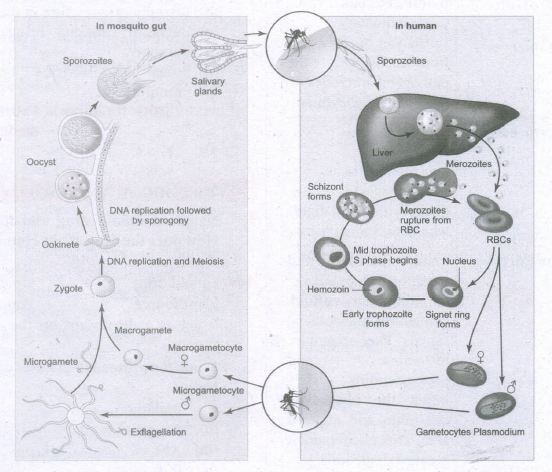
(viii) The schizont divides and produces mononucleated merozoites.
(ix) Eventually the erythrocyte lyses, releasing the merozoites and haemozoin toxin into the blood stream to infect other erythrocytes.
(x) Lysis of red blood cells results in fever and other symptoms.
(xi) This erythrocytic stage is cyclic and repeats itself approximately every 48 to 72 hours or longer depending on the species of Plasmodium involved.
(xii) The sudden release of merozoites triggers an attack on the RBCs.
(xiii) Occasionally, merozoites differentiate into macrogametocytes and microgametocytes. when these are ingested by a mosquito, they develop into male and female gametes respectively.
2.
3.
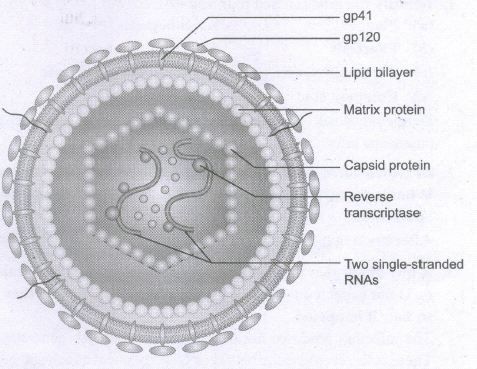
The human immunodeficiency virus belongs to the genus Lentivirus. When observed under the electron microscope, HIV is seen as a spherical virus, 100-120 nm in diameter, containing a dense core surrounded by a lipoprotein envelope. The envelope has .glycoprotein (GP) spikes termed GP 41 and GP 120. At the core, there are two large single-stranded RNA. Attached to the RNA are molecules of reverse transcripte. It also contains enzymes like protease and ribonuclease. The core is covered by a capsid made of proteins. This is followed by another layer of matrix proteins as shown above.
4.
Different types of antigen and antibody reactions: The reaction between soluble antigen and antibody leads to the visible precipitate formation, which is called a precipitin reaction. Antibodies that bring about precipitate formation on reacting with antigens are called as precipitins. Whenever a particulate antigen interacts with its antibody, it would result in clumping or agglutination of the particulate antigen, which is called agglutination reaction. The antibody 'involved in bringing about agglutination reaction is called agglutinin. Opsonisation or enhanced attachment is the process by which a pathogen is marked of ingestion and destruction by a phagocyte. Opsonization involves the binding of an opsonin i.e., antibody, to a receptor on the pathogens. cell membrane. After opsonin binds to the membrane, phagocytes are attracted to the pathogen. So, opsonization is a process in which pathogens are coated with a substance called an opsonin, marking the pathogen out for destruction by the immune system. This results in a much more efficient phagocytosis. The neutralization reactions are the reactions of antigen-antibody that involve the elimination of the harmful effects of bacterial exotoxins or a virus by specific antibodies. These neutralizing substances i.e. antibodies are known. as antitoxins. This specific antibody is produced by a host cell in response to a bacterial exotoxin or corresponding toxoid (inactivated toxin).
5.
Lymphocytes: About 20-30% of the white blood cells are lymphocytes. They have a large nucleus filling most of the cell, surrounded by a little cytoplasm. The two main types of lymphocytes are Band T lymphocytes. Both these are produced in the bone marrow. B lymphocytes (B cells) stay in the bone marrow until they are mature. Then they circulate around the body. Some remain in the blood, while others accumulate in the lymph nodes and spleen. T lymphocytes leave the bone marrow and mature in the thymus gland. Once mature, T cells also accumulate in the same areas of the body as B cells. Lymphocytes have receptor proteins on their surface. When receptors on a B cell bind with an antigen, the B cell becomes activated and divides rapidly to produce plasma cells. The plasma cells produce antibodies. SomeB cells do not produce antibodies but become memory cells. These cells are responsible for the secondary immune response. T lymphocytes do not produce antibodies. They recognize antigen-presenting cells and destroy them. The two important types of T cells are Helper T cells and Killer T cells. Helper T cells release a chemical called cytokine which activates B cells. Killer cells move around the body and destroy cells which are damaged or infected. Apart from these cells neutrophils and monocytes destroy foreign cells by phagocytosis. Monocytes when they mature into large cells, they are called macrophages which performs phagocytosis on any foreign organism. Dendritic cells are called so because it's covered with long, thin membrane extensions that resemble dendrites of nerve cells. These cells present the antigen to T-helper cells. Four types of dendritic cells are known. They are Langerhans, interstitial cells, myeloid and lymphoid cells.
6.
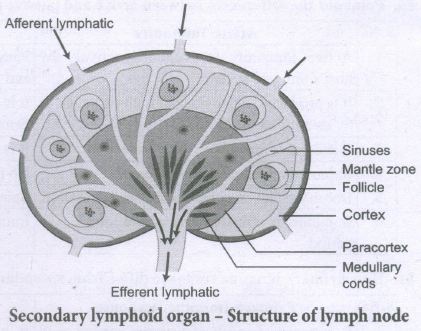
Lymph node has three zones. They are the cortex, paracortex, and medulla. The outer most layer of the lymph node is called cortex, which consists of B-lymphocytes, macrophages, and follicular dendritic cells. The paracortex zone is beneath the cortex, which is richly populated by T lymphocytes and interdigitating dendritic cells. The innermost zone is called the medulla which is sparsely populated by lymphocytes, but many of them are plasma cells, which actively secrete antibody molecules. As the lymph enters, it slowly percolates through the cortex, paracortex, and medulla, giving sufficient chance for the phagocytic cells and dendritic cells to trap the antigen brought by the lymph. The lymph leaving a node carries enriched antibodies secreted by the medullary plasma cells against the antigens that enter the lymph node. Sometimes visible swelling of lymph nodes occurs due to active immune response and increased the concentration of lymphocytes. Thus swollen lymph nodes may signal an infection. There are several groups of lymph nodes. The most frequently enlarged lymph nodes are found in the neck, under the chin, in the armpits, and in the groin.
7.
Thymus is most active during the neonatal and pre-adolescent periods. The. thymus is a fiat and bilobed organ located behind the stemun, above the heart. Each lobe of the thymus contains numerous lobules, separated from each other by connective tissue called septa. Each lobule is differentiated into an outer cortex and an inner medulla. Within each lobule, the developing T cells called thymocytes are arranged into outer cortex and inner medulla. The inner medulla contains immature thymocytes and outer cortex has matured thymocytes. One of its main secretions is the hormone thymosin. It stimulates the T cell to become mature and immunocompetent. By the early teens, the thymus begins to atrophy and is replaced by adipose tissue.
8.
| S.No | Primary Immune Response | Secondary Immune Response |
|---|---|---|
| 1. | It occurs as a result of primary contact with an antigen. | It occurs as a result of second and subsequent contacts with the same antigen |
| 2. | Antibody level reaches peak in 7 to 10 days | Antibody level reaches peak in 3 to 5 days. |
| 3. | Prolonged period is required to establish immunity | It establishes immunity in a short time. |
| 4. | There is rapid decline in antibody level | Antibody level remains high for longer period. |
| 5. | It appears mainly in the lymph nodes and spleen. | It appears mainly in the bone marrow followed by the spleen and lymph nodes |
9.
| S. No | Active Immunity | Passive Immunity |
|---|---|---|
| 1. | Active immunity is produced actively by host's immune system | Passive immunity is received passively and there is no active host participation |
| 2. | It is produced due to contact with pathogen or by its antigen. | It is produced due to antibodies obtained from outside |
| 3. | It is durable and effective in protection. | It is transient and less effective |
| 4. | Immunological memory is present | No memory |
| 5. | Booster effect on subsequent dose is possible. | Subsequent dose is less effective |
| 6. | Immunity is effective only after a short period | Immunity develops immediately |
10.
| Type of innate immunity | Mechanism |
|---|---|
| 1. Anatomical barriers Skin Mucus membrane |
Prevents the entry' of microbes. Its acidic environment (pH 3-5) retards the growth of microbes Mucus entraps foreign microorganisms and competes with microbes for attachment. |
| 2. Physiological barriers Temperature Low pH Chemical mediators |
Normal body temperature inhibits the growth of pathogens. Fever also inhibits the growth of pathogens The acidity of gastric secretions (HCI) kills most ingested microbes Lysozyme acts as antibacterial agent and cleaves the bacterial cell wall. Interferons induce antiviral state in the uninfected cells. Complementary substances produced from leucocytes lyse the pathogenic microbes or facilitate phagocytosis. |
| 3. Phagocytic barriers | Specialized cells (Monocytes, neutrophils, tissue macrophages) phagocytose and digest whole microorganisms |
| 4. Inflammatory barriers | Tissue damage and infection induce leakage of vascular fluid, containing chemotactic signals like serotonin, histamine, and prostaglandins. They influx the phagocytic cells into the affected area. This phenomenon is called diapedesis. |
11.
Helminths are mostly endoparasitic in the gut and blood of human beings and cause diseases called helminthiasis. The two most prevalent helminthic diseases are Ascariasis and Filariasis. Ascaris is a monogenic parasite and exhibits sexual dimorphism. Ascariasis is a disease caused by the intestinal endoparasite Ascaris lumbricoides commonly called the roundworms. It is transmitted through ingestion of embryonated eggs through contaminated food and water. Children playing in contaminated soils are also prone to have a chance of transfer of eggs from hand to mouth. The symptoms of the disease are abdominal pain, vomiting, headache, anemia, irritability, and diarrhoea. A heavy infection can cause nutritional deficiency and severe abdominal pain and causes stunted growth in children. It may also cause enteritis, hepatitis, and bronchitis.
Filariasis is caused by Wuchereria bancrofti, commonly called filarial worm. It is found in the lymph vessels and lymph nodes of man. Wuchereria bancrofti is sexually dimorphic, viviparous and digenic. The life cycle is completed in two hosts, man and the female Culex mosquitoes. The female filarial worm gives rise to juveniles called microfilariae larvae. In the lymph glands, the juveniles develop into adults. The accumulation of the worms blocks the lymphatic system resulting in inflammation of the lymph nodes. In some cases, the obstruction of lymph vessels causes elephantiasis or filariasis of the limbs, scrotum and mammary glands
12.
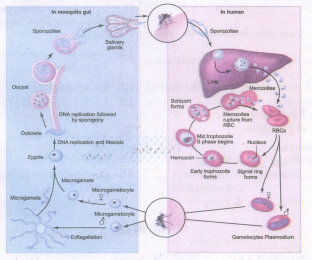
(i) Plasmodium vivax is a digenic parasite, involving two hosts, man as the secondary host and female Anopheles mosquito as the primary host. The life cycle of Plasmodium involves three phases namely schizogony, gamogony and sporogony (f.g)
(ii) The parasite first enters the human blood stream through the bite of an infected female Anopheles mosquito. As it feeds, the mosquito injects the saliva containing the sporozites.
(iii) The sporozoites within the blood stream enter the hepatic cells of the liver and undergoes multiple asexual fission (schizogony). This produces merozoites which are released from liver cells.
(iv) The merozoites penetrate the RBC's. Inside the RBC of Blood, the merozoite of Plasmodium to develop as unicellular trophozoites. The trophozoite grows in size and a central vacuole develops pushing them to one side of cytoplasm and becomes the signet ring stage.
(v)The trophozoite nucleus then divides asexually to produce the The schizont divides and produces on nucleated merozoites.
(vi) Eventually the erythrocyte lyses, releasing the merozoites and haemozoin toxin into the blood stream to infect other erythrocytes. Lysis of red blood cells results in cycles of fever and other symptoms. This erythrocytic stage is cyclic and repeats itself approximately every 48 to72 or longer depending on the species of Plasmodium involved. The sudden release of merozoites triggers an attack on the RBCs.
(vii) Occasionally, merozoites differentiate into macrogametocytes and microgametocytes When these are ingested by a mosquito, they develop into male and female gametes respectively
In the mosquito's gut, the infected erythrocytes lyse and male and female gametes fertilize to form a diploid zygote called ookinete. The ookinete migrates to the mosquito's gut wall and develops into an oocyte.
The oocyte undergoes meiosis by a process called sporogony to form sporozoites. These sporozoites migrate to the salivary glands of the mosquito. The cycle is now completed and when the mosquito bites another human host, the sporozoites are injected and the cycle begins a new.
The pathological changes caused by malaria, affect not only the erythrocytes but also the spleen and other visceral organs. Incubation period of malaria is about 12 days. The early symptoms of malaria are headache, nausea and muscular pain. The classic symptoms first develop with the synchronized release of merozoites, hemozoin toxin and erythrocyte debris into the bloodstream resulting in malarial paroxysms - shivering chills, high fever followed by sweating. Fever and chills are caused partly by malarial toxins that induce macrophages to release tumor necrosis factor (TNF-a) and interleukin.
13.
| S.No | Diseases | Caustive agent | Site of infection | Mode of transmission | Symptoms |
|---|---|---|---|---|---|
| 1. | Common cold | Rhino viruses | Respiratory tract | Droplet infection | Nasal congestion and discharge sore throat, cough and headache |
| 2. | Mumps | Mumps cirus (RNA virus)Paramyxa cirus |
Salivary glands | Saliva and droplet infection | Enlargement of the parotid glands |
| 3. | Measles | Rubella virus (RNA virus Parmyxco), | Skin and respiratory tract | Droplet infection | Sore throat, running nose cough and fever. reddish rashes on the skin, neck and ears |
| 4. | Viral hepatitis | Hepatitis - B virus | Liver | Parenteral route blood transfusion | Liver damage, jaundice, nausea yellowish eyes, fever and pain in the abdomen |
| 5. | Chicken pox | Varicella-Zoster virus (DNA Virus | Respiratory tract,skin and nervous | Droplet infection and direct contact | Mild fever with itchy skin, rash and blisters |
14.
Protozoan Disease :
1. Protozoans are unicellular organisms and can sometimes cause illness.
2. Common protozoal diseases include malaria, giardia, and toxoplasmosis.
The two diseases caused by protozoans are Malaria and Kala-azar.
Causative agent:
1. Malaria -a single-celled parasite of the genus plasmodiu
2. Kala-azar - Leishmania organism.
15.
| No | Diseases | Causative agent | Site of infection | Mode of transmission | Symptoms |
|---|---|---|---|---|---|
| 1. | Shigellosis (Bacillary dysentery) | Shigella sp. | Intestine | Food and water contaminated by faces oral route | Abdominal pain,dehydration, blood and mucus in the stools |
| 2. | Bubonic plague (Black death) | Yersinia pestis | Lymph nodes' | Rat flea vectorXenopsylla cheopis | Fever, headache, and swollen lymph nodes |
| 3. | Diphtheria | Corynebacterium diphtheriae | Larynx, skin nasal and genital passage | Droplet infection | Fever, sore throat, hoarseness and difficulty in breathing |
| 4. | Cholera | Vibrio cholerae | Intestine | Contaminated food and water/faecal oral route | Severe diarrhoea and dehydration |
| 5. | Tetanus)Lock jaw) | Clostridium tetani | Spasm of muscles | Through wound infection | Rigidity of jaw muscle increased heart beat rate and spasm of the muscles of the jaw and face |

12th Standard Syllabus & Materials
12th Standard
TN 12th Computer Applications களப்பெயர் முறைமை (DNS) Sample Question Papers Study Material - QB365 Set A
NEW12th Standard
TN 12th Computer Applications வலையமைப்பு எடுத்துக்காட்டுகள் மற்றும் நெறிமுறைகள் Sample Question Papers Study Material - QB365 Set A
NEW12th Standard
TN 12th Computer Applications கணினி வலையமைப்பு ஓர் அறிமுகம் Sample Question Papers Study Material - QB365 Set A
NEW12th Standard
TN 12th Computer Applications PHP-உடன் MySQL-ஐ இணைத்தல் Sample Question Papers Study Material - QB365 Set A



Tamilnadu Stateboard 12th Standard Subjects

Maths

Chemistry

Physics
Biology

Computer Science

Business Maths and Statistics

Economics

Commerce

Accountancy

History

Computer Applications
Biology
Computer Technology
Computer Applications
Computer Science
Business Maths and Statistics
Commerce
Economics
Maths
Chemistry
Physics
Computer Technology
History
Accountancy

Tamil

English

French
Tamilnadu Stateboard Standards

