
 100% FREE ACCESS
12th Standard Syllabus & Materials
12th Standard
TN 12th Computer Applications மின்னணு தரவு பரிமாற்றம் Sample Question Papers Study Material - QB365 Set A
NEW12th Standard
TN 12th Computer Applications மின் - வணிக பாதுகாப்பு அமைப்புகள் Sample Question Papers Study Material - QB365 Set A
NEW12th Standard
TN 12th Computer Applications மின்னணு செலுத்தல் முறைகள் Sample Question Papers Study Material - QB365 Set A
NEW12th Standard
TN 12th Computer Applications மின் - வணிகம் Sample Question Papers Study Material - QB365 Set A
NEW12th Standard
TN 12th Computer Applications திறந்த மூல கருத்துருக்கள் Sample Question Papers Study Material - QB365 Set A
NEW12th Standard
TN 12th Computer Applications வலையமைப்பு வடமிடல் Sample Question Papers Study Material - QB365 Set A

Published on: 26/08/2022
QB365 provides a detailed and simple solution for every Possible Book Back Questions in Class 12 Biology Subject - Zoology - Human Reproduction, English Medium. It will help Students to get more practice questions, Students can Practice these question papers in addition to score best marks.
Download Tamil Nadu 12th Standard Biology question papers, model tests, one-mark questions, important questions, and public exam papers in PDF format. Free study materials and answer keys for TN State Board students.
Questions + Answers key
Take MCQ Biology Test1.
The following is the illustration of the sequence of ovarian events (a-i) in a human female.
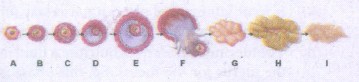
a) Identify the figure that illustrates ovulation and mention the stage of oogenesis it represents.
b) Name the ovarian hormone and the pituitary hormone that have caused the above-mentioned events.
c) Explain the changes that occurs in the uterus simultaneously in anticipation.
d) Write the difference between C and H.
2.
Explain the various phases of the menstrual cycle.
1.
(a) The figure 'F' represent ovulation.
Stage of oogenesis - Ovulatory or luteal stage of oogenesis
(b) (i) The ovarian hormone is progesterone which is released during ovulation.
(ii) The pituitary hormones are the follicle-stimulating hormone (FSH) and Luteinizing hormone (LSH) which are released during and ovulation from anterior pituitary gland.
(c) The endometrium of the uterus gets thickened and blood supply to the endometrium increase.
(d) Figure 'C' represents the secondary follicle and figure h represents the degenerating corpus luteum.
| Secondary follicle | Corpus luteurn |
| lt is surrounded by layers of granulosa cells | Absence of granulosa cells |
| Theca layer is present | Theca layer is absent. |
2.
Menstrual cycle / Ovarian cycle
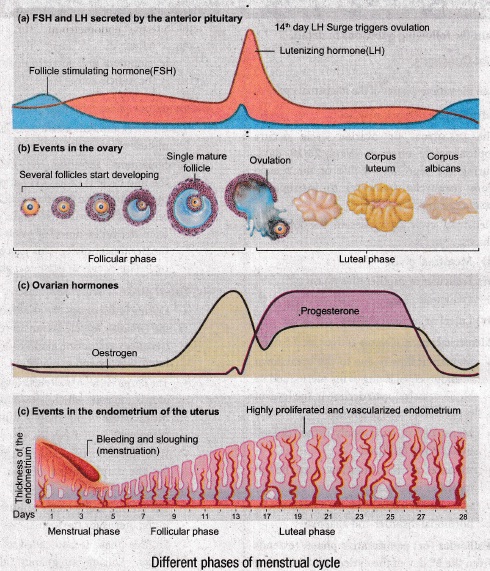
(i) The menstrual or ovarian cycle occurs approximately once in every 28/29 days, during the reproductive life of the female from menarche (puberty) to menopause except during pregnancy.
(ii) Menstrual cycle comprises of the following phases:
1. Menstrual phase
2. Follicular or proliferative phase
3. Ovulatory phase
4. Luteal or, secretory phase
(i) Menstrual phase: (Occurs and last for 3-5 days)
1. Menstrual flow is due to the breakdown of endometrial lining of the uterus, and its blood vessels due to decline in the level of progesterone and oestrogen.
2. Menstruation occurs only if the released ovum is not fertilized.
3. Absence of menstruation may be an indicator of pregnancy
4. However, it could also be due to stress, hormonal disorder and anaemia.
(ii) Follicular (or) proliferative phase: (extends from the 5th day of the cycle until the time of ovulation)
1. During this phase, the primary follicle in the ovary grows to become a fully mature Graafian follicle and simultaneously, the endometrium regenerates through proliferation. These changes in the ovary and the uterus are induced by the secretion of gonadotropins like FSH and LH, which increase gradually during the follicular phase. lt stimulates follicular development and secretion of oestrogen by the follicle cells.
(iii) Ovulatory phase (about 14th day):
1. Both LH and FSH attain peak level in the middle of the cycle.
2. Maximttm secretion of LH during the mid-cycle is called LH surge induces the rupture of the Graafian follicle and the release of the ovum (secondary oocyte) from the break down of ovary wall into the peritoneal cavity. This process called ovulation occurs at late luteal phase.
(iv) Luteal phase or secretory phase;
1. During luteal phase, the remaining part of the Graalian follicle is transformed into a transitory endocrine gland called corpus luteum at the end of ovulation.
2. The corpus luteum secretes a large amount of progesterone which is essential for the maintenance of the endometrium during pregnancy.
3. If fertilization takes place, it paves way for the implantation of the fertilized ovum.
4. The uterine wall secretes a nutritious fluid in the uterus for the foetus.
5. So, this phase is also called as secretory phase. During pregnancy all events of menstrual cycle stop and there is no menstruation.
6. In the absence of fertilization, the corpus luteum degenerates completely and leaves a scar tissue called corpus Albicans.
7. It also initiates the disintegration of the endometrium leading to menstruation, marking repetition of the next cycle.

12th Standard Syllabus & Materials
12th Standard
TN 12th Computer Applications களப்பெயர் முறைமை (DNS) Sample Question Papers Study Material - QB365 Set A
NEW12th Standard
TN 12th Computer Applications வலையமைப்பு எடுத்துக்காட்டுகள் மற்றும் நெறிமுறைகள் Sample Question Papers Study Material - QB365 Set A
NEW12th Standard
TN 12th Computer Applications கணினி வலையமைப்பு ஓர் அறிமுகம் Sample Question Papers Study Material - QB365 Set A
NEW12th Standard
TN 12th Computer Applications PHP-உடன் MySQL-ஐ இணைத்தல் Sample Question Papers Study Material - QB365 Set A



Tamilnadu Stateboard 12th Standard Subjects

Maths

Chemistry

Physics
Biology

Computer Science

Business Maths and Statistics

Economics

Commerce

Accountancy

History

Computer Applications
Biology
Computer Technology
Computer Applications
Computer Science
Business Maths and Statistics
Commerce
Economics
Maths
Chemistry
Physics
Computer Technology
History
Accountancy

Tamil

English

French
Tamilnadu Stateboard Standards

