
 100% FREE ACCESS
12th Standard Syllabus & Materials
12th Standard
TN 12th Computer Applications மின்னணு தரவு பரிமாற்றம் Sample Question Papers Study Material - QB365 Set A
NEW12th Standard
TN 12th Computer Applications மின் - வணிக பாதுகாப்பு அமைப்புகள் Sample Question Papers Study Material - QB365 Set A
NEW12th Standard
TN 12th Computer Applications மின்னணு செலுத்தல் முறைகள் Sample Question Papers Study Material - QB365 Set A
NEW12th Standard
TN 12th Computer Applications மின் - வணிகம் Sample Question Papers Study Material - QB365 Set A
NEW12th Standard
TN 12th Computer Applications திறந்த மூல கருத்துருக்கள் Sample Question Papers Study Material - QB365 Set A
NEW12th Standard
TN 12th Computer Applications வலையமைப்பு வடமிடல் Sample Question Papers Study Material - QB365 Set A

Published on: 30/08/2022
QB365 provides a detailed and simple solution for every Possible Creative Questions in Class 12 Biology Subject - Zoology - Immunology, English Medium. It will help Students to get more practice questions, Students can Practice these question papers in addition to score best marks.
Download Tamil Nadu 12th Standard Biology question papers, model tests, one-mark questions, important questions, and public exam papers in PDF format. Free study materials and answer keys for TN State Board students.
Questions + Answers key
Take MCQ Biology Test1.
Describe the structure of HIV with a diagram.
2.
Write a note on different types of antigen antibody reactions.
3.
Explain the role of thymus as an lymphoid organ.
4.
Tabulate the types of Innate immunity and explain the mechanism involved.
1.
(i) The human immunodeficiency virus belongs to the genus Lentivirus
(ii) When observed under the microscope, HIV is seen as a electron spherical virus, 100-12 nm in diameter, containing a dense core surrounded by a lipoprotein envelope.
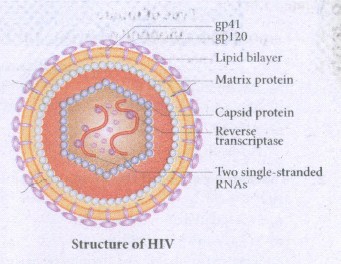
(iii) The envelope has glycoprotein (gp) spikes termed gp 41 and gp 120. At the core, there are two large single stranded RNA.
(iv) Attached to the RNA are molecules of reverse transcriptase. It also contains enzymes like protease and ribonuclease.
(v) The core is covered by a capsid made of proteins. This is followed by another layer of matrix' proteins as shown in the Fig.
2.
The different types of antigen-antibody reaction are:
(i) Precipitin: The reaction between soluble antigen and antibody leads to visible precipitate formation, which is called precipitin reaction. Antibodies that bring about precipitate formation on reacting with antigens are called as precipitins.
(ii) Agglutinstion: Whenever a particulate antigen interacts with its antibody, it would result in clumping or agglutination of the particulate antigen, which is called agglutination reaction. The antibody involved in bringing about agglutination reaction is called agglutinin.
(iii) Opsonisation: Opsonisation or enhanced attachment is the process by which a pathogen is marked of ingestion and destruction by a phagocyte. Opsonisation involves the binding of an opsonin i.e., antibody, to a receptor on the pathogen's cell membrane. After opsonin binds to the membrane, phagocytesare attracted to the pathogen. So, opsonisation is a process in which pathogens are coated with a substance called an opsonin, marking the pathogen out for destruction by the immune system. This results in a much more efficient phagocytosis.
(iv) Neutralization: The neutralization reactions are the reactions or antigenantibody that involve the climinai ion of harmful effects of bacterial exotoxins or a virus by specific antibodies. These neutralizing substances i.e., antibodies are known as antitoxins. This specific antibody is produced by a host cell in response to a bacterial exotoxin or corresponding toxoid.
3.
Thymus is most active during the neonatal an pre-adolescent periods. The thymus is a flat and bilobed organ located behind the sternum, above the heart.
(ii) Each lobe of the thymus contains numerous lobules, separated from each other by connective tissue called septa. Each lobule is differentiated into an outer cortex and an inner medulla.
(iii) Within each lobule, the developing T cells called thymocytes are arranged into outer cortex and inner medulla. The inner medulla contains immature thymocytes and outer cortex has matured thymocytes.
(iv) One of its main secretions is the hormone thymosin. It stimulates the T cell to become mature and immunocompetent. By the early teens, the thymus begins to atrophy and is replaced by adipose tissue.
4.
| Types of innate immunity | Mechanism |
| 1. Anatomical barriers | |
| Skin | Prevents the entry of microbes. Its acidic environment (pH 3-5) retards the growth of microbes. |
| Mucus membrane | Mucus entraps foreign microorganisms and competes with microbes for attachment. |
| 2. Physiological barriers | |
| Temperature | Normal body temperature. inhibits the growth of pathogens. Fever also inhibits the growth of pathogens. |
| Low pH | Acidity of gastric secretions (HCl) kills most ingested microbes. |
| Chemical mediators | Lysozyme acts as antibacterial agent and cleaves the bacterial cell wall. Interferons induce antiviral state in the uninfected cells. Complementary substances produced from leucocytes lyse the pathogenic microbes or facilitate phagocytosis. |
| 3. Phagocytic barriers | Specialized cells (Monocytes, neutrophils, tissue macrophages) phagocytose, and digest whole micro organisms. |
| 4. Inflammatory barriers | Tissue damage and infection induce leakage of vascular fl uid, containing chemotactic signals like serotonin, histamine and prostaglandins. They influx the phagocytic cells into the affected area. This phenomenon is called diapedesis. |

12th Standard Syllabus & Materials
12th Standard
TN 12th Computer Applications களப்பெயர் முறைமை (DNS) Sample Question Papers Study Material - QB365 Set A
NEW12th Standard
TN 12th Computer Applications வலையமைப்பு எடுத்துக்காட்டுகள் மற்றும் நெறிமுறைகள் Sample Question Papers Study Material - QB365 Set A
NEW12th Standard
TN 12th Computer Applications கணினி வலையமைப்பு ஓர் அறிமுகம் Sample Question Papers Study Material - QB365 Set A
NEW12th Standard
TN 12th Computer Applications PHP-உடன் MySQL-ஐ இணைத்தல் Sample Question Papers Study Material - QB365 Set A



Tamilnadu Stateboard 12th Standard Subjects

Maths

Chemistry

Physics
Biology

Computer Science

Business Maths and Statistics

Economics

Commerce

Accountancy

History

Computer Applications
Biology
Computer Technology
Computer Applications
Computer Science
Business Maths and Statistics
Commerce
Economics
Maths
Chemistry
Physics
Computer Technology
History
Accountancy

Tamil

English

French
Tamilnadu Stateboard Standards

