
 100% FREE ACCESS
12th Standard Syllabus & Materials
12th Standard
TN 12th Maths Applications of Matrices and Determinants Sample Question Papers Study Material - QB365 Set A
NEW12th Standard
TN 12th Computer Applications மின்னணு தரவு பரிமாற்றம் Sample Question Papers Study Material - QB365 Set A
NEW12th Standard
TN 12th Computer Applications மின் - வணிக பாதுகாப்பு அமைப்புகள் Sample Question Papers Study Material - QB365 Set A
NEW12th Standard
TN 12th Computer Applications மின்னணு செலுத்தல் முறைகள் Sample Question Papers Study Material - QB365 Set A
NEW12th Standard
TN 12th Computer Applications மின் - வணிகம் Sample Question Papers Study Material - QB365 Set A
NEW12th Standard
TN 12th Computer Applications திறந்த மூல கருத்துருக்கள் Sample Question Papers Study Material - QB365 Set A

Published on: 27/08/2022
QB365 provides a detailed and simple solution for every Possible Creative Questions in Class 12 Biology Subject - Zoology - Microbes in Human Welfare, English Medium. It will help Students to get more practice questions, Students can Practice these question papers in addition to score best marks.
Download Tamil Nadu 12th Standard Biology question papers, model tests, one-mark questions, important questions, and public exam papers in PDF format. Free study materials and answer keys for TN State Board students.
Questions + Answers key
Take MCQ Biology Test1.
How are baculoviruses and bacilius thuringienis used as biocontrol agents? Why are they preferred over readily available chemical pesticides?
2.
Bioremediation & microbes - Discuss.
3.
How microbes are used in Gobar gas production?
4.
Describe the stages of Sewage treatment process
5.
Explain the role of microbes in the production of enzymes & bio-active molecules
6.
Explain the working of a biogas plant
7.
Explain the process of sewage treatment.
8.
What is the key difference between primary and secondary sewage treatment?
1.
Nucleo polyhedrovirus (buculoviruses)
(i) These are Buculoviruses, which are pathogens that attack insects and other arthropods.
(ii) The genus Nucleopolyhedrovirus is used as a biocontrol agent.
(iii) These viruses are species specific and have narrow spectrum insecticidal applications.
Bacillus thuringiensis
(i) Bacillus thuringiensis is a soil dwelling bacterium and serves as a biopesticide containing a toxin called cry toxin.
(ii) The ingested Delta-endotoxins along with the food reach the alkaline medium of digestion of gut of insect.
(iii) Here the in soluble crystal become soluble. They cry toxin then gets inserted into the gut cell membrane and insect is paralyzed the gut the insect stops eating and starves to death.
(iv) The spores of this bacterium are insecticidal and used to control the larvae of many insect pests.
(v) They are available in sachets as dried spores, which have to be mixed with water and sprayed onto vulnerable plants.
(vi) Bacterium produces crystal proteins called Delta-endotoxin which is encoded by cry genes.
(vii) Delta-endotoxins have specific activities against the insects of the orders Lepidoptera, Diptera, Coleoptera and Hymenoptera.
(viii) When they are eaten by the larvae, the toxin becomes active in the gut of the larvae and kills them.
(x) Through genetic engineering, the gene coding for the protein is introduced into irops plants which makes them resistant to the insect pest.
(xi) Biological controls of pests and pathogens must be preferred to chemical pesticides because.
(i) The chemicals are toxic and extremely harmful human being and other animals.
(ii) The chemical also cause pollution of soil, groundwater and our agricultural products.
2.
Aerobic microbes degrade the pollutants in the presence of oxygen. They mainly degrade pesticides and hydrocarbons. Pseudomonas putida is a genetically engineered microorganism (GEM). Ananda Mohan Chakrabarty obtained patent for this recombinant bacterial strain. It is multiplasmid hydrocarbon-degrading bacterium which can digest the hydrocarbons in the oil spills.
Nitrosomonas europaea is also capable of degrading benzene and a variety of halogenated organic compounds including trichloroethylene and vinyl chloride. Ideonella sakaiensis is currently tried for recycling of PET plastics. These bacteria use PETase and MHETase enzymes to breakdown PET plastic into terephthalic acid and ethylene glycol.
Anaerobic microbes degrade the pollutants in the absence of oxygen. Dechloromonas aromatica has the ability to degrade benzene anaerobically and to oxidize toluene and xylene. Phanerochaete chrysosporium an anaerobic fungus exhibits strong potential for bioremediation of pesticides, polyaromatic hydrocarbons, dyes, trinitrotoluene, cyanides, carbon tetrachloride, etc., Dehalococcoides species are responsible for anaerobic bioremediation of toxic trichloroethene to nontoxic ethane. Pestalotiopsis microspora is a species of endophytic fungus capable of breaking down and digesting polyurethane. This makes the fungus a potential candidate for bioremediation projects involving large quantities of plastics.
3.
Biogas is a mixture of different gases produced by the breakdown of organic matter in the absence of oxygen. Biogas can be produced from raw materials such as agricultural wastes, manure, municipal wastes, plant material, sewage, food waste, etc., Biogas is produced under the anaerobic condition when the organic materials are converted through microbiological reactions into gas and organic fertilizer. Biogas primarily consists of methane (63 percent), along with CO2 and hydrogen. Methane-producing bacteria are called methanogens and one such common bacterium is Methanobacterium. Biogas is devoid of smell and bums with a blue flame without smoke. The Methanogens are also present in anaerobic sludge and rumen of cattle. In the rumen, these bacteria help in the breakdown of cellulose. The excreta of cattle called dung is commonly called "Gobar". Gobar gas is generated by the anaerobic decomposition of cattle dung. It consists of methane, CO2 with some hydrogen, nitrogen and other gases in trace amounts.
In a biogas plant, anaerobic digestion is carried out in an airtight cylindrical tank known as digester. It is made up of concrete bricks and cement or steel. Bio-wastes are collected and a slurry of dung is fed into this digester. It has a side opening into which organic materials for digestion are incorporated for microbial activity. Anaerobic digestion is accomplished in three stages: solubilisation, acidogenesis, and methanogens. The outlet is connected to a pipe to supply biogas. The slurry is drained through another outlet and is used as fertilizer. Biogas is used for cooking and lighting. The technology of biogas production was developed in India mainly due to the efforts of the Indian Agricultural Research Institute (IARl) and Khadi and Village Industries Commission (KVIC).
4.
Sewage treatment is usually performed in the following three stages
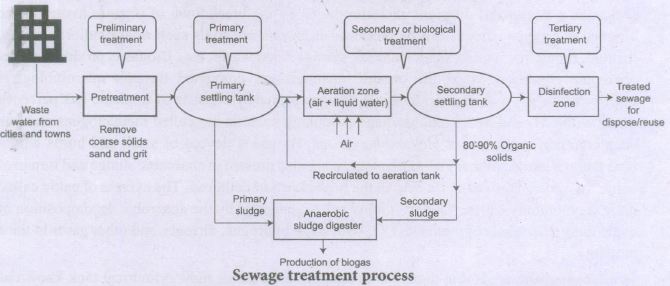
Primary treatment: Primary treatment involves the physical removal of solid and particulate organic and inorganic materials from the sewage through filtration and sedimentation. Floating debris is removed by sequential filtration. Then the grit (soil and small pebbles) are removed by sedimentation. All solids that settle form the primary sludge and the supernatant forms the effluent. The effluent from the primary settling tank is taken for secondary treatment.
Secondary treatment or biological treatment: The primary effluent is passed into large aeration tanks where it is constantly agitated mechanically and air is pumped into it. This allows vigorous growth of useful aerobic microbes into floc (masses of bacteria associated with fungal filaments to form mesh like structures). While growing, these microbes consume the major part of the organic matter in the effluent. This significantly reduces the BOD (Biochemical oxygen demand or Biological oxygen demand). BOD refers to the amount of the oxygen that would be consumed, if all the organic matter in one litre of water were oxidized by bacteria. The sewage water is treated till the BOD is reduced. The greater the BOD of the waste water more is its polluting potential. Once the BOD of sewage water is reduced significantly, the effluent is then passed into a settling tank where the bacterial "floes" are allowed to sediment. This sediment is called activated sludge. A small part of activated sludge is pumped back into the aeration tank to serve as the inoculum. The remaining major part of the sludge is pumped into large tanks called anaerobic sludge digesters. Here, the bacteria which grow anaerobically, digest the bacteria and the fungi in the sludge. During this digestion, bacteria produce a mixture of gases such as methane, hydrogen sulphide and CO2. These gases form biogas and can be used as a source of energy.
Tertiary treatment: Tertiary treatment is the final process that improves the quality of the waste water before it is reused, recycled or released into natural water bodies. This treatment removes the remaining inorganic compounds and substances, such as nitrogen and phosphorus. UV is an ideal disinfectant for wastewater since it does not alter the water quality - except for inactivating microorganisms. UV is a chemical free process that can completely replace the existing chlorination system and also inactivates chlorine-resistant microorganisms like Cryptosporidium and Giardia.
5.
Microbes used for production of chemicals like organic acids and enzymes. Examples of organic acid producers are Aspergillus niger for citric acid, Acetobacter aceti for acetic acid, Rhizopus oryzae for fumaric acid, Clostridium butyricum for butyric acid and Lactobacillus for lactic acid.
Yeast (Saccharomyces cerevisiae) and bacteria are used for commercial production of enzymes. Lipases are used in detergent formulations and are used for removing oily stains from the laundry. Bottled juices are clarified by the use of pectinase, protease, and cellulase. Rennet can also be used to separate milk into solid curds for cheese making. Streptokinase produced by the bacterium Streptococcus and genetically engineered Streptococci are used as "clot buster" for removing clots from the blood. vessels of patients who have undergone myocardial infarction.
Cyclosporin A, an immunosuppressant used in organ transplantation is produced from the fungus Trichoderma polysporum. It is also used for its anti-inflammatory, anti-fungal, and anti-parasitic properties. Statins produced by the yeast Monascus purpureus have been used to lower blood cholesterol levels. It acts by competitively inhibiting the enzyme responsible for the synthesis of cholesterol. Recombinant human insulin has been produced predominantly using E. coli and Saccharomyces cerevisiae for therapeutic use in human.
6.
(i) Biogas is a mixture of different gases produced by the breakdown of organic matter in the absence of oxygen. Biogas can be produced from raw materials such as agricultural wastes, manure, municipal wastes, plant material, sewage, food waste, etc.,
(ii) The excreta of cattle called dung is commonly called "Gobar'. Gobar gas is generated by the anaerobic decomposition of cattle dung. It consists of methane, CO2 with some hydrogen, nitrogen and other gases in trace amounts.
(iii) In a biogas plant, anaerobic digestion is carried out in an air tight cylindrical tank known as digester (Fig.). It is made up of concrete bricks and cement or steel. Bio-wastes are collected and slurry of dung is fed into this digester. It has a side opening into which organic materials for digestion are incorporated for microbial activity. Anaerobic digestion is accomplished in three stages: solubilisation, acidogenesis and methanogenisis. The outlet is connected to a pipe to supply biogas. The slurry is drained through another outlet and is used as fertilizer. Biogas is used for cooking and lighting.
7.
Sewage treatment is usually performed in the following three stages:
(I) Primary treatment:
(a) Primary treatment involves the physical removal of solid and particulate organic and inorganic materials from the sewage through filtration and sedimentation.
(b) Floating debris is removed by sequential filtration. Then the grit (soil and small pebbles) are removed by sedimentation.
(c) All solids that settle form the primary sludge and the supernatant forms the effluerit and is taken for secondary treatment.
(II) Secondary treatment or biological treatment:
(a) The primary effluent is passed into large aeration tanks where it is constantly agitated mechanically and air is pumped into it.
(b) This allows vigorous growth of useful aerobic microbes into floc (masses of bacteria associated with fungal filaments to form mesh like structures). Which consume the organic matter in the effluent.
(c) This significantly reduces the BOD (Biochemical oxygen demand or Biological oxygen demand). BOD refers to the amount of the oxygen that would be consumed, if all the organic matter in one litre of water were oxidized by bacteria. The sewage water is treated till the BOD is reduced. The greater the BOD of the waste water more is its polluting potential.
(d) Once the BOD of sewage water is reduced Significantly, the effluent is then passed into a settling tank where the bacterial "flocs" are allowed to sediment. Which is called activated sludge. A small part of activated sludge is pumped back into the aeration tank to serve as the inoculum.
(e) The remaining major part of the sludge is pumped into large tanks called anaerobic sludge digesters. Here, the bacteria which grow anaerobically, digest the bacteria and the fungi in the sludge. During digestion, bacteria produce a mixture of gases such as methane, hydrogen sulphide and CO2 Which form biogas and can be used as a source of energy.
(III) Tertiary treatment
(a) Tertiary treatment is the final process that improves the quality of the waste water before it is reused, recycled or released into natural water bodies.
(b) This treatment removes the remaining inorganic compounds and substances, such as nitrogen and phosphorus.
(c) UV is an ideal disinfectant for wastewater since it does not alter the water quality - except for inactivating microorganisms. UV is a chemical-free process that can completely replace the existing chlorination system and also inactivates chlorine-resistant microorganisms like Cryptosporidium and Giardia.
8.
| S. No | Primary Treatment | Secondary Treatment |
|---|---|---|
| i. | It involves the physical removal of solid, and particulate organic and inorganic materials fro the sewage through filtration and sedimentation. The supernatant is the effluent which is taken for secondary treatment. | The process takes place in large aeration tanks with vigorous growth of microbes. The organisms break down the organic matter and reduces the Biological oxygen demand it is further passed into a setting tank where are bacterial 'flocs' sediment to form the activated sludge. |
| ii. | It is a total physical process. | It is a biological process. |
| iii. | The solid waste is mainly removed. | The dissolved organic waste is removed by this process by aerobic and anaerobic means. |
| iv | It is a similar process. | It is more time consuming and a major part of sewage treatment. |
| v. | No by products are produced | Biogas production occurs. |

12th Standard Syllabus & Materials
12th Standard
TN 12th Computer Applications வலையமைப்பு வடமிடல் Sample Question Papers Study Material - QB365 Set A
NEW12th Standard
TN 12th Computer Applications களப்பெயர் முறைமை (DNS) Sample Question Papers Study Material - QB365 Set A
NEW12th Standard
TN 12th Computer Applications வலையமைப்பு எடுத்துக்காட்டுகள் மற்றும் நெறிமுறைகள் Sample Question Papers Study Material - QB365 Set A
NEW12th Standard
TN 12th Computer Applications கணினி வலையமைப்பு ஓர் அறிமுகம் Sample Question Papers Study Material - QB365 Set A



Tamilnadu Stateboard 12th Standard Subjects

Maths

Chemistry

Physics
Biology

Computer Science

Business Maths and Statistics

Economics

Commerce

Accountancy

History

Computer Applications
Biology
Computer Technology
Computer Applications
Computer Science
Business Maths and Statistics
Commerce
Economics
Maths
Chemistry
Physics
Computer Technology
History
Accountancy

Tamil

English

French
Tamilnadu Stateboard Standards

