
 100% FREE ACCESS
12th Standard Syllabus & Materials
12th Standard
TN 12th Maths Applications of Matrices and Determinants Sample Question Papers Study Material - QB365 Set A
NEW12th Standard
TN 12th Computer Applications மின்னணு தரவு பரிமாற்றம் Sample Question Papers Study Material - QB365 Set A
NEW12th Standard
TN 12th Computer Applications மின் - வணிக பாதுகாப்பு அமைப்புகள் Sample Question Papers Study Material - QB365 Set A
NEW12th Standard
TN 12th Computer Applications மின்னணு செலுத்தல் முறைகள் Sample Question Papers Study Material - QB365 Set A
NEW12th Standard
TN 12th Computer Applications மின் - வணிகம் Sample Question Papers Study Material - QB365 Set A
NEW12th Standard
TN 12th Computer Applications திறந்த மூல கருத்துருக்கள் Sample Question Papers Study Material - QB365 Set A

Published on: 26/08/2022
QB365 provides a detailed and simple solution for every Possible Book Back Questions in Class 12 Biology Subject - Zoology - Molecular Genetics, English Medium. It will help Students to get more practice questions, Students can Practice these question papers in addition to score best marks.
Download Tamil Nadu 12th Standard Biology question papers, model tests, one-mark questions, important questions, and public exam papers in PDF format. Free study materials and answer keys for TN State Board students.
Questions + Answers key
Take MCQ Biology Test1.
Explain the formation of a nucleosome.
2.
Why did Hershey and Chase use radioactively labelled phosphorous and sulphur only? Would they have got the same result if they use radiolabelled carbon and nitrogen?
3.
How is the two stage process of protein synthesis advantageous?
4.
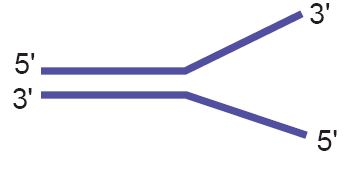
a) Identify the figure given below
b) Redraw the structure as a replicating fork and label the parts
c) Write the source of energy for this replication and name the enzyme involved in this process.
d) Mention the differences in the synthesis of protein, based on the polarity of the two template strands.
5.
What are the three structural differences between RNA and DNA?
6.
Why the human genome project is called a mega project?
1.
(i) In eukaryotes, chromatin is formed by a series of repeating units called nucleosomes.
(ii) Korenberg proposed a model for the nucleosome, in which 2 molecules of the four histone proteins H2A, H2B, H3 AND H4 are organized to form a unit of eight molecules called histone octamere.
(iii) The negatively charged DNA is wrapped around the positively charged histone octamer to form a structure called nucleosome. A typical nucleosome contains 200 bp of DNA helix.
(iv) The histone octameres are in close contact and DNA is coiled on the outside of nucleosome.
(v) Neighbouring nucleosomes are connected by linker DNA (Hl) that is exposed to enzymes. The DNA makes two complete turns around the histone octameres and the two turns are sealed off by an HI molecule
(vi) Chromatin lacking HI has beads on a string appearance in which DNA enters and leaves the nucleosomes at random places.
(vii) HI of one nucleosome can interact with HI of the neighbouring nucleosomes resulting in the further folding of the fibre.
2.
1. They wanted to know whether the proteins coat or the DNA core of the virus entered , into the infected cells. This would help them to determine whether genes were made up protein or of DNA.
2. They used radioactive isotopes of phosphorous - 32 and sulfur - 35 as markers. So they could trace the proteins and DNA to see what they were doing to the cell.
3. They were perfect because proteins contain almost no phosphorous and DNA contains no sulfur, so the radioactive isotopes would show up in the cells if the P-32 or S-35 appeared. If S-35 shown up in the bacteria. It meant the viruses protein had been injected into the bacteria, if the P-32 was found in the bacteria the DNA had been injected into the bacteria.
4. By that they concluded the genetic material of the bacteriophage was DNA, not protein.
5. If in Hershey and Chase's experiments, the phages were labeled with radioactive carbon, the label would be found in all components of the phages and of the phase ghosts (empty capsids) and possible in all components of the bacteria because carbon is found in all organic material.
6. If Hershey and Chase used radiolabeled nitrogen they would see that the cells would be labelled in the nucleus, in the membrane and possibly throughout the cell. Additionally, numerous components of the phage ghosts and the progeny phage would be labelled.
7. Nitrogen is found in proteins and in DNA so they were not able to get actual result that the genetic material of the phage was DNA, if they use radio isotopes labelled with carbon and nitrogen.
3.
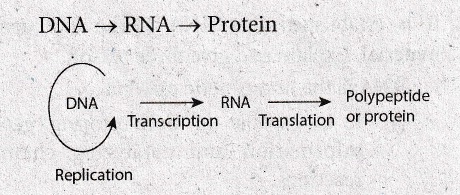
1. The process protein synthesis actually consists of two stages-transcription and translation.
2. In eukaryotic cells, transcription takes place in the nucleus. During transcription, DNA is used as a template to make a molecule of messenger RNA (mRNA). The molecule of mRNA then leaves the nucleus and reaches ribosome in the cytoplasm, where translation occurs.
3. During translation, the genetic code in mRNA is read and used to make a protein.
4. These two processes are summedup by the central dogma of molecular biology
4.
(a) Replicating fork of DNA
(b)
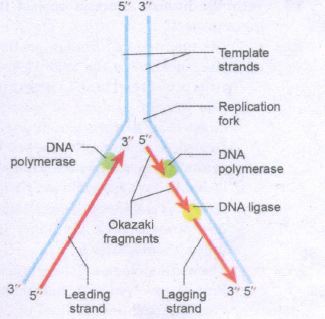
(c) Source of Energy:
NTP's are used in the synthesis of RNA primers and ATP is used as an energy source for some of the enzymes, needed to initiate and sustain DNA synthesis occurs at the replication fork.
Enzymes involved in replication :
(i) DNA Helicase
(ii) DNA polymerase
(iii) Topoisomerase/DNA Gyrase
(iv) DNA ligase
(v) Primase
(d) Both the strands of (parental) DNA act as template for the synthesis of new strands
1. On the templates strand with \(3^{\prime} \rightarrow 5^{\prime}\) polarity the new strand (leading strand) is synthesized as a continuous stretch. It is called continuous synthesis (DNA polymerase carryout polymerisation).
2. On the other strand \(5^{\prime} \rightarrow 3^{\prime}\) polarity DNA synthesized as short stretches; it is called discontinuous synthesis.
3. Later the short stretches of DNA are joined by DNA-ligases into a continuous strand called lagging strand.
5.
Structural difference between DNA and RNA.
| DNA | RNA |
| It is double stranded with exception of some viruses | It is generally single stranded |
| It is the genetic material in all living organism | It is genetic material in some viruses only |
| The sugar is deoxy ribose (pentose) | The sugar is ribose (pentose) |
| Nitrogenous bases present are adenine, guanine, thymine and cytosine | Nitrogenous bases present are adenine, guanine, cytosine and uracil |
| It is less reactive, chemically and structurally more stable. | It is more reactive chemically and structurally less stable |
| It usually occurs inside the nucleus and in some cell organelles like mitochondria and chloroplasts. |
Very little RNA occurs inside the nucleus. most of its found in the cytoplasm |
6.
Human genome project was considered to be a mega project because
1. It had a specific goal to sequence for everybase pair present in the human genome. (Human Genome has 3.1647 billion nucleotide base pairs).
2. It took around 13 years of completion and got accomplished in year 2006.
3. It was a large-scale project, which aimed at developing new technology and generating new information in the field of genomic studies.
4. As a result of it, several news areas and avenues have opened up in the field of genetics, biotechnology and medical sciences.
5. It provided clues regarding the understanding of human biology.

12th Standard Syllabus & Materials
12th Standard
TN 12th Computer Applications வலையமைப்பு வடமிடல் Sample Question Papers Study Material - QB365 Set A
NEW12th Standard
TN 12th Computer Applications களப்பெயர் முறைமை (DNS) Sample Question Papers Study Material - QB365 Set A
NEW12th Standard
TN 12th Computer Applications வலையமைப்பு எடுத்துக்காட்டுகள் மற்றும் நெறிமுறைகள் Sample Question Papers Study Material - QB365 Set A
NEW12th Standard
TN 12th Computer Applications கணினி வலையமைப்பு ஓர் அறிமுகம் Sample Question Papers Study Material - QB365 Set A



Tamilnadu Stateboard 12th Standard Subjects

Maths

Chemistry

Physics
Biology

Computer Science

Business Maths and Statistics

Economics

Commerce

Accountancy

History

Computer Applications
Biology
Computer Technology
Computer Applications
Computer Science
Business Maths and Statistics
Commerce
Economics
Maths
Chemistry
Physics
Computer Technology
History
Accountancy

Tamil

English

French
Tamilnadu Stateboard Standards

