
 100% FREE ACCESS
12th Standard Syllabus & Materials
12th Standard
TN 12th Computer Applications மின்னணு தரவு பரிமாற்றம் Sample Question Papers Study Material - QB365 Set A
NEW12th Standard
TN 12th Computer Applications மின் - வணிக பாதுகாப்பு அமைப்புகள் Sample Question Papers Study Material - QB365 Set A
NEW12th Standard
TN 12th Computer Applications மின்னணு செலுத்தல் முறைகள் Sample Question Papers Study Material - QB365 Set A
NEW12th Standard
TN 12th Computer Applications மின் - வணிகம் Sample Question Papers Study Material - QB365 Set A
NEW12th Standard
TN 12th Computer Applications திறந்த மூல கருத்துருக்கள் Sample Question Papers Study Material - QB365 Set A
NEW12th Standard
TN 12th Computer Applications வலையமைப்பு வடமிடல் Sample Question Papers Study Material - QB365 Set A

Published on: 26/08/2022
QB365 provides a detailed and simple solution for every Possible Creative Questions in Class 12 Biology Subject - Zoology - Molecular Genetics, English Medium. It will help Students to get more practice questions, Students can Practice these question papers in addition to score best marks.
Download Tamil Nadu 12th Standard Biology question papers, model tests, one-mark questions, important questions, and public exam papers in PDF format. Free study materials and answer keys for TN State Board students.
Questions + Answers key
Take MCQ Biology Test1.
Mutations on genetic code affects the phenotype. Describe with example.
2.
Explain the transcription process in prokaryotes with needed diagram.
3.
Give a detailed account of a transcription unit.
4.
Meselson and Stahl's experiment proved the semi-conservation mode of DNA replication. Explain.
5.
How the DNA is packed in an eukaryotic cell?
6.
Explain the properties of DNA that makes it an ideal genetic material.
7.
Describe Hershey and Chase experiment. What is concluded by their experiment?
8.
Describe the steps involved in DNA finger printing.
9.
Explain the negative control of transcription initiation as described by Jacob and Monod.
10.
Describe the structure of tRNA with a diagram.
11.
Explain how mutation can impact genetic code with an example
12.
List the salient features of genetic code.
13.
14.
Explain the properties of genetic material.
15.
List the salient features of classical concept of gene.
1.
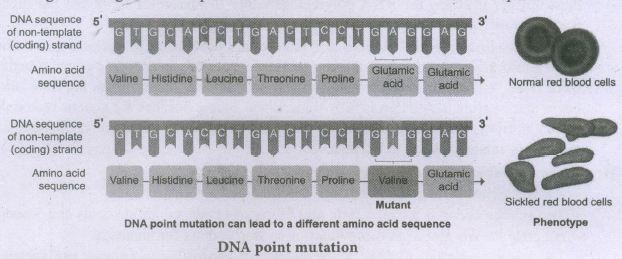
The simplest type of mutation at the molecular level is a change in nucleotide that substitutes one base for another. Such changes are known as base substitutions which may occur spontaneously or due to the action of mutagens. A well-studied example is sickle cell anaemia in humans which results from a point mutation of an allele of \(\beta \) - haemoglobin gene (\(\beta \) Hb).
A haemoglobin molecule consists of four polypeptide chains of two types, two a chains and two \(\beta \) chains. Each chain has a heme group on its surface. The heme groups are involved in the binding of oxygen. The human blood disease, sickle cell anaemia is due to abnormal haemoglobin. This abnormality in haemoglobin is due to a single base substitution at the sixth codon of the beta-globin gene from GAG to GTG in \(\beta \) -chain of haemoglobin. It results in a change of amino acid glutamic acid to valine at the 6th position of the \(\beta \) -chain. This is the classical example of point mutation that results in the change of amino acids residue glutamic acid to valine. The mutant haemoglobin undergoes polymerisation under oxygen tension causing the change in the shape of the RBC from biconcave to a sickle-shaped structure.
2.
In prokaryotes, there are three major types of RNAs: mRNA, tRNA, and rRNA. All three RNAs are needed to synthesize a protein in a cell. The mRNA provides the template, tRNA brings amino acids and reads the genetic code, and rRNAs play structural and catalytic role during translation. There is a single DNA-dependent RNA polymerase that' catalyses transcription of all types of RNA. It binds to the promoter and initiates transcription (Initiation).
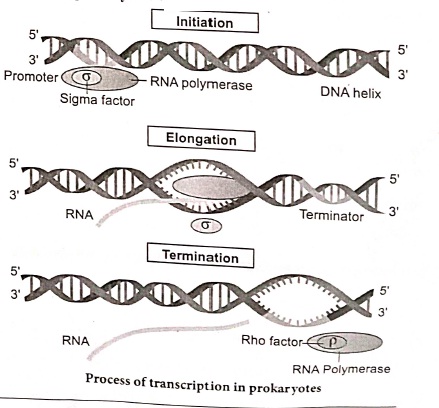
The polymerases binding sites are called promoters. It uses nucleoside triphosphate as substrate and polymerases in a template depended fashion following the rule of complementarity. After the initiation of transcription, the polymerase continues to elongate the RNA, adding one nucleotide after another to the growing RNA chain. Only a short stretch of RNA remains bound to the enzyme, when the polymerase reaches a terminator at the end of a gene, the nascent RNA falls off, so also the RNA polymerase.
The RNA polymerase is only capable of catalyzing the process of elongation. The RNA polymerase associates transiently with initiation factor sigma (\(\sigma \)) and termination factor rho (\(\rho \)) to initiate and terminate the transcription, respectively. Association of RNA with these factors instructs the RNA polymerase either to initiate or terminate the process of transcription.
In bacteria, since the mRNA does not require any processing to become active and also since transcription and translation take place simultaneously in the same compartment (since there is no separation of cytosol and nucleus in bacteria), many times the translation can begin much before the mRNA is fully transcribed. This is because the genetic material is not separated from other cell organelles by a nuclear membrane consequently; transcription and translation can be coupled in bacteria.
3.
A transcriptional unit in DNA is defined by three regions, a promoter, the structural gene, and a terminator. The promoter is located towards the 5' end. It is a DNA sequence that provides binding site for RNA polymerase. The presence of promoter in a transcription unit defines the template and coding strands. The terminator region located towards the 3' end of the coding strand contains a DNA sequence that causes the RNA polymerase to stop transcribing. In eukaryotes the promoter has AT-rich regions called TATA box (Goldberg- Rogness box) and in prokaryotes, this region is called Pribnow box. Besides promoter, eukaryotes also require an enhancer. The two strands of the DNA in the structural gene of a transcription unit have opposite polarity. DNA dependent RNA polymerase catalyses the polymerization in only one direction, the strand that has the polarity 3'\(\rightarrow\)5' acts as a template, and is called the template strand. The other strand which has the polarity 5'\(\rightarrow\)3' has a sequence same as RNA (except thymine instead of uracil) and is displaced during transcription. This strand is called coding strand.
The structural gene may be monocistronic (eukaryotes) or polycistronic (prokaryotes). In eukaryotes, each mRNA carries only a single gene and encodes information for only a single protein and is called monocistronic mRNA. In prokaryotes, clusters of related genes, known as operon, often found next to each other on the chromosome are transcribed together to give a single mRNA and hence are polycistronic.
4.
The mode of DNA replication was determined in 1958 by Meselson and Stahl. They designed an experiment to distinguish between semi-conservative, conservative and dispersive replications. In their experiment, they grew two cultures of E.coli for many generations in separate media. The 'heavy' culture was grown in a medium in which the nitrogen source (NH4CI) contained the heavy isotope 15N and the 'light' culture was grown in a medium in which the nitrogen source contained light isotope 14N for many generations. At the end of growth, they observed that the bacterial DNA in the heavy culture contained only 14N and in the light culture only 14N. The heavy DNA could be distinguished from light DNA (15N from 14N)with a technique called Cesium Chloride (CsCI) density gradient centrifugation. In this process, heavy and light DNA extracted from cells in the two cultures settled into two distinct and separate bands (hybrid DNA).
The heavy culture (15N) was then transferred into a medium that had only NH4CI and took samples at various definite time intervals (20 minutes duration). After the first replication, they extracted DNA and subjected it to density gradient centrifugation. The DNA settled into a band that was intermediate in position between the previously determined heavy and light bands. After the second replication (40 minutes duration), they again extracted DNA samples, and this time found the DNA settling into two bands, one at the light band position and one at intermediate position. These results confirm Watson and Crick's semi-conservative replication hypothesis.
5.
In eukaryotes, organization is more complex. Chromatin is formed by a series of repeating units called nucleosomes. Kornberg proposed a model for the nucleosome, in which 2 molecules of the four histone proteins H2A, H2B, H3 and H4 are organized to form a unit of eight molecules called histone octamere. The negatively charged DNA is wrapped around the positively charged histone octamere to form a structure called nucleosome. A typical nucleosome contains 200 bp of DNA helix. The histone octameres are in close contact and DNA is coiled on the outside of nucleosome. Neighbouring nucleosomes are connected by linker DNA (HI) that is exposed to enzymes. The DNA makes two complete turns around the histone octameres and the two turns are sealed off by an HI molecule. Chromatin lacking HI has a beads-on-a-string appearance in which DNA enters and leaves the nucleosomes at random places. HI of one nucleosome can interact with HI of the neighbouring nucleosomes resulting in the further folding of the fibre. The chromatin fiber in interphase nuclei and mitotic chromosomes have a diameter that vary between 200-300 nm and represents inactive chromatin. 30 nm fibre arises from the folding of nucleosome, chains into a solenoid structure having six nucleosomes per turn. This structure is stabilized by interaction between different HI molecules. DNA is a solenoid and packed about 40 folds. The hierarchical nature of chromosome structure is illustrated. Additional set of proteins are required for packing of chromatin at higher level and are referred to as non-histone chromosomal proteins (NHC). In a typical nucleus, some regions of chromatin are loosely packed (lightly stained) and are referred to as euchromatin. The chromatin that is tightly packed (stained darkly) is called heterochromatin. Euchromatin is transcriptionally active and heterochromatin is transcriptionally inactive.
6.
i) Self Replication: It should be able to replicate. According to the rule of base pairing and complementarity, both nucleic acids (DNA and RNA) have the ability to direct duplications. Proteins fail to fulfill this criteria.
ii) Stability: It should be stable structurally and chemically. The genetic material should be stable enough not to change with different stages of life cycle, age or with change in physiology of the organism. Stability as one of property of genetic material was clearly evident in Griffith's transforming principle. Heat which killed the bacteria did not destroy some of the properties of genetic material. in DNA the two strands being complementary, if separated (denatured) by heating can come together (renaturation) when appropriate condition is provided. Further, 2' OH group present at every nucleotide in RNA is a reactive group that makes RNA liable and easily degradable. RNA is also known to be catalytic and reactive. Hence, DNA is chemically more stable and chemically less reactive when compared to RNA. Presence of thymine instead of uracil in DNA confers additional stability to DNA.
iii) Information storage: It should be able to express itself in the form of 'Mendelian characters'. RNA can directly code for protein synthesis and can easily express the characters. DNA, however, depends on RNA for synthesis of proteins. Both DNA and RNA can act as genetic material, but DNA being more stable stores the genetic information and RNA transfers the genetic information.
iv) Variation through mutation: It should be able to mutate. Both DNA and RNA are able to mutate. RNA being unstable mutates at a faster rate. Thus viruses having RNA genome with shorter life span can mutate and evolve faster. The above discussion indicates that both RNA and DNA can function as genetic material. DNA is more stable and is preferred for storage of genetic information.
7.
Alfred Hershey and Martha Chase (1952) conducted experiments on bacteriophages that infect bacteria. Phage T2 is a virus that infects the bacterium Escherichia coli. When phages (virus) are added to bacteria, they adsorb to the outer surface, some material enters the bacterium, and then later each bacterium lyses to release a large number of progeny phage. Hershey and Chase wanted to observe whether it was DNA or protein that entered the bacteria. All nucleic acids contain phosphorus and contain sulphur (in the amino acid cysteine and methionine). Hershey and Chase designed an experiment using radioactive isotopes of Sulphur (35S) and phosphorus (32P) to keep separate track of the viral protein and nucleic acids during the infection process. The phages were allowed to infect bacteria in culture medium which containing the radioactive isotopes 35Sor 32p. The bacteriophage that grew in the presence of 35Shad labelled proteins and bacteriophages grown in the presence of 32p had labelled DNA. The differential labelling thus enabled them to identify DNA and proteins of the phage. Hershey and Chase mixed the labelled phages with unlabeled E. coli and allowed bacteriophages to attack and inject their genetic material. Soon after infection (before lysis of bacteria), the bacterial cells were gently agitated in a blender to loosen the adhering phase particles. It was observed that only 32p was found associated with bacterial cells and 35S was in the surrounding medium and not in the bacterial cells. When phage progeny was studied for radioactivity, it was found that it carried only 32p and not 35S. These results clearly indicate that only DNA and not protein coat entered the bacterial cells. Hershey and Chase thus conclusively proved that it was DNA, not protein, which carries the hereditary information from virus to bacteria.
8.
Steps in DNA printing:
i) Extraction of DNA: The process of DNA fingerprinting starts with obtaining a sample of DNA from blood, semen, vaginal fluids, hair roots, teeth, bones, etc.,
ii) Polymerase chain reaction (PCR) In many situations, there is only a small amount of DNA available for fingerprinting. If needed many copies / f the DNA can be produced by PCR (DNA amplification).
iii) Fragmenting DNA: DNA is treated with restriction enzymes which cut the DNA into smaller fragments at specific sites.
iv) Separation of DNA electrophoresis: During electrophoresis in an agarose gel, the DNA fragments are separated into bands of different sizes. The bands of separated DNA are sieved out of the gel using a nylon membrane (treated with chemicals that allow for it to break the hydrogen bonds of DNA so there are single strands).
v) Denaturing DNA: The DNA on gels is denatured by using alkaline chemicals or by heating.
vi) Blotting: The DNA band pattern in the gel is transferred to a thin nylon membrane placed over the 'size fractionated DNA strand' by Southern blotting.
vii) Using probes to identify specific DNA: A radioactive probe (DNA labeled with a radioactive substance) is added to the DNA bands. The probe attaches by base pairing to those restriction fragments that are complementary to its sequence. The probes can also be prepared by using either. 'fluorescent substance' or 'radioactive isotopes'.
viii) Hybridization with probe: After the probe hybridizes and the excess probe washed off, a photographic film is placed on the membrane containing 'DNA hybrids'.
ix) Exposure film to make a genetic/ DNA Fingerprint: The radioactive label exposes the film to form an image (image of bands) corresponding to specific DNA bands. The thick and thin dark bands form a pattern of bars which constitutes a genetic fingerprint.
9.
i) JAcob and Monod proposed the classical model of Lac operon to explain gene expression and regulation in E.coli. In lac operon, a polycistronic structural gene is regulated by a common promoter and regulatory gene.
ii) When the cell is using its normal energy source as glucose, the gene transcribes a repressor mRNA and after its translation, are pressor protein is produced. It binds to the operator region of the operon and prevents translation, as a result, β-galactosidase is not produced.
iii) In the absence of preferred carbon source such as glucose, if lactose is available as an energy source for the bacteria then lactose enters the cell as a result of permease enzyme. Lactose acts as an inducer and interacts with the repressor to inactivate it.
iv) The repressor protein binds to the operator of the operon and prevents RNA polymerase from transcribing the operon.
v) In the presence of inducer, such as lactose, or allolactose, the repressor is inactivated by interaction with the inducer. This allows RNA polymerase to bind to the promoter site and transcribe the operon to produce lac mRNA which enables formation of all the required enzymes needed for lactose metabolism.
vi) This regulation of lac operon by the repressor is an example of negative control of transcription initiation.
10.
i) The transfer RNA, (tRNA) molecule of a cell acts as a vehicle that picks up the amino acids scattered through the cytoplasm and also reads specific codes of mRNA molecules. Hence it is called an adapter molecule This term was postulated by Francis Crick.
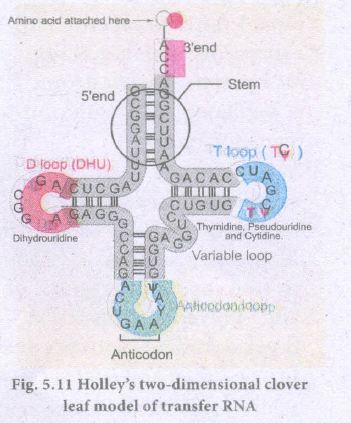
(ii) The two dimensional clover leaf model of tRNA was proposed by Robert Holley. The secondary structure of tRNA depicted in the following picture looks like a clover leaf.
(iii) In actual structure, the tRNA is a compact molecule which looks like an inverted I.
(iv) The clover leaf model of tRNA shows the presence of three arms namely DHU arm, middle arm and TΨC arm.
(v) These arms have loops such as amino acyl binding loop, anticodon loop and ribosomal binding loop at their ends. In addition it also shows a small lump called variable loop or extra arm.
(vi) The amino acid is attached to one end (amino acid acceptor end) and the other end consists of three anticodon nucleotides.
(vii) The anticodon pairs with a codon in mRNA ensuring that the correct amino acid is incorporated into the growing polypeptide chain.
(viii) Four different regions of double-stranded RNA are formed during the folding process. Modified bases are especially common in tRNA.
(ix) Wobbling between anticodon and codon allows some tRNA molecules to read more than one codon.
11.
i) Comparative studies of mutations (sudden change in a gene) and corresponding alteration in amino acid sequence of specific protein have confirmed the validity of the genetic code.
ii) The simplest type of mutation at the molecular level is a change in nucleotide that substitutes one base for another and are known as base substitutions which may occur spontaneously or due to the action of mutagens.
iii) An example is sickle cell anaemia in humans which results from a point mutation of an allele of B-haemoglobin gene (βHb)
iv) A haemoglobin molecule consists of four polypeptide chans of two types, two a chains and two B chains. Each chain has a heme group on its surface. The heme groups are involved in the binding of oxygen.
v) The human blood disease, sickle cell anaemia is due to abnormal haemoglobin due to a single base substitution at the sixth codon of the beta globin gene from GAG to GTG in' β-chain of haemoglobin. It results in a change of amino acid glutamic acid to valine at the 6th position of β-chain.
vi) This is point mutation that results in the change of amino acids residue glutamic acid to valine. The mutant haemoglobin undergoes polymerisation under oxygen tension causing the change in the shape of the RBC from biconcave to a sickle shaped structure.
12.
The salient features of genetic code are as follows:
(i) The genetic codon is a triplet code and 61 codons code for amino acids and 3 codons do not code for any amino acid and function as stop codon (Termination).
(ii) The genetic code is universal. It means that all known living systems use nucleic acids and the same three base codons (triplet codon) direct the synthesis of protein from amino acids. for example, the mRNA (UUU) codon codes for phenylalanine in all cells of all organisms. some exceptions are reported in prokaryotic, mitochondrial and chloroplast genomes. However similarities are more common than differences. Most part of the genetic code is universal in prokaryotes and eukaryotes.
(iii) A non-overlapping codon means that the same letter is not used for two different codons. for instance, the nucleotide sequence GUU GUC represents only two codons.
(iv) It is comma less, which means that the message would be read directly from one end to the other i.e., no punctuation are needed between two codes.
(v) A degenerate code means that more than one triplet codon could code for a specific amino acid. for example, codons GUU, GCU, GUA and GUG code for valine.
(vi) Non-ambiguous code means that one codon will code for one amino acid.
(vii) The code is always read in a fixed direction i.e. from 5'⟶3' direction called polarity.
(viii) AUG has dual functions. It acts as a initiator codon and also codes for the amino acid methionine.
(ix) UAA, UAG (tyrosine) and UGA (tryptophan) codons are designated as termination (stop) codons and also are known as "non-sense" codons.
13.
14.
(i) DNA acts as a genetic material. However, in some viruses like Tobacco mosaic virus (TMV), bacteriophage θB, RNA acts as the genetic material. A molecule that can act as a genetic material should have the following properties:
(ii) Self Replication: It should be able to replicate. According to the rule of base pairing and complementarity, both nucleic acids (DNA and RNA) have the ability to direct duplications. Proteins fail to fulfill this criteria.
(iii) It should be stable structurally and chemically. The genetic material should be stable enough not to change with different stages of life cycle, age or with change in physiology of the organism.
(iv) Griffith's transforming principle, Heat which killed the bacteria did not destroy some of the properties of genetic material. In DNA the two strands being complementary, if separated (denatured) by heating can come together (renaturation) when appropriate condition is provided.
(v) Further 2' OH group present at every nucleotide in RNA is a reactive group that makes RNA liable and easily degradable. RNA is also known to be catalytic and reactive.
(vi) Hence DNA is chemically more stable and chemically less reactive when compared to RNA.
(vii) Presence of thymine instead of uracil in DNA confers additional stability to DNA.
(viii) It should be able to express itself in the form of Mendelian characters ', RNA can directly code for protein synthesis DNA, however depends on RNA for synthesis of proteins.
(ix) Both DNA and RNA can act as a genetic material, but DNA- being more stable stores the genetic information and RNA transfers the genetic information
(x) Variation through mutation: It should be able to mutate. Both DNA and RNA are able to mutate. RNA being unstable, mutates at a faster rate.
15.
According to the classical concept of gene introduced by Sutton in 1902, genes have been defined as discrete particles that follow Mendelian rules of inheritance, occupy a definite locus in the chromosome and are responsible for the expression of specific phenotypic character. They show the following properties:
(i) Number of genes in each organism is more than the number of chromosomes; hence several genes are located on the same chromosome.
(ii) The genes are arranged in a single linear order like beads on a string.
(iii) Each gene occupies a specific position called locus.
(iv) Genes may exist in several alternate forms called alleles.
(v) Genes may undergo sudden change in positions and composition called mutations.
(vi) Genes are capable of self-duplication producing their own copies.

12th Standard Syllabus & Materials
12th Standard
TN 12th Computer Applications களப்பெயர் முறைமை (DNS) Sample Question Papers Study Material - QB365 Set A
NEW12th Standard
TN 12th Computer Applications வலையமைப்பு எடுத்துக்காட்டுகள் மற்றும் நெறிமுறைகள் Sample Question Papers Study Material - QB365 Set A
NEW12th Standard
TN 12th Computer Applications கணினி வலையமைப்பு ஓர் அறிமுகம் Sample Question Papers Study Material - QB365 Set A
NEW12th Standard
TN 12th Computer Applications PHP-உடன் MySQL-ஐ இணைத்தல் Sample Question Papers Study Material - QB365 Set A



Tamilnadu Stateboard 12th Standard Subjects

Maths

Chemistry

Physics
Biology

Computer Science

Business Maths and Statistics

Economics

Commerce

Accountancy

History

Computer Applications
Biology
Computer Technology
Computer Applications
Computer Science
Business Maths and Statistics
Commerce
Economics
Maths
Chemistry
Physics
Computer Technology
History
Accountancy

Tamil

English

French
Tamilnadu Stateboard Standards

