
 100% FREE ACCESS
12th Standard Syllabus & Materials
12th Standard
TN 12th Maths Applications of Matrices and Determinants Sample Question Papers Study Material - QB365 Set A
NEW12th Standard
TN 12th Computer Applications மின்னணு தரவு பரிமாற்றம் Sample Question Papers Study Material - QB365 Set A
NEW12th Standard
TN 12th Computer Applications மின் - வணிக பாதுகாப்பு அமைப்புகள் Sample Question Papers Study Material - QB365 Set A
NEW12th Standard
TN 12th Computer Applications மின்னணு செலுத்தல் முறைகள் Sample Question Papers Study Material - QB365 Set A
NEW12th Standard
TN 12th Computer Applications மின் - வணிகம் Sample Question Papers Study Material - QB365 Set A
NEW12th Standard
TN 12th Computer Applications திறந்த மூல கருத்துருக்கள் Sample Question Papers Study Material - QB365 Set A

Published on: 27/08/2022
QB365 provides a detailed and simple solution for every Possible Book Back Questions in Class 12 Biology Subject - Zoology - Organisms and Population, English Medium. It will help Students to get more practice questions, Students can Practice these question papers in addition to score best marks.
Download Tamil Nadu 12th Standard Biology question papers, model tests, one-mark questions, important questions, and public exam papers in PDF format. Free study materials and answer keys for TN State Board students.
Questions + Answers key
Take MCQ Biology Test1.
Describe Population Age Distribution
2.
Differentiate between Tundra and Taiga Biomes.
3.
Give an account of population regulation
4.
Differentiate J and S shaped curve
5.
6.
Give the characters of a Biome ?
7.
Explain hibernation and aestivation with examples.
1.
(i) The proportion of the age groups in a population is its age distribution attribute.
(ii) This determines the reproductive status of the population at the given time and is an indicator of the future population size.
(iii) Usually a rapidly growing population will have larger proportion of young individuals.
(iv) A stable population will have an even distribution of various age classes.
(v) A declining population tends to have a larger proportion of older individuals
2.
| No. | Tundra Biome | Taiga Biomes |
|---|---|---|
| 1. | This is almost treeless plain in the northern parts of Asia, Europe, and North America. | Taiga is a forest of coniferous trees such as spruce, fir and pine. |
| 2. | Winters are long with little daylight, summers are short, with long daylight hours. | Summer temperature ranges from 10octo 21oPc. |
| 3. | Because of the severe winters, many of the animals are migratory. For E g: the many shore birds and water fowl such as ducks and geese, nest in the Tundra during the summer and migrate south for the winter. |
Important migratory herbivores include moose, elk, deer and reindeer. Moose and reindeer migrate to the Taiga for winter and to Tundra for summers. |
3.
(i) The inherent tendency of all animal populations is to increase in number. But it does not increase indefinitely.
(ii) Once the carrying capacity of the environment is reached, population numbers remain static or fluctuate depending on environmental conditions.
(iii) This is regulated by many factors which are:
1. Density independent - Extrinsic factors
2. Density dependent - Intrinsic factors
(iv) Extrinsic factors include the availability of space, shelter, weather, food, etc.
(v) Intrinsic factors include competition, predation, emigration, immigration, and diseases.
4.
| S. No. | J shaped curve | S shaped curve |
|---|---|---|
| 1. | When a population increases rapidly in an exponential fashion and then stops abruptly due to environmental resistance or due to sudden appearance of a limiting factor, they are said to exhibit J-shaped growth form, |
Some populations, as in a population of small mammals, increase lowly at first then more rapidly & gradually slow down as environmental resistance increases where by equilibrium is reached and maintained |
| 2. | Many insects show explosive increase in number during the rainy season followed by their disappearance at the end of season. | Their growth is represented by s shaped growth curve. |
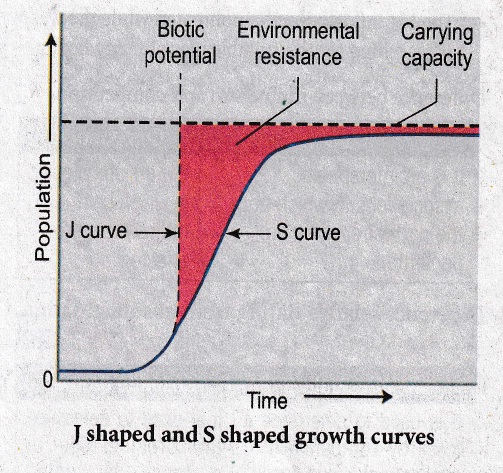
5.
6.
Characters of biome
(i) Location, geographical position (Latitude, Longitude)
(ii) Climate and physiochemical environment
(iii) Predominant plant and animal life
(iv) Boundaries between biomes are not always sharply defined. Transition or transient zones are seen as in case of grassland and forest biomes.
7.
Hibernation:
Spending the winter in an inactive dormant state to escape in time, is called hibernation. E.g: Bears and Frogs.
Aestivation:
Spending the dry, hot period in an inactive state to escape in time is called aestivation .E.g: Snails and Fish.

12th Standard Syllabus & Materials
12th Standard
TN 12th Computer Applications வலையமைப்பு வடமிடல் Sample Question Papers Study Material - QB365 Set A
NEW12th Standard
TN 12th Computer Applications களப்பெயர் முறைமை (DNS) Sample Question Papers Study Material - QB365 Set A
NEW12th Standard
TN 12th Computer Applications வலையமைப்பு எடுத்துக்காட்டுகள் மற்றும் நெறிமுறைகள் Sample Question Papers Study Material - QB365 Set A
NEW12th Standard
TN 12th Computer Applications கணினி வலையமைப்பு ஓர் அறிமுகம் Sample Question Papers Study Material - QB365 Set A



Tamilnadu Stateboard 12th Standard Subjects

Maths

Chemistry

Physics
Biology

Computer Science

Business Maths and Statistics

Economics

Commerce

Accountancy

History

Computer Applications
Biology
Computer Technology
Computer Applications
Computer Science
Business Maths and Statistics
Commerce
Economics
Maths
Chemistry
Physics
Computer Technology
History
Accountancy

Tamil

English

French
Tamilnadu Stateboard Standards

