
 100% FREE ACCESS
12th Standard Syllabus & Materials
12th Standard
TN 12th Maths Applications of Matrices and Determinants Sample Question Papers Study Material - QB365 Set A
NEW12th Standard
TN 12th Computer Applications மின்னணு தரவு பரிமாற்றம் Sample Question Papers Study Material - QB365 Set A
NEW12th Standard
TN 12th Computer Applications மின் - வணிக பாதுகாப்பு அமைப்புகள் Sample Question Papers Study Material - QB365 Set A
NEW12th Standard
TN 12th Computer Applications மின்னணு செலுத்தல் முறைகள் Sample Question Papers Study Material - QB365 Set A
NEW12th Standard
TN 12th Computer Applications மின் - வணிகம் Sample Question Papers Study Material - QB365 Set A
NEW12th Standard
TN 12th Computer Applications திறந்த மூல கருத்துருக்கள் Sample Question Papers Study Material - QB365 Set A

Published on: 27/08/2022
QB365 provides a detailed and simple solution for every Possible Book Back Questions in Class 12 Biology Subject - Zoology - Organisms and Population, English Medium. It will help Students to get more practice questions, Students can Practice these question papers in addition to score best marks.
Download Tamil Nadu 12th Standard Biology question papers, model tests, one-mark questions, important questions, and public exam papers in PDF format. Free study materials and answer keys for TN State Board students.
Questions + Answers key
Take MCQ Biology Test1.
Describe Growth Models/Curves.
2.
3.
Give an account of the properties of soil.
4.
Classify the adaptive traits found in organisms
5.
What are the ways by which organisms respond to abiotic factors?
1.
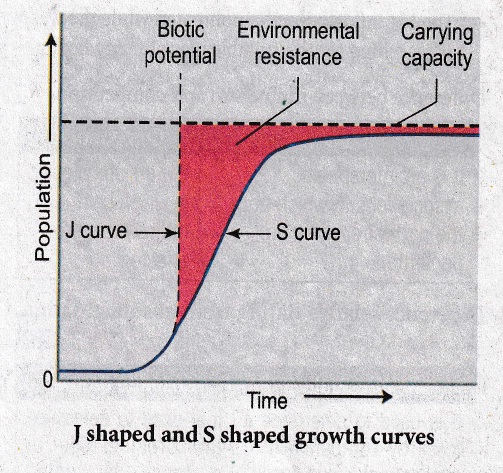
Biotic potential:
It is the maximum reproductive capacity of an organism under optimum environmental conditions.
Carrying capacity:
The maximum number of organisms live in a region can support without environmental degradation is called carrying capacity.
Environmental resistance:
Is the sum total of the environmental limiting factors, both biotic and abiotic which together act to prevent the biotic potential of an organism from being realized.
2.
3.
Properties of soil
(i) Texture of soil - The texture of soil is determined by the size of the soil particles. The types of soil include sand, silt and clay on the basis of their size differences.
(ii) Porosity - The space present between soil particles in a given volume of soil are called pore spaces. The percentage of soil volume occupied by pore space or by the interstitial spaces is called porosity of the soil.
(iii) Permeability of soil - The characteristic of soil that determines the movement of water through pore spaces is known as soil permeability. Soil permeability is directly dependent on the pore size. Water holding capacity of the soil is inversely dependent on soil porosity.
(iv) Soil Temperature - Soil gets its heat energy from solar radiation, decomposing organic matter, and heat from the interior of the earth. Soil temperature affects the germination of seeds, growth of roots and biological activity of soil-inhabiting micro-and macro-organisms.
(v) Soil water - In soil, water is not only important as a solvent and transporting agent, but also maintains soil texture, arrangement, and compactness of soil particles, making soil habitable for plants and animals.
4.
Adaptation is a dynamic evolutionary process that fits organisms to their environment and enhancing their evolutionary fitness.
(a) Structural adaptations:
1. The external and internal structures of animals can help them to adapt better to their environment. Some of the most common examples are mammals growing thicker fur to survive freezing climates.
2. Some of the most attractive adaptations in nature occur for reasons of crypsis. (e.g: Camouflage) and mimicry.
3. Cryptic animals are those which camouflage perfectly with their environment and are almost impossible to detect. Certain reptiles and insects such as chameleons and stick insects show this type of adaptation, which helps in prey capture or to evade from predators. Likewise, horse legs are suitable for fast running and adapted for grasslands or plains and similar terrestrial environments.
(b) Behavioural adaptations:
1. Action and behaviour of animals are instinctive or learned. Animals develop certain behavioural traits or adaptations for survival.
2. Fleeing from a predator, hiding during sleep, seeking refuge from climate change or moving to find different food sources are all behavioural adaptations.
3. The two most characteristic forms of behavioural adaptations are migration and courtship.
4. Migration allows the animals to find better resources or evade threat.
5. Courtship is a set of behavioural patterns to find a made to reproduce.
6. Most nocturnal animals remain underground (or) inactive during daytime.
7. This is a modification of their feeding and activity pattern (or) habit (or) behaviour.
(c) Physiological adaptations:
1. The adaptations of organisms that help them to live and survive in their environment with unique niches.
2. Example: Lions have sharp canines to hunt and tear meat of preys and digestive system suitable for digesting raw meat.
3. The two most well-known physiological adaptations are hibernation and aestivation.
4. These are two different types of inactivity where the metabolic rate slows down so much that the animal can survive without eating or drinking.
5. Aquatic medium and terrestrial habitats have their own respective environmental conditions. Hence organisms have to evolve appropriate adaptations to select suitable habitats and niches.
5.
Every living organism responds to its environment. There are various ways by which organisms respond to abiotic conditions. The types of response observed are:
Regulate:
1. Some organisms are able to maintain homeostasis by physiological means which ensures constant body temperature, ionic/ osmotic balance. Birds, mammals and a fewer lower vertebrate and invertebrate species are capable of such regulation.
Conform:
1. Most animals cannot maintain a constant internal environment.
2. Their body temperature changes with the ambient temperature.
3. In aquatic animals like fishes, the osmotic concentration of the body fluids changes with that of the ambient water osmotic concentration. Such animals are called conformers. In case of extreme condition, the inhabitants relocate themselves as in-migration
Migrate:
1. Organisms tend to move away temporarily from a stressful habitat to a new, hospitable area and return when the stressful period is over.
2. Birds migrate from Siberia to Vedanthangal in Tamilnadu to escape from the severe winter periods.
Suspend:
1. In certain conditions, if the organism is unable to migrate, it may avoid the stress by becoming inactive.
2. This is seen commonly in bears going into hibernation during winter.
3. Some snails and fish go into aestivation to avoid summer related problems like heat and desiccation.
4. Some lower animal suspend a certain phase of their life cycle which is to as diapause.

12th Standard Syllabus & Materials
12th Standard
TN 12th Computer Applications வலையமைப்பு வடமிடல் Sample Question Papers Study Material - QB365 Set A
NEW12th Standard
TN 12th Computer Applications களப்பெயர் முறைமை (DNS) Sample Question Papers Study Material - QB365 Set A
NEW12th Standard
TN 12th Computer Applications வலையமைப்பு எடுத்துக்காட்டுகள் மற்றும் நெறிமுறைகள் Sample Question Papers Study Material - QB365 Set A
NEW12th Standard
TN 12th Computer Applications கணினி வலையமைப்பு ஓர் அறிமுகம் Sample Question Papers Study Material - QB365 Set A



Tamilnadu Stateboard 12th Standard Subjects

Maths

Chemistry

Physics
Biology

Computer Science

Business Maths and Statistics

Economics

Commerce

Accountancy

History

Computer Applications
Biology
Computer Technology
Computer Applications
Computer Science
Business Maths and Statistics
Commerce
Economics
Maths
Chemistry
Physics
Computer Technology
History
Accountancy

Tamil

English

French
Tamilnadu Stateboard Standards

